Slovakia Aviation Market Size, Share & Growth Rate
The Slovakia Aviation Market was estimated at USD 283 Million in 2025 and is projected to reach USD 379 Million by 2032, growing at a CAGR of 4.3% from 2026 to 2032. This growth trajectory is driven by a resurgence in tourism and a robust increase in business travel as global connectivity improves. Investment in airport infrastructure and a shift toward low-cost carriers are also catalyzing market expansion, making air travel more accessible to a broader demographic.
Slovakia Aviation Market Year-wise Growth Rate and Key Drivers
This graph highlights how the Slovakia Aviation Market has steadily grown over the years, supported by major growth factors.
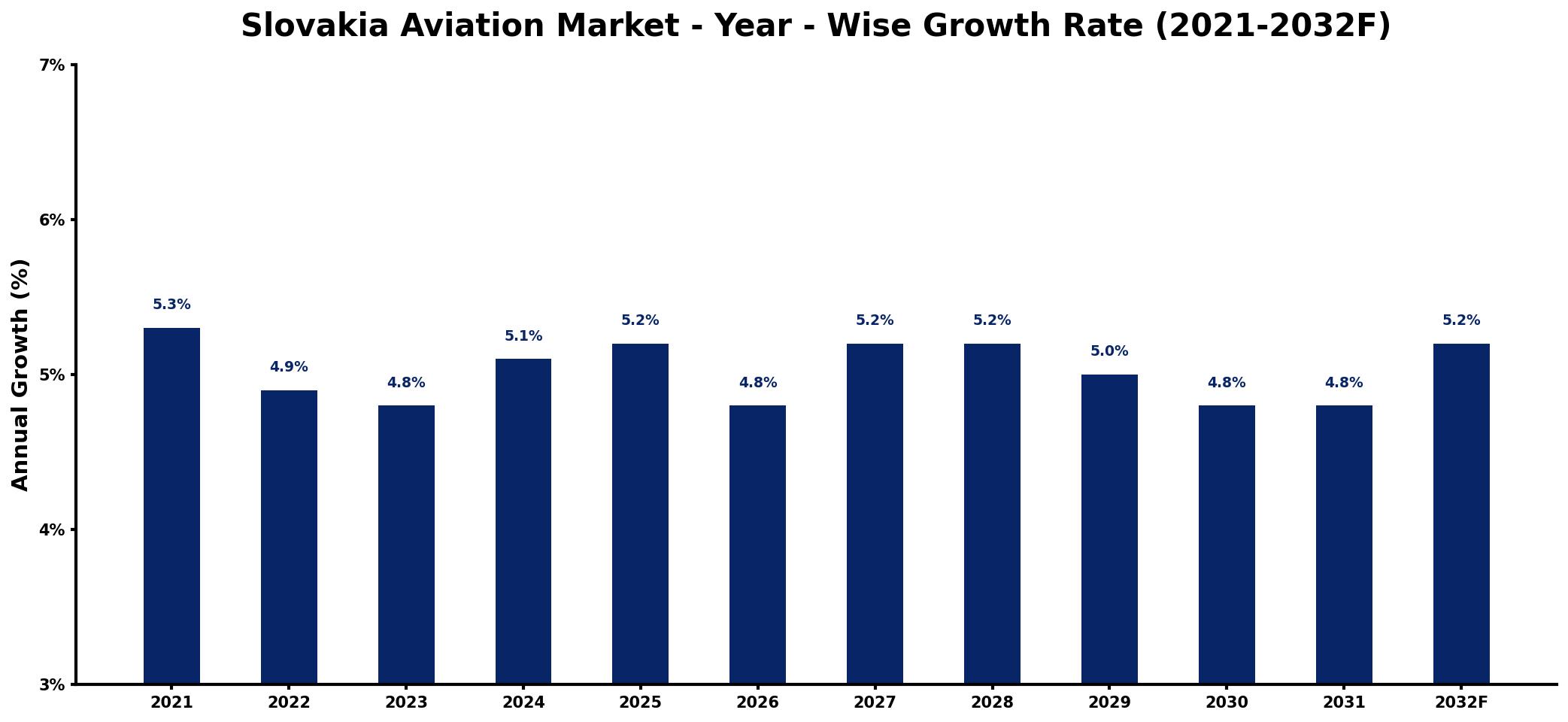
The table below presents the year‑wise growth rates along with the key drivers influencing the market
| Year | Growth Rate | Major Drivers |
| 2021 | 5.3% | Rising travel demand post pandemic |
| 2022 | 4.9% | Increased investment in infrastructure |
| 2023 | 4.8% | Expanding regional connectivity initiatives |
| 2024 | 5.1% | Growing interest in leisure travel |
| 2025 | 5.2% | Boost in business travel activities |
| 2026 | 4.8% | Enhanced cargo transport capabilities |
| 2027 | 5.2% | Development of eco-friendly technologies |
| 2028 | 5.2% | growing emerging market penetration |
| 2029 | 5.0% | Surge in tourist arrivals growth |
| 2030 | 4.8% | Emerging markets attracting investments |
| 2031 | 4.8% | Technological advancements in logistics |
| 2032 | 5.2% | Expansion of low-cost carriers |
Note: Market size estimations and growth projections presented in this report are based on 6Wresearch's proprietary forecasting methodology, utilizing the latest available industry data, government publications, and primary research inputs.
Slovakia Aviation Market Synopsis
The Slovakia Aviation Market is uniquely characterized by its strategic location in Central Europe, which facilitates increased air traffic and connectivity across European cities. The presence of Bratislava Airport, the nation's busiest airport, underscores the growing demand for air travel and serves as a critical hub for both international and domestic flights.
Additionally, the market is bolstered by a burgeoning aviation manufacturing sector and various maintenance, repair, and overhaul (MRO) services. Government initiatives aimed at enhancing infrastructure and promoting tourism further strengthen the overall aviation ecosystem, indicating a market ripe for expansion.
Slovakia Aviation Market Key Takeaways
- Bratislava Airport leads in passenger traffic, marking its significance in the Central European aviation landscape.
- A shift towards low-cost airlines is reshaping travel patterns, catering to both leisure and business travelers.
- Government investments in airport infrastructure are paving the way for enhanced operational efficiencies.
- The emphasis on sustainability is driving the adoption of cleaner aviation technologies and practices.
- A shortage of skilled aviation professionals presents challenges that could impact future market growth.
Evaluation of Restraints in Slovakia Aviation Market
Despite its promising growth, the Slovakia Aviation Market faces several constraints. Limited airport infrastructure development is a significant hurdle, particularly in the context of increasing passenger volumes. This inadequacy can lead to congestion and delays, adversely affecting traveler experiences. Moreover, a notable shortage of skilled personnel, such as pilots and maintenance technicians, threatens to limit operational capacities and ensure safety standards. Regulatory challenges, alongside fierce competition from neighboring countries, complicate the market landscape, necessitating strategic interventions to foster sustainable growth.
Slovakia Aviation Market Trends
Emerging trends in the Slovakia Aviation Market point towards a robust shift in consumer preferences, particularly for low-cost travel options. The increasing connectivity between Slovakia and major European destinations is reshaping travel dynamics, encouraging both tourism and business travel. Additionally, the sector is experiencing a rapid transformation with the adoption of digital technologies that enhance customer experience—ranging from online ticket booking to innovative in-flight services. There is also a growing awareness and commitment to sustainability, with stakeholders actively pursuing initiatives to minimize environmental impact through greener aviation practices.
Slovakia Aviation Market Opportunities
Investment opportunities in the Slovakia Aviation Market are abundant, especially in the realms of MRO services and airport infrastructure development. As air traffic volumes continue to increase, the demand for high-quality maintenance solutions for aircraft fleets will grow. Furthermore, developing pilot training facilities presents a lucrative avenue to address the existing skills gap in the aviation workforce. With ongoing government support for modernizing infrastructure, stakeholders have a unique chance to invest in projects that promise long-term returns as passenger numbers surge.
Government Initiatives in the Slovakia Aviation Market
The Slovak government has implemented a range of policies aimed at enhancing the aviation sector, emphasizing safety and compliance with international standards. The Civil Aviation Authority of the Slovak Republic (CAA) plays a pivotal role in regulating the market, ensuring alignment with the European Union Aviation Safety Agency (EASA) standards. Government initiatives also focus on liberalizing the market to encourage competition, stimulate growth, and enhance the overall quality of aviation services, thereby positioning Slovakia as a competitive player in the European aviation landscape.
Future Insights of the Slovakia Aviation Market
Looking ahead to 2026-2032, the Slovakia Aviation Market is poised for steady growth, fueled by rising tourism and enhanced economic conditions. The countrys geographic advantages, combined with continuous investments in infrastructure, are likely to elevate air travel demand significantly. The rise of low-cost carriers alongside a more environmentally conscious approach in aviation practices will further influence market dynamics. However, stakeholders must remain vigilant to potential risks, such as fluctuating fuel prices and regional competition, to capitalize on the opportunities that lie ahead.
Slovakia Aviation Market Latest Developments (2025 - 2026)
In recent months, the Slovakia Aviation Market has seen strategic moves towards enhancing airport facilities and integrating advanced technology into air traffic management systems. Ongoing investments by the government in upgrading infrastructure aim to accommodate increasing passenger traffic effectively. Additionally, airlines are exploring partnerships to expand their route networks, responding to the growing demand for connectivity in the region. This focus on modernization and collaboration indicates a proactive approach to fostering a vibrant aviation landscape in Slovakia.
Slovakia Aviation Market - Key Attractiveness of the Report
- 10 Years of Market Numbers
- Historical Data Starting from 2022 to 2025
- Base Year: 2025
- Forecast Data until 2032
- Key Performance Indicators Impacting the Market
- Major Upcoming Developments and Projects
Key Highlights of the Report:
- Slovakia Aviation Market Outlook
- Market Size of Slovakia Aviation Market, 2025
- Forecast of Slovakia Aviation Market, 2032
- Historical Data and Forecast of Slovakia Aviation Revenues & Volume for the Period 2022-2032F
- Slovakia Aviation Market Trend Evolution
- Slovakia Aviation Market Drivers and Challenges
- Slovakia Aviation Price Trends
- Slovakia Aviation Porter's Five Forces
- Slovakia Aviation Industry Life Cycle
- Historical Data and Forecast of Slovakia Aviation Market Revenues & Volume By Type for the Period 2022-2032F
- Historical Data and Forecast of Slovakia Aviation Market Revenues & Volume By Commercial Aviation for the Period 2022-2032F
- Historical Data and Forecast of Slovakia Aviation Market Revenues & Volume By Military Aviation for the Period 2022-2032F
- Historical Data and Forecast of Slovakia Aviation Market Revenues & Volume By General Aviation for the Period 2022-2032F
- Slovakia Aviation Import Export Trade Statistics
- Market Opportunity Assessment By Type
- Slovakia Aviation Top Companies Market Share
- Slovakia Aviation Competitive Benchmarking By Technical and Operational Parameters
- Slovakia Aviation Company Profiles
- Slovakia Aviation Key Strategic Recommendations






































