Azerbaijan Building Construction Market Size, Share & Growth Rate
The Azerbaijan Building Construction Market was estimated at USD 866 Million in 2025 and is projected to reach USD 1593 Million by 2032, growing at a CAGR of 9.1% from 2026 to 2032. This robust growth trajectory is primarily driven by substantial government investments in infrastructure, an increase in urbanization, and a shift towards modern, sustainable building practices. Moreover, the influx of foreign capital and the execution of large-scale development projects contribute significantly to this optimistic outlook.
Azerbaijan Building Construction Market Year-wise Growth Rate and Key Drivers
This graph highlights how the Azerbaijan Building Construction Market has steadily grown over the years, supported by major growth factors.
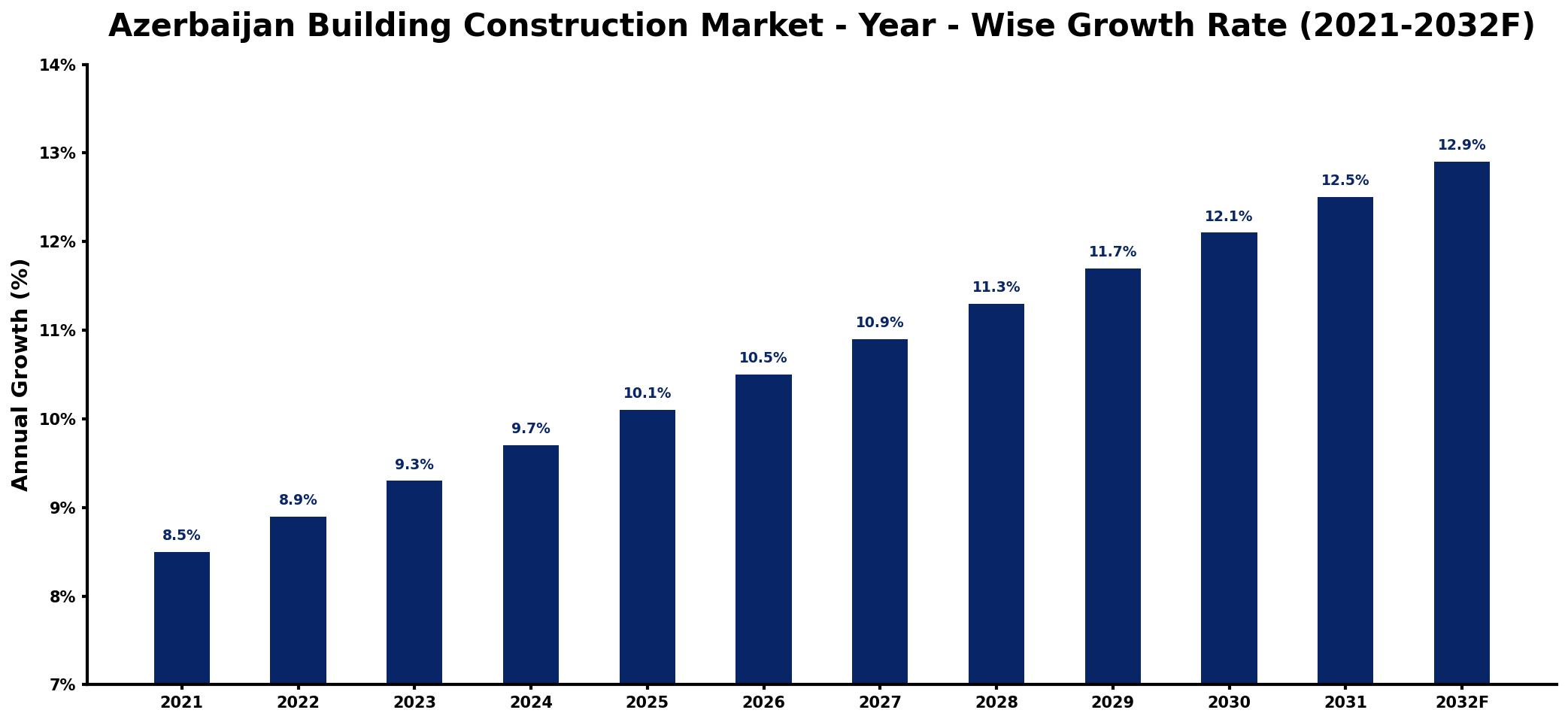
The table below presents the year‑wise growth rates along with the key drivers influencing the market
| Year | Growth Rate | Major Drivers |
| 2021 | 8.5% | Rising urban population demand |
| 2022 | 8.9% | Increased foreign direct investments |
| 2023 | 9.3% | Government infrastructure projects expansion |
| 2024 | 9.7% | Growing residential housing needs |
| 2025 | 10.1% | Enhanced commercial real estate activity |
| 2026 | 10.5% | Technological advancements adoption rate |
| 2027 | 10.9% | Sustainable development initiatives launch |
| 2028 | 11.3% | Rising disposable income levels |
| 2029 | 11.7% | Revitalization of urban areas |
| 2030 | 12.1% | improved processing technologies adoption |
| 2031 | 12.5% | Expansion of regional trade agreements |
| 2032 | 12.9% | Growing interest in renewable energy |
Note: Market size estimations and growth projections presented in this report are based on 6Wresearch's proprietary forecasting methodology, utilizing the latest available industry data, government publications, and primary research inputs.
Azerbaijan Building Construction Market Synopsis
The most significant force shaping the Azerbaijan building construction market is the government's proactive approach to infrastructure development. This includes initiatives aimed at enhancing urban landscapes and promoting sustainable practices, which have ignited a surge in both domestic and foreign investment.
In addition, the increasing demand for residential and commercial properties reflects the country's rapid urbanization. The commitment to modernizing construction methods and implementing innovative technologies further cements the market's potential for growth and development.
Azerbaijan Building Construction Market Key Takeaways
- Significant government investment is a primary catalyst for growth in the building construction sector.
- The market is increasingly focusing on sustainability and energy-efficient building practices.
- Urbanization and a rising population are driving demand for new housing and infrastructure.
- Foreign investment is welcomed and encouraged through favorable government policies.
- Challenges such as skilled labor shortages and regulatory complexities remain critical considerations for stakeholders.
Evaluation of Restraints in Azerbaijan Building Construction Market
Despite its promising growth, the Azerbaijan building construction market faces notable restraints that could hinder progress. Regulatory complexities often slow down project approvals, creating a bottleneck for construction activities. Additionally, the limited availability of skilled labor presents significant challenges, impacting project timelines and overall efficiency. Fluctuating material costs and economic uncertainties related to oil prices further exacerbate these issues, requiring stakeholders to adapt quickly to maintain competitive advantages. Addressing these constraints will necessitate strategic planning and collaboration among industry players.
Azerbaijan Building Construction Market Trends
There is a clear trend towards sustainable and energy-efficient construction practices within the Azerbaijan market. The rise of green building initiatives, including LEED certification and the utilization of eco-friendly materials, is gaining momentum. Smart building technology, which enhances energy management and security, is also becoming increasingly popular. Furthermore, modular construction methods are emerging as cost-effective solutions, while mixed-use developments are reshaping urban planning by integrating residential, commercial, and recreational spaces into cohesive communities.
Azerbaijan Building Construction Market Opportunities
Investment opportunities in the Azerbaijan building construction market are particularly robust, spurred by the growing need for infrastructure and urban development. Key areas include residential and commercial real estate projects, as well as significant infrastructure developments such as roads, airports, and bridges. The governments push to diversify the economy and improve infrastructure creates a fertile ground for local and international investors seeking long-term growth. The countrys strategic location as a conduit between Europe and Asia further enhances its attractiveness for logistics and transportation-related investments.
Government Initiatives in the Azerbaijan Building Construction Market
Azerbaijan's government actively promotes sustainable development in the building construction sector through various initiatives. This includes enforcing regulations that encourage the use of environmentally friendly materials and technologies. Additionally, there are programs aimed at improving energy efficiency in buildings and enhancing the overall construction process. The government has also made strides to attract foreign investment through partnerships and incentives, which facilitate innovation and competitiveness while addressing critical housing shortages and urban development needs.
Future Insights of the Azerbaijan Building Construction Market
Looking ahead to 2026-2032, the Azerbaijan building construction market is set to undergo significant transformation, fueled by ongoing infrastructure projects and heightened investments. The government's dedication to diversifying the economy, coupled with an increasing focus on tourism, will drive demand for varied construction types, including residential, commercial, and hospitality. As urbanization continues to rise, new housing units and public infrastructure will be essential. However, market participants must navigate potential risks associated with fluctuating oil prices and geopolitical tensions, which may influence investment strategies and project execution.
Azerbaijan Building Construction Market Latest Developments (2025 - 2026)
Recent developments in the Azerbaijan building construction market indicate a focused effort on enhancing urban infrastructure and promoting green construction practices. Initiatives have surfaced to streamline the approval process for construction projects, which could significantly reduce delays. Moreover, there is a noticeable trend towards integrating advanced technologies in building design and management, aligning with global sustainability standards. The commitment to urban regeneration and mixed-use developments continues to reshape the landscape, presenting fresh opportunities for investment and collaboration across the sector.
Azerbaijan Building Construction Market - Key Attractiveness of the Report
- 10 Years of Market Numbers
- Historical Data Starting from 2022 to 2025
- Base Year: 2025
- Forecast Data until 2032
- Key Performance Indicators Impacting the Market
- Major Upcoming Developments and Projects
Key Highlights of the Report:
- Azerbaijan Building Construction Market Outlook
- Market Size of Azerbaijan Building Construction Market, 2025
- Forecast of Azerbaijan Building Construction Market, 2032
- Historical Data and Forecast of Azerbaijan Building Construction Revenues & Volume for the Period 2022-2032F
- Azerbaijan Building Construction Market Trend Evolution
- Azerbaijan Building Construction Market Drivers and Challenges
- Azerbaijan Building Construction Price Trends
- Azerbaijan Building Construction Porter's Five Forces
- Azerbaijan Building Construction Industry Life Cycle
- Historical Data and Forecast of Azerbaijan Building Construction Market Revenues & Volume By Type for the Period 2022-2032F
- Historical Data and Forecast of Azerbaijan Building Construction Market Revenues & Volume By Residential for the Period 2022-2032F
- Historical Data and Forecast of Azerbaijan Building Construction Market Revenues & Volume By Non-residential for the Period 2022-2032F
- Historical Data and Forecast of Azerbaijan Building Construction Market Revenues & Volume By Construction Type for the Period 2022-2032F
- Historical Data and Forecast of Azerbaijan Building Construction Market Revenues & Volume By New Construction for the Period 2022-2032F
- Historical Data and Forecast of Azerbaijan Building Construction Market Revenues & Volume By Renovation for the Period 2022-2032F
- Historical Data and Forecast of Azerbaijan Building Construction Market Revenues & Volume By Application for the Period 2022-2032F
- Historical Data and Forecast of Azerbaijan Building Construction Market Revenues & Volume By Owned for the Period 2022-2032F
- Historical Data and Forecast of Azerbaijan Building Construction Market Revenues & Volume By Rental for the Period 2022-2032F
- Historical Data and Forecast of Azerbaijan Building Construction Market Revenues & Volume By End User for the Period 2022-2032F
- Historical Data and Forecast of Azerbaijan Building Construction Market Revenues & Volume By Private for the Period 2022-2032F
- Historical Data and Forecast of Azerbaijan Building Construction Market Revenues & Volume By Public for the Period 2022-2032F
- Azerbaijan Building Construction Import Export Trade Statistics
- Market Opportunity Assessment By Type
- Market Opportunity Assessment By Construction Type
- Market Opportunity Assessment By Application
- Market Opportunity Assessment By End User
- Azerbaijan Building Construction Top Companies Market Share
- Azerbaijan Building Construction Competitive Benchmarking By Technical and Operational Parameters
- Azerbaijan Building Construction Company Profiles
- Azerbaijan Building Construction Key Strategic Recommendations






































