Azerbaijan Cigarette Market Size, Share & Growth Rate
The Azerbaijan Cigarette Market was estimated at USD 455 Million in 2025 and is projected to reach USD 614 Million by 2032, growing at a CAGR of 4.4% from 2026 to 2032. This growth trajectory is fueled by the robust demand for tobacco products, with a substantial segment of the population remaining active smokers despite heightened regulatory measures. The market's resilience is further supported by the affordability of cigarettes relative to neighboring regions and the extensive distribution network that ensures easy access to a variety of brands.
Azerbaijan Cigarette Market Year-wise Growth Rate and Key Drivers
This graph highlights how the Azerbaijan Cigarette Market has steadily grown over the years, supported by major growth factors.
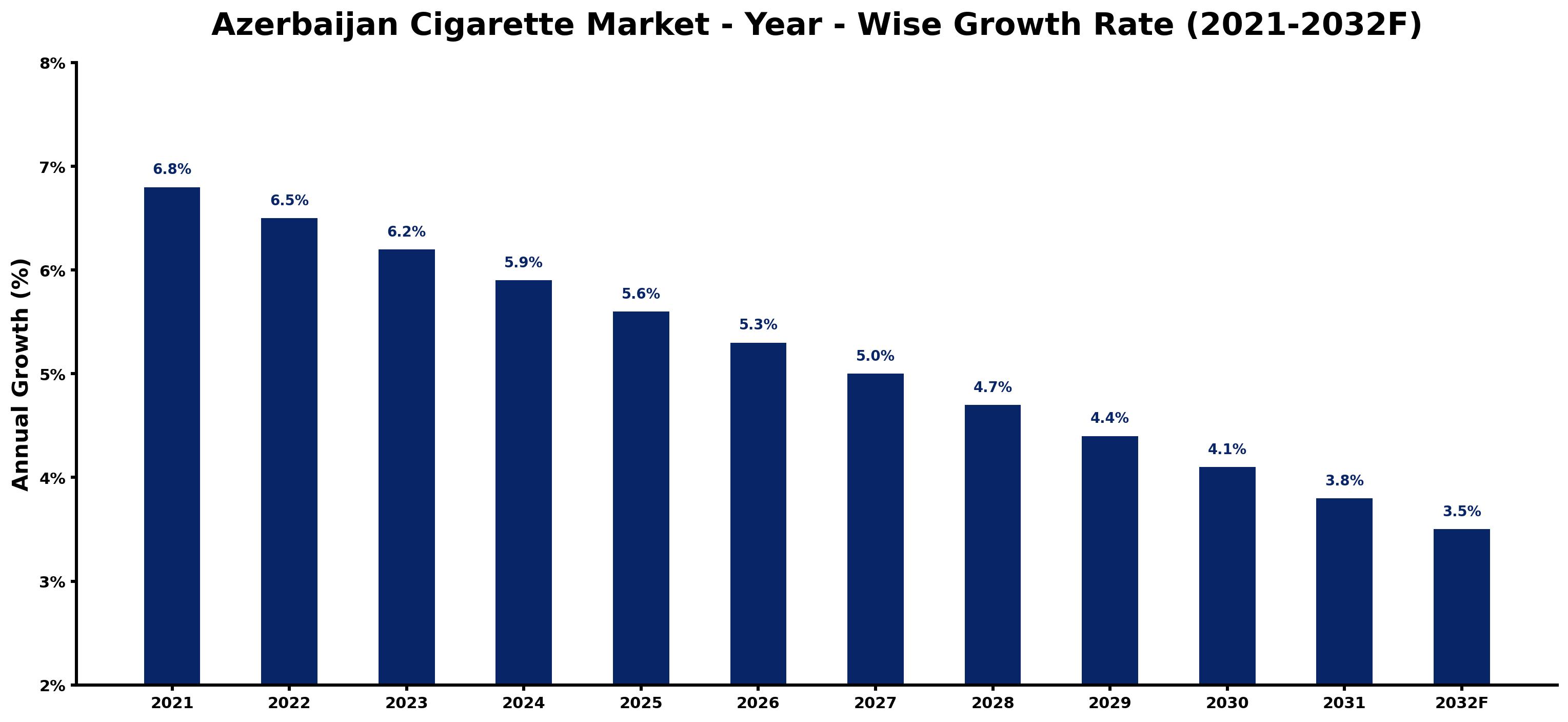
The table below presents the year‑wise growth rates along with the key drivers influencing the market
| Year | Growth Rate | Major Drivers |
| 2021 | 6.8% | Increasing industrial automation investments |
| 2022 | 6.5% | Increasing industrial automation investments |
| 2023 | 6.2% | Growing renewable energy integration projects |
| 2024 | 5.9% | Government infrastructure modernization initiatives |
| 2025 | 5.6% | Rapid growth in telecom and data center sectors |
| 2026 | 5.3% | Increasing shift toward cleaner alternatives |
| 2027 | 5.0% | Increasing shift toward cleaner alternatives |
| 2028 | 4.7% | Technology transition toward sustainable alternatives |
| 2029 | 4.4% | Technology transition toward sustainable alternatives |
| 2030 | 4.1% | Increasing shift toward cleaner alternatives |
| 2031 | 3.8% | Increasing shift toward cleaner alternatives |
| 2032 | 3.5% | Declining investments in legacy infrastructure |
Note - Market size estimations and growth projections presented in this report are based on 6Wresearch's advanced forecasting approach, validated with industry datasets as of June 2026.
Azerbaijan Cigarette Market Synopsis
The foremost force shaping the Azerbaijan Cigarette Market is the persistent high rate of smoking among its population. Despite growing health awareness and government regulations aimed at reducing consumption, the market shows remarkable durability, largely due to the entrenched cultural acceptance of smoking.
Additionally, the proliferation of foreign tobacco brands and the introduction of innovative products signal a dynamic marketplace. While new health-conscious alternatives like e-cigarettes are emerging, traditional cigarette products continue to see substantial demand, particularly among older demographics.
Azerbaijan Cigarette Market Key Takeaways
- The market remains dominated by foreign brands, ensuring a diverse offering for consumers.
- Government regulations have led to an evolving landscape, including increased taxes and public smoking bans.
- There is a notable shift towards premium and flavored cigarettes, catering to a younger audience.
- The ongoing battle against the black market poses significant challenges for legitimate vendors.
- Investment opportunities exist in innovative product development and enhancing distribution channels.
Evaluation of Restraints in Azerbaijan Cigarette Market
Despite its growth, the Azerbaijan Cigarette Market faces critical restraints that may hinder future expansion. The prevalence of a thriving black market undermines the revenue potential for legitimate businesses and poses challenges for tax collection. Furthermore, increasing taxation and stricter regulations can drive consumers toward cheaper illicit options, complicating the landscape for compliant vendors. The rising public health awareness around smoking also contributes to a gradual decline in traditional cigarette consumption, pushing industry stakeholders to adapt quickly to evolving market conditions.
Azerbaijan Cigarette Market Trends
Emerging trends in the Azerbaijan Cigarette Market include a significant shift towards reduced-risk products, such as e-cigarettes and heated tobacco alternatives. As health consciousness grows among consumers, many are gravitating towards these innovative options. Concurrently, premium and flavored cigarette offerings are becoming increasingly popular, particularly among younger smokers, which is prompting major tobacco companies to revise their product strategies accordingly. This trend not only reflects a changing consumer preference but also aligns with the industry's response to regulatory pressures aimed at reducing traditional cigarette consumption.
Azerbaijan Cigarette Market Opportunities
There are considerable investment opportunities within the Azerbaijan Cigarette Market. Companies can capitalize on the growing demand for premium and flavored products by enhancing brand positioning and marketing strategies. Moreover, there is potential for expansion in the distribution networks to capture underserved regions within the country. The introduction of innovative, reduced-risk products aligns with changing consumer preferences, offering a pathway for growth. Additionally, exploring potential export markets to neighboring countries may present a new avenue for revenue generation.
Government Initiatives in the Azerbaijan Cigarette Market
The Azerbaijan government has implemented a series of policies aimed at regulating the tobacco market effectively. These measures include public smoking bans, advertising restrictions, and mandatory graphic health warnings on packaging. Increased taxation on tobacco products has been a key strategy to discourage consumption, while efforts to improve public health awareness about smoking's dangers are ongoing. Moreover, the government actively pursues initiatives to combat illicit tobacco trade, ensuring compliance with regulatory frameworks.
Future Insights of the Azerbaijan Cigarette Market
Looking ahead to 2026-2032, the Azerbaijan Cigarette Market is expected to undergo significant changes driven by public health campaigns and regulatory reforms. Although traditional cigarette consumption is likely to decline due to a shift towards healthier alternatives, specific segments—particularly premium products—may still experience growth. The ability of tobacco companies to innovate and adapt to consumer preferences will be crucial in maintaining their market share. A focus on reduced-risk products could offer a sustainable path forward amidst shifting market dynamics.
Azerbaijan Cigarette Market Latest Developments (May 2025 - June 2026)
Recent developments in the Azerbaijan Cigarette Market reflect ongoing transformations influenced by regulatory changes and consumer preferences. There has been a noticeable uptick in the availability of innovative tobacco products, including e-cigarettes, as companies aim to capture the interest of health-conscious consumers. Additionally, regulatory enforcement on advertising and promotional practices is intensifying, prompting companies to revise their marketing strategies to remain compliant while appealing to their target demographics.
Azerbaijan Cigarette Market - Key Attractiveness of the Report
- 10 Years of Market Numbers
- Historical Data Starting from 2022 to 2025
- Base Year: 2025
- Forecast Data until 2032
- Key Performance Indicators Impacting the Market
- Major Upcoming Developments and Projects
Key Highlights of the Report:
- Azerbaijan Cigarette? Market Outlook
- Market Size of Azerbaijan Cigarette? Market, 2025
- Forecast of Azerbaijan Cigarette? Market, 2032
- Historical Data and Forecast of Azerbaijan Cigarette? Revenues & Volume for the Period 2022-2032F
- Azerbaijan Cigarette? Market Trend Evolution
- Azerbaijan Cigarette? Market Drivers and Challenges
- Azerbaijan Cigarette? Price Trends
- Azerbaijan Cigarette? Porter's Five Forces
- Azerbaijan Cigarette? Industry Life Cycle
- Historical Data and Forecast of Azerbaijan Cigarette? Market Revenues & Volume By Type for the Period 2022-2032F
- Historical Data and Forecast of Azerbaijan Cigarette? Market Revenues & Volume By Light for the Period 2022-2032F
- Historical Data and Forecast of Azerbaijan Cigarette? Market Revenues & Volume By Medium for the Period 2022-2032F
- Historical Data and Forecast of Azerbaijan Cigarette? Market Revenues & Volume By Others for the Period 2022-2032F
- Historical Data and Forecast of Azerbaijan Cigarette? Market Revenues & Volume By Distribution Channel for the Period 2022-2032F
- Historical Data and Forecast of Azerbaijan Cigarette? Market Revenues & Volume By Tobacco Shops for the Period 2022-2032F
- Historical Data and Forecast of Azerbaijan Cigarette? Market Revenues & Volume By Supermarket and Hypermarkets for the Period 2022-2032F
- Historical Data and Forecast of Azerbaijan Cigarette? Market Revenues & Volume By Convenience Stores for the Period 2022-2032F
- Historical Data and Forecast of Azerbaijan Cigarette? Market Revenues & Volume By Online Stores for the Period 2022-2032F
- Historical Data and Forecast of Azerbaijan Cigarette? Market Revenues & Volume By Others for the Period 2022-2032F
- Azerbaijan Cigarette? Import Export Trade Statistics
- Market Opportunity Assessment By Type
- Market Opportunity Assessment By Distribution Channel
- Azerbaijan Cigarette? Top Companies Market Share
- Azerbaijan Cigarette? Competitive Benchmarking By Technical and Operational Parameters
- Azerbaijan Cigarette? Company Profiles
- Azerbaijan Cigarette? Key Strategic Recommendations






































