Azerbaijan Coaxial Cables Market Summary
The azerbaijan coaxial cables market was estimated at USD 330 Million in 2025 and is projected to reach USD 597 Million by 2032, growing at a CAGR of 10.2% from 2026 to 2032.
Azerbaijan Coaxial Cables Market Year-wise Growth Rate and Key Drivers
This graph highlights how the Azerbaijan Coaxial Cables Market has steadily grown over the past five years, supported by major growth factors.
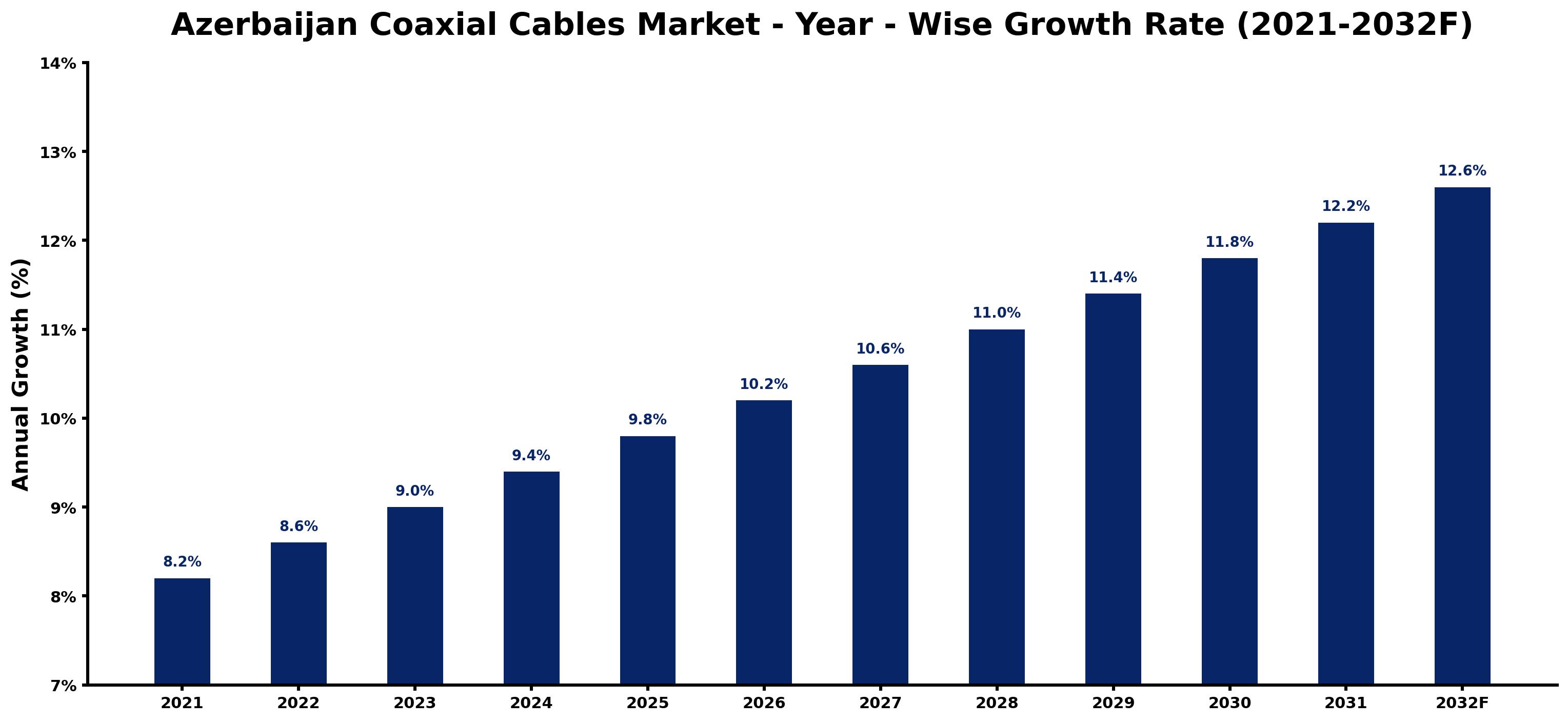
The table below presents the year wise growth rates along with the key drivers influencing the market
| Year | Growth Rate | Major Drivers |
| 2021 | 8.2% | Market recovery post-pandemic stimulates demand for reliable communication infrastructure. |
| 2022 | 8.6% | Increased urbanization prompts significant investments in telecommunications within urban areas. |
| 2023 | 9.0% | Emerging technologies create new requirements for high-performance coaxial cables in Azerbaijan. |
| 2024 | 9.4% | Legacy copper grid failures highlight the need for modern cable solutions and upgrades. |
| 2025 | 9.8% | Local manufacturers expand operations, enhancing production capacity for coaxial cables. |
| 2026 | 10.2% | Energy-efficient infrastructure projects lead to higher demand for advanced coaxial cable solutions. |
| 2027 | 10.6% | Azerbaijan's integration into global supply chains increases imports of specialized cable technologies. |
| 2028 | 11.0% | Telecommunications providers innovate offerings, pushing for advanced connectivity solutions nationwide. |
| 2029 | 11.4% | Government partnerships with private sector drive infrastructure projects requiring robust cabling. |
| 2030 | 11.8% | Smart city initiatives introduce new cable networks, enhancing urban connectivity and resilience. |
| 2031 | 12.2% | Increased investment in renewable energy sources raises demand for specialized coaxial applications. |
| 2032 | 12.6% | Competitive market landscape encourages continuous innovation and improved cable performance standards. |
Note - Market size estimations and growth projections presented in this report are based on 6Wresearch's advanced forecasting approach, validated with industry datasets as of June 2026.
Azerbaijan Coaxial Cables Market Synopsis
The Azerbaijan Coaxial Cables Market is projected to reach 10.2% and witness significant growth during the forecast period (2026-2032). This growth is primarily driven by the escalating demand from key sectors such as telecommunications, broadcasting, and infrastructure development. The market landscape is marked by a blend of domestic manufacturers and international entities, collectively offering a comprehensive range of products tailored to meet diverse customer requirements.
Azerbaijan Coaxial Cables Market Growth Drivers
The expansion of the Azerbaijan Coaxial Cables Market is underpinned by several crucial growth drivers:
- Increasing demand from the telecommunications sector is propelling the need for advanced coaxial cable solutions, specifically to support the rollout of 5G networks and enhanced broadband services.
- Technological advancements in coaxial cable design are leading to products with superior data transmission capabilities and durability, which are essential for modern communication systems.
- The Azerbaijani government's initiatives to bolster digital infrastructure and improve internet penetration are creating a robust demand for high-quality coaxial cables.
- There is a rising trend towards smart home applications and high-definition video streaming, which necessitates dependable coaxial cable solutions to facilitate uninterrupted service.
- Growing environmental awareness among consumers and companies is driving the demand for eco-friendly coaxial cable options, which are increasingly being developed by manufacturers.
Azerbaijan Coaxial Cables Market Trends and Opportunities
Within the Azerbaijan Coaxial Cables Market, several notable trends are shaping the landscape:
- The push for high-performance coaxial cables is becoming more pronounced as industries adapt to the increasing data demands of technologies like the Internet of Things (IoT) and cloud computing.
- Manufacturers are prioritizing the development of coaxial cables with enhanced flexibility and strength, allowing for more innovative applications across various sectors, including telecommunications and broadcasting.
- There's a notable shift towards recyclable and eco-friendly materials in cable production, responding to the broader sustainability initiatives being adopted by many companies.
- The penetration of advanced broadcasting solutions, including digital channels and streaming platforms, is driving the need for high-quality coaxial cables that can support the required signal integrity.
- Investment in research and development is on the rise, enabling manufacturers to introduce innovative products that meet the evolving needs of end-users across diverse industries.
Azerbaijan Coaxial Cables Market Challenges and Restraints
Despite the positive growth trajectory, the Azerbaijan Coaxial Cables Market faces several challenges:
- The prevalence of counterfeit coaxial cables poses significant risks, undermining the revenue of legitimate manufacturers and endangering consumer safety.
- A lack of standardization and regulatory oversight within the industry results in inconsistent product quality, which can adversely affect market confidence among consumers.
- Intense competition from imported coaxial cables creates pricing pressures, making it difficult for local manufacturers to maintain competitive pricing while ensuring quality.
- Fluctuating raw material prices can act as a barrier to production cost control, complicating pricing strategy for manufacturers in the market.
- Currency exchange rate volatility can further complicate import costs and financial planning for local players attempting to source international materials.
Azerbaijan Coaxial Cables Market Investment Opportunities
Amid these challenges, the Azerbaijan Coaxial Cables Market presents several lucrative investment opportunities:
- Investing in the production of high-quality coaxial cables tailored to the requirements of the expanding telecommunications sector can yield attractive returns.
- There is a growing need for coaxial cables in industrial applications, particularly in the oil and gas sector, where they are essential for data transmission and monitoring systems.
- Strategic collaborations with local telecommunications companies can enhance market penetration and foster growth in product distribution channels.
- Public-private partnerships focused on infrastructure development projects can provide a platform for investments in advanced coaxial cable technologies.
- As digital infrastructure continues to modernize, focusing on product innovation will create opportunities for market players to differentiate themselves from competitors.
Azerbaijan Coaxial Cables Market Government Investment and Initiatives
The government of Azerbaijan has taken active steps to bolster the Coaxial Cables Market through various policies and initiatives:
- Establishment of regulatory frameworks aimed at ensuring product quality and safety has been pivotal in promoting fair competition among manufacturers and enhancing consumer protection.
- Public investment in digital infrastructure projects is aimed at increasing internet accessibility, which directly contributes to heightened demand for coaxial cables.
- Government incentives for research and development in telecommunications technology encourage innovation among local manufacturers, fostering a competitive edge within the market.
- Policies have been put in place to monitor pricing practices within the industry, aimed at preventing anti-competitive behaviors while promoting sectoral growth.
- Efforts to engage with international trade partners are focused on enhancing the capabilities of domestic manufacturers to compete globally.
Azerbaijan Coaxial Cables Market Latest Developments (May 2025 - June 2026)
Recent developments in the Azerbaijan Coaxial Cables Market indicate a shift towards increased investment in innovative technologies. There has been a concerted effort to enhance the manufacturing processes through automation, improving productivity and reducing lead times for product delivery. The push for compliance with international quality standards has encouraged local manufacturers to upgrade their offerings. Additionally, there has been a rise in collaborative projects between the government and private sector to upgrade the country's telecommunications infrastructure, which is expected to create a more favorable environment for market growth.
Azerbaijan Coaxial Cables Market - Key Attractiveness of the Report
- 10 Years of Market Numbers
- Historical Data Starting from 2022 to 2025
- Base Year: 2025
- Forecast Data until 2032
- Key Performance Indicators Impacting the Market
- Major Upcoming Developments and Projects
Key Highlights of the Report:
- Azerbaijan Coaxial Cables Market Outlook
- Market Size of Azerbaijan Coaxial Cables Market, 2025
- Forecast of Azerbaijan Coaxial Cables Market, 2032F
- Historical Data and Forecast of Azerbaijan Coaxial Cables Revenues & Volume for the Period 2022-2032F
- Azerbaijan Coaxial Cables Market Trend Evolution
- Azerbaijan Coaxial Cables Market Drivers and Challenges
- Azerbaijan Coaxial Cables Price Trends
- Azerbaijan Coaxial Cables Porter's Five Forces
- Azerbaijan Coaxial Cables Industry Life Cycle
- Historical Data and Forecast of Azerbaijan Coaxial Cables Market Revenues & Volume By Types for the Period 2022-2032F
- Historical Data and Forecast of Azerbaijan Coaxial Cables Market Revenues & Volume By Hard-line Cable for the Period 2022-2032F
- Historical Data and Forecast of Azerbaijan Coaxial Cables Market Revenues & Volume By Triaxial Cable for the Period 2022-2032F
- Historical Data and Forecast of Azerbaijan Coaxial Cables Market Revenues & Volume By Twin Axial Cable for the Period 2022-2032F
- Historical Data and Forecast of Azerbaijan Coaxial Cables Market Revenues & Volume By Applications for the Period 2022-2032F
- Historical Data and Forecast of Azerbaijan Coaxial Cables Market Revenues & Volume By Internet Data Transfer for the Period 2022-2032F
- Historical Data and Forecast of Azerbaijan Coaxial Cables Market Revenues & Volume By Video Distribution for the Period 2022-2032F
- Historical Data and Forecast of Azerbaijan Coaxial Cables Market Revenues & Volume By Radio Distribution Frequency Transfer for the Period 2022-2032F
- Historical Data and Forecast of Azerbaijan Coaxial Cables Market Revenues & Volume By Others for the Period 2022-2032F
- Historical Data and Forecast of Azerbaijan Coaxial Cables Market Revenues & Volume By End-users for the Period 2022-2032F
- Historical Data and Forecast of Azerbaijan Coaxial Cables Market Revenues & Volume By Cable Television Industry for the Period 2022-2032F
- Historical Data and Forecast of Azerbaijan Coaxial Cables Market Revenues & Volume By Military and Aerospace for the Period 2022-2032F
- Historical Data and Forecast of Azerbaijan Coaxial Cables Market Revenues & Volume By Internet Service Providers for the Period 2022-2032F
- Historical Data and Forecast of Azerbaijan Coaxial Cables Market Revenues & Volume By Telephone Network Operators for the Period 2022-2032F
- Historical Data and Forecast of Azerbaijan Coaxial Cables Market Revenues & Volume By Communication Equipment Manufactures for the Period 2022-2032F
- Azerbaijan Coaxial Cables Import Export Trade Statistics
- Market Opportunity Assessment By Types
- Market Opportunity Assessment By Applications
- Market Opportunity Assessment By End-users
- Azerbaijan Coaxial Cables Top Companies Market Share
- Azerbaijan Coaxial Cables Competitive Benchmarking By Technical and Operational Parameters
- Azerbaijan Coaxial Cables Company Profiles
- Azerbaijan Coaxial Cables Key Strategic Recommendations






































