Azerbaijan Consent Management Market Size & Growth Rate (2026-2032)
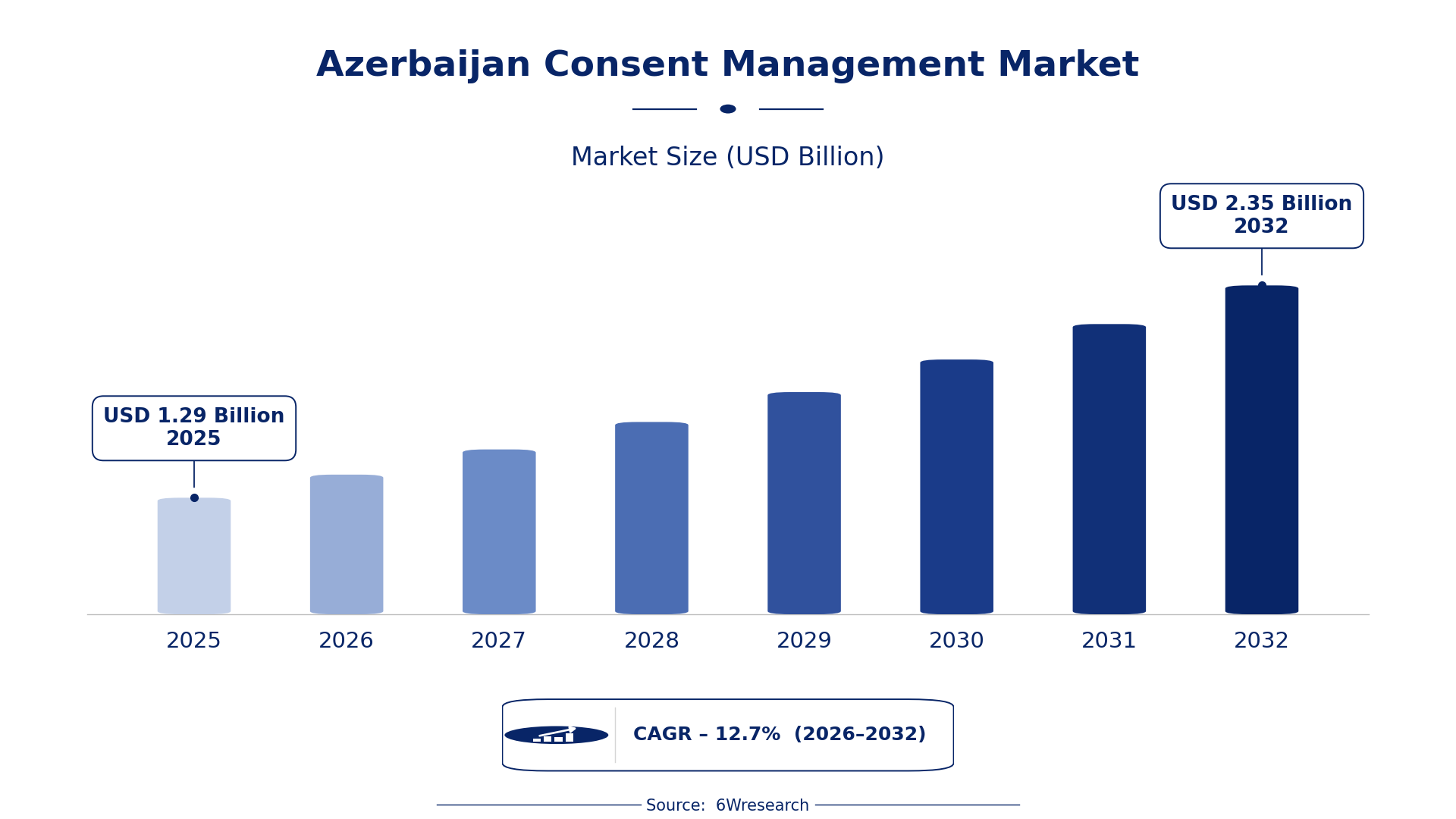
The Azerbaijan Consent Management Market was estimated at USD 1290 Million in 2025 and is projected to reach USD 2348 Million by 2032, growing at a CAGR of 12.7% from 2026 to 2032.
Azerbaijan Consent Management Market Synopsis
The rising emphasis on data privacy and compliance with regulations like GDPR is the strongest force shaping the Azerbaijan Consent Management Market. Organizations are increasingly prioritizing consent management as a critical component of their data governance strategies, reflecting a broader cultural shift towards consumer rights and ethical data practices.
As businesses become more aware of the legal implications of data processing, the demand for robust consent management solutions is escalating. This shift not only supports compliance but also fosters consumer trust, which is vital for sustaining long-term customer relationships.
Azerbaijan Consent Management Market Year-wise Growth Rate and Key Drivers
This graph illustrates the annual growth rates of the Azerbaijan Consent Management Market from 2021 to 2032, highlighting a steady upward trajectory and projected expansion over the forecast period.
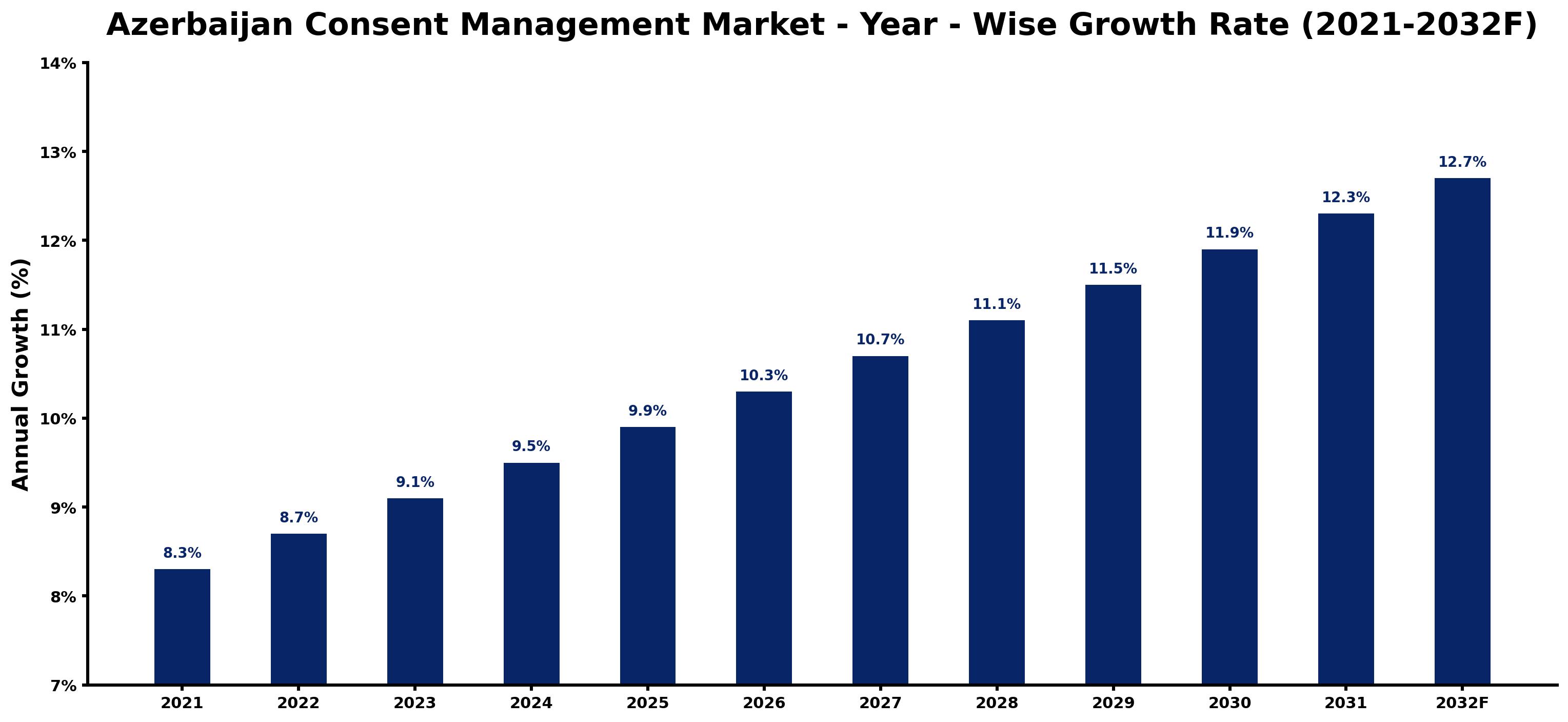
The table below presents the year‑wise growth rates along with the key drivers influencing the market
| Year | Growth Rate | Major Drivers |
| 2021 | 8.3% | Adoption of national data protection regulations by government. |
| 2022 | 8.7% | Increased awareness of digital privacy among citizens. |
| 2023 | 9.1% | Implementation of biometric identification systems driving consent growth. |
| 2024 | 9.5% | Corporate compliance with EU GDPR influencing local practices. |
| 2025 | 9.9% | Local startups focusing on identity management solutions emerging. |
| 2026 | 10.3% | Government-led initiatives promoting digital identity frameworks. |
| 2027 | 10.7% | Investment in cybersecurity enhancing trust in digital services. |
| 2028 | 11.1% | Growth of e-commerce requiring enhanced user consent mechanisms. |
| 2029 | 11.5% | Rising mobile internet penetration facilitating digital consent solutions. |
| 2030 | 11.9% | Public campaigns emphasizing importance of personal data rights. |
| 2031 | 12.3% | Partnerships between tech firms and government for data security. |
| 2032 | 12.7% | Emergence of advanced analytics fostering personalized consent offerings. |
Note: Market size estimations and growth projections presented in this report are based on 6Wresearch's proprietary forecasting methodology, utilizing the latest available industry data, government publications, and primary research inputs.
Azerbaijan Consent Management Market Key Takeaways
Below are some of the specific key takeaways from the market, including:
- Increased regulatory scrutiny is driving demand for consent management solutions.
- Businesses are investing in platforms that enhance transparency and user control over data.
- Consumer awareness regarding data privacy is at an all-time high, influencing market dynamics.
- There is a growing trend towards user-friendly consent mechanisms to build trust.
- Investment in local solutions tailored to Azerbaijan’s regulatory needs is becoming essential.
Evaluation of Restraints in Azerbaijan Consent Management Market
The Azerbaijan Consent Management Market faces notable constraints primarily due to a general lack of awareness surrounding data protection regulations. Many businesses are still in the dark about the implications of non-compliance, which can lead to severe legal penalties. on top of that, there’s a scarcity of locally-developed consent management solutions that cater specifically to the unique legal and cultural landscape of Azerbaijan. Addressing these gaps through education and the development of tailored solutions will be crucial for market progress.
Azerbaijan Consent Management Market Trends
One of the most significant trends is the shift towards more transparent consent mechanisms. Businesses are beginning to realize that consumers favor clarity in how their data is handled, prompting the adoption of user-friendly consent management platforms. This trend is complemented by an increasing demand for solutions that allow consumers to easily manage their data preferences across digital platforms.
Another trend is the integration of artificial intelligence and machine learning technologies into consent management systems. These technologies enhance the capability of businesses to analyze user preferences and streamline consent processes, ultimately leading to improved user experiences.
Azerbaijan Consent Management Market Opportunities
The demand for consent management solutions presents lucrative investment opportunities in Azerbaijan. Businesses are looking for user-friendly platforms that simplify consent collection and documentation. There’s also potential for consulting services aimed at helping organizations develop effective consent management strategies. Companies focused on training and education regarding best practices in data privacy are likely to find a receptive market. Additionally, technologies that enhance transparency in data handling are expected to attract significant interest.
Government Initiatives in the Azerbaijan Consent Management Market
Government policy is playing a critical role in shaping the Azerbaijan Consent Management Market. With the implementation of data protection regulations aligned with GDPR, businesses are required to prioritize explicit consent for data processing. This regulatory framework is driving the need for effective consent management solutions across various sectors.
- A regulatory framework introduced in 2025 mandates that businesses obtain explicit consent from individuals before processing their personal data.
- A national digital economy initiative is currently underway, promoting the adoption of technology solutions aimed at enhancing data privacy and security.
- Support programs for local tech startups focused on data management solutions are planned for launch in 2026.
- The government is currently developing public awareness campaigns to educate consumers on their data privacy rights and the importance of consent.
Future Insights of the Azerbaijan Consent Management Market
Looking ahead to 2026-2032, the Azerbaijan Consent Management Market is expected to flourish as businesses increasingly recognize the necessity of obtaining proper consent for data collection. As regulatory pressures mount, organizations will seek to enhance their data governance practices to comply with evolving privacy laws. The demand for technology solutions that streamline consent management processes is anticipated to grow significantly, reflecting a broader commitment to data privacy and consumer trust.
Azerbaijan Consent Management Market Latest Developments
Over the past 12-14 months, the Azerbaijan Consent Management Market has seen increased activity, driven by the urgent need for compliance with data protection laws. Organizations are proactively seeking advanced solutions to manage user consent and enhance transparency in data processing.
- A major technology vendor launched a comprehensive consent management platform in early 2025, aimed at businesses looking to comply with new regulations.
- An initiative that began in mid-2025 focuses on integrating consent management solutions with existing customer relationship management systems.
- A partnership between local tech firms is currently underway to develop tailored consent management solutions for small and medium enterprises.
- A rollout expected to begin in late 2026 will introduce a public training program on best practices in data privacy and consent management for businesses.
Azerbaijan Consent Management Market - Key Attractiveness of the Report
- 10 Years of Market Numbers
- Historical Data Starting from 2022 to 2025
- Base Year: 2025
- Forecast Data until 2032
- Key Performance Indicators Impacting the Market
- Major Upcoming Developments and Projects
Key Highlights of the Report:
- Azerbaijan Consent Management Market Outlook
- Market Size of Azerbaijan Consent Management Market, 2025
- Forecast of Azerbaijan Consent Management Market, 2032
- Historical Data and Forecast of Azerbaijan Consent Management Revenues & Volume for the Period 2022-2032F
- Azerbaijan Consent Management Market Trend Evolution
- Azerbaijan Consent Management Market Drivers and Challenges
- Azerbaijan Consent Management Price Trends
- Azerbaijan Consent Management Porter's Five Forces
- Azerbaijan Consent Management Industry Life Cycle
- Historical Data and Forecast of Azerbaijan Consent Management Market Revenues & Volume By Component for the Period 2022-2032F
- Historical Data and Forecast of Azerbaijan Consent Management Market Revenues & Volume By Software for the Period 2022-2032F
- Historical Data and Forecast of Azerbaijan Consent Management Market Revenues & Volume By Services for the Period 2022-2032F
- Historical Data and Forecast of Azerbaijan Consent Management Market Revenues & Volume By Deployment Type for the Period 2022-2032F
- Historical Data and Forecast of Azerbaijan Consent Management Market Revenues & Volume By Cloud for the Period 2022-2032F
- Historical Data and Forecast of Azerbaijan Consent Management Market Revenues & Volume By On-premises for the Period 2022-2032F
- Historical Data and Forecast of Azerbaijan Consent Management Market Revenues & Volume By Touchpoint for the Period 2022-2032F
- Historical Data and Forecast of Azerbaijan Consent Management Market Revenues & Volume By Mobile App for the Period 2022-2032F
- Historical Data and Forecast of Azerbaijan Consent Management Market Revenues & Volume By Web App for the Period 2022-2032F
- Historical Data and Forecast of Azerbaijan Consent Management Market Revenues & Volume By Organization Size for the Period 2022-2032F
- Historical Data and Forecast of Azerbaijan Consent Management Market Revenues & Volume By Large Enterprises for the Period 2022-2032F
- Historical Data and Forecast of Azerbaijan Consent Management Market Revenues & Volume By Small and Medium-sized Enterprises (SMEs) for the Period 2022-2032F
- Azerbaijan Consent Management Import Export Trade Statistics
- Market Opportunity Assessment By Component
- Market Opportunity Assessment By Deployment Type
- Market Opportunity Assessment By Touchpoint
- Market Opportunity Assessment By Organization Size
- Azerbaijan Consent Management Top Companies Market Share
- Azerbaijan Consent Management Competitive Benchmarking By Technical and Operational Parameters
- Azerbaijan Consent Management Company Profiles
- Azerbaijan Consent Management Key Strategic Recommendations






































