Azerbaijan Contactless Payment Market Size & Growth Rate (2026-2032)
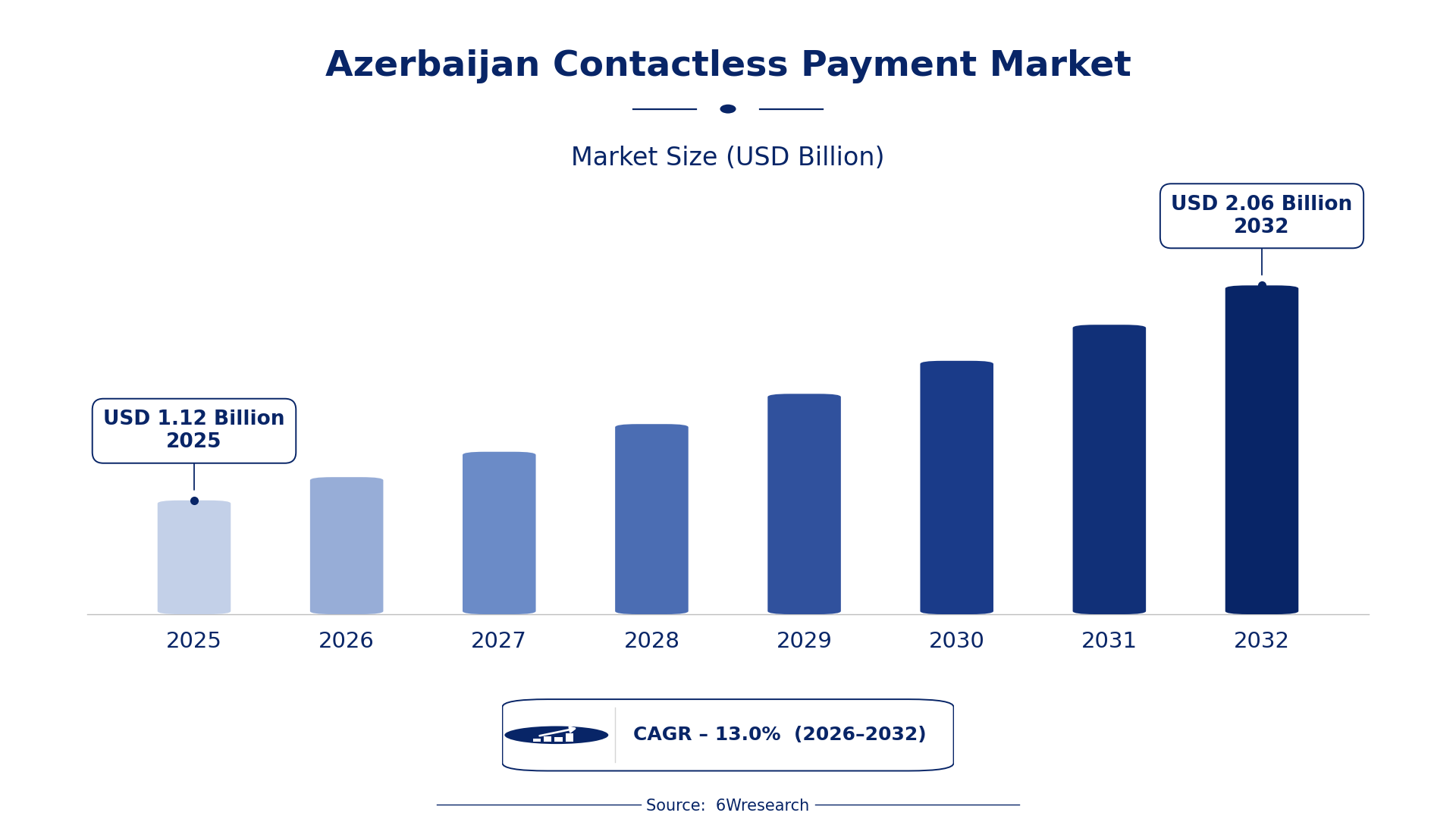
The Azerbaijan Contactless Payment Market was estimated at USD 1116 Million in 2025 and is projected to reach USD 2064 Million by 2032, growing at a CAGR of 13.0% from 2026 to 2032.
Azerbaijan Contactless Payment Market Synopsis
The Azerbaijan Contactless Payment Market is currently experiencing dynamic growth fueled by a shift in consumer preferences towards swift and hygienic transaction methods. As the digital payments ecosystem expands, the country is witnessing an increasing acceptance of contactless solutions among consumers and businesses alike.
Looking ahead, the market is set to benefit from supportive government initiatives and advancements in technology. With ongoing infrastructure improvements and heightened consumer demand for convenience, the trajectory points towards a more cashless society, solidifying Azerbaijan's position in the global contactless payment arena.
Azerbaijan Contactless Payment Market Year-wise Growth Rate and Key Drivers
This graph illustrates the annual growth rates of the Azerbaijan Contactless Payment Market from 2021 to 2032, highlighting a steady upward trajectory and projected expansion over the forecast period.
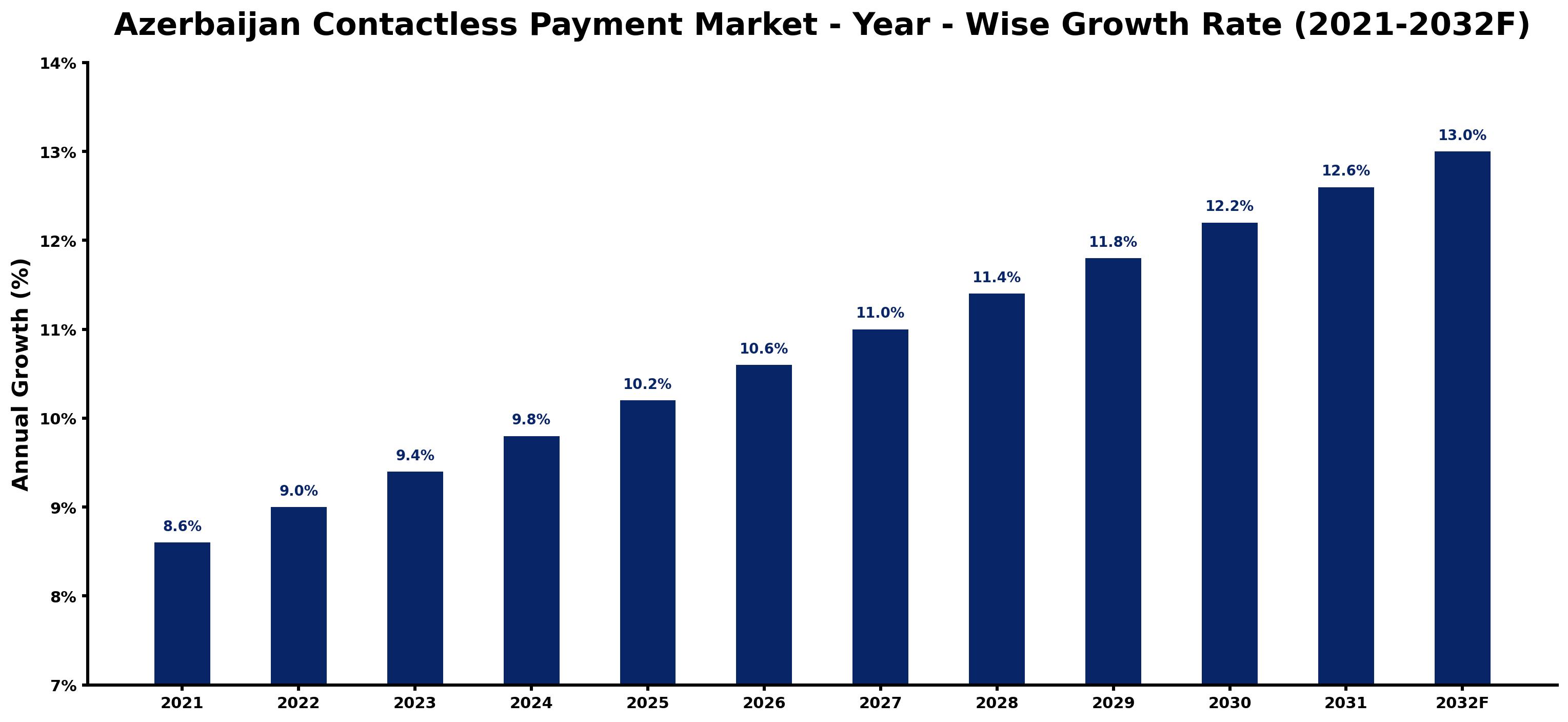
The table below presents the year‑wise growth rates along with the key drivers influencing the market
| Year | Growth Rate | Major Drivers |
| 2021 | 8.6% | Central Bank's digital transformation initiatives boosting cashless transactions. |
| 2022 | 9.0% | Growing smartphone penetration enhancing contactless payment adoption. |
| 2023 | 9.4% | Government's push for a cashless economy attracts investments. |
| 2024 | 9.8% | Increased merchant acceptance of contactless payment systems. |
| 2025 | 10.2% | Promotion of financial literacy initiatives encouraging digital payment use. |
| 2026 | 10.6% | Rise in tourism accelerating demand for contactless options. |
| 2027 | 11.0% | Bank partnerships launching innovative mobile payment solutions. |
| 2028 | 11.4% | E-commerce growth leading to higher contactless payment usage. |
| 2029 | 11.8% | Youth demographics favoring digital payments over cash transactions. |
| 2030 | 12.2% | Improved payment infrastructure enhancing consumer confidence in contactless. |
| 2031 | 12.6% | Retail sector modernization promoting more digital payment options. |
| 2032 | 13.0% | Increased security features attracting consumers to contactless payments. |
Note: Market size estimations and growth projections presented in this report are based on 6Wresearch's proprietary forecasting methodology, utilizing the latest available industry data, government publications, and primary research inputs.
Azerbaijan Contactless Payment Market Key Takeaways
Below are some of the specific key takeaways from the market, including:
- Rising consumer adoption of contactless payment methods due to convenience and hygiene considerations.
- Government initiatives aimed at enhancing digital payment infrastructure and security standards.
- Technological advancements driving the evolution of mobile wallets and wearable payment devices.
- Growing competition from fintech companies pushing traditional banks to innovate their payment offerings.
- Increasing integration of contactless payment solutions in retail, transportation, and hospitality sectors.
Evaluation of Restraints in Azerbaijan Contactless Payment Market
Despite its growth potential, the Azerbaijan Contactless Payment Market faces notable challenges. One major restraint is the need for secure and interoperable payment solutions that satisfy both consumer and merchant expectations. Many users remain cautious about adopting new technologies due to concerns regarding data security and the interoperability of systems. on top of that, regulatory barriers and infrastructure inadequacies can hinder the widespread acceptance of contactless payment methods, making it crucial for stakeholders to address these issues proactively.
Azerbaijan Contactless Payment Market Trends
Several trends are shaping the demand and technology within the Azerbaijan Contactless Payment Market. Firstly, the COVID-19 pandemic accelerated the shift towards contactless transactions, as consumers sought safer payment options. Secondly, advancements in Near Field Communication (NFC) technology have made it easier for merchants to adopt contactless systems. Finally, the rising popularity of mobile wallets reflects changing consumer behavior, with an increasing number of individuals preferring digital payment solutions over cash or traditional card transactions.
Azerbaijan Contactless Payment Market Opportunities
Opportunities abound in the Azerbaijan Contactless Payment Market, especially in sectors like e-commerce and transportation. As businesses enhance their digital infrastructure, there is potential for significant investments in contactless payment solutions. The rise of fintech startups is also creating a fertile environment for innovative payment technologies. Additionally, collaborations between tech companies and traditional financial institutions can lead to the development of more comprehensive payment ecosystems, further driving market growth.
Government Initiatives in the Azerbaijan Contactless Payment Market
Government policies are vital in shaping the Azerbaijan Contactless Payment Market, focusing on financial inclusion and security. The Azerbaijani government is actively working to establish a regulatory framework that supports the development of contactless payment technologies, ensuring consumer protection and enhancing the overall efficiency of digital transactions. By prioritizing these initiatives, the government aims to boost public confidence in cashless transactions and foster an environment conducive to innovation.
- A national digital infrastructure upgrade programme that is currently in its rollout phase, aimed at improving connectivity for payment processing.
- A regulatory framework introduced in 2025 mandating billing transparency and data protection for contactless transactions.
- Support initiatives for businesses adopting contactless payment solutions, which are currently underway to encourage greater market participation.
- A planned public-private partnership expected to enhance NFC infrastructure by 2028, facilitating easier access to contactless payment methods.
- Ongoing cybersecurity initiatives that focus on mitigating risks associated with digital payment technologies.
Future Insights of the Azerbaijan Contactless Payment Market
Between 2026 and 2032, the Azerbaijan Contactless Payment Market is expected to continue its upward trajectory, driven by ongoing digital transformation. Increasing consumer comfort with cashless transactions and sustained government support for digital payment infrastructures will be crucial. Additionally, as technology advances, we can anticipate a greater variety of contactless solutions entering the market, further enhancing user experience and security. This strategic alignment among stakeholders will ultimately define the future landscape of contactless payments in Azerbaijan.
Azerbaijan Contactless Payment Market Latest Developments
In the past year, the Azerbaijan Contactless Payment Market has witnessed a surge of activity, with various initiatives focused on enhancing payment technologies. Stakeholders are increasingly investing in infrastructure that supports contactless payment solutions, reflecting the growing demand from consumers and businesses alike. The market is becoming more competitive as new players emerge, pushing traditional entities to adapt their strategies to stay relevant.
- A leading regional operator launched a new mobile wallet service in Q2 2025, enhancing payment flexibility for users.
- In early 2025, a major technology vendor completed the rollout of contactless payment terminals across multiple retail outlets, improving transaction efficiency.
- An initiative that began in late 2025 is currently underway, focusing on training merchants to better accept and promote contactless payments.
- A planned rollout expected to begin in early 2026 will introduce biometric authentication features for enhanced security in contactless transactions.
- In mid-2025, a partnership between local banks was established to create a unified platform for contactless payment solutions, streamlining user experience.
Azerbaijan Contactless Payment Market - Key Attractiveness of the Report
- 10 Years of Market Numbers
- Historical Data Starting from 2022 to 2025
- Base Year: 2025
- Forecast Data until 2032
- Key Performance Indicators Impacting the Market
- Major Upcoming Developments and Projects
Key Highlights of the Report:
- Azerbaijan Contactless Payment Market Outlook
- Market Size of Azerbaijan Contactless Payment Market, 2025
- Forecast of Azerbaijan Contactless Payment Market, 2032
- Historical Data and Forecast of Azerbaijan Contactless Payment Revenues & Volume for the Period 2022-2032F
- Azerbaijan Contactless Payment Market Trend Evolution
- Azerbaijan Contactless Payment Market Drivers and Challenges
- Azerbaijan Contactless Payment Price Trends
- Azerbaijan Contactless Payment Porter's Five Forces
- Azerbaijan Contactless Payment Industry Life Cycle
- Historical Data and Forecast of Azerbaijan Contactless Payment Market Revenues & Volume By Component for the Period 2022-2032F
- Historical Data and Forecast of Azerbaijan Contactless Payment Market Revenues & Volume By Hardware for the Period 2022-2032F
- Historical Data and Forecast of Azerbaijan Contactless Payment Market Revenues & Volume By Solutions for the Period 2022-2032F
- Historical Data and Forecast of Azerbaijan Contactless Payment Market Revenues & Volume By Services for the Period 2022-2032F
- Historical Data and Forecast of Azerbaijan Contactless Payment Market Revenues & Volume By Vertical for the Period 2022-2032F
- Historical Data and Forecast of Azerbaijan Contactless Payment Market Revenues & Volume By Retail for the Period 2022-2032F
- Historical Data and Forecast of Azerbaijan Contactless Payment Market Revenues & Volume By Hospitality for the Period 2022-2032F
- Historical Data and Forecast of Azerbaijan Contactless Payment Market Revenues & Volume By Healthcare for the Period 2022-2032F
- Historical Data and Forecast of Azerbaijan Contactless Payment Market Revenues & Volume By Energy and Utilities for the Period 2022-2032F
- Historical Data and Forecast of Azerbaijan Contactless Payment Market Revenues & Volume By Transportation and Logistics for the Period 2022-2032F
- Historical Data and Forecast of Azerbaijan Contactless Payment Market Revenues & Volume By BFSI for the Period 2022-2032F
- Historical Data and Forecast of Azerbaijan Contactless Payment Market Revenues & Volume By Others (Government, telecommunications, and education) for the Period 2022-2032F
- Azerbaijan Contactless Payment Import Export Trade Statistics
- Market Opportunity Assessment By Component
- Market Opportunity Assessment By Vertical
- Azerbaijan Contactless Payment Top Companies Market Share
- Azerbaijan Contactless Payment Competitive Benchmarking By Technical and Operational Parameters
- Azerbaijan Contactless Payment Company Profiles
- Azerbaijan Contactless Payment Key Strategic Recommendations






































