Azerbaijan Electrical Components Market Size, Share & Growth Rate
The Azerbaijan Electrical Components Market was estimated at USD 1419 Million in 2025 and is projected to reach USD 2472 Million by 2032, growing at a CAGR of 8.3% from 2026 to 2032. This growth trajectory is primarily driven by the government's increasing investments in infrastructure development, coupled with a burgeoning demand for sustainable and energy-efficient electrical solutions. As urbanization and industrialization accelerate, the local market is positioned to benefit significantly from both domestic and foreign investments.
Azerbaijan Electrical Components Market Year-wise Growth Rate and Key Drivers
This graph highlights how the Azerbaijan Electrical Components Market has steadily grown over the years, supported by major growth factors.
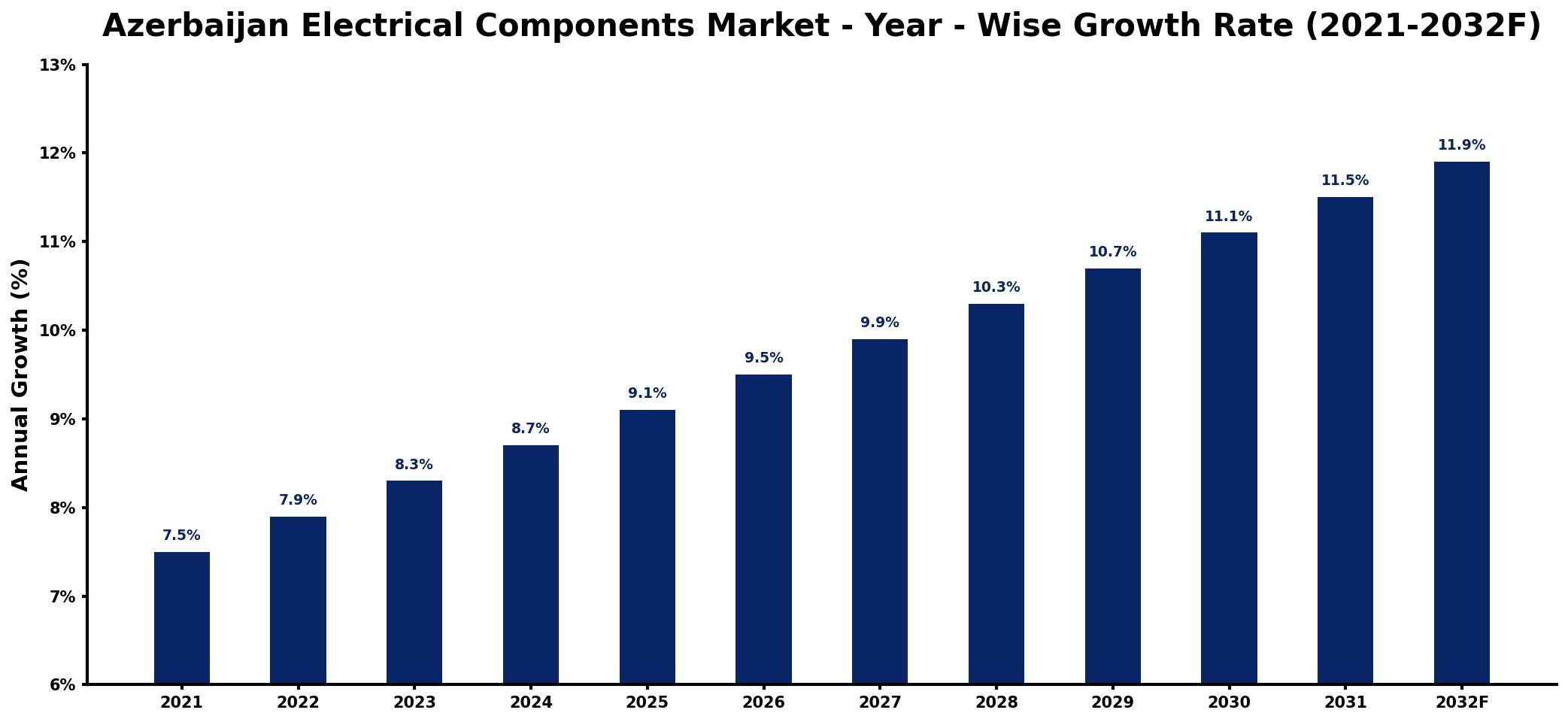
The table below presents the year‑wise growth rates along with the key drivers influencing the market
| Year | Growth Rate | Major Drivers |
| 2021 | 7.5% | Rising construction and infrastructure projects |
| 2022 | 7.9% | Increased investments in renewable energy |
| 2023 | 8.3% | Growing consumer electronics demand |
| 2024 | 8.7% | Expansion of telecommunications networks |
| 2025 | 9.1% | Development of smart grid technologies |
| 2026 | 9.5% | Surge in automotive manufacturing activity |
| 2027 | 9.9% | Enhanced government energy efficiency initiatives |
| 2028 | 10.3% | Increased industrial automation adoption |
| 2029 | 10.7% | Growth in residential solar installations |
| 2030 | 11.1% | Rising demand for electric vehicles |
| 2031 | 11.5% | growing automotive sector requirements |
| 2032 | 11.9% | Investment in advanced manufacturing technologies |
Note: Market size estimations and growth projections presented in this report are based on 6Wresearch's proprietary forecasting methodology, utilizing the latest available industry data, government publications, and primary research inputs.
Azerbaijan Electrical Components Market Synopsis
The most influential force currently shaping the Azerbaijan Electrical Components Market is the rapid modernization of the nation's infrastructure. This transformation is underpinned by extensive government initiatives aimed at overhauling the electrical grid and boosting energy efficiency across various sectors.
In addition to infrastructural upgrades, the market is witnessing a notable shift toward the adoption of advanced technologies. This trend reflects a growing preference for smart electrical components, which cater to the needs of an increasingly tech-savvy consumer base and a progressive industrial environment.
Azerbaijan Electrical Components Market Key Takeaways
- The Azerbaijan Electrical Components Market is set for significant growth, with a projected market size of USD 2472 Million by 2032.
- Investment in renewable energy and energy-efficient technologies is driving demand in the electrical components sector.
- The market is characterized by a strong focus on innovation, with companies developing smarter, more sustainable products.
- Government policies are supportive of foreign investment, making it an attractive environment for international players.
- While challenges remain, the opportunities for growth and development in this sector are substantial.
Evaluation of Restraints in Azerbaijan Electrical Components Market
The Azerbaijan Electrical Components Market faces several restraints that hinder its full potential. A significant limitation is the reliance on imported components, which leaves the market vulnerable to supply chain disruptions and fluctuating costs due to currency volatility. Additionally, a limited domestic production capacity and a shortage of skilled labor constrain local manufacturing efforts. Regulatory barriers also add complexity for companies attempting to navigate the market, leading to increased costs and potential delays in product launches. These factors together contribute to a challenging competitive landscape, with a need for strategic approaches to overcome existing limitations.
Azerbaijan Electrical Components Market Trends
Current trends in the Azerbaijan Electrical Components Market highlight a growing emphasis on sustainability and energy efficiency. Consumers are increasingly aware of environmental issues, driving demand for components that meet stringent energy standards. Furthermore, there is a notable rise in the adoption of smart technologies such as IoT-enabled devices, which facilitate improved control and monitoring of electrical systems. Alongside these trends, the industry is witnessing a surge in digitization and automation, pushing companies to innovate and develop more robust and reliable electrical components for various applications.
Azerbaijan Electrical Components Market Opportunities
Investment opportunities within the Azerbaijan Electrical Components Market are abundant, particularly in the areas of production and distribution of essential components like wires, switches, and sockets. The government's commitment to expanding renewable energy sources presents a golden opportunity for investment in solar panels and energy storage systems. Strategic partnerships with local manufacturers can also offer substantial advantages, allowing investors to tap into the growing domestic demand. Additionally, focusing on research and development can lead to breakthroughs in sustainable electrical solutions, positioning investors favorably within this evolving market landscape.
Government Initiatives in the Azerbaijan Electrical Components Market
The Azerbaijani government has implemented a range of initiatives aimed at bolstering the electrical components market. These include tax incentives to attract foreign investment and the establishment of free trade zones to facilitate international commerce. The government is also prioritizing improvements in energy efficiency standards, which enhance overall market stability. Furthermore, policies promoting innovation through research and development partnerships with educational institutions are designed to foster technological advancement within the industry, setting the stage for long-term growth.
Future Insights of the Azerbaijan Electrical Components Market
Looking ahead to the period from 2026 to 2032, the Azerbaijan Electrical Components Market is anticipated to continue its upward trajectory, largely driven by ongoing industrialization and infrastructure development. The increasing demand for energy-efficient products and the integration of smart technologies will further stimulate market growth. Nonetheless, players in the market must navigate challenges, such as fluctuating raw material prices and heightened competition from international manufacturers. Nevertheless, with continued government support and advancements in technology, the market is well-positioned for sustainable growth and innovation.
Azerbaijan Electrical Components Market Latest Developments (2025 - 2026)
Recent developments in the Azerbaijan Electrical Components Market reflect a dynamic industry landscape. Companies are increasingly focusing on sustainable product lines, responding to consumer demand for greener solutions. Collaborative initiatives between local manufacturers and international firms are becoming more common, facilitating technology transfer and enhancing local production capabilities. Moreover, the government continues to enhance regulatory frameworks, aiming to streamline processes and promote competitiveness within the market. As new projects emerge, the sector is poised for transformative changes in the coming years.
Azerbaijan Electrical Components Market - Key Attractiveness of the Report
- 10 Years of Market Numbers
- Historical Data Starting from 2022 to 2025
- Base Year: 2025
- Forecast Data until 2032
- Key Performance Indicators Impacting the Market
- Major Upcoming Developments and Projects
Key Highlights of the Report:
- Azerbaijan Electrical Components Market Outlook
- Market Size of Azerbaijan Electrical Components Market, 2025
- Forecast of Azerbaijan Electrical Components Market, 2032
- Historical Data and Forecast of Azerbaijan Electrical Components Revenues & Volume for the Period 2022-2032F
- Azerbaijan Electrical Components Market Trend Evolution
- Azerbaijan Electrical Components Market Drivers and Challenges
- Azerbaijan Electrical Components Price Trends
- Azerbaijan Electrical Components Porter's Five Forces
- Azerbaijan Electrical Components Industry Life Cycle
- Historical Data and Forecast of Azerbaijan Electrical Components Market Revenues & Volume By Building Automation for the Period 2022-2032F
- Historical Data and Forecast of Azerbaijan Electrical Components Market Revenues & Volume By Datacom Accessories for the Period 2022-2032F
- Historical Data and Forecast of Azerbaijan Electrical Components Market Revenues & Volume By Security & wiring Accessories for the Period 2022-2032F
- Historical Data and Forecast of Azerbaijan Electrical Components Market Revenues & Volume By Cables & Wires for the Period 2022-2032F
- Historical Data and Forecast of Azerbaijan Electrical Components Market Revenues & Volume By Datacom Cables for the Period 2022-2032F
- Historical Data and Forecast of Azerbaijan Electrical Components Market Revenues & Volume By LV Cables for the Period 2022-2032F
- Historical Data and Forecast of Azerbaijan Electrical Components Market Revenues & Volume By MV&HV Cables for the Period 2022-2032F
- Historical Data and Forecast of Azerbaijan Electrical Components Market Revenues & Volume By Special Cables for the Period 2022-2032F
- Historical Data and Forecast of Azerbaijan Electrical Components Market Revenues & Volume By Industrial Automation for the Period 2022-2032F
- Historical Data and Forecast of Azerbaijan Electrical Components Market Revenues & Volume By Automation Controls for the Period 2022-2032F
- Historical Data and Forecast of Azerbaijan Electrical Components Market Revenues & Volume By Auxiliary Controls for the Period 2022-2032F
- Historical Data and Forecast of Azerbaijan Electrical Components Market Revenues & Volume By Drives & Motion Controls for the Period 2022-2032F
- Historical Data and Forecast of Azerbaijan Electrical Components Market Revenues & Volume By Measurement Controls and Relays for the Period 2022-2032F
- Historical Data and Forecast of Azerbaijan Electrical Components Market Revenues & Volume By Lighting for the Period 2022-2032F
- Historical Data and Forecast of Azerbaijan Electrical Components Market Revenues & Volume By Fixtures for the Period 2022-2032F
- Historical Data and Forecast of Azerbaijan Electrical Components Market Revenues & Volume By Lamps & LEDs for the Period 2022-2032F
- Historical Data and Forecast of Azerbaijan Electrical Components Market Revenues & Volume By Power Distribution for the Period 2022-2032F
- Historical Data and Forecast of Azerbaijan Electrical Components Market Revenues & Volume By Cable Management for the Period 2022-2032F
- Historical Data and Forecast of Azerbaijan Electrical Components Market Revenues & Volume By Enclosures & Panels for the Period 2022-2032F
- Historical Data and Forecast of Azerbaijan Electrical Components Market Revenues & Volume By LV Electrical Distribution for the Period 2022-2032F
- Historical Data and Forecast of Azerbaijan Electrical Components Market Revenues & Volume By Renewable Energies for the Period 2022-2032F
- Historical Data and Forecast of Azerbaijan Electrical Components Market Revenues & Volume By HVAC for the Period 2022-2032F
- Historical Data and Forecast of Azerbaijan Electrical Components Market Revenues & Volume By Renewable energy for the Period 2022-2032F
- Historical Data and Forecast of Azerbaijan Electrical Components Market Revenues & Volume By Safety & Tools for the Period 2022-2032F
- Historical Data and Forecast of Azerbaijan Electrical Components Market Revenues & Volume By Safety Equipment for the Period 2022-2032F
- Historical Data and Forecast of Azerbaijan Electrical Components Market Revenues & Volume By Working Tools & Accessories for the Period 2022-2032F
- Azerbaijan Electrical Components Import Export Trade Statistics
- Market Opportunity Assessment By Building Automation
- Market Opportunity Assessment By Cables & Wires
- Market Opportunity Assessment By Industrial Automation
- Market Opportunity Assessment By Lighting
- Market Opportunity Assessment By Power Distribution
- Market Opportunity Assessment By Renewable Energies
- Market Opportunity Assessment By Safety & Tools
- Azerbaijan Electrical Components Top Companies Market Share
- Azerbaijan Electrical Components Competitive Benchmarking By Technical and Operational Parameters
- Azerbaijan Electrical Components Company Profiles
- Azerbaijan Electrical Components Key Strategic Recommendations






































