Azerbaijan Fish Farming Market Size, Share & Growth Rate
The Azerbaijan Fish Farming Market was estimated at USD 1365 Million in 2025 and is projected to reach USD 2289 Million by 2032, growing at a CAGR of 7.7% from 2026 to 2032. This robust growth is primarily fueled by the rising consumer preference for high-quality, locally sourced seafood and the country's commitment to enhancing aquaculture practices. Additionally, government support and investments in sustainable farming technologies are further propelling the market forward.
Azerbaijan Fish Farming Market Year-wise Growth Rate and Key Drivers
This graph highlights how the Azerbaijan Fish Farming Market has steadily grown over the years, supported by major growth factors.
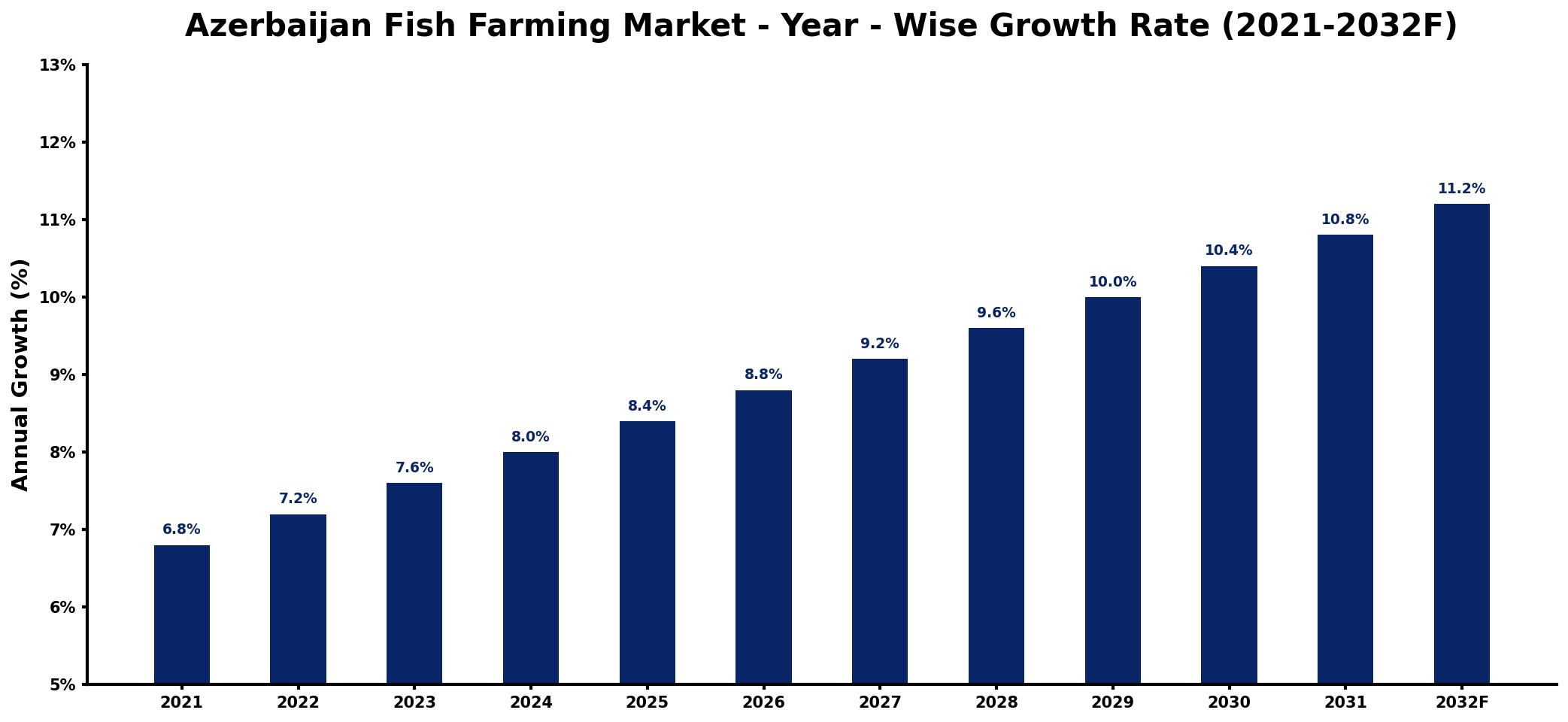
The table below presents the year‑wise growth rates along with the key drivers influencing the market
| Year | Growth Rate | Major Drivers |
| 2021 | 6.8% | increased consumer health awareness |
| 2022 | 7.2% | rising demand for sustainable proteins |
| 2023 | 7.6% | expansion of aquaculture technologies |
| 2024 | 8.0% | growing investments in infrastructure |
| 2025 | 8.4% | enhanced distribution network efficiency |
| 2026 | 8.8% | increased government support initiatives |
| 2027 | 9.2% | growing export market opportunities |
| 2028 | 9.6% | rising popularity of seafood cuisines |
| 2029 | 10.0% | increased focus on food security |
| 2030 | 10.4% | growing urban population demands |
| 2031 | 10.8% | rising export shipment volumes |
| 2032 | 11.2% | enhanced product quality standards |
Note: Market size estimations and growth projections presented in this report are based on 6Wresearch's proprietary forecasting methodology, utilizing the latest available industry data, government publications, and primary research inputs.
Azerbaijan Fish Farming Market Synopsis
Azerbaijans fish farming sector is increasingly focused on cultivating species that cater to local tastes, such as sturgeon and trout, which have seen significant market interest. The countrys unique geographical advantages and abundant freshwater resources create a fertile environment for aquaculture growth, allowing farmers to meet both local and regional demand.
The commitment to sustainable practices is becoming a hallmark of the Azerbaijani fish farming market. The growing consumer awareness of health benefits associated with fish consumption is prompting a shift towards more environmentally friendly production methods, which are slowly being adopted by fish farmers across the region.
Azerbaijan Fish Farming Market Key Takeaways
- The market is experiencing robust growth due to rising domestic demand for high-quality fish products.
- Government initiatives play a crucial role in supporting technological advancements within the industry.
- Sustainable aquaculture practices are becoming increasingly popular among local fish farmers.
- Investors are showing interest in modernizing fish farming operations to enhance productivity and profitability.
- Infrastructure improvements and training programs are essential to address existing challenges in the sector.
Evaluation of Restraints in Azerbaijan Fish Farming Market
Despite its potential, the Azerbaijan fish farming market faces several challenges that could hinder growth. Limited access to high-quality fish feed and advanced equipment constrains production capabilities. In addition, the infrastructure for transportation and storage is often inadequate, affecting the supply chain. Furthermore, variable government regulations can create uncertainty for farmers, and competition from imported fish products continues to pose a threat to local producers.
Azerbaijan Fish Farming Market Trends
The trend towards sustainable aquaculture is prominent in Azerbaijan, as fish farmers are increasingly adopting practices that minimize ecological impact. Technological innovations, including automated feeding systems and advanced water quality monitoring tools, are gaining traction, helping improve both efficiency and fish health. Furthermore, a rising consumer preference for transparency in sourcing and production methods is pushing the market toward more ethical practices.
Azerbaijan Fish Farming Market Opportunities
There are substantial opportunities for investment in the Azerbaijan fish farming market, particularly in the cultivation of high-demand species such as sturgeon and trout. Establishing modern farms equipped with state-of-the-art technology presents a significant growth avenue. Additionally, the increasing consumer demand for locally sourced and sustainably produced fish offers fertile ground for innovative farming practices and value-added products.
Government Initiatives in the Azerbaijan Fish Farming Market
The Azerbaijani government has implemented a range of policies aimed at bolstering the fish farming sector. Financial incentives and subsidies for fish farmers are designed to promote investment in advanced technologies and sustainable practices. There is also a focus on research and development to improve fish farming productivity, which aligns with the government's broader goal of reducing reliance on fish imports while enhancing local industry competitiveness.
Future Insights of the Azerbaijan Fish Farming Market
Looking ahead to 2026-2032, the Azerbaijan fish farming market is poised for significant expansion. The confluence of increasing consumer awareness about the health benefits of fish, alongside supportive government policies, is expected to drive growth. Furthermore, as the industry embraces more sustainable practices and innovative technologies, it will likely strengthen its competitive edge within the regional marketplace, paving the way for enhanced productivity and profitability.
Azerbaijan Fish Farming Market Latest Developments (2025 - 2026)
Recent developments in the Azerbaijan fish farming market indicate a strong commitment towards modernizing aquaculture practices. Initiatives focusing on sustainability have gained traction, with various stakeholders engaging in discussions to improve environmental standards. The integration of new technologies aimed at enhancing production efficiency is also on the rise, showing promising signs for the future direction of the industry.
Azerbaijan Fish Farming Market - Key Attractiveness of the Report
- 10 Years of Market Numbers
- Historical Data Starting from 2022 to 2025
- Base Year: 2025
- Forecast Data until 2032
- Key Performance Indicators Impacting the Market
- Major Upcoming Developments and Projects
Key Highlights of the Report:
- Azerbaijan Fish Farming Market Outlook
- Market Size of Azerbaijan Fish Farming Market, 2025
- Forecast of Azerbaijan Fish Farming Market, 2032
- Historical Data and Forecast of Azerbaijan Fish Farming Revenues & Volume for the Period 2022-2032F
- Azerbaijan Fish Farming Market Trend Evolution
- Azerbaijan Fish Farming Market Drivers and Challenges
- Azerbaijan Fish Farming Price Trends
- Azerbaijan Fish Farming Porter's Five Forces
- Azerbaijan Fish Farming Industry Life Cycle
- Historical Data and Forecast of Azerbaijan Fish Farming Market Revenues & Volume By Environment for the Period 2022-2032F
- Historical Data and Forecast of Azerbaijan Fish Farming Market Revenues & Volume By Marine Water for the Period 2022-2032F
- Historical Data and Forecast of Azerbaijan Fish Farming Market Revenues & Volume By Fresh Water for the Period 2022-2032F
- Historical Data and Forecast of Azerbaijan Fish Farming Market Revenues & Volume By Brackish Water for the Period 2022-2032F
- Historical Data and Forecast of Azerbaijan Fish Farming Market Revenues & Volume By Fish Type for the Period 2022-2032F
- Historical Data and Forecast of Azerbaijan Fish Farming Market Revenues & Volume By Pompano for the Period 2022-2032F
- Historical Data and Forecast of Azerbaijan Fish Farming Market Revenues & Volume By Snappers for the Period 2022-2032F
- Historical Data and Forecast of Azerbaijan Fish Farming Market Revenues & Volume By Groupers for the Period 2022-2032F
- Historical Data and Forecast of Azerbaijan Fish Farming Market Revenues & Volume By Salmon for the Period 2022-2032F
- Historical Data and Forecast of Azerbaijan Fish Farming Market Revenues & Volume By Milkfish for the Period 2022-2032F
- Historical Data and Forecast of Azerbaijan Fish Farming Market Revenues & Volume By Tuna for the Period 2022-2032F
- Historical Data and Forecast of Azerbaijan Fish Farming Market Revenues & Volume By Tilapia for the Period 2022-2032F
- Historical Data and Forecast of Azerbaijan Fish Farming Market Revenues & Volume By Others for the Period 2022-2032F
- Azerbaijan Fish Farming Import Export Trade Statistics
- Market Opportunity Assessment By Environment
- Market Opportunity Assessment By Fish Type
- Azerbaijan Fish Farming Top Companies Market Share
- Azerbaijan Fish Farming Competitive Benchmarking By Technical and Operational Parameters
- Azerbaijan Fish Farming Company Profiles
- Azerbaijan Fish Farming Key Strategic Recommendations






































