Azerbaijan Fish Market Size, Share & Growth Rate
The Azerbaijan Fish Market was estimated at USD 1213 Million in 2025 and is projected to reach USD 2220 Million by 2032, growing at a CAGR of 9.0% from 2026 to 2032. This growth trajectory is primarily fueled by increasing domestic consumption of fish, as well as a growing interest in sustainable and locally sourced seafood options. The rich biodiversity of the Caspian Sea provides ample opportunity for both local consumption and export, further driving market expansion.
Azerbaijan Fish Market Year-wise Growth Rate and Key Drivers
This graph highlights how the Azerbaijan Fish Market has steadily grown over the years, supported by major growth factors.
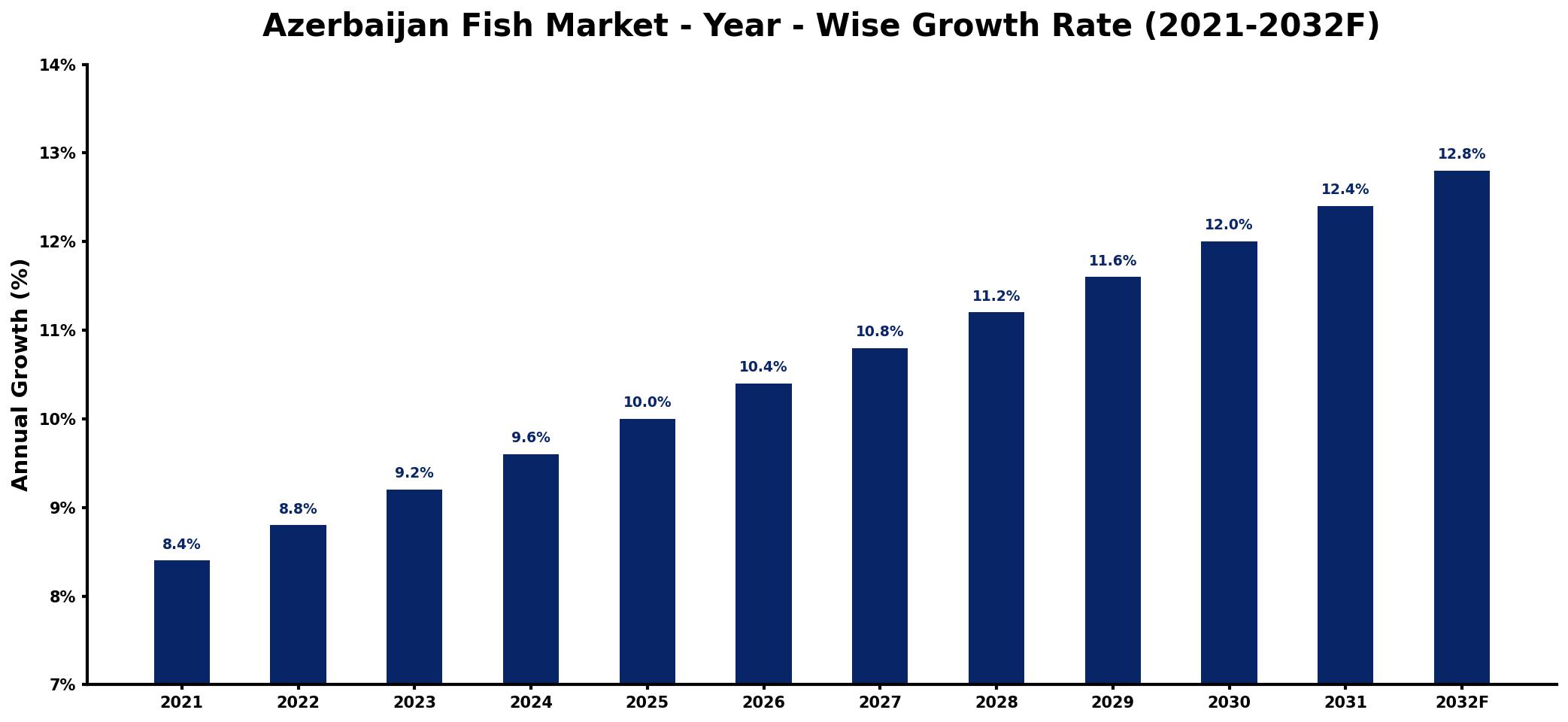
The table below presents the year‑wise growth rates along with the key drivers influencing the market
| Year | Growth Rate | Major Drivers |
| 2021 | 8.4% | Rising health consciousness among consumers |
| 2022 | 8.8% | Increased domestic aquaculture investments |
| 2023 | 9.2% | Expansion of distribution networks |
| 2024 | 9.6% | Growing popularity of seafood cuisines |
| 2025 | 10.0% | Innovations in preservation technologies |
| 2026 | 10.4% | Increased export opportunities identified |
| 2027 | 10.8% | Strengthened regulatory support initiatives |
| 2028 | 11.2% | Enhanced sustainability practices adopted |
| 2029 | 11.6% | Emerging market for processed alternatives |
| 2030 | 12.0% | Technological advancements in farming |
| 2031 | 12.4% | Strengthened consumer preference trends |
| 2032 | 12.8% | Growing demand for premium products |
Note: Market size estimations and growth projections presented in this report are based on 6Wresearch's proprietary forecasting methodology, utilizing the latest available industry data, government publications, and primary research inputs.
Azerbaijan Fish Market Synopsis
The strongest force shaping the Azerbaijan Fish Market today is the increasing consumer demand for sustainable seafood. As the populace becomes more environmentally conscious, there is a marked preference for fish that are sourced responsibly, with a growing emphasis on traceability and quality.
Additionally, the market is seeing a shift towards value-added products, such as smoked fish and ready-to-cook options. This trend not only caters to the evolving preferences of consumers looking for convenience but also helps local producers enhance their profit margins.
Azerbaijan Fish Market Key Takeaways
- The market is expected to expand significantly, reaching USD 2220 Million by 2032.
- Increased focus on sustainability and traceability is reshaping consumer purchasing habits.
- Value-added seafood products are gaining popularity among local consumers.
- Emerging trends include online purchasing and home delivery services.
- The government is actively supporting the fishing sector through regulations and subsidies.
Evaluation of Restraints in Azerbaijan Fish Market
Despite its promising growth, the Azerbaijan Fish Market faces significant constraints that could hinder its potential. Sustainability concerns persist, with issues related to overfishing and the environmental impacts of fishing practices threatening long-term viability. Furthermore, inconsistent quality control presents challenges in ensuring the freshness and safety of seafood products. Limited market access for smaller players creates an uneven playing field, often favoring larger operations and making it difficult for local fishers to thrive.
Azerbaijan Fish Market Trends
Current trends in the Azerbaijan Fish Market indicate a strong movement toward sustainability and ethical sourcing. Consumers are increasingly drawn to products that demonstrate environmental responsibility, leading to a rise in demand for certified sustainable seafood. Moreover, there is an uptick in the popularity of processed seafood options, including dried and smoked varieties, which not only cater to local tastes but also attract a growing tourist demographic. The digital transformation is further influencing the market, with online sales becoming more prevalent, especially as the pandemic has shifted consumer buying behaviors.
Azerbaijan Fish Market Opportunities
Investment opportunities abound in the Azerbaijan Fish Market, particularly in aquaculture and processing facilities. Developing aquaculture projects can effectively meet the demand for high-quality, locally sourced fish while reducing pressure on wild stocks. Additionally, modern processing facilities can significantly enhance product quality and safety, setting the stage for international exports. Cold chain logistics represent another area ripe for investment, as improving storage and transport capabilities can minimize waste and ensure consumers receive fresh products.
Government Initiatives in the Azerbaijan Fish Market
The government of Azerbaijan is actively implementing policies aimed at ensuring sustainability in the fishing sector. Regulations are in place to manage fish stocks and prevent overfishing, reflecting a commitment to the health of the Caspian Sea's ecosystem. Efforts to monitor the quality and safety of seafood products are crucial for consumer protection. Furthermore, the government offers support to local fishermen through subsidies and training programs, aiming to bolster the industry's competitiveness and foster a robust seafood economy.
Future Insights of the Azerbaijan Fish Market
Looking ahead to 2026-2032, the Azerbaijan Fish Market is well-positioned for steady growth. Factors such as rising awareness of healthy eating habits and the importance of seafood in diets will continue to bolster demand. Advances in technology and improvements in fishing infrastructure are also expected to enhance production efficiency. However, the market must navigate challenges related to environmental sustainability and international competition to fully realize its potential. With strategic initiatives in place, the future appears bright for this vital sector.
Azerbaijan Fish Market Latest Developments (2025 - 2026)
Recent developments in the Azerbaijan Fish Market have centered on enhancing sustainability and improving product quality. There is a growing emphasis on establishing traceability systems to assure consumers of responsible sourcing. Additionally, local fishers are increasingly collaborating with the government to receive training on sustainable practices, aligning production methods with modern standards. Innovations in logistics have also been a focus, aiming to streamline the supply chain and reduce waste.
Azerbaijan Fish Market - Key Attractiveness of the Report
- 10 Years of Market Numbers
- Historical Data Starting from 2022 to 2025
- Base Year: 2025
- Forecast Data until 2032
- Key Performance Indicators Impacting the Market
- Major Upcoming Developments and Projects
Key Highlights of the Report:
- Azerbaijan Fish Market Outlook
- Market Size of Azerbaijan Fish Market, 2025
- Forecast of Azerbaijan Fish Market, 2032
- Historical Data and Forecast of Azerbaijan Fish Revenues & Volume for the Period 2022-2032F
- Azerbaijan Fish Market Trend Evolution
- Azerbaijan Fish Market Drivers and Challenges
- Azerbaijan Fish Price Trends
- Azerbaijan Fish Porter's Five Forces
- Azerbaijan Fish Industry Life Cycle
- Historical Data and Forecast of Azerbaijan Fish Market Revenues & Volume By Fish Type for the Period 2022-2032F
- Historical Data and Forecast of Azerbaijan Fish Market Revenues & Volume By Inland Fishes for the Period 2022-2032F
- Historical Data and Forecast of Azerbaijan Fish Market Revenues & Volume By Marine Fishes for the Period 2022-2032F
- Historical Data and Forecast of Azerbaijan Fish Market Revenues & Volume By Shrimps for the Period 2022-2032F
- Historical Data and Forecast of Azerbaijan Fish Market Revenues & Volume By Scampi for the Period 2022-2032F
- Historical Data and Forecast of Azerbaijan Fish Market Revenues & Volume By Product Type for the Period 2022-2032F
- Historical Data and Forecast of Azerbaijan Fish Market Revenues & Volume By Fresh for the Period 2022-2032F
- Historical Data and Forecast of Azerbaijan Fish Market Revenues & Volume By Frozen for the Period 2022-2032F
- Historical Data and Forecast of Azerbaijan Fish Market Revenues & Volume By Canned for the Period 2022-2032F
- Historical Data and Forecast of Azerbaijan Fish Market Revenues & Volume By Others for the Period 2022-2032F
- Historical Data and Forecast of Azerbaijan Fish Market Revenues & Volume By Distribution Channel for the Period 2022-2032F
- Historical Data and Forecast of Azerbaijan Fish Market Revenues & Volume By Retail for the Period 2022-2032F
- Historical Data and Forecast of Azerbaijan Fish Market Revenues & Volume By Institutional for the Period 2022-2032F
- Historical Data and Forecast of Azerbaijan Fish Market Revenues & Volume By Sector for the Period 2022-2032F
- Historical Data and Forecast of Azerbaijan Fish Market Revenues & Volume By Organised for the Period 2022-2032F
- Historical Data and Forecast of Azerbaijan Fish Market Revenues & Volume By Unorganised for the Period 2022-2032F
- Azerbaijan Fish Import Export Trade Statistics
- Market Opportunity Assessment By Fish Type
- Market Opportunity Assessment By Product Type
- Market Opportunity Assessment By Distribution Channel
- Market Opportunity Assessment By Sector
- Azerbaijan Fish Top Companies Market Share
- Azerbaijan Fish Competitive Benchmarking By Technical and Operational Parameters
- Azerbaijan Fish Company Profiles
- Azerbaijan Fish Key Strategic Recommendations






































