Azerbaijan Flower and Ornamental Plants Market Summary
The azerbaijan flower and ornamental plants market was estimated at USD 457 Million in 2025 and is projected to reach USD 864 Million by 2032, growing at a CAGR of 11.0% from 2026 to 2032.
Azerbaijan Flower and Ornamental Plants Market Year-wise Growth Rate and Key Drivers
This graph highlights how the Azerbaijan Flower and Ornamental Plants Market has steadily grown over the past five years, supported by major growth factors.
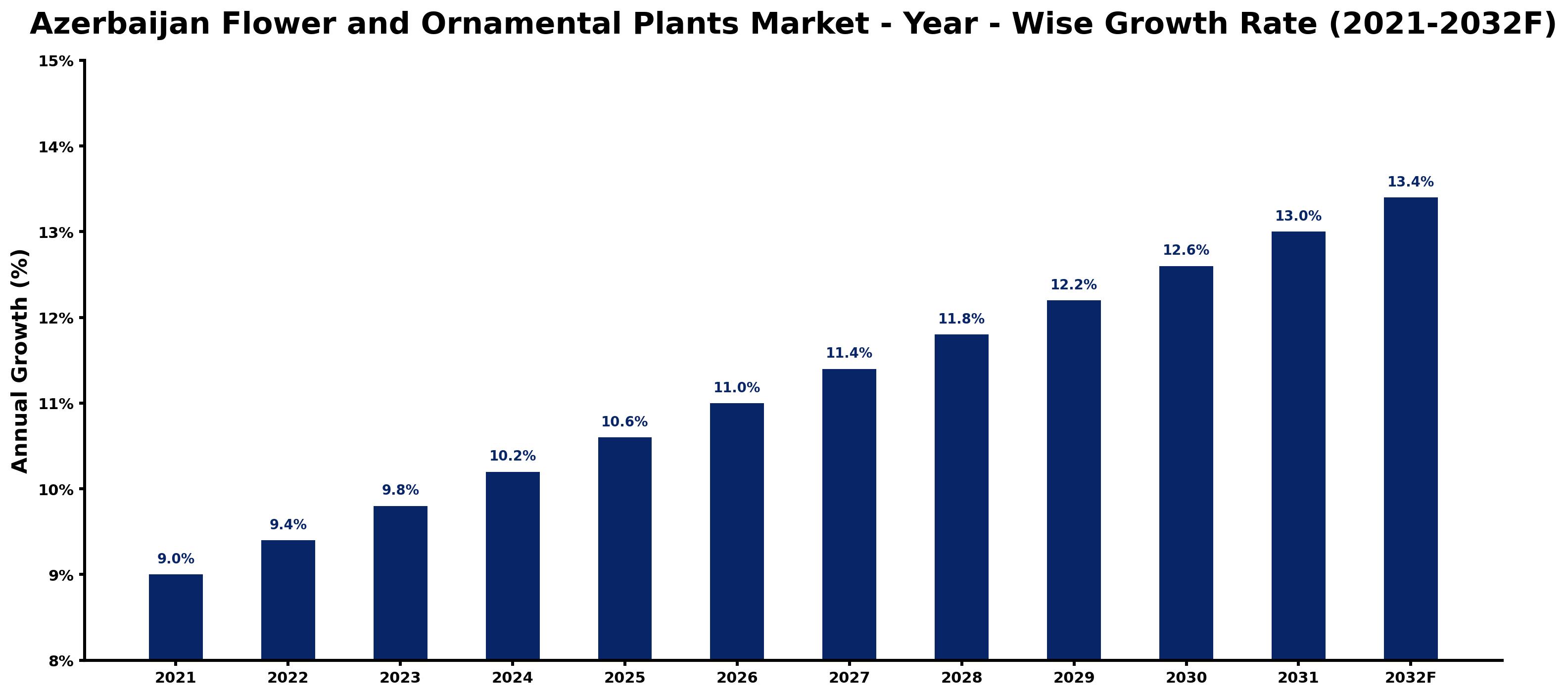
The table below presents the year wise growth rates along with the key drivers influencing the market
| Year | Growth Rate | Major Drivers |
| 2021 | 9.0% | Local nurseries began expanding, responding to emerging consumer interest in home gardening. |
| 2022 | 9.4% | Increased urbanization led to a higher demand for decorative plants in city landscapes. |
| 2023 | 9.8% | Social media heavily influenced floral design trends, raising public awareness of horticulture. |
| 2024 | 10.2% | A surge in eco-consciousness prompted interest in sustainable gardening practices and products. |
| 2025 | 10.6% | Landscaping projects for new residential complexes spurred demand for ornamental plants. |
| 2026 | 11.0% | Collaborations with local artists showcased flowers in public art installations and events. |
| 2027 | 11.4% | The wedding industry flourished, significantly increasing demand for bespoke floral arrangements. |
| 2028 | 11.8% | Plant-based wellness trends motivated consumers to invest in indoor plants for health benefits. |
| 2029 | 12.2% | Commercial spaces adopted biophilic designs, emphasizing greenery for employee well-being. |
| 2030 | 12.6% | Educational programs in schools promoted gardening skills, inspiring youth interest in horticulture. |
| 2031 | 13.0% | Growth in e-commerce platforms facilitated broader access to rare and exotic plant varieties. |
| 2032 | 13.4% | Tourism initiatives highlighted botanical gardens, boosting local interest and market engagement. |
Note - Market size estimations and growth projections presented in this report are based on 6Wresearch's advanced forecasting approach, validated with industry datasets as of June 2026.
Azerbaijan Flower and Ornamental Plants Market Synopsis
The Azerbaijan Flower and Ornamental Plants Market is projected to reach 11.0% and witness significant growth during the forecast period (2026-2032). This growth is attributed to several factors, including urbanization, rising disposable incomes, and an increasing interest in enhancing both indoor and outdoor environments. Consumers are increasingly drawn to a diverse range of flowers and ornamental plants, comprising both local species and imported varieties. The market structure is characterized by various stakeholders, including retail nurseries, online sales platforms, and landscaping services catering to a broad demographic of residential and commercial clients.
Azerbaijan Flower and Ornamental Plants Market Growth Drivers
Several key drivers are propelling the Azerbaijan Flower and Ornamental Plants Market. Urbanization is significantly impacting demand as more individuals seek to beautify their living and working spaces. Rising disposable incomes allow consumers to invest in decorative plants and flowers, further stimulating market growth. As gardening becomes a widespread hobby, the interest in both indoor and outdoor gardening supplies grows. The shift towards eco-friendly and sustainable gardening practices is fostering demand for locally sourced and organic plant options. Additionally, the increase in gifting occasions has led to a surge in flower sales, enhancing the market's overall growth.
Azerbaijan Flower and Ornamental Plants Market Trends and Opportunities
The current landscape of the Azerbaijan Flower and Ornamental Plants Market reveals several trends that present opportunities for growth. A marked rise in the preference for indoor plants, particularly succulents and air-purifying varieties, indicates a shift towards incorporating greenery within residential and office settings. Consumers are becoming more discerning about their choices, favoring sustainable and organic plants that align with eco-conscious values. The popularity of unique and exotic plant varieties is also on the rise, offering potential differentiation for market players. Furthermore, the growing trend of e-commerce is facilitating easy access to a wider array of flowers and plants, contributing positively to sales.
Azerbaijan Flower and Ornamental Plants Market Challenges and Restraints
Despite the growth potential, the Azerbaijan Flower and Ornamental Plants Market faces several challenges. The country's geographical and climatic conditions can hinder the cultivation of certain plant varieties, creating a dependency on imports that can drive up costs and complicate supply chains. Additionally, infrastructure inadequacies in transportation and storage for perishable items can lead to losses and inefficiencies in distribution. Limited public awareness about plant care and maintenance can deter some consumers from investing in ornamental plants. Furthermore, external factors such as political instability and fluctuating exchange rates can adversely affect market dynamics.
Azerbaijan Flower and Ornamental Plants Market Investment Opportunities
The Azerbaijan Flower and Ornamental Plants Market offers various investment avenues for stakeholders both locally and from abroad. Opportunities exist in establishing greenhouse facilities for year-round production, which can significantly reduce reliance on imports. Retail outlets targeting urban populations or e-commerce platforms designed to enhance accessibility can tap into the growing market demand effectively. Furthermore, collaborating with local farmers to boost cultivation techniques and introduce innovative plant varieties can enhance market competitiveness. Additionally, exporting premium-quality flowers and ornamental plants to adjacent markets can open up new revenue streams.
Azerbaijan Flower and Ornamental Plants Market Government Investment and Initiatives
The government of Azerbaijan is committed to enhancing the flower and ornamental plants market through various support initiatives. Key policies focus on developing the horticultural sector, aiming to boost local production while decreasing dependency on imports. Financial incentives and support schemes are encouraged to attract investments into innovative greenhouse technologies and modern agricultural practices. Streamlined regulations are also being pursued to facilitate market access for local producers and stimulate export activities. These frameworks reflect the government's ongoing commitment to fostering a sustainable and competitive flower and ornamental plants industry in Azerbaijan.
Azerbaijan Flower and Ornamental Plants Market Latest Developments (May 2025 - June 2026)
The period from May 2025 to June 2026 has seen notable developments in the Azerbaijan Flower and Ornamental Plants Market. Increasing consumer awareness regarding the benefits of indoor plants has popularized sustainable gardening practices. Retailers have begun enhancing their offerings to include more eco-friendly and organic options, tapping into the growing consumer preference for sustainable products. E-commerce platforms have gained traction, allowing consumers to conveniently access a wider range of flowers and plants. Furthermore, educational initiatives focusing on plant care and maintenance are being introduced, aimed at increasing consumer confidence and engagement in the market.
Azerbaijan Flower and Ornamental Plants Market - Key Attractiveness of the Report
- 10 Years of Market Numbers
- Historical Data Starting from 2022 to 2025
- Base Year: 2025
- Forecast Data until 2032
- Key Performance Indicators Impacting the Market
- Major Upcoming Developments and Projects
Key Highlights of the Report:
- Azerbaijan Flower and Ornamental Plants Market Outlook
- Market Size of Azerbaijan Flower and Ornamental Plants Market, 2025
- Forecast of Azerbaijan Flower and Ornamental Plants Market, 2032F
- Historical Data and Forecast of Azerbaijan Flower and Ornamental Plants Revenues & Volume for the Period 2022-2032F
- Azerbaijan Flower and Ornamental Plants Market Trend Evolution
- Azerbaijan Flower and Ornamental Plants Market Drivers and Challenges
- Azerbaijan Flower and Ornamental Plants Price Trends
- Azerbaijan Flower and Ornamental Plants Porter's Five Forces
- Azerbaijan Flower and Ornamental Plants Industry Life Cycle
- Historical Data and Forecast of Azerbaijan Flower and Ornamental Plants Market Revenues & Volume By Product Type for the Period 2022-2032F
- Historical Data and Forecast of Azerbaijan Flower and Ornamental Plants Market Revenues & Volume By Potted Plants for the Period 2022-2032F
- Historical Data and Forecast of Azerbaijan Flower and Ornamental Plants Market Revenues & Volume By Cut Flowers for the Period 2022-2032F
- Historical Data and Forecast of Azerbaijan Flower and Ornamental Plants Market Revenues & Volume By Application for the Period 2022-2032F
- Historical Data and Forecast of Azerbaijan Flower and Ornamental Plants Market Revenues & Volume By Home for the Period 2022-2032F
- Historical Data and Forecast of Azerbaijan Flower and Ornamental Plants Market Revenues & Volume By Commercial for the Period 2022-2032F
- Azerbaijan Flower and Ornamental Plants Import Export Trade Statistics
- Market Opportunity Assessment By Product Type
- Market Opportunity Assessment By Application
- Azerbaijan Flower and Ornamental Plants Top Companies Market Share
- Azerbaijan Flower and Ornamental Plants Competitive Benchmarking By Technical and Operational Parameters
- Azerbaijan Flower and Ornamental Plants Company Profiles
- Azerbaijan Flower and Ornamental Plants Key Strategic Recommendations






































