Azerbaijan Functional Apparel Market Size, Share & Growth Rate
The Azerbaijan Functional Apparel Market was estimated at USD 884 Million in 2025 and is projected to reach USD 1566 Million by 2032, growing at a CAGR of 8.5% from 2026 to 2032. This robust growth trajectory is primarily fueled by an increasing emphasis on health and fitness among consumers, along with a surge in outdoor activities. Moreover, advancements in textile technologies are contributing to the development of multifunctional apparel that meets the diverse needs of active lifestyle enthusiasts.
Azerbaijan Functional Apparel Market Year-wise Growth Rate and Key Drivers
This graph highlights how the Azerbaijan Functional Apparel Market has steadily grown over the years, supported by major growth factors.
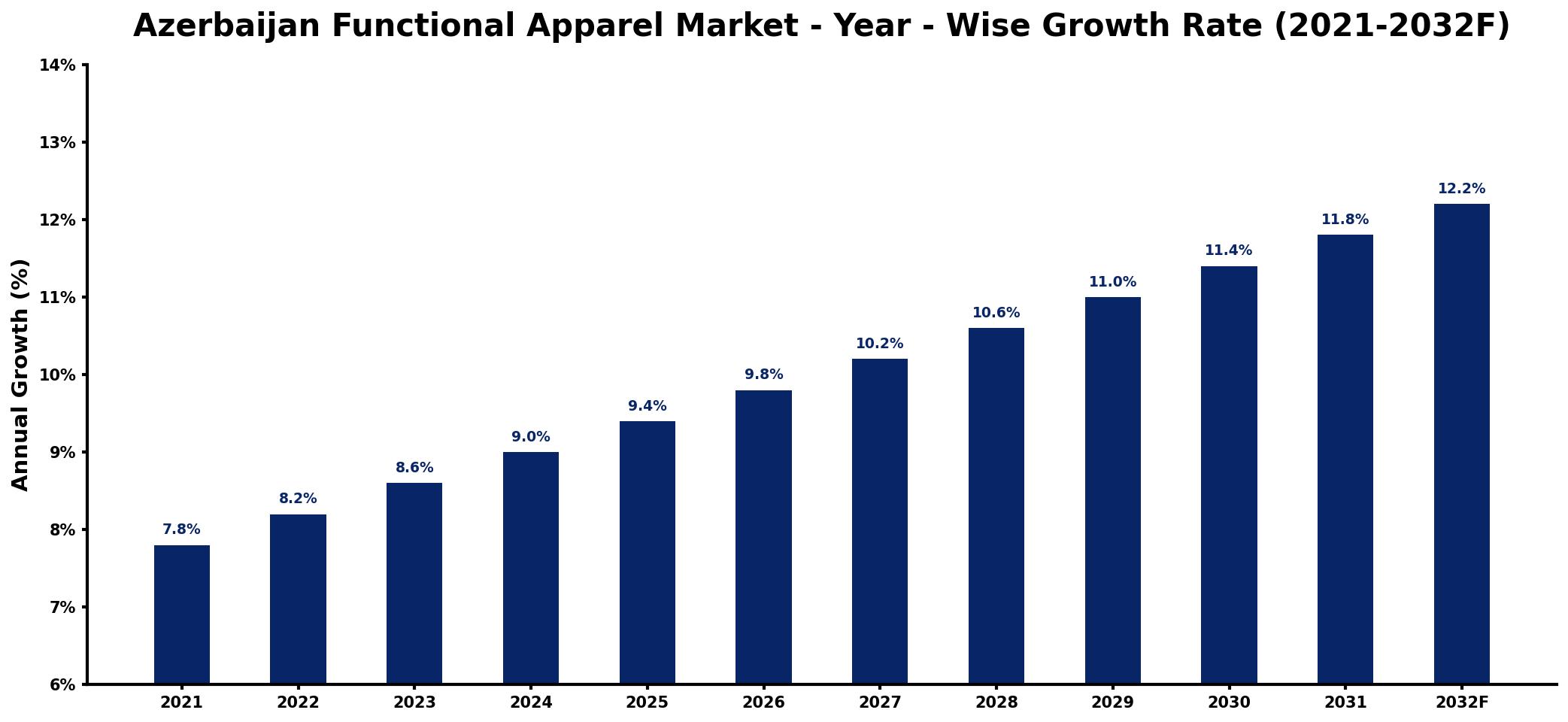
The table below presents the year‑wise growth rates along with the key drivers influencing the market
| Year | Growth Rate | Major Drivers |
| 2021 | 7.8% | Rising health consciousness among consumers |
| 2022 | 8.2% | Increased outdoor recreational activities |
| 2023 | 8.6% | Growing popularity of fitness trends |
| 2024 | 9.0% | Expansion of e-commerce platforms |
| 2025 | 9.4% | Investment in sustainable materials |
| 2026 | 9.8% | Technological advancements in production |
| 2027 | 10.2% | Emergence of new market players |
| 2028 | 10.6% | Enhanced marketing strategies adopted |
| 2029 | 11.0% | Collaborations with fitness influencers |
| 2030 | 11.4% | Diversification of product offerings |
| 2031 | 11.8% | Growth in urban lifestyle segments |
| 2032 | 12.2% | increased overall sector activity |
Note: Market size estimations and growth projections presented in this report are based on 6Wresearch's proprietary forecasting methodology, utilizing the latest available industry data, government publications, and primary research inputs.
Azerbaijan Functional Apparel Market Synopsis
The strongest force currently shaping the Azerbaijan Functional Apparel Market is the growing consumer awareness surrounding fitness and wellness. This trend is prompting a shift towards high-performance clothing that not only provides comfort but also enhances athletic performance across various activities.
Additionally, the increasing participation in outdoor sports and recreational activities is driving the demand for specialized clothing. Consumers are looking for apparel that offers protective features, such as UV protection and moisture management, which are crucial for outdoor enthusiasts navigating Azerbaijan's diverse environments.
Azerbaijan Functional Apparel Market Key Takeaways
- The market is witnessing a significant shift towards multifunctional clothing, catering to diverse consumer needs.
- Innovations in fabric technologies are a critical enabler for performance-enhancing functional apparel.
- Consumer preferences are increasingly leaning towards sustainable and eco-friendly materials.
- Government policies aimed at ensuring product safety and quality significantly influence market dynamics.
- Collaboration between textile manufacturers and apparel brands is essential for overcoming market challenges.
Evaluation of Restraints in Azerbaijan Functional Apparel Market
Despite the positive growth outlook, several restraints hinder the market's potential. One primary limitation lies in the challenge of aligning innovation with consumer acceptance. While features such as moisture-wicking and UV protection are technologically advanced, ensuring these garments also meet consumer expectations for durability, comfort, and style remains a hurdle. Additionally, the market faces a shortage of material innovations that strike the right balance between performance and affordability, which can restrict broader consumer adoption.
Azerbaijan Functional Apparel Market Trends
Current trends indicate a strong shift towards smart textiles, integrating technology into functional apparel for enhanced performance. Wearable technology, such as fitness trackers incorporated into clothing, is becoming increasingly popular among health-conscious consumers. Furthermore, the emphasis on sustainability is prompting brands to explore eco-friendly materials and production processes, reflecting a broader global trend toward responsible consumerism.
Azerbaijan Functional Apparel Market Opportunities
The market is ripe with opportunities for growth, particularly in the realm of performance-enhancing textiles that cater to niche segments such as extreme sports and outdoor survival gear. Additionally, the rise of e-commerce offers brands an avenue to reach broader audiences, especially in urban areas where consumer demand is steadily increasing. Brands that successfully leverage online platforms and engage in targeted marketing can position themselves favorably in this expanding market.
Government Initiatives in the Azerbaijan Functional Apparel Market
The Azerbaijani government plays a critical role in shaping the functional apparel market through regulatory frameworks that emphasize product safety and quality standards. Policies include stringent textile labeling requirements to ensure consumer protection and safety. Furthermore, there are initiatives aimed at supporting research and development within the textile sector, fostering innovation that aligns with both local and international standards.
Future Insights of the Azerbaijan Functional Apparel Market
Looking forward to the period between 2026 and 2032, the Azerbaijan Functional Apparel Market is expected to continue its upward trajectory driven by evolving consumer preferences and technological advancements. Increased investment in R&D by manufacturers is likely to lead to the introduction of more innovative products that align with performance expectations. Moreover, as outdoor activities gain popularity, brands that can effectively cater to this growing demographic will find significant opportunities for expansion.
Azerbaijan Functional Apparel Market Latest Developments (2025 - 2026)
Recent developments in the Azerbaijan Functional Apparel Market showcase a growing trend towards collaborations between textile manufacturers and tech companies, aimed at incorporating smart features into apparel. Additionally, there has been a noticeable increase in campaigns promoting active lifestyles, further driving consumer interest in performance apparel. Efforts to enhance the sustainability of production processes are also gaining traction, reflecting the broader commitment to environmental responsibility within the industry.
Azerbaijan Functional Apparel Market - Key Attractiveness of the Report
- 10 Years of Market Numbers
- Historical Data Starting from 2022 to 2025
- Base Year: 2025
- Forecast Data until 2032
- Key Performance Indicators Impacting the Market
- Major Upcoming Developments and Projects
Key Highlights of the Report:
- Azerbaijan Functional Apparel Market Outlook
- Market Size of Azerbaijan Functional Apparel Market, 2025
- Forecast of Azerbaijan Functional Apparel Market, 2032
- Historical Data and Forecast of Azerbaijan Functional Apparel Revenues & Volume for the Period 2022-2032F
- Azerbaijan Functional Apparel Market Trend Evolution
- Azerbaijan Functional Apparel Market Drivers and Challenges
- Azerbaijan Functional Apparel Price Trends
- Azerbaijan Functional Apparel Porter's Five Forces
- Azerbaijan Functional Apparel Industry Life Cycle
- Historical Data and Forecast of Azerbaijan Functional Apparel Market Revenues & Volume By Product Type for the Period 2022-2032F
- Historical Data and Forecast of Azerbaijan Functional Apparel Market Revenues & Volume By Sportswear for the Period 2022-2032F
- Historical Data and Forecast of Azerbaijan Functional Apparel Market Revenues & Volume By Activewear for the Period 2022-2032F
- Historical Data and Forecast of Azerbaijan Functional Apparel Market Revenues & Volume By Protective Clothing for the Period 2022-2032F
- Historical Data and Forecast of Azerbaijan Functional Apparel Market Revenues & Volume By Others for the Period 2022-2032F
- Historical Data and Forecast of Azerbaijan Functional Apparel Market Revenues & Volume By Application for the Period 2022-2032F
- Historical Data and Forecast of Azerbaijan Functional Apparel Market Revenues & Volume By Sports Industry for the Period 2022-2032F
- Historical Data and Forecast of Azerbaijan Functional Apparel Market Revenues & Volume By Outdoor Clothing for the Period 2022-2032F
- Historical Data and Forecast of Azerbaijan Functional Apparel Market Revenues & Volume By Healthcare sector for the Period 2022-2032F
- Historical Data and Forecast of Azerbaijan Functional Apparel Market Revenues & Volume By Distribution Channel for the Period 2022-2032F
- Historical Data and Forecast of Azerbaijan Functional Apparel Market Revenues & Volume By Offline Store for the Period 2022-2032F
- Historical Data and Forecast of Azerbaijan Functional Apparel Market Revenues & Volume By Online Store for the Period 2022-2032F
- Azerbaijan Functional Apparel Import Export Trade Statistics
- Market Opportunity Assessment By Product Type
- Market Opportunity Assessment By Application
- Market Opportunity Assessment By Distribution Channel
- Azerbaijan Functional Apparel Top Companies Market Share
- Azerbaijan Functional Apparel Competitive Benchmarking By Technical and Operational Parameters
- Azerbaijan Functional Apparel Company Profiles
- Azerbaijan Functional Apparel Key Strategic Recommendations






































