Azerbaijan Herbal Cosmetics Market Size, Share & Growth Rate
The Azerbaijan Herbal Cosmetics Market was estimated at USD 958 Million in 2025 and is projected to reach USD 1615 Million by 2032, growing at a CAGR of 7.7% from 2026 to 2032. This robust growth trajectory is primarily driven by rising consumer demand for natural and organic products, coupled with an increasing awareness of the benefits associated with herbal ingredients in skincare. Moreover, the shift towards sustainable beauty and the need for eco-friendly formulations is further energizing the market landscape.
Azerbaijan Herbal Cosmetics Market Year-wise Growth Rate and Key Drivers
This graph highlights how the Azerbaijan Herbal Cosmetics Market has steadily grown over the years, supported by major growth factors.
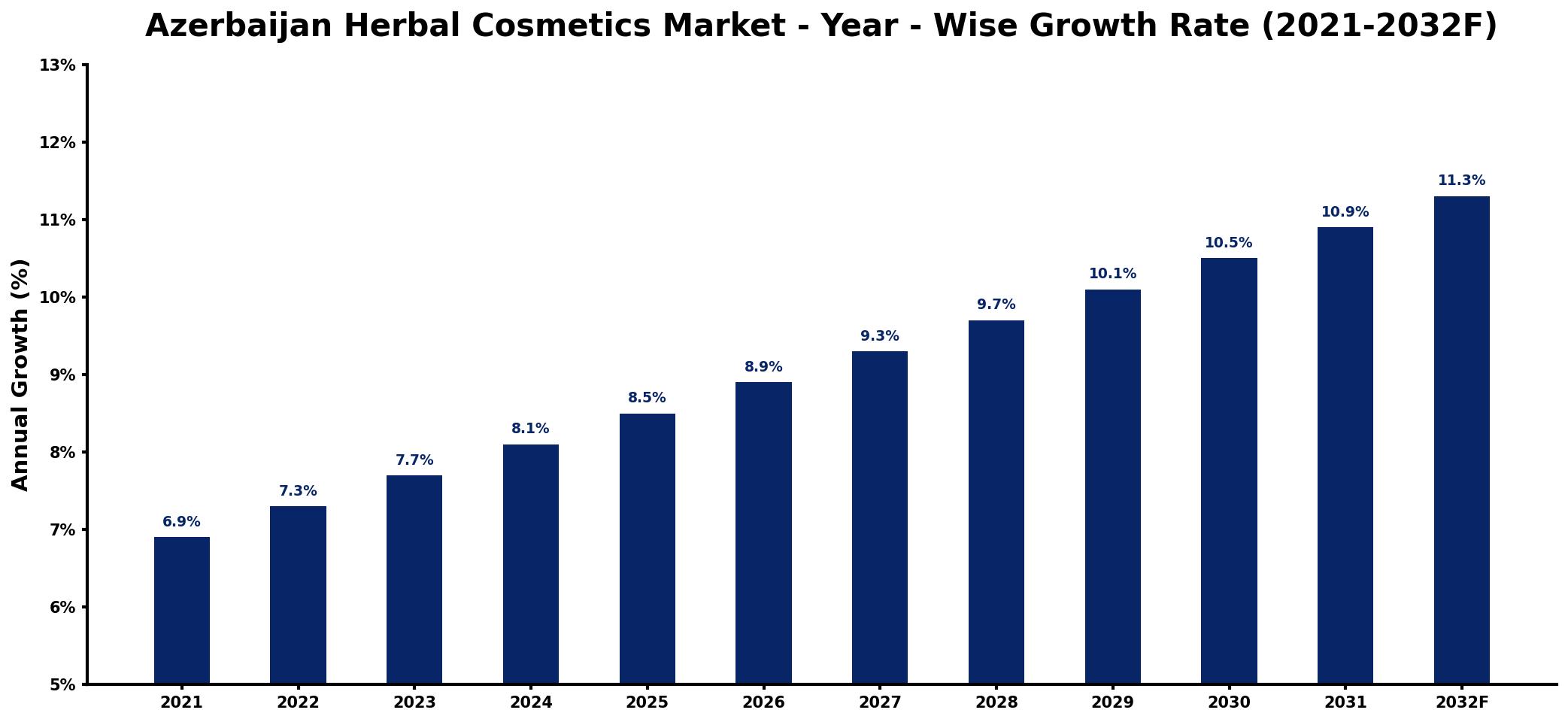
The table below presents the year‑wise growth rates along with the key drivers influencing the market
| Year | Growth Rate | Major Drivers |
| 2021 | 6.9% | Rising consumer interest in natural |
| 2022 | 7.3% | Increased investment in sustainable sourcing |
| 2023 | 7.7% | Growing awareness of environmental benefits |
| 2024 | 8.1% | Expansion of retail distribution channels |
| 2025 | 8.5% | Surge in online shopping platforms |
| 2026 | 8.9% | Enhanced marketing strategies targeting youth |
| 2027 | 9.3% | Collaborations with wellness influencers |
| 2028 | 9.7% | Introduction of innovative product lines |
| 2029 | 10.1% | Strengthening of local manufacturing capabilities |
| 2030 | 10.5% | Growing popularity of eco-friendly packaging |
| 2031 | 10.9% | Increased focus on health benefits |
| 2032 | 11.3% | Strengthened regulatory support for sustainability |
Note: Market size estimations and growth projections presented in this report are based on 6Wresearch's proprietary forecasting methodology, utilizing the latest available industry data, government publications, and primary research inputs.
Azerbaijan Herbal Cosmetics Market Synopsis
The Azerbaijan Herbal Cosmetics Market is evolving rapidly as consumers become more educated about the benefits of using products made from natural ingredients. This shift in consumer behavior is prompting both local and international brands to expand their offerings, introducing a diverse range of herbal cosmetics tailored to meet the demands of this burgeoning market.
Recent trends indicate a notable increase in the preference for cruelty-free and environmentally friendly beauty products, which aligns perfectly with the attributes of herbal cosmetics. As consumers seek safer alternatives that reflect their values, the market is poised for remarkable advancements.
Azerbaijan Herbal Cosmetics Market Key Takeaways
- The market is experiencing significant growth driven by consumer awareness and demand for natural ingredients.
- Eco-friendly packaging and sustainability practices are becoming essential aspects of product development.
- Local botanical resources are increasingly integrated into product formulations, promoting traditional Azerbaijani ingredients.
- Investments in research and development are key to creating innovative herbal cosmetics that resonate with health-conscious consumers.
- The market remains relatively untapped, offering ample opportunities for new entrants and innovative product lines.
Evaluation of Restraints in Azerbaijan Herbal Cosmetics Market
Despite its promising growth, the Azerbaijan Herbal Cosmetics Market faces several limitations. One significant barrier is the relatively low consumer awareness regarding the benefits and efficacy of herbal cosmetics, which can impede widespread adoption. Additionally, the absence of stringent regulatory standards may raise concerns about product safety and quality among consumers. Distribution issues further complicate market access, as many herbal products are not readily available in retail outlets or online platforms. To navigate these challenges effectively, it is essential to bolster consumer education, enhance regulatory frameworks, and improve the availability of herbal cosmetics.
Azerbaijan Herbal Cosmetics Market Trends
The trend towards herbal cosmetics is reinforced by a growing demand for organic beauty products, especially those with plant-based ingredients. Many consumers now actively seek out products that are free from synthetic chemicals and harsh additives. Furthermore, eco-friendly packaging is gaining traction, as brands strive to align with environmentally conscious consumer behavior. The incorporation of traditional Azerbaijani herbs into formulations highlights a unique market opportunity, showcasing local heritage while appealing to modern consumer preferences.
Azerbaijan Herbal Cosmetics Market Opportunities
The Azerbaijan Herbal Cosmetics Market is ripe with investment opportunities due to the escalating demand for safe and natural beauty products. Entrepreneurs can capitalize on this trend by launching innovative product lines that leverage local botanicals. Collaborations with local suppliers can enhance product authenticity while addressing sustainability concerns. Moreover, as awareness about the potential dangers of synthetic ingredients grows, there is a clear pathway for new entrants to carve out significant market share.
Government Initiatives in the Azerbaijan Herbal Cosmetics Market
The government of Azerbaijan has taken proactive measures to support the herbal cosmetics sector through various regulatory frameworks. The State Agency for Standardization, Metrology and Patent plays a crucial role in ensuring product quality and safety by overseeing the registration and certification of herbal cosmetic products. Additionally, recent legislation encourages the incorporation of natural and organic ingredients in cosmetic formulations, contributing to the development of a robust herbal cosmetics market.
Future Insights of the Azerbaijan Herbal Cosmetics Market
Looking ahead to 2026-2032, the Azerbaijan Herbal Cosmetics Market is set for substantial expansion. The increasing consumer inclination towards natural and herbal products will continue to drive demand, as will the ongoing shift toward clean and eco-friendly beauty solutions. Companies are expected to invest in product innovation and marketing strategies to effectively capture the growing interest in herbal cosmetics, positioning themselves favorably within this evolving landscape.
Azerbaijan Herbal Cosmetics Market Latest Developments (2025 - 2026)
Recent developments in the Azerbaijan Herbal Cosmetics Market indicate a heightened focus on innovation and sustainability. Companies are actively launching new product lines that emphasize natural ingredients and ethical sourcing, aligning with consumer values. Additionally, the trend towards digital marketing strategies is becoming more pronounced, enabling brands to reach a broader audience while enhancing consumer engagement through targeted campaigns.
Azerbaijan Herbal Cosmetics Market - Key Attractiveness of the Report
- 10 Years of Market Numbers
- Historical Data Starting from 2022 to 2025
- Base Year: 2025
- Forecast Data until 2032
- Key Performance Indicators Impacting the Market
- Major Upcoming Developments and Projects
Key Highlights of the Report:
- Azerbaijan Herbal Cosmetics Market Outlook
- Market Size of Azerbaijan Herbal Cosmetics Market, 2025
- Forecast of Azerbaijan Herbal Cosmetics Market, 2032
- Historical Data and Forecast of Azerbaijan Herbal Cosmetics Revenues & Volume for the Period 2022-2032F
- Azerbaijan Herbal Cosmetics Market Trend Evolution
- Azerbaijan Herbal Cosmetics Market Drivers and Challenges
- Azerbaijan Herbal Cosmetics Price Trends
- Azerbaijan Herbal Cosmetics Porter's Five Forces
- Azerbaijan Herbal Cosmetics Industry Life Cycle
- Historical Data and Forecast of Azerbaijan Herbal Cosmetics Market Revenues & Volume By Physical State for the Period 2022-2032F
- Historical Data and Forecast of Azerbaijan Herbal Cosmetics Market Revenues & Volume By Solid for the Period 2022-2032F
- Historical Data and Forecast of Azerbaijan Herbal Cosmetics Market Revenues & Volume By Semi-solid for the Period 2022-2032F
- Historical Data and Forecast of Azerbaijan Herbal Cosmetics Market Revenues & Volume By Liquid for the Period 2022-2032F
- Historical Data and Forecast of Azerbaijan Herbal Cosmetics Market Revenues & Volume By Product for the Period 2022-2032F
- Historical Data and Forecast of Azerbaijan Herbal Cosmetics Market Revenues & Volume By Skin Care Product for the Period 2022-2032F
- Historical Data and Forecast of Azerbaijan Herbal Cosmetics Market Revenues & Volume By Hair Care Product for the Period 2022-2032F
- Historical Data and Forecast of Azerbaijan Herbal Cosmetics Market Revenues & Volume By Baby Care Product for the Period 2022-2032F
- Historical Data and Forecast of Azerbaijan Herbal Cosmetics Market Revenues & Volume By Oral Care Product for the Period 2022-2032F
- Historical Data and Forecast of Azerbaijan Herbal Cosmetics Market Revenues & Volume By Make-up Product for the Period 2022-2032F
- Historical Data and Forecast of Azerbaijan Herbal Cosmetics Market Revenues & Volume By Distribution Channel for the Period 2022-2032F
- Historical Data and Forecast of Azerbaijan Herbal Cosmetics Market Revenues & Volume By Supermarket for the Period 2022-2032F
- Historical Data and Forecast of Azerbaijan Herbal Cosmetics Market Revenues & Volume By Pharmacy for the Period 2022-2032F
- Historical Data and Forecast of Azerbaijan Herbal Cosmetics Market Revenues & Volume By Departmental Store for the Period 2022-2032F
- Historical Data and Forecast of Azerbaijan Herbal Cosmetics Market Revenues & Volume By Beauty Spa/Salon for the Period 2022-2032F
- Historical Data and Forecast of Azerbaijan Herbal Cosmetics Market Revenues & Volume By Internet Retailing for the Period 2022-2032F
- Historical Data and Forecast of Azerbaijan Herbal Cosmetics Market Revenues & Volume By Specialty Store for the Period 2022-2032F
- Azerbaijan Herbal Cosmetics Import Export Trade Statistics
- Market Opportunity Assessment By Physical State
- Market Opportunity Assessment By Product
- Market Opportunity Assessment By Distribution Channel
- Azerbaijan Herbal Cosmetics Top Companies Market Share
- Azerbaijan Herbal Cosmetics Competitive Benchmarking By Technical and Operational Parameters
- Azerbaijan Herbal Cosmetics Company Profiles
- Azerbaijan Herbal Cosmetics Key Strategic Recommendations






































