China Herbal Cosmetics Market Size, Share & Growth Rate
The China Herbal Cosmetics Market was estimated at USD 80 Million in 2025 and is projected to reach USD 92 Million by 2032, growing at a CAGR of 2.0% from 2026 to 2032. This growth trajectory is primarily driven by a notable shift in consumer preferences towards natural and organic beauty solutions, as more individuals seek products that align with their health and wellness goals. Increased awareness of the benefits of herbal ingredients in addressing specific skin and hair care concerns further fuels demand.
China Herbal Cosmetics Market Year-wise Growth Rate and Key Drivers
This graph highlights how the China Herbal Cosmetics Market has steadily grown over the years, supported by major growth factors.
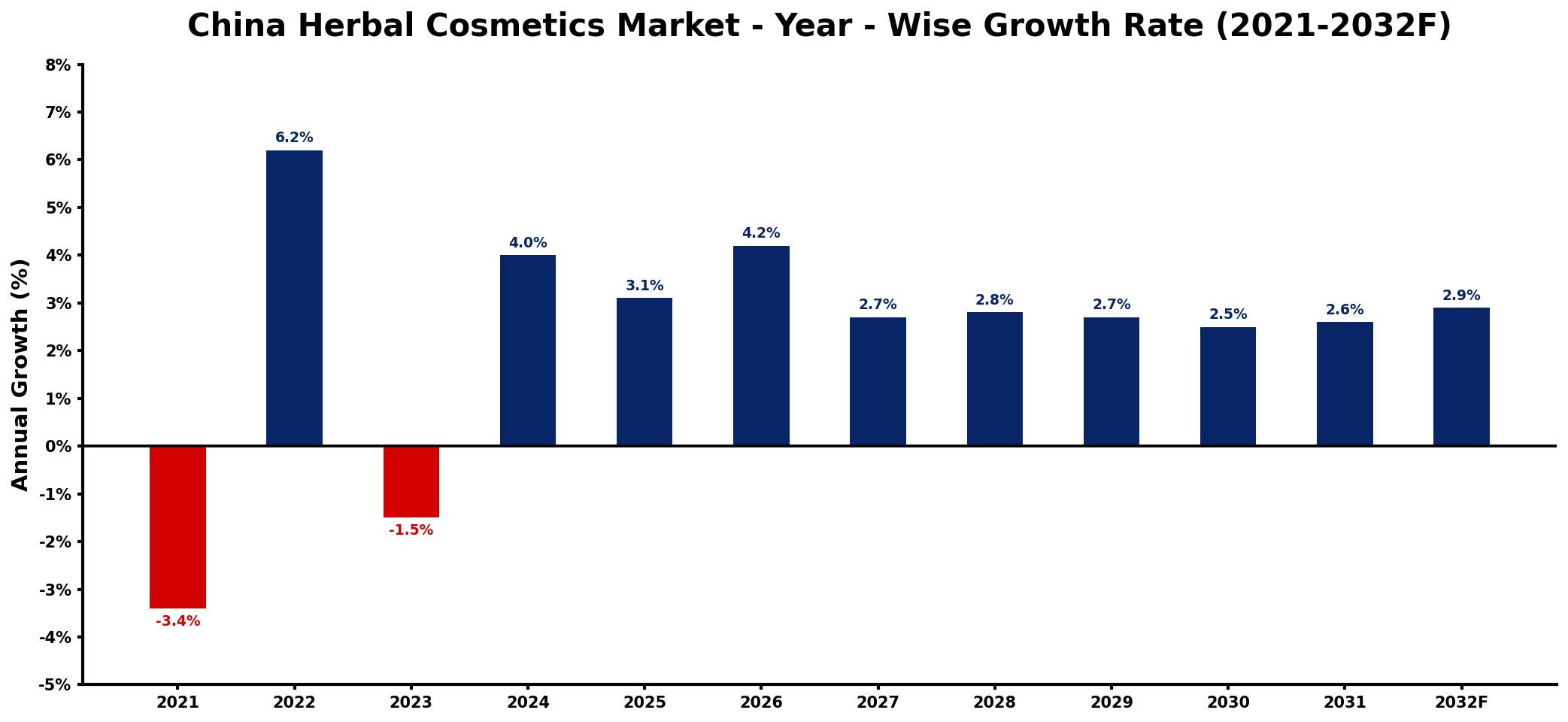
The table below presents the year‑wise growth rates along with the key drivers influencing the market
| Year | Growth Rate | Major Drivers |
| 2021 | -3.4% | Consumer interest in natural ingredients |
| 2022 | 6.2% | Rising demand for sustainable products |
| 2023 | -1.5% | Market saturation of synthetic alternatives |
| 2024 | 4.0% | Increased investment in natural beauty |
| 2025 | 3.1% | Expansion of e-commerce channels |
| 2026 | 4.2% | Growth in wellness tourism sector |
| 2027 | 2.7% | Emergence of new retail formats |
| 2028 | 2.8% | Focus on personalized beauty solutions |
| 2029 | 2.7% | Integration of technology in retail |
| 2030 | 2.5% | Collaboration with wellness influencers |
| 2031 | 2.6% | Adoption of clean beauty standards |
| 2032 | 2.9% | Strengthening of local supply chains |
Note: Market size estimations and growth projections presented in this report are based on 6Wresearch's proprietary forecasting methodology, utilizing the latest available industry data, government publications, and primary research inputs.
China Herbal Cosmetics Market Synopsis
A pivotal force shaping the China Herbal Cosmetics Market is the burgeoning consumer demand for natural beauty products that offer both efficacy and safety. Traditional Chinese herbal ingredients, such as ginseng and goji berry, are gaining traction for their proven benefits, fostering a deeper connection between consumers and their personal care choices.
Moreover, the rise of e-commerce platforms has transformed the retail landscape, facilitating easier access to these products and allowing brands to reach a broader audience. As eco-consciousness becomes increasingly ingrained in consumer behavior, brands emphasizing sustainability in their formulations are positioned to thrive.
China Herbal Cosmetics Market Key Takeaways
- Consumer preference for natural ingredients is a major driver of market growth.
- Traditional Chinese herbal remedies are increasingly integrated into modern beauty products.
- E-commerce channels are essential for expanding market reach and consumer engagement.
- Regulatory frameworks are evolving to support product safety and efficacy.
- Investment opportunities lie in innovation and collaboration with local suppliers.
Evaluation of Restraints in China Herbal Cosmetics Market
Despite the market's promising outlook, several restraints could impede its progress. Counterfeit products pose a significant threat, undermining consumer trust and raising health concerns associated with substandard ingredients. Additionally, the lack of comprehensive regulations specifically governing herbal cosmetics can create confusion for consumers, which may limit market growth. Furthermore, the perception of herbal cosmetics as outdated or traditional can hinder their appeal among younger demographics, necessitating innovative marketing strategies that align with contemporary beauty standards.
China Herbal Cosmetics Market Trends
The China Herbal Cosmetics Market is characterized by current trends emphasizing eco-friendly and sustainable formulations. More brands are incorporating traditional Chinese ingredients into their products, aligning with the growing health consciousness among consumers. A significant trend includes the demand for cruelty-free and vegan certifications, alongside the increasing popularity of multifunctional beauty products that offer diverse benefits. This focus on holistic beauty solutions is further propelling the market forward.
China Herbal Cosmetics Market Opportunities
Significant growth opportunities exist within the China Herbal Cosmetics Market for investors and companies willing to adapt to the evolving landscape. Collaborations with local herbal suppliers can enhance product authenticity and appeal. The ongoing digital transformation offers avenues for brands to engage with tech-savvy consumers through innovative marketing techniques and targeted online campaigns. Furthermore, the rise of clean beauty initiatives positions companies that prioritize natural ingredients favorably in this dynamic market.
Government Initiatives in the China Herbal Cosmetics Market
The Chinese government plays an active role in regulating the herbal cosmetics sector, focusing on safety and efficacy through established policies. The Regulation on the Supervision and Administration of Cosmetics mandates rigorous testing and certification for products incorporating herbal ingredients. Additionally, the Law on Traditional Chinese Medicine encourages innovation in herbal formulations. These initiatives are designed to support market growth while ensuring consumer protection and public health.
Future Insights of the China Herbal Cosmetics Market
Looking ahead to the 2026-2032 period, the China Herbal Cosmetics Market is expected to continue its upward trend, fueled by the growing emphasis on health and wellness in personal care. The increasing adoption of natural and organic products will likely drive innovation, pushing brands to explore new herbal formulations that resonate with consumers. Government support for traditional herbal remedies further bolsters market potential, creating an encouraging environment for investment and product development.
China Herbal Cosmetics Market Latest Developments (2025 - 2026)
Recent developments in the China Herbal Cosmetics Market indicate a marked increase in product launches that incorporate innovative herbal ingredients tailored to modern beauty needs. Many brands are focusing on enhancing their online presence to capture the growing e-commerce segment, while initiatives promoting sustainable practices are gaining traction. Collaborations between traditional herbalists and cosmetic manufacturers are also on the rise, aiming to combine time-honored remedies with contemporary formulations.
China Herbal Cosmetics Market - Key Attractiveness of the Report
- 10 Years of Market Numbers
- Historical Data Starting from 2022 to 2025
- Base Year: 2025
- Forecast Data until 2032
- Key Performance Indicators Impacting the Market
- Major Upcoming Developments and Projects
Key Highlights of the Report:
- China Herbal Cosmetics Market Outlook
- Market Size of China Herbal Cosmetics Market, 2025
- Forecast of China Herbal Cosmetics Market, 2032
- Historical Data and Forecast of China Herbal Cosmetics Revenues & Volume for the Period 2022-2032F
- China Herbal Cosmetics Market Trend Evolution
- China Herbal Cosmetics Market Drivers and Challenges
- China Herbal Cosmetics Price Trends
- China Herbal Cosmetics Porter's Five Forces
- China Herbal Cosmetics Industry Life Cycle
- Historical Data and Forecast of China Herbal Cosmetics Market Revenues & Volume By Physical State for the Period 2022-2032F
- Historical Data and Forecast of China Herbal Cosmetics Market Revenues & Volume By Solid for the Period 2022-2032F
- Historical Data and Forecast of China Herbal Cosmetics Market Revenues & Volume By Semi-solid for the Period 2022-2032F
- Historical Data and Forecast of China Herbal Cosmetics Market Revenues & Volume By Liquid for the Period 2022-2032F
- Historical Data and Forecast of China Herbal Cosmetics Market Revenues & Volume By Product for the Period 2022-2032F
- Historical Data and Forecast of China Herbal Cosmetics Market Revenues & Volume By Skin Care Product for the Period 2022-2032F
- Historical Data and Forecast of China Herbal Cosmetics Market Revenues & Volume By Hair Care Product for the Period 2022-2032F
- Historical Data and Forecast of China Herbal Cosmetics Market Revenues & Volume By Baby Care Product for the Period 2022-2032F
- Historical Data and Forecast of China Herbal Cosmetics Market Revenues & Volume By Oral Care Product for the Period 2022-2032F
- Historical Data and Forecast of China Herbal Cosmetics Market Revenues & Volume By Make-up Product for the Period 2022-2032F
- Historical Data and Forecast of China Herbal Cosmetics Market Revenues & Volume By Distribution Channel for the Period 2022-2032F
- Historical Data and Forecast of China Herbal Cosmetics Market Revenues & Volume By Supermarket for the Period 2022-2032F
- Historical Data and Forecast of China Herbal Cosmetics Market Revenues & Volume By Pharmacy for the Period 2022-2032F
- Historical Data and Forecast of China Herbal Cosmetics Market Revenues & Volume By Departmental Store for the Period 2022-2032F
- Historical Data and Forecast of China Herbal Cosmetics Market Revenues & Volume By Beauty Spa/Salon for the Period 2022-2032F
- Historical Data and Forecast of China Herbal Cosmetics Market Revenues & Volume By Internet Retailing for the Period 2022-2032F
- Historical Data and Forecast of China Herbal Cosmetics Market Revenues & Volume By Specialty Store for the Period 2022-2032F
- China Herbal Cosmetics Import Export Trade Statistics
- Market Opportunity Assessment By Physical State
- Market Opportunity Assessment By Product
- Market Opportunity Assessment By Distribution Channel
- China Herbal Cosmetics Top Companies Market Share
- China Herbal Cosmetics Competitive Benchmarking By Technical and Operational Parameters
- China Herbal Cosmetics Company Profiles
- China Herbal Cosmetics Key Strategic Recommendations






































