Myanmar Herbal Cosmetics Market Size, Share & Growth Rate
The Myanmar Herbal Cosmetics Market was estimated at USD 212 Million in 2025 and is projected to reach USD 295 Million by 2032, growing at a CAGR of 4.8% from 2026 to 2032. This growth trajectory is largely driven by an increasing consumer preference for natural and organic products, which is reshaping the landscape of beauty and personal care in Myanmar. As traditional beauty remedies gain popularity and health-conscious consumers seek alternatives free from harsh chemicals, the market is poised for remarkable expansion.
Myanmar Herbal Cosmetics Market Year-wise Growth Rate and Key Drivers
This graph highlights how the Myanmar Herbal Cosmetics Market has steadily grown over the years, supported by major growth factors.
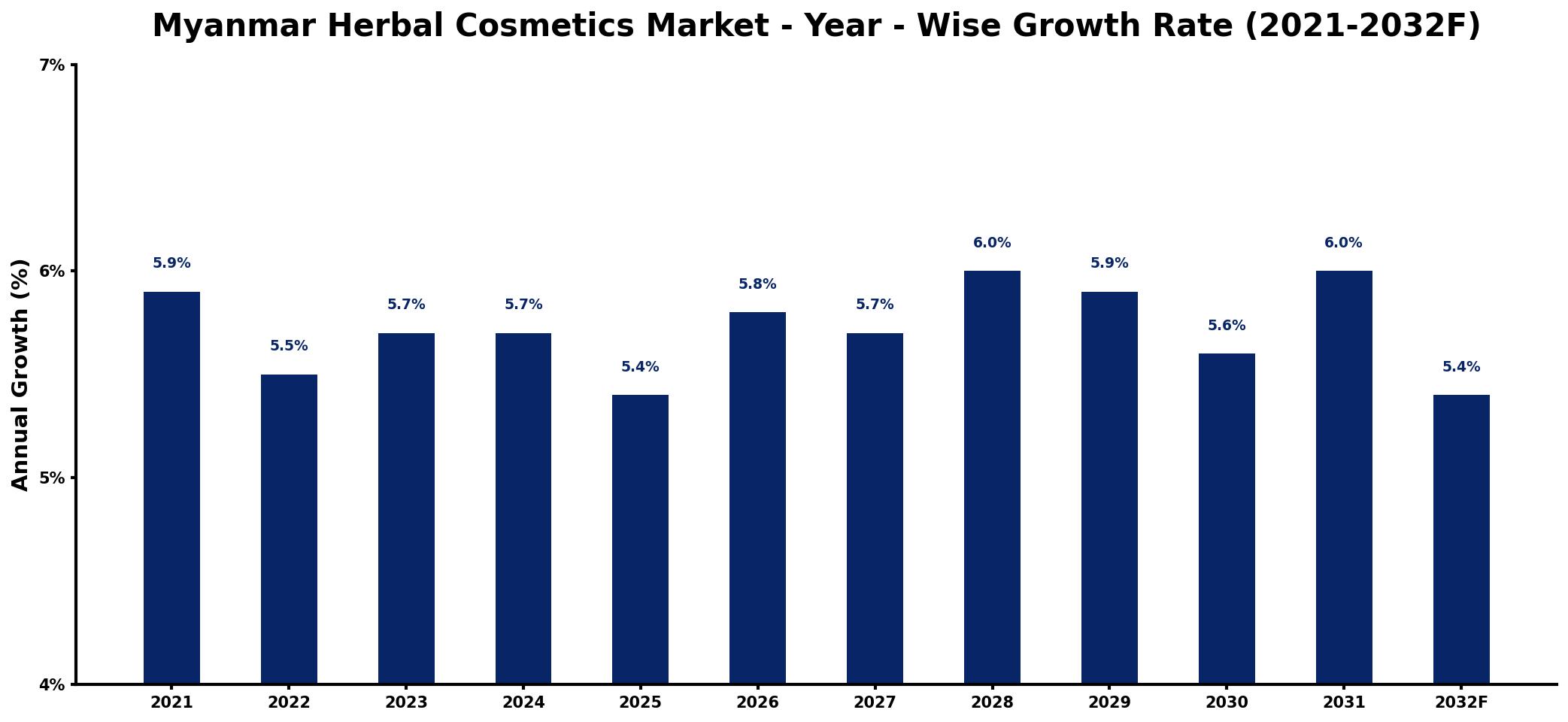
The table below presents the year‑wise growth rates along with the key drivers influencing the market
| Year | Growth Rate | Major Drivers |
| 2021 | 5.9% | Rising consumer health consciousness |
| 2022 | 5.5% | Increased disposable income levels |
| 2023 | 5.7% | Growing popularity of natural ingredients |
| 2024 | 5.7% | Expansion of retail distribution channels |
| 2025 | 5.4% | Emergence of new market entrants |
| 2026 | 5.8% | Higher demand for sustainable products |
| 2027 | 5.7% | Strengthened online shopping platforms |
| 2028 | 6.0% | Increased investment in local brands |
| 2029 | 5.9% | Enhanced product innovation initiatives |
| 2030 | 5.6% | Growing awareness of ethical sourcing |
| 2031 | 6.0% | Strengthening of regional trade partnerships |
| 2032 | 5.4% | Rising influence of social media |
Note: Market size estimations and growth projections presented in this report are based on 6Wresearch's proprietary forecasting methodology, utilizing the latest available industry data, government publications, and primary research inputs.
Myanmar Herbal Cosmetics Market Synopsis
The Myanmar herbal cosmetics market has recently gained significant momentum, reflecting a shift towards products rooted in natural ingredients and traditional practices. As consumers grow increasingly aware of the benefits of herbal formulations, market dynamics are evolving to prioritize authenticity, wellness, and sustainability.
Looking ahead, this market is set to witness sustained growth driven by innovations in product development, packaging, and targeted marketing strategies. The integration of locally sourced ingredients not only strengthens cultural connections but also appeals to the rising consumer interest in eco-friendly beauty solutions.
Myanmar Herbal Cosmetics Market Key Takeaways
- The market is shifting towards natural, organic products as consumer awareness of herbal benefits grows.
- Local ingredients such as thanaka, turmeric, and tamarind are gaining traction in product formulations.
- Online retail channels are emerging as crucial avenues for market expansion and consumer reach.
- Sustainable and eco-friendly packaging is becoming a focal point for brands catering to environmentally conscious consumers.
- The government promotes the local herbal industry, supporting growth through regulatory frameworks.
Evaluation of Restraints in Myanmar Herbal Cosmetics Market
Despite the promising growth potential of the Myanmar herbal cosmetics market, several restraints are holding back its full potential. Limited consumer awareness and education regarding the benefits of herbal cosmetics contribute to slower adoption rates compared to conventional products. Additionally, a lack of standardization and regulation creates concerns regarding quality and safety. Distribution challenges, such as insufficient retail outlets and inadequate infrastructure, further complicate market access. Moreover, local manufacturers face heightened competition from established international brands and counterfeit products, necessitating a strategic focus on marketing, education, and quality improvement to build consumer trust.
Myanmar Herbal Cosmetics Market Trends
The current trend in the Myanmar herbal cosmetics market reflects a robust shift towards natural and organic ingredients. Consumers are increasingly aware of the adverse effects of chemical-laden products, leading to a demand for remedies that promote skin health and overall wellness. Moreover, brands are harnessing local herbal knowledge, integrating traditional ingredients into innovative products. There is also a notable movement toward sustainable practices, including eco-friendly packaging, which resonates well with the environment-conscious consumer base. The rise of e-commerce platforms further enables access to a wider variety of herbal cosmetics, enhancing consumer choice and driving market growth.
Myanmar Herbal Cosmetics Market Opportunities
Investment opportunities in the Myanmar herbal cosmetics market are abundant as consumers increasingly prioritize natural and organic alternatives. As disposable incomes rise and lifestyle changes foster a demand for wellness-centric products, businesses can capitalize on this trend by developing innovative formulations that highlight local ingredients. Collaborations with local suppliers and leveraging digital marketing strategies can effectively engage consumers, enhancing brand visibility and market penetration. This evolving landscape offers significant potential for high returns, making it an attractive sector for investment.
Government Initiatives in the Myanmar Herbal Cosmetics Market
The Myanmar government has enacted various policies to regulate and promote the herbal cosmetics market. Guidelines established by the Food and Drug Administration (FDA) in 2018 focus on the registration and importation of herbal cosmetics to ensure safety and quality standards. The Ministry of Health and Sports is actively involved in licensing and monitoring these products, safeguarding consumer health while encouraging the use of traditional ingredients. These initiatives aim not only to support local herbal industries but also to enhance consumer trust through stringent regulatory practices.
Future Insights of the Myanmar Herbal Cosmetics Market
The future outlook for the Myanmar herbal cosmetics market appears promising as health-conscious consumers continue to embrace natural and organic products. Increasing environmental awareness is likely to sustain the demand for herbal alternatives, further bolstered by government support for local ingredients and traditional practices. As the market evolves, businesses that adapt to consumer preferences and integrate sustainable practices will likely thrive. With rising disposable incomes and a gradual shift towards healthier lifestyles, the market is projected to witness robust growth through 2032.
Myanmar Herbal Cosmetics Market Latest Developments (2025 - 2026)
Recent developments in the Myanmar herbal cosmetics market showcase a growing emphasis on innovation and local sourcing. Companies are increasingly engaging in product diversification, incorporating a variety of local herbs and plants into their offerings. Furthermore, the expansion of online retail channels has made it easier for consumers to access a wider array of herbal cosmetics. In tandem with increased consumer education campaigns, these developments point towards a more informed and engaged market landscape.
Myanmar Herbal Cosmetics Market - Key Attractiveness of the Report
- 10 Years of Market Numbers
- Historical Data Starting from 2022 to 2025
- Base Year: 2025
- Forecast Data until 2032
- Key Performance Indicators Impacting the Market
- Major Upcoming Developments and Projects
Key Highlights of the Report:
- Myanmar Herbal Cosmetics Market Outlook
- Market Size of Myanmar Herbal Cosmetics Market, 2025
- Forecast of Myanmar Herbal Cosmetics Market, 2032
- Historical Data and Forecast of Myanmar Herbal Cosmetics Revenues & Volume for the Period 2022-2032F
- Myanmar Herbal Cosmetics Market Trend Evolution
- Myanmar Herbal Cosmetics Market Drivers and Challenges
- Myanmar Herbal Cosmetics Price Trends
- Myanmar Herbal Cosmetics Porter's Five Forces
- Myanmar Herbal Cosmetics Industry Life Cycle
- Historical Data and Forecast of Myanmar Herbal Cosmetics Market Revenues & Volume By Physical State for the Period 2022-2032F
- Historical Data and Forecast of Myanmar Herbal Cosmetics Market Revenues & Volume By Solid for the Period 2022-2032F
- Historical Data and Forecast of Myanmar Herbal Cosmetics Market Revenues & Volume By Semi-solid for the Period 2022-2032F
- Historical Data and Forecast of Myanmar Herbal Cosmetics Market Revenues & Volume By Liquid for the Period 2022-2032F
- Historical Data and Forecast of Myanmar Herbal Cosmetics Market Revenues & Volume By Product for the Period 2022-2032F
- Historical Data and Forecast of Myanmar Herbal Cosmetics Market Revenues & Volume By Skin Care Product for the Period 2022-2032F
- Historical Data and Forecast of Myanmar Herbal Cosmetics Market Revenues & Volume By Hair Care Product for the Period 2022-2032F
- Historical Data and Forecast of Myanmar Herbal Cosmetics Market Revenues & Volume By Baby Care Product for the Period 2022-2032F
- Historical Data and Forecast of Myanmar Herbal Cosmetics Market Revenues & Volume By Oral Care Product for the Period 2022-2032F
- Historical Data and Forecast of Myanmar Herbal Cosmetics Market Revenues & Volume By Make-up Product for the Period 2022-2032F
- Historical Data and Forecast of Myanmar Herbal Cosmetics Market Revenues & Volume By Distribution Channel for the Period 2022-2032F
- Historical Data and Forecast of Myanmar Herbal Cosmetics Market Revenues & Volume By Supermarket for the Period 2022-2032F
- Historical Data and Forecast of Myanmar Herbal Cosmetics Market Revenues & Volume By Pharmacy for the Period 2022-2032F
- Historical Data and Forecast of Myanmar Herbal Cosmetics Market Revenues & Volume By Departmental Store for the Period 2022-2032F
- Historical Data and Forecast of Myanmar Herbal Cosmetics Market Revenues & Volume By Beauty Spa/Salon for the Period 2022-2032F
- Historical Data and Forecast of Myanmar Herbal Cosmetics Market Revenues & Volume By Internet Retailing for the Period 2022-2032F
- Historical Data and Forecast of Myanmar Herbal Cosmetics Market Revenues & Volume By Specialty Store for the Period 2022-2032F
- Myanmar Herbal Cosmetics Import Export Trade Statistics
- Market Opportunity Assessment By Physical State
- Market Opportunity Assessment By Product
- Market Opportunity Assessment By Distribution Channel
- Myanmar Herbal Cosmetics Top Companies Market Share
- Myanmar Herbal Cosmetics Competitive Benchmarking By Technical and Operational Parameters
- Myanmar Herbal Cosmetics Company Profiles
- Myanmar Herbal Cosmetics Key Strategic Recommendations






































