Azerbaijan Industrial Machinery Market Size, Share & Growth Rate
The Azerbaijan Industrial Machinery Market was estimated at USD 294 Million in 2025 and is projected to reach USD 373 Million by 2032, growing at a CAGR of 3.5% from 2026 to 2032. This growth trajectory is largely influenced by the ongoing initiatives in manufacturing modernization and the urgent demand for advanced automation technologies across various sectors. Furthermore, substantial investments in infrastructure development are expected to bolster the market, as industries seek to enhance productivity and operational efficiency.
Azerbaijan Industrial Machinery Market Year-wise Growth Rate and Key Drivers
This graph highlights how the Azerbaijan Industrial Machinery Market has steadily grown over the years, supported by major growth factors.
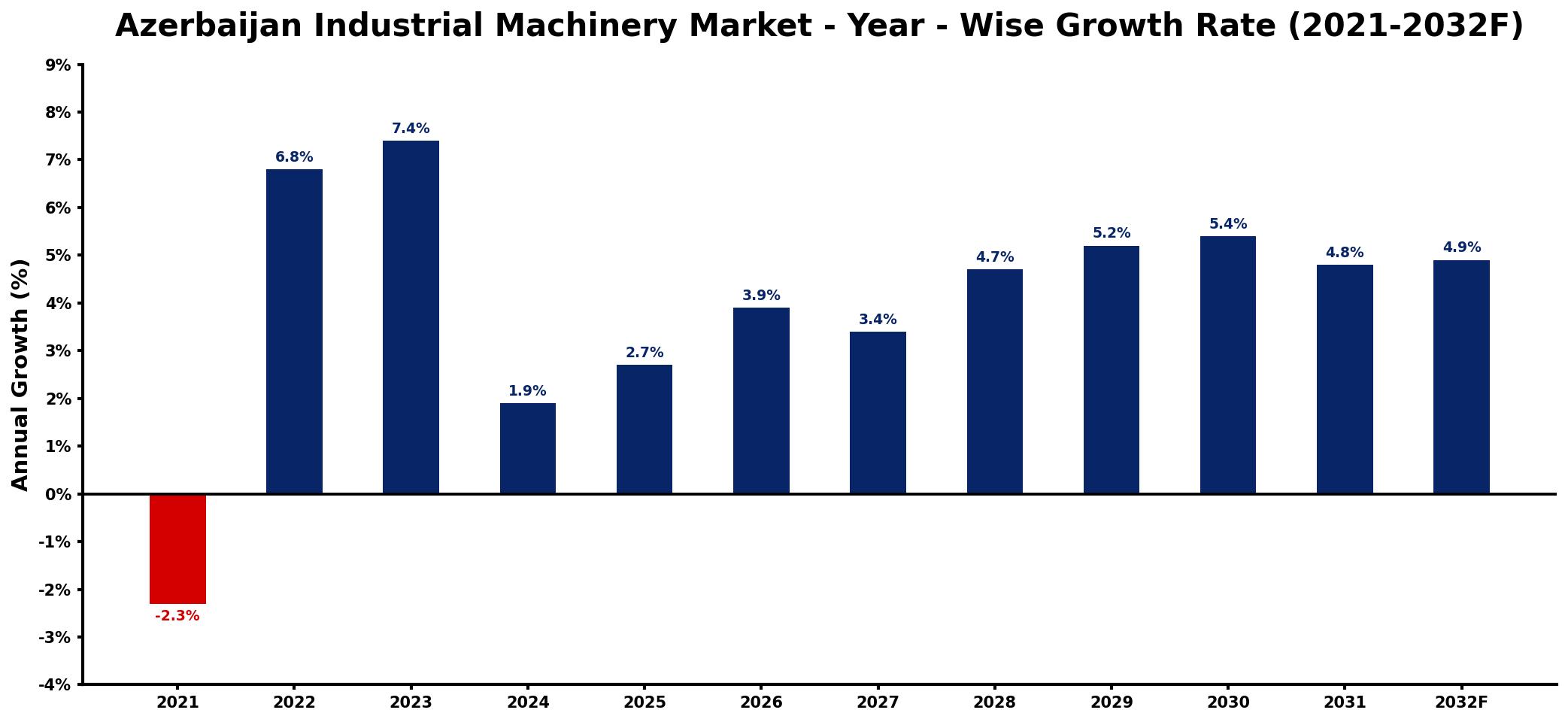
The table below presents the year‑wise growth rates along with the key drivers influencing the market
| Year | Growth Rate | Major Drivers |
| 2021 | -2.3% | decreased investment in infrastructure projects |
| 2022 | 6.8% | rising demand for construction equipment |
| 2023 | 7.4% | increased focus on renewable energy |
| 2024 | 1.9% | expansion of manufacturing capabilities |
| 2025 | 2.7% | growing automation in production processes |
| 2026 | 3.9% | enhanced government support initiatives |
| 2027 | 3.4% | boost in foreign direct investments |
| 2028 | 4.7% | development of logistics and distribution |
| 2029 | 5.2% | surge in agricultural technology adoption |
| 2030 | 5.4% | advancements in digital transformation solutions |
| 2031 | 4.8% | increased emphasis on sustainability practices |
| 2032 | 4.9% | growth in regional trade partnerships |
Note: Market size estimations and growth projections presented in this report are based on 6Wresearch's proprietary forecasting methodology, utilizing the latest available industry data, government publications, and primary research inputs.
Azerbaijan Industrial Machinery Market Synopsis
In Azerbaijan, the industrial machinery market is gaining momentum due to an increasing need for modern machinery that caters to manufacturing, construction, and agriculture. Notably, the push for automation through advanced technologies, such as CNC machines and robotics, is transforming traditional practices, making processes more efficient and cost-effective.
The country is also witnessing an escalation in infrastructure projects, including urban development and energy initiatives, which are creating a growing demand for construction machinery and related equipment. As foreign investments continue to flow into Azerbaijan, opportunities for market expansion are evident.
Azerbaijan Industrial Machinery Market Key Takeaways
- Azerbaijans industrial machinery market is poised for significant growth driven by modernization and automation needs.
- The market's expansion is supported by substantial infrastructure development projects across multiple sectors.
- Government initiatives aimed at enhancing local manufacturing capabilities are fostering an attractive business environment.
- Demand for advanced machinery technologies, including robotics and CNC systems, is on the rise.
- Challenges related to skilled labor shortages and outdated machinery continue to impact market dynamics.
Evaluation of Restraints in Azerbaijan Industrial Machinery Market
Despite its potential, the Azerbaijan industrial machinery market faces significant challenges that can hinder its growth. One major constraint is the limited access to modern technology, which is often a result of economic limitations. Many sectors still depend on outdated machinery, making it difficult to transition to more efficient systems. Additionally, there is a notable skills gap, with a shortage of trained personnel capable of operating advanced machinery. Compliance with international standards also poses hurdles, potentially stalling innovation and adaptation within the market.
Azerbaijan Industrial Machinery Market Trends
Current trends in the Azerbaijan industrial machinery market include a strong emphasis on automation, with companies increasingly investing in high-tech solutions like IoT-enabled machinery and smart manufacturing processes. The move towards sustainability is another significant trend, as businesses explore energy-efficient machinery and renewable energy technologies. Furthermore, there is a rising interest in modular machinery that allows for flexibility in production, catering to the evolving needs of various industries.
Azerbaijan Industrial Machinery Market Opportunities
The future of the Azerbaijan industrial machinery market is promising, with several growth opportunities on the horizon. The ongoing urbanization and infrastructure projects present a ripe landscape for investment in construction machinery. Additionally, sectors like agriculture are witnessing a surge in demand for mechanization, driving the need for agricultural implements. By capitalizing on foreign investments and fostering innovation in machinery technologies, companies can establish a strong foothold in this growing market.
Government Initiatives in the Azerbaijan Industrial Machinery Market
The Azerbaijani government has instituted several initiatives aimed at promoting the industrial machinery market. These include financial incentives for local manufacturers, support for research and development, and efforts to facilitate technology transfer from foreign partners. Additionally, there are programs designed to enhance workforce training and skills development in machinery operation and maintenance, ensuring a steady supply of qualified professionals in the industry.
Future Insights of the Azerbaijan Industrial Machinery Market
Looking ahead to 2026-2032, the Azerbaijan industrial machinery market is expected to evolve significantly, primarily driven by technological advancements and increased investment in automation. As industries strive to improve efficiency, the demand for cutting-edge machinery solutions will rise. Furthermore, the government's commitment to enhancing infrastructure and modernizing manufacturing processes will create a conducive environment for sustained market growth. With the right strategies and innovations, stakeholders can capitalize on the burgeoning opportunities in this promising sector.
Azerbaijan Industrial Machinery Market Latest Developments (2025 - 2026)
In recent months, the Azerbaijan industrial machinery market has seen a surge in collaborative efforts between local manufacturers and international technology providers, aimed at integrating advanced production techniques. Several initiatives have been launched focused on enhancing automation and ensuring compliance with global standards. The governments investment in vocational training programs has also intensified, responding to the urgent need for skilled labor in modern machinery operation and maintenance.
Azerbaijan Industrial Machinery Market - Key Attractiveness of the Report
- 10 Years of Market Numbers
- Historical Data Starting from 2022 to 2025
- Base Year: 2025
- Forecast Data until 2032
- Key Performance Indicators Impacting the Market
- Major Upcoming Developments and Projects
Key Highlights of the Report:
- Azerbaijan Industrial Machinery Market Outlook
- Market Size of Azerbaijan Industrial Machinery Market, 2025
- Forecast of Azerbaijan Industrial Machinery Market, 2032
- Historical Data and Forecast of Azerbaijan Industrial Machinery Revenues & Volume for the Period 2022-2032F
- Azerbaijan Industrial Machinery Market Trend Evolution
- Azerbaijan Industrial Machinery Market Drivers and Challenges
- Azerbaijan Industrial Machinery Price Trends
- Azerbaijan Industrial Machinery Porter's Five Forces
- Azerbaijan Industrial Machinery Industry Life Cycle
- Historical Data and Forecast of Azerbaijan Industrial Machinery Market Revenues & Volume By Application for the Period 2022-2032F
- Historical Data and Forecast of Azerbaijan Industrial Machinery Market Revenues & Volume By Agriculture for the Period 2022-2032F
- Historical Data and Forecast of Azerbaijan Industrial Machinery Market Revenues & Volume By Construction for the Period 2022-2032F
- Historical Data and Forecast of Azerbaijan Industrial Machinery Market Revenues & Volume By Packaging for the Period 2022-2032F
- Historical Data and Forecast of Azerbaijan Industrial Machinery Market Revenues & Volume By Food Processing for the Period 2022-2032F
- Historical Data and Forecast of Azerbaijan Industrial Machinery Market Revenues & Volume By Mining for the Period 2022-2032F
- Historical Data and Forecast of Azerbaijan Industrial Machinery Market Revenues & Volume By Semiconductor Manufacturing for the Period 2022-2032F
- Azerbaijan Industrial Machinery Import Export Trade Statistics
- Market Opportunity Assessment By Application
- Azerbaijan Industrial Machinery Top Companies Market Share
- Azerbaijan Industrial Machinery Competitive Benchmarking By Technical and Operational Parameters
- Azerbaijan Industrial Machinery Company Profiles
- Azerbaijan Industrial Machinery Key Strategic Recommendations






































