Azerbaijan Molasses Market Size, Share & Growth Rate
The Azerbaijan Molasses Market was estimated at USD 1345 Million in 2025 and is projected to reach USD 2305 Million by 2032, growing at a CAGR of 8.0% from 2026 to 2032. This robust growth trajectory is driven by a rising demand for molasses across multiple sectors, including animal feed and food and beverage industries. Additionally, the increasing awareness of molasses' health benefits, particularly among health-conscious consumers, is further propelling market expansion.
Azerbaijan Molasses Market Year-wise Growth Rate and Key Drivers
This graph highlights how the Azerbaijan Molasses Market has steadily grown over the years, supported by major growth factors.
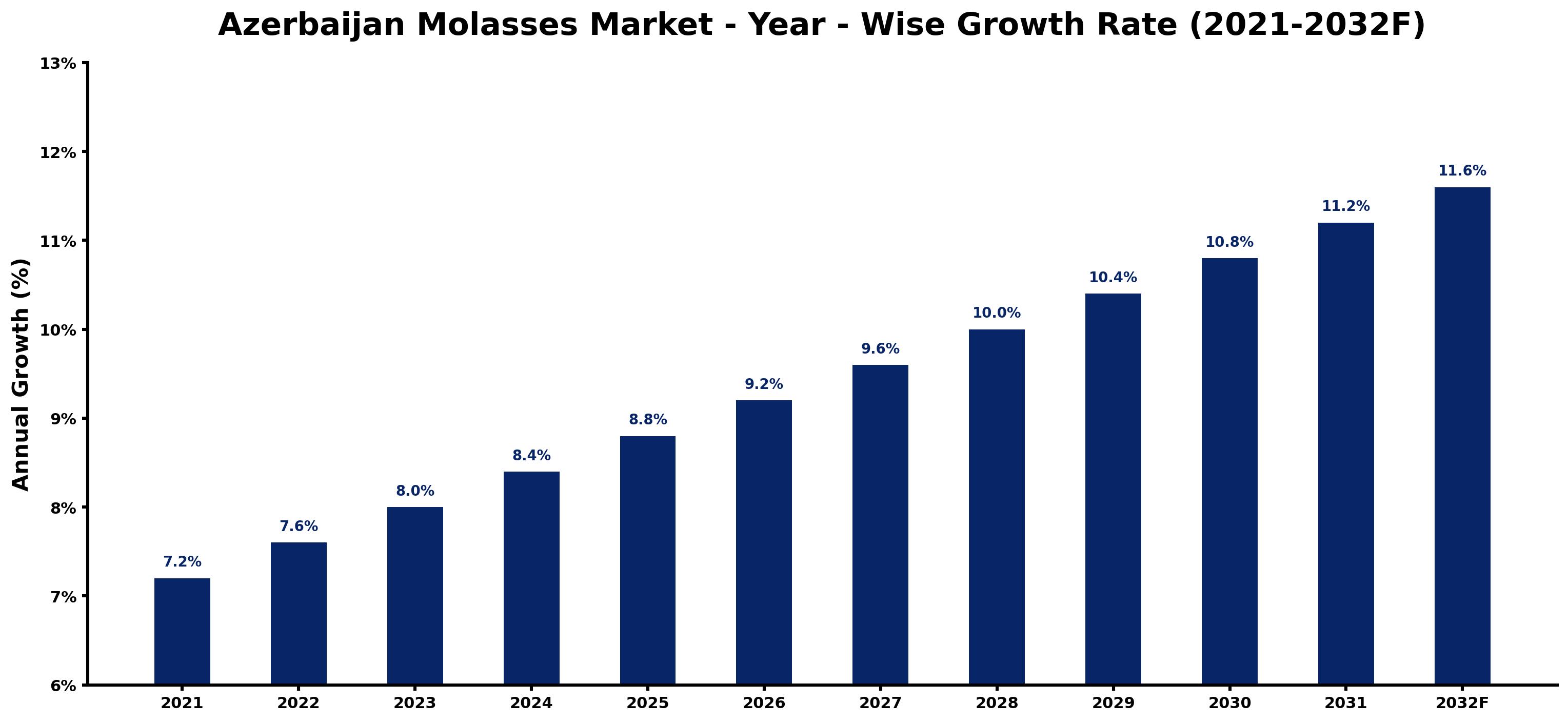
The table below presents the year‑wise growth rates along with the key drivers influencing the market
| Year | Growth Rate | Major Drivers |
| 2021 | 7.2% | Increasing smart city development projects |
| 2022 | 7.6% | Growing urbanization and commercial development |
| 2023 | 8.0% | Expansion of commercial construction activities |
| 2024 | 8.4% | Growing renewable energy integration projects |
| 2025 | 8.8% | Increasing industrial automation investments |
| 2026 | 9.2% | Growing urbanization and commercial development |
| 2027 | 9.6% | Increasing industrial infrastructure investments |
| 2028 | 10.0% | Increasing industrial infrastructure investments |
| 2029 | 10.4% | Increasing smart city development projects |
| 2030 | 10.8% | Growing renewable energy integration projects |
| 2031 | 11.2% | Increasing industrial infrastructure investments |
| 2032 | 11.6% | Expansion of manufacturing activities |
Note - Market size estimations and growth projections presented in this report are based on 6Wresearch’s advanced forecasting approach, validated with industry datasets as of June 2026.
Azerbaijan Molasses Market Synopsis
In Azerbaijan, molasses is predominantly utilized as a nutritious ingredient in animal feed, significantly contributing to livestock health and productivity. This application is gaining traction as local farmers seek cost-effective and nutrient-rich alternatives to conventional feed additives.
Moreover, molasses is increasingly favored in the food and beverage industry for its natural sweetening properties, with consumers gravitating toward clean label products. This shift in consumer preferences is further influencing manufacturers to explore innovative product formulations featuring molasses.
Azerbaijan Molasses Market Key Takeaways
- The market is expected to experience significant growth due to rising demand in multiple end-use industries.
- Health benefits associated with molasses are driving consumer preferences towards natural sweeteners.
- Investment in modern processing facilities and distribution networks presents lucrative opportunities for stakeholders.
- Government policies are aimed at promoting sustainable practices within the molasses production sector.
- Competitive pressures from alternative sweeteners necessitate strategic marketing initiatives to educate consumers.
Evaluation of Restraints in Azerbaijan Molasses Market
Despite the promising growth potential, the Azerbaijan Molasses Market faces notable challenges. Limited consumer awareness regarding the nutritional advantages of molasses can impede market penetration. Additionally, fluctuating prices of raw materials, influenced by climate variability, often create unpredictability in production costs. Competition from alternative sweeteners and syrups further complicates market dynamics, as consumers may opt for cheaper substitutes. Logistical hurdles, such as inadequate storage and transportation facilities, additionally restrict efficient distribution channels, affecting overall market performance.
Azerbaijan Molasses Market Trends
The Azerbaijan Molasses Market is witnessing several emerging trends that are reshaping consumer preferences and product offerings. A noticeable shift towards organic and non-GMO molasses products reflects growing consumer demand for clean, sustainable, and ethically sourced ingredients. Additionally, increasing consumer interest in health and wellness is driving the demand for molasses as a natural source of essential minerals and antioxidants, further enhancing its appeal in both food applications and dietary supplements.
Azerbaijan Molasses Market Opportunities
The potential for investment in the Azerbaijan molasses market is significant, particularly in the establishment of advanced processing facilities aimed at meeting the rising demand from diverse sectors such as biofuel, alcohol production, and animal feed. Modernizing production processes and ensuring high-quality standards can attract partnerships with local sugar mills, thereby securing a consistent supply of raw materials. Additionally, exploring export opportunities to neighboring markets can broaden market reach and enhance profitability.
Government Initiatives in the Azerbaijan Molasses Market
The Azerbaijani government has enacted various policies aimed at fostering a stable and sustainable molasses market. These include quality control standards for production facilities and incentives for research and development within the agriculture sector. Furthermore, regulations governing trade activities within the molasses market are designed to support local producers while promoting fair competition. Such initiatives are intended to enhance production efficiency and ensure the market's long-term viability.
Future Insights of the Azerbaijan Molasses Market
Looking ahead to the period from 2026 to 2032, the Azerbaijan Molasses Market is anticipated to experience steady growth driven by the increasing applications of molasses in food and animal feed sectors. With the strong agricultural base supporting sugarcane cultivation, the raw material supply is expected to remain robust. However, market participants will need to navigate challenges posed by price fluctuations and competition from alternative sweeteners, ensuring strategic marketing and innovation remain at the forefront of their efforts.
Azerbaijan Molasses Market Latest Developments (May 2025 - June 2026)
Recent developments in the Azerbaijan Molasses Market indicate a continued focus on sustainability and quality improvement among producers. Industry stakeholders are increasingly engaging in collaborations to enhance supply chain efficiency and product quality. There is also a noticeable trend towards greater investment in research initiatives aimed at exploring new applications of molasses, particularly in health and wellness sectors.
Azerbaijan Molasses Market - Key Attractiveness of the Report
- 10 Years of Market Numbers
- Historical Data Starting from 2022 to 2025
- Base Year: 2025
- Forecast Data until 2032
- Key Performance Indicators Impacting the Market
- Major Upcoming Developments and Projects
Key Highlights of the Report:
- Azerbaijan Molasses? Market Outlook
- Market Size of Azerbaijan Molasses? Market, 2025
- Forecast of Azerbaijan Molasses? Market, 2032
- Historical Data and Forecast of Azerbaijan Molasses? Revenues & Volume for the Period 2022-2032F
- Azerbaijan Molasses? Market Trend Evolution
- Azerbaijan Molasses? Market Drivers and Challenges
- Azerbaijan Molasses? Price Trends
- Azerbaijan Molasses? Porter's Five Forces
- Azerbaijan Molasses? Industry Life Cycle
- Historical Data and Forecast of Azerbaijan Molasses? Market Revenues & Volume By Source for the Period 2022-2032F
- Historical Data and Forecast of Azerbaijan Molasses? Market Revenues & Volume By Sugarcane for the Period 2022-2032F
- Historical Data and Forecast of Azerbaijan Molasses? Market Revenues & Volume By Sugarbeet for the Period 2022-2032F
- Historical Data and Forecast of Azerbaijan Molasses? Market Revenues & Volume By Type for the Period 2022-2032F
- Historical Data and Forecast of Azerbaijan Molasses? Market Revenues & Volume By Regular Molasses for the Period 2022-2032F
- Historical Data and Forecast of Azerbaijan Molasses? Market Revenues & Volume By Blackstrap Molasses for the Period 2022-2032F
- Historical Data and Forecast of Azerbaijan Molasses? Market Revenues & Volume By Nature for the Period 2022-2032F
- Historical Data and Forecast of Azerbaijan Molasses? Market Revenues & Volume By Organic for the Period 2022-2032F
- Historical Data and Forecast of Azerbaijan Molasses? Market Revenues & Volume By Conventional for the Period 2022-2032F
- Historical Data and Forecast of Azerbaijan Molasses? Market Revenues & Volume By End-Use for the Period 2022-2032F
- Historical Data and Forecast of Azerbaijan Molasses? Market Revenues & Volume By Industrial? for the Period 2022-2032F
- Historical Data and Forecast of Azerbaijan Molasses? Market Revenues & Volume By Commercial for the Period 2022-2032F
- Historical Data and Forecast of Azerbaijan Molasses? Market Revenues & Volume By Household for the Period 2022-2032F
- Historical Data and Forecast of Azerbaijan Molasses? Market Revenues & Volume By Sales Channel for the Period 2022-2032F
- Historical Data and Forecast of Azerbaijan Molasses? Market Revenues & Volume By Direct for the Period 2022-2032F
- Historical Data and Forecast of Azerbaijan Molasses? Market Revenues & Volume By Indirect for the Period 2022-2032F
- Azerbaijan Molasses? Import Export Trade Statistics
- Market Opportunity Assessment By Source
- Market Opportunity Assessment By Type
- Market Opportunity Assessment By Nature
- Market Opportunity Assessment By End-Use
- Market Opportunity Assessment By Sales Channel
- Azerbaijan Molasses? Top Companies Market Share
- Azerbaijan Molasses? Competitive Benchmarking By Technical and Operational Parameters
- Azerbaijan Molasses? Company Profiles
- Azerbaijan Molasses? Key Strategic Recommendations






































