Azerbaijan Nuclear Fuel Market Size, Share & Growth Rate
The Azerbaijan Nuclear Fuel Market was estimated at USD 1124 Million in 2025 and is projected to reach USD 2068 Million by 2032, growing at a CAGR of 9.1% from 2026 to 2032. This growth trajectory is largely driven by the nations strategic initiatives to diversify energy sources and reduce reliance on fossil fuels. With the Baku Nuclear Power Plant under construction, the demand for nuclear fuel is anticipated to surge, reflecting Azerbaijan's commitment to enhancing its energy security.
Azerbaijan Nuclear Fuel Market Year-wise Growth Rate and Key Drivers
This graph highlights how the Azerbaijan Nuclear Fuel Market has steadily grown over the years, supported by major growth factors.
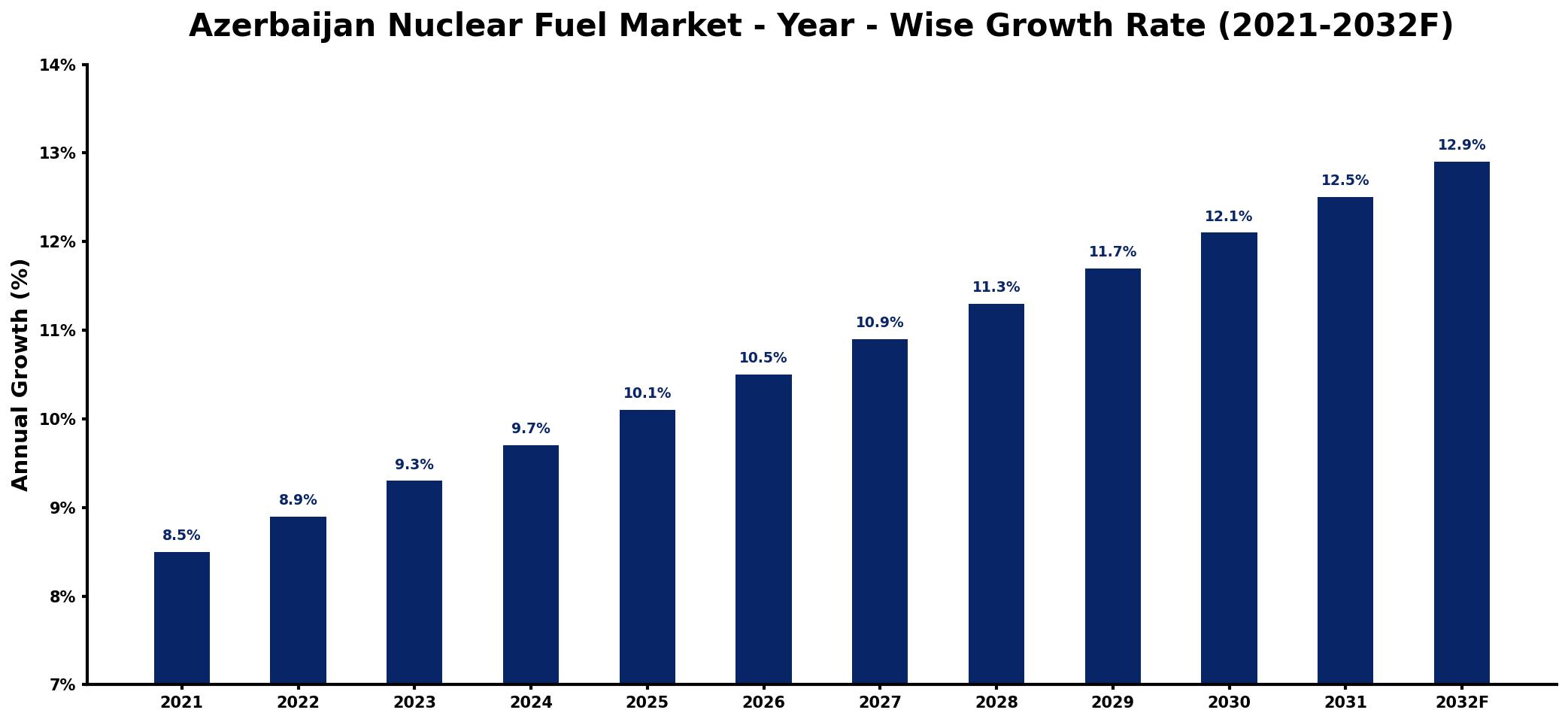
The table below presents the year‑wise growth rates along with the key drivers influencing the market
| Year | Growth Rate | Major Drivers |
| 2021 | 8.5% | Rising energy demand in industry |
| 2022 | 8.9% | Increased investments in infrastructure |
| 2023 | 9.3% | Growing focus on energy security |
| 2024 | 9.7% | Expansion of renewable energy projects |
| 2025 | 10.1% | Technological advancements in generation |
| 2026 | 10.5% | Strengthened regulatory support initiatives |
| 2027 | 10.9% | Surge in international partnerships |
| 2028 | 11.3% | Diversification of energy sources strategy |
| 2029 | 11.7% | Enhanced public awareness campaigns |
| 2030 | 12.1% | Development of export opportunities |
| 2031 | 12.5% | Growth in research and development |
| 2032 | 12.9% | Emergence of innovative financing models |
Note: Market size estimations and growth projections presented in this report are based on 6Wresearch's proprietary forecasting methodology, utilizing the latest available industry data, government publications, and primary research inputs.
Azerbaijan Nuclear Fuel Market Synopsis
The most significant force shaping the Azerbaijan Nuclear Fuel Market is the government's proactive approach to expanding its nuclear energy capabilities. This strategic move is part of a broader agenda to achieve energy independence and sustainability. As global emphasis shifts toward cleaner energy sources, Azerbaijan is positioned to leverage its nuclear potential to meet increasing electricity demands.
Despite its limited existing capacity, Azerbaijan's nuclear sector presents ample opportunities for growth and modernization. The governments commitment to developing a domestic nuclear fuel production industry is expected to reduce import dependencies while fostering technological advancements in the sector.
Azerbaijan Nuclear Fuel Market Key Takeaways
- The Azerbaijan Nuclear Fuel Market is projected to grow significantly, with a forecasted CAGR of 9.1% from 2026 to 2032.
- Government initiatives aimed at expanding nuclear capabilities are pivotal in driving market growth.
- There is a notable shift toward advanced fuel technologies that enhance efficiency and safety.
- International collaborations are critical in shaping the future landscape of the market.
- Investment opportunities exist in uranium mining, processing, and infrastructure development.
Evaluation of Restraints in Azerbaijan Nuclear Fuel Market
While the Azerbaijan Nuclear Fuel Market exhibits promising potential, several restraints hinder its immediate expansion. The primary challenge remains the countrys heavy reliance on imported nuclear fuel, making it susceptible to global supply chain disruptions. These import dependencies not only pose risks of price volatility but also challenge the economic viability of nuclear projects. Furthermore, establishing a robust domestic production capability demands significant capital investment and expertise, which are currently limited within Azerbaijan's nascent nuclear infrastructure. Ensuring adherence to international safety and security standards adds another layer of complexity to the development process.
Azerbaijan Nuclear Fuel Market Trends
Key trends emerging within the Azerbaijan Nuclear Fuel Market include a growing focus on sustainability and carbon emission reduction. As global narratives shift towards green energy, nuclear power is increasingly regarded as a vital component of a balanced energy portfolio. The sector is witnessing a surge in interest towards advanced nuclear technologies, which promise higher efficiency rates and improved safety measures. Additionally, partnerships with international entities for knowledge exchange are helping to enhance local capacities and drive technological innovation, establishing a framework for long-term sustainability in the nuclear fuel market.
Azerbaijan Nuclear Fuel Market Opportunities
The Azerbaijan Nuclear Fuel Market harbors substantial opportunities for investment, particularly in uranium mining and fuel processing. With the ongoing development of the Baku Nuclear Power Plant, stakeholders can capitalize on the increasing domestic demand for nuclear fuel. Collaborations with local mining firms could enable investors to secure critical supplies, fostering a self-sufficient supply chain. Furthermore, the market presents avenues for developing storage and transportation solutions tailored for nuclear materials, which are essential for the growing sector. Overall, strategic investments in these areas could yield significant returns as Azerbaijan pivots toward cleaner energy solutions.
Government Initiatives in the Azerbaijan Nuclear Fuel Market
The Azerbaijani government plays a crucial role in regulating and promoting the nuclear fuel market. The State Agency on Alternative and Renewable Energy Sources oversees initiatives aimed at ensuring the safe use of nuclear energy while adhering to international standards. Additionally, Azerbaijans participation in various international treaties reflects its commitment to responsible nuclear practices and collaboration on nuclear safety and technology advancements. These policies create a supportive framework for the growth of the nuclear fuel sector and underscore the governments resolve to develop a sustainable energy future.
Future Insights of the Azerbaijan Nuclear Fuel Market
Looking ahead to 2026-2032, the Azerbaijan Nuclear Fuel Market is set to evolve significantly. With the governments proactive stance on energy diversification and nuclear development, a robust growth trajectory appears likely. Opportunities to enhance energy security are abundant, especially given Azerbaijans strategic geographical position. The concerted effort to attract foreign investment and technological expertise will be crucial in overcoming existing challenges and achieving the market's long-term sustainability goals. However, market participants must navigate potential regulatory hurdles and public sentiment surrounding nuclear energy as they chart their future paths.
Azerbaijan Nuclear Fuel Market Latest Developments (2025 - 2026)
Recent industry developments indicate a continued focus on expanding Azerbaijan's nuclear energy capabilities. The government has announced various initiatives aimed at enhancing domestic production capabilities and reducing import reliance. Additionally, ongoing collaborations with international partners have resulted in knowledge transfer agreements, positioning Azerbaijan favorably in the global nuclear landscape. As the construction of the Baku Nuclear Power Plant progresses, stakeholders are closely monitoring the potential impacts on the local nuclear fuel supply chain.
Azerbaijan Nuclear Fuel Market - Key Attractiveness of the Report
- 10 Years of Market Numbers
- Historical Data Starting from 2022 to 2025
- Base Year: 2025
- Forecast Data until 2032
- Key Performance Indicators Impacting the Market
- Major Upcoming Developments and Projects
Key Highlights of the Report:
- Azerbaijan Nuclear Fuel Market Outlook
- Market Size of Azerbaijan Nuclear Fuel Market, 2025
- Forecast of Azerbaijan Nuclear Fuel Market, 2032
- Historical Data and Forecast of Azerbaijan Nuclear Fuel Revenues & Volume for the Period 2022-2032F
- Azerbaijan Nuclear Fuel Market Trend Evolution
- Azerbaijan Nuclear Fuel Market Drivers and Challenges
- Azerbaijan Nuclear Fuel Price Trends
- Azerbaijan Nuclear Fuel Porter's Five Forces
- Azerbaijan Nuclear Fuel Industry Life Cycle
- Historical Data and Forecast of Azerbaijan Nuclear Fuel Market Revenues & Volume By Fuel Type for the Period 2022-2032F
- Historical Data and Forecast of Azerbaijan Nuclear Fuel Market Revenues & Volume By Uranium Fuel for the Period 2022-2032F
- Historical Data and Forecast of Azerbaijan Nuclear Fuel Market Revenues & Volume By Mixed Oxidenuclear Fuel for the Period 2022-2032F
- Historical Data and Forecast of Azerbaijan Nuclear Fuel Market Revenues & Volume By Reactor Type for the Period 2022-2032F
- Historical Data and Forecast of Azerbaijan Nuclear Fuel Market Revenues & Volume By Boiling Water Reactor for the Period 2022-2032F
- Historical Data and Forecast of Azerbaijan Nuclear Fuel Market Revenues & Volume By Pressurized Water Reactor for the Period 2022-2032F
- Azerbaijan Nuclear Fuel Import Export Trade Statistics
- Market Opportunity Assessment By Fuel Type
- Market Opportunity Assessment By Reactor Type
- Azerbaijan Nuclear Fuel Top Companies Market Share
- Azerbaijan Nuclear Fuel Competitive Benchmarking By Technical and Operational Parameters
- Azerbaijan Nuclear Fuel Company Profiles
- Azerbaijan Nuclear Fuel Key Strategic Recommendations






































