Global Nuclear Fuel Market Highlights
| Market Size (2025) | USD 7000 Billion |
| Forecast Size (2032) | USD 11600 Billion |
| CAGR | 7.20% |
| Base Year | 2025 |
| Forecast Period | 2026-2032 |
| Largest Region | Asia-Pacific |
| Fastest Growing Region | Europe |
| Largest Segment | Uranium Fuel |
| Fastest Growing Segment | Mixed Oxide Fuel |
| Leading Companies | Framatome, Westinghouse Electric Company, Rosatom, AREVA, Toshiba |
Global Nuclear Fuel Market Size & Growth Rate (2026-2032)
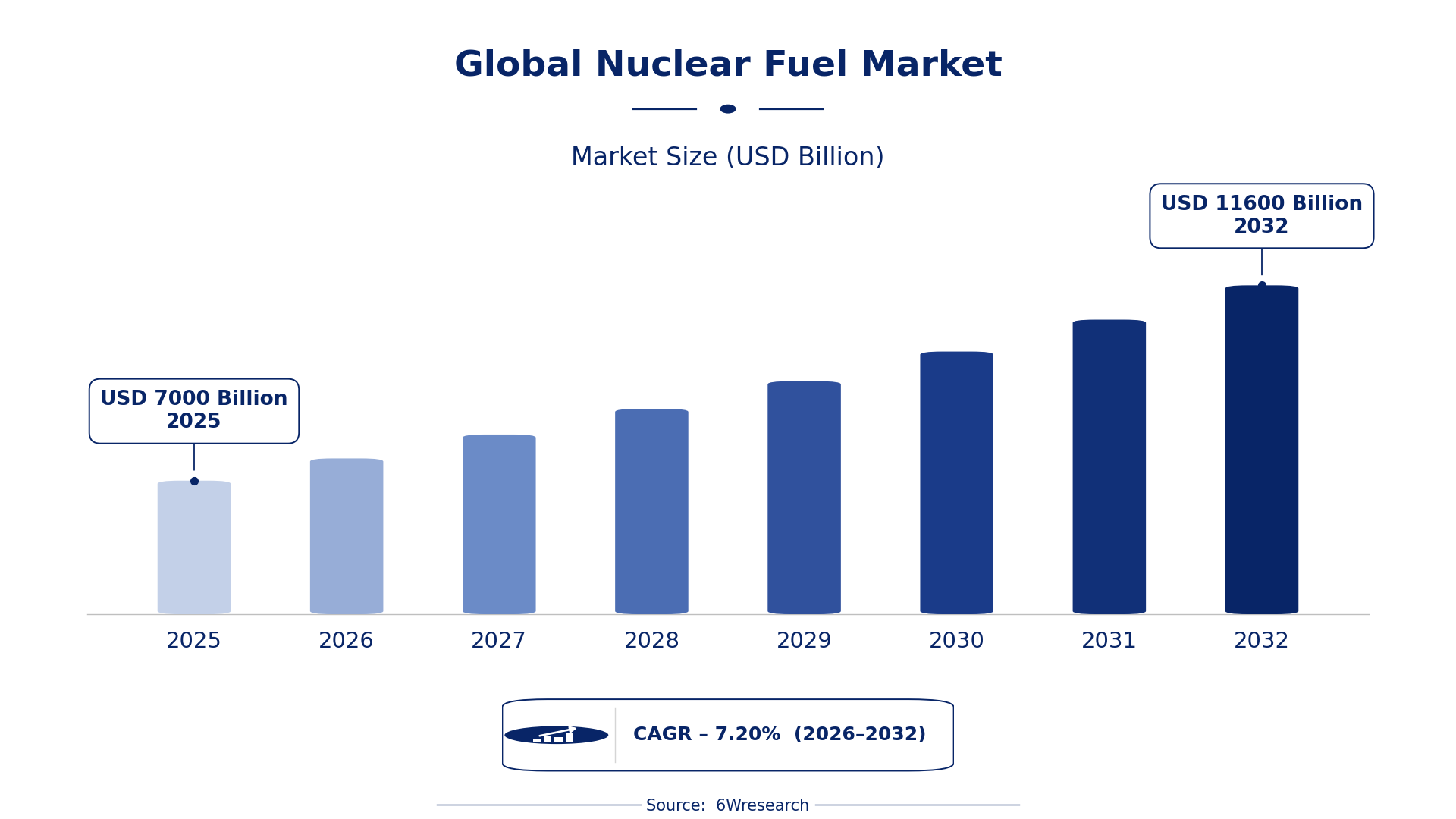
The Global Nuclear Fuel Market was estimated at USD 7000 Billion in 2025 and is projected to reach USD 11600 Billion by 2032, growing at a CAGR of 7.20% from 2026 to 2032.
Global Nuclear Fuel Market Synopsis
The Global Nuclear Fuel Market is currently undergoing significant structural changes, driven by renewed interests in clean energy production and advancements in nuclear technology. Emerging economies are ramping up investments in nuclear infrastructure, recognizing it as a viable alternative to fossil fuels for reducing carbon emissions. Specifically, nations like India and China are expanding their nuclear capabilities, fundamentally reshaping energy strategies.
Moreover, the shift toward more efficient fuel types, such as mixed oxide fuel, highlights the industry's focus on safety and performance. The integration of accident-tolerant fuels aligns with global standards for energy security, which is particularly salient as countries navigate public perception challenges surrounding nuclear energy. This market distinguishes itself from adjacent segments by not just providing power but also enhancing energy resilience.
Global Nuclear Fuel Market Year-wise Growth Rate and Key Drivers
This graph illustrates the annual growth rates of the Global Nuclear Fuel Market from 2022 to 2032, highlighting a steady upward trajectory and projected expansion over the forecast period.
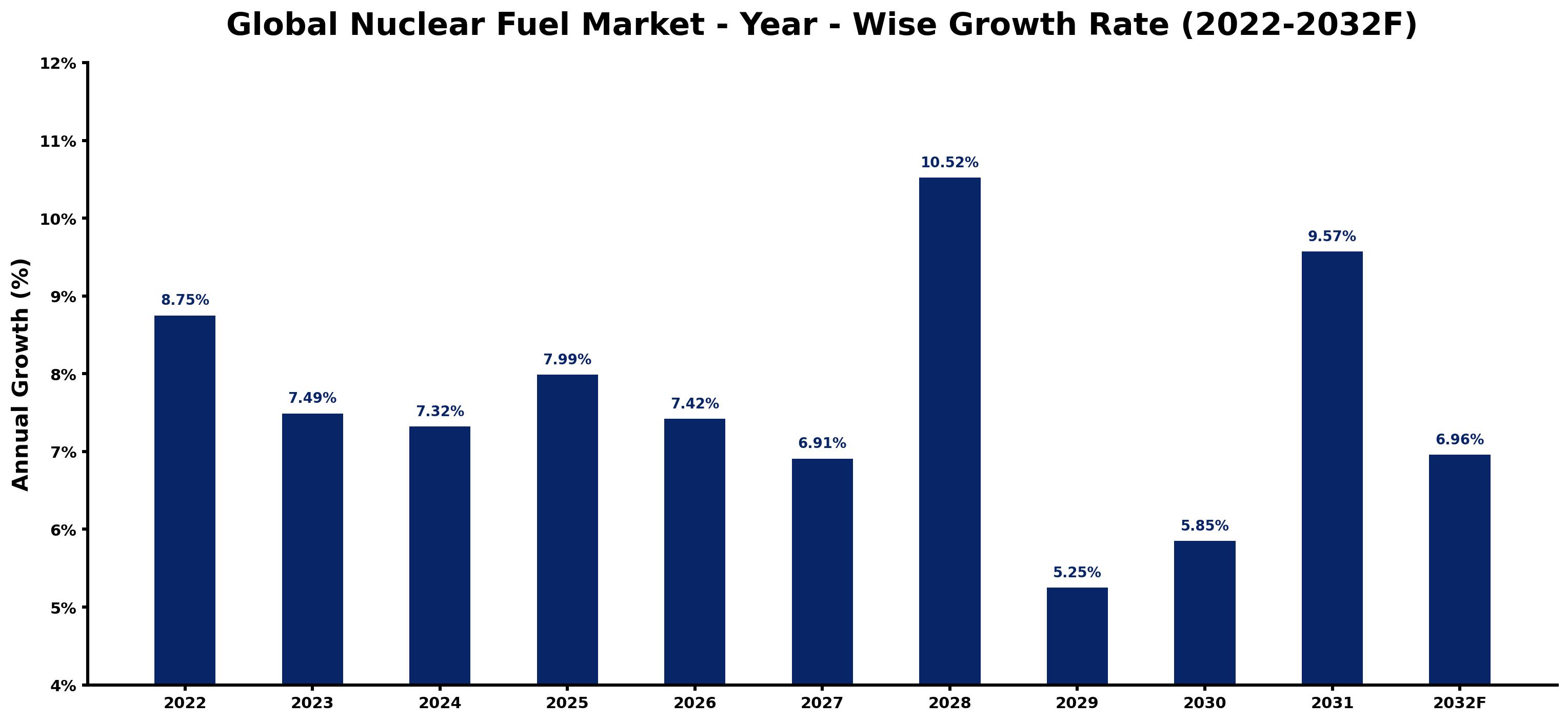
The table below presents the year‑wise growth rates along with the key drivers influencing the market
| Year | Growth Rate (%) | Major Drivers |
| 2022 | 8.75 | Advanced nuclear technologies enhance efficiency, paving the way for market recovery. |
| 2023 | 7.49 | Consumer preferences shift towards cleaner energy sources, driving nuclear fuel adoption. |
| 2024 | 7.32 | Utilities prioritize nuclear fuel to balance grid modernization and renewable energy needs. |
| 2025 | 7.99 | Investors see potential in nuclear fuel projects, leading to increased capital allocation. |
| 2026 | 7.42 | Emerging markets in Asia expand nuclear fuel usage to meet growing energy demands. |
| 2027 | 6.91 | Intense competition among energy providers reshapes nuclear fuel procurement strategies. |
| 2028 | 10.52 | Nuclear supply chains evolve with infrastructure improvements enhancing fuel delivery efficiency. |
| 2029 | 5.25 | As decarbonization mandates strengthen, nuclear fuel becomes vital in reducing emissions. |
| 2030 | 5.85 | Implementing stricter regulations on emissions prompts a shift to nuclear fuel solutions. |
| 2031 | 9.57 | A growing emphasis on skilled labor enhances operations in the nuclear fuel sector. |
| 2032 | 6.96 | Fluctuating uranium prices impact the cost dynamics of global nuclear fuel production. |
Note - Market size estimations and growth projections presented in this report are based on 6Wresearch's proprietary research methodology, combining internal industry data, secondary research, and primary validation, updated periodically to reflect current market conditions. As markets evolve rapidly, figures for certain industries may vary slightly and are intended as informed estimates rather than absolute figures. For the most current market sizing, we recommend validating figures with a 6Wresearch analyst.
Global Nuclear Fuel Market Key Takeaways
Below are some of the specific key takeaways from the market, including:
- China is expected to construct over 20 new nuclear reactors by 2030, significantly impacting fuel demand.
- Over 42% of the market share in 2025 is projected to be dominated by uranium fuel, which remains the primary choice for existing nuclear plants.
- Mixed oxide fuel is projected to grow at a CAGR of 8.5% from 2026 to 2032 due to its application in advanced reactors.
- In 2021, companies like Framatome announced substantial partnerships aimed at developing next-generation nuclear fuel technologies.
- The European Union aims to increase nuclear energy's contribution to its total energy mix from 26% to 30% by 2030.
Evaluation of Restraints in Global Nuclear Fuel Market
The Global Nuclear Fuel Market faces several constraints, notably high entry and operational costs, which can exceed $6 Billion for constructing a nuclear power plant. These significant upfront investments create apprehension among investors, particularly in regions with fluctuating regulatory landscapes. For example, the stringent safety regulations imposed by the U.S. Nuclear Regulatory Commission (NRC) have led to delays and increased costs, affecting both existing and new projects significantly.
Global Nuclear Fuel Market Trends
A notable trend in the Global Nuclear Fuel Market involves technological shifts toward advanced reactor designs that improve safety and efficiency. Small Modular Reactors (SMRs), for instance, are gaining traction due to their scalability and lower investment thresholds. Companies such as Westinghouse Electric Company are actively involved in developing SMR technologies that promise quicker deployment timelines, shown by their recent contracts aimed at deploying multiple units by 2025. Furthermore, the focus on accident-tolerant fuels, exemplified by GE Hitachi's development of new fuel types that can withstand extreme conditions, is reshaping operational safety standards in the industry.
Global Nuclear Fuel Market Opportunities
Future revenue opportunities in the Global Nuclear Fuel Market are primarily tied to expanding nuclear infrastructure in emerging economies. For instance, India’s ambitious plans to add 12 GWe of nuclear capacity by 2030 present lucrative prospects for fuel suppliers. Additionally, the adaptation of nuclear power in hybrid energy systems, where it complements renewable sources, opens avenues for innovative fuel solutions. A recent project by the World Nuclear Association anticipates that such integrations could result in an increased demand for specialized fuels, including mixed oxide types, projected at 5% growth annually through 2032.
Global Nuclear Fuel Market by Fuel Type
Uranium Fuel remains the largest segment of the Global Nuclear Fuel Market, commanding a share of approximately 42% in 2025. Its extensive use in current reactors is supported by established supply chains and mining operations. Conversely, Mixed Oxide Fuel is identified as the fastest-growing segment, with a projected CAGR of 8.5% from 2026 to 2032. This growth is attributed to its application in advanced reactor technologies aiming for enhanced safety and sustainability, making it increasingly attractive to power companies looking to modernize their fleets.
Global Nuclear Fuel Market by Reactor Type
Pressurized Water Reactors (PWRs) dominate the Global Nuclear Fuel Market, accounting for roughly 56% of the market share as of 2025 due to their widespread use in both the United States and Europe. However, Boiling Water Reactors (BWRs) are seeing an accelerated growth rate, expected to achieve a CAGR of 8.2% from 2026 to 2032. This increase is fueled by advancements in reactor design that emphasize efficiency and operational flexibility, making BWRs a compelling option for certain geographical regions.
Global Nuclear Fuel Market by Region
Asia-Pacific is the largest region in the Global Nuclear Fuel Market, holding approximately 48% of the share in 2025, significantly influenced by China and India’s robust nuclear initiatives. Conversely, Europe is anticipated to be the fastest-growing region with a projected CAGR of 8.0% from 2026 to 2032. The EU's commitment to enhancing its energy mix with nuclear power as a low-carbon option positions it favorably, while ongoing technological advancements further contribute to its growth trajectory.
Government Initiatives in the Global Nuclear Fuel Market
The regulatory landscape shaping the Global Nuclear Fuel Market is increasingly characterized by supportive government initiatives aimed at promoting nuclear energy as a sustainable alternative. Several nations are enacting policies that both sustain existing nuclear power plants and pave the way for new reactors, thereby ensuring a steady supply of nuclear fuel.
- U.S. Department of Energy, Advanced Reactor Demonstration Program, launched in 2020, allocates $160 million to expedite the commercialization of next-generation nuclear technologies.
- European Commission, EU Nuclear Safety Directive, revised in 2021 to enhance safety protocols for existing plants and support new reactor development.
- Indian Atomic Energy Regulatory Board, National Policy on Nuclear Power, introduced in 2021, encourages private investment to expand capacity by 2030.
- China National Energy Administration, 14th Five-Year Plan for Energy Development (2021-2025), promotes the construction of 6 new reactors, aiming to address increasing energy needs sustainably.
Future Insights of the Global Nuclear Fuel Market
As investment in nuclear energy infrastructure escalates, especially in emerging markets, the Global Nuclear Fuel Market is expected to witness significant transformation by 2032. Notably, projects, such as India's strategy to add 12 GWe of nuclear capacity by 2030, catalyze a shift in fuel requirements. Companies are exploring advanced reactor designs and hybrid energy systems that integrate renewable resources, emphasizing the necessity for innovative fuel solutions that align with both safety and efficiency metrics.
Global Nuclear Fuel Market Latest Developments
Recent advancements in the Global Nuclear Fuel Market signal the industry's dynamic nature, with companies aligning their strategies to better address both market demands and technological innovations. Key developments include:
- Framatome recently completed the development of new accident-tolerant fuel technology, enhancing operational safety for existing reactors.
- In late 2022, Westinghouse Electric Company announced its ongoing collaboration with various international regulatory bodies to streamline safety protocol updates across nuclear facilities.
- As of early 2023, Rosatom commenced construction on advanced reactors in Eastern Europe, positioning itself strategically to cater to rising regional energy demands.
- AREVA is currently working on a project that aims to commercialize mixed oxide fuel technology by 2025, representing a significant leap in fuel efficiency.
Global Nuclear Fuel Market Key Players and Industry Positioning
The Global Nuclear Fuel Market is characterized by a consolidated structure, dominated by a handful of key players that leverage unique technological competencies and market positioning to maintain competitiveness. The growing emphasis on safety and innovative fuel types necessitates a continuous adaptation of strategies to respond to both regulatory changes and evolving consumer preferences.
| Leading Company | Core Strength | Strategic Focus |
|---|---|---|
| Framatome | Expert in accident-tolerant fuel technologies | Enhancing operational safety and reactor performance |
| Westinghouse Electric Company | Leader in Small Modular Reactor (SMR) development | Expanding modular technology to reduce costs |
| Rosatom | Strong presence in Eastern Europe and Asia | Pioneering advanced reactor projects |
| AREVA | Expertise in mixed oxide fuel production | Investing in next-gen fuel technologies |
| Toshiba | Diversified technology portfolio | Integrating renewable energy solutions with nuclear |
As these key players evolve, they actively shape the market's trajectory, influencing the adoption of innovative technologies and strategic partnerships to fulfill the growing energy demands.
Key Attractiveness of the Report
- 10 Years of Market Numbers
- Historical Data Starting from 2022 to 2025
- Base Year: 2025
- Forecast Data until 2032
- Key Performance Indicators Impacting the Market
- Major Upcoming Developments and Projects
Key Highlights of the Report:
- Global Nuclear Fuel Market Outlook
- Market Size of Global Nuclear Fuel Market, 2025
- Forecast of Global Nuclear Fuel Market, 2032
- Historical Data and Forecast of Global Nuclear Fuel Revenues & Volume for the Period 2022-2032
- Global Nuclear Fuel Market Trend Evolution
- Global Nuclear Fuel Market Drivers and Challenges
- Global Nuclear Fuel Price Trends
- Global Nuclear Fuel Porter's Five Forces
- Global Nuclear Fuel Industry Life Cycle
- Historical Data and Forecast of Global Nuclear Fuel Market Revenues & Volume
- Historical Data and Forecast of Global Nuclear Fuel Market Revenues & Volume By Fuel Type for the Period 2022-2032
- Historical Data and Forecast of Global Nuclear Fuel Market Revenues & Volume By Uranium Fuel for the Period 2022-2032
- Historical Data and Forecast of Global Nuclear Fuel Market Revenues & Volume By Mixed Oxidenuclear Fuel for the Period 2022-2032
- Historical Data and Forecast of Global Nuclear Fuel Market Revenues & Volume By Reactor Type for the Period 2022-2032
- Historical Data and Forecast of Global Nuclear Fuel Market Revenues & Volume By Boiling Water Reactor for the Period 2022-2032
- Historical Data and Forecast of Global Nuclear Fuel Market Revenues & Volume By Pressurized Water Reactor for the Period 2022-2032
- Historical Data and Forecast of North America Nuclear Fuel Market Revenues & Volume By Fuel Type for the Period 2022-2032
- Historical Data and Forecast of North America Nuclear Fuel Market Revenues & Volume By Uranium Fuel for the Period 2022-2032
- Historical Data and Forecast of North America Nuclear Fuel Market Revenues & Volume By Mixed Oxidenuclear Fuel for the Period 2022-2032
- Historical Data and Forecast of North America Nuclear Fuel Market Revenues & Volume By Reactor Type for the Period 2022-2032
- Historical Data and Forecast of North America Nuclear Fuel Market Revenues & Volume By Boiling Water Reactor for the Period 2022-2032
- Historical Data and Forecast of North America Nuclear Fuel Market Revenues & Volume By Pressurized Water Reactor for the Period 2022-2032
- Historical Data and Forecast of United States of America Nuclear Fuel Market Revenues & Volume for the Period 2022-2032
- Historical Data and Forecast of Canada Nuclear Fuel Market Revenues & Volume for the Period 2022-2032
- Historical Data and Forecast of Rest of North America Nuclear Fuel Market Revenues & Volume for the Period 2022-2032
- Historical Data and Forecast of Latin America (LATAM) Nuclear Fuel Market Revenues & Volume By Fuel Type for the Period 2022-2032
- Historical Data and Forecast of Latin America (LATAM) Nuclear Fuel Market Revenues & Volume By Uranium Fuel for the Period 2022-2032
- Historical Data and Forecast of Latin America (LATAM) Nuclear Fuel Market Revenues & Volume By Mixed Oxidenuclear Fuel for the Period 2022-2032
- Historical Data and Forecast of Latin America (LATAM) Nuclear Fuel Market Revenues & Volume By Reactor Type for the Period 2022-2032
- Historical Data and Forecast of Latin America (LATAM) Nuclear Fuel Market Revenues & Volume By Boiling Water Reactor for the Period 2022-2032
- Historical Data and Forecast of Latin America (LATAM) Nuclear Fuel Market Revenues & Volume By Pressurized Water Reactor for the Period 2022-2032
- Historical Data and Forecast of Brazil Nuclear Fuel Market Revenues & Volume for the Period 2022-2032
- Historical Data and Forecast of Mexico Nuclear Fuel Market Revenues & Volume for the Period 2022-2032
- Historical Data and Forecast of Argentina Nuclear Fuel Market Revenues & Volume for the Period 2022-2032
- Historical Data and Forecast of Rest of LATAM Nuclear Fuel Market Revenues & Volume for the Period 2022-2032
- Historical Data and Forecast of Asia Nuclear Fuel Market Revenues & Volume By Fuel Type for the Period 2022-2032
- Historical Data and Forecast of Asia Nuclear Fuel Market Revenues & Volume By Uranium Fuel for the Period 2022-2032
- Historical Data and Forecast of Asia Nuclear Fuel Market Revenues & Volume By Mixed Oxidenuclear Fuel for the Period 2022-2032
- Historical Data and Forecast of Asia Nuclear Fuel Market Revenues & Volume By Reactor Type for the Period 2022-2032
- Historical Data and Forecast of Asia Nuclear Fuel Market Revenues & Volume By Boiling Water Reactor for the Period 2022-2032
- Historical Data and Forecast of Asia Nuclear Fuel Market Revenues & Volume By Pressurized Water Reactor for the Period 2022-2032
- Historical Data and Forecast of China Nuclear Fuel Market Revenues & Volume for the Period 2022-2032
- Historical Data and Forecast of India Nuclear Fuel Market Revenues & Volume for the Period 2022-2032
- Historical Data and Forecast of Japan Nuclear Fuel Market Revenues & Volume for the Period 2022-2032
- Historical Data and Forecast of Rest of Asia Nuclear Fuel Market Revenues & Volume for the Period 2022-2032
- Historical Data and Forecast of Africa Nuclear Fuel Market Revenues & Volume By Fuel Type for the Period 2022-2032
- Historical Data and Forecast of Africa Nuclear Fuel Market Revenues & Volume By Uranium Fuel for the Period 2022-2032
- Historical Data and Forecast of Africa Nuclear Fuel Market Revenues & Volume By Mixed Oxidenuclear Fuel for the Period 2022-2032
- Historical Data and Forecast of Africa Nuclear Fuel Market Revenues & Volume By Reactor Type for the Period 2022-2032
- Historical Data and Forecast of Africa Nuclear Fuel Market Revenues & Volume By Boiling Water Reactor for the Period 2022-2032
- Historical Data and Forecast of Africa Nuclear Fuel Market Revenues & Volume By Pressurized Water Reactor for the Period 2022-2032
- Historical Data and Forecast of South Africa Nuclear Fuel Market Revenues & Volume for the Period 2022-2032
- Historical Data and Forecast of Nigeria Nuclear Fuel Market Revenues & Volume for the Period 2022-2032
- Historical Data and Forecast of Egypt Nuclear Fuel Market Revenues & Volume for the Period 2022-2032
- Historical Data and Forecast of Rest of Africa Nuclear Fuel Market Revenues & Volume for the Period 2022-2032
- Historical Data and Forecast of Europe Nuclear Fuel Market Revenues & Volume By Fuel Type for the Period 2022-2032
- Historical Data and Forecast of Europe Nuclear Fuel Market Revenues & Volume By Uranium Fuel for the Period 2022-2032
- Historical Data and Forecast of Europe Nuclear Fuel Market Revenues & Volume By Mixed Oxidenuclear Fuel for the Period 2022-2032
- Historical Data and Forecast of Europe Nuclear Fuel Market Revenues & Volume By Reactor Type for the Period 2022-2032
- Historical Data and Forecast of Europe Nuclear Fuel Market Revenues & Volume By Boiling Water Reactor for the Period 2022-2032
- Historical Data and Forecast of Europe Nuclear Fuel Market Revenues & Volume By Pressurized Water Reactor for the Period 2022-2032
- Historical Data and Forecast of United Kingdom Nuclear Fuel Market Revenues & Volume for the Period 2022-2032
- Historical Data and Forecast of France Nuclear Fuel Market Revenues & Volume for the Period 2022-2032
- Historical Data and Forecast of Germany Nuclear Fuel Market Revenues & Volume for the Period 2022-2032
- Historical Data and Forecast of Rest of Europe Nuclear Fuel Market Revenues & Volume for the Period 2022-2032
- Historical Data and Forecast of Middle East Nuclear Fuel Market Revenues & Volume By Fuel Type for the Period 2022-2032
- Historical Data and Forecast of Middle East Nuclear Fuel Market Revenues & Volume By Uranium Fuel for the Period 2022-2032
- Historical Data and Forecast of Middle East Nuclear Fuel Market Revenues & Volume By Mixed Oxidenuclear Fuel for the Period 2022-2032
- Historical Data and Forecast of Middle East Nuclear Fuel Market Revenues & Volume By Reactor Type for the Period 2022-2032
- Historical Data and Forecast of Middle East Nuclear Fuel Market Revenues & Volume By Boiling Water Reactor for the Period 2022-2032
- Historical Data and Forecast of Middle East Nuclear Fuel Market Revenues & Volume By Pressurized Water Reactor for the Period 2022-2032
- Historical Data and Forecast of Saudi Arabia Nuclear Fuel Market Revenues & Volume for the Period 2022-2032
- Historical Data and Forecast of UAE Nuclear Fuel Market Revenues & Volume for the Period 2022-2032
- Historical Data and Forecast of Turkey Nuclear Fuel Market Revenues & Volume for the Period 2022-2032
- Historical Data and Forecast of Rest of Middle East Nuclear Fuel Market Revenues & Volume for the Period 2022-2032
- Global Nuclear Fuel Market - Key Performance Indicators
- Global Nuclear Fuel Market - Import Export Trade Statistics
- Global Nuclear Fuel Market - Opportunity Assessment By Countries
- Global Nuclear Fuel Market - Opportunity Assessment By Fuel Type
- Global Nuclear Fuel Market - Opportunity Assessment By Reactor Type
- Global Nuclear Fuel Market - Top Companies Market Share
- Global Nuclear Fuel Market - Top Companies Profiles
- Global Nuclear Fuel Market - Comparison of Players in Technical and Operating Parameters
- Global Nuclear Fuel Market - Strategic Recommendations
Markets Covered
The Global Nuclear Fuel Market report provides a detailed analysis of the following market segments:
By Regions and Countries:
- North America
- Europe
- LATAM
- Middle East
- Asia
- Africa
By Fuel Type:
- Uranium Fuel
- Mixed Oxidenuclear Fuel
By Reactor Type:
- Boiling Water Reactor
- Pressurized Water Reactor






































