Brazil Nuclear Fuel Market Size, Share & Growth Rate
The Brazil Nuclear Fuel Market was estimated at USD 123 Million in 2025 and is projected to reach USD 146 Million by 2032, growing at a CAGR of 2.5% from 2026 to 2032. This growth trajectory is significantly driven by Brazil's strategic focus on nuclear energy as a clean alternative to traditional fossil fuels. The ongoing governmental support, along with advancements in nuclear technology and a growing public awareness of the benefits of nuclear power, plays a vital role in fostering this market's expansion.
Brazil Nuclear Fuel Market Year-wise Growth Rate and Key Drivers
This graph highlights how the Brazil Nuclear Fuel Market has steadily grown over the years, supported by major growth factors.
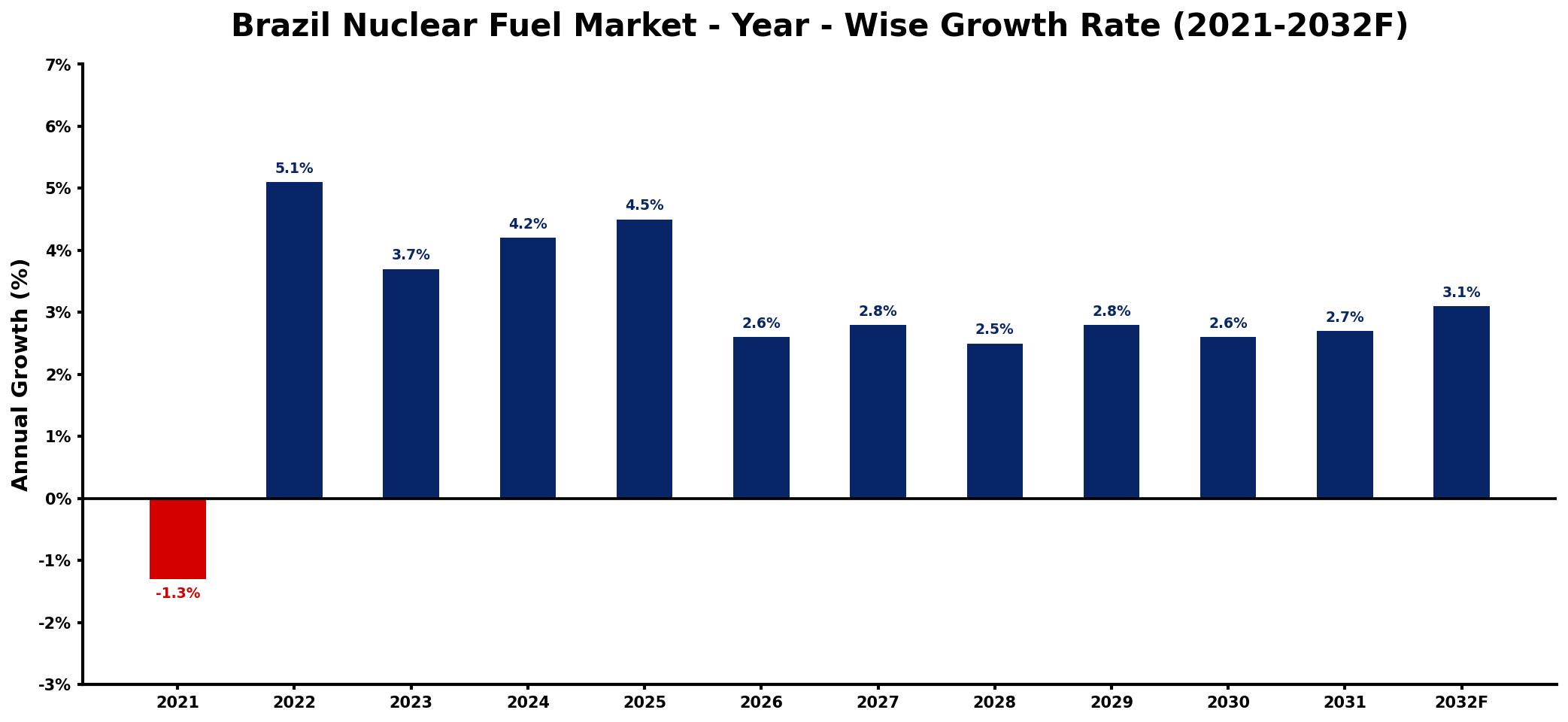
The table below presents the year‑wise growth rates along with the key drivers influencing the market
| Year | Growth Rate | Major Drivers |
| 2021 | -1.3% | decreased investments in energy sector |
| 2022 | 5.1% | increased energy demand from industries |
| 2023 | 3.7% | expansion of renewable energy initiatives |
| 2024 | 4.2% | growth in energy infrastructure projects |
| 2025 | 4.5% | rising international energy cooperation |
| 2026 | 2.6% | enhanced technological advancements adoption |
| 2027 | 2.8% | growing interest in sustainable practices |
| 2028 | 2.5% | increased governmental energy policies support |
| 2029 | 2.8% | growing commercial sector adoption |
| 2030 | 2.6% | rising consumer awareness on sustainability |
| 2031 | 2.7% | enhanced partnerships in energy sectors |
| 2032 | 3.1% | increased capital investment inflows |
Note: Market size estimations and growth projections presented in this report are based on 6Wresearch's proprietary forecasting methodology, utilizing the latest available industry data, government publications, and primary research inputs.
Brazil Nuclear Fuel Market Synopsis
The Brazilian landscape for nuclear fuel is evolving, fueled by an urgent need for energy diversification. Currently, the country is investing in nuclear power as a sustainable energy source to combat climate change and meet rising energy demands.
Despite facing challenges such as regulatory scrutiny and public skepticism, Brazil remains committed to its nuclear energy goals. This commitment is reflected in the country's efforts to develop a comprehensive regulatory framework that assures safety and promotes innovation in nuclear fuel management.
Brazil Nuclear Fuel Market Key Takeaways
- The market is expected to grow steadily, reflecting Brazil's commitment to a diversified energy mix.
- Government initiatives and advancements in technology are crucial drivers of market growth.
- There is a significant push towards cleaner energy sources to mitigate climate change impacts.
- Public perception and regulatory compliance remain key factors influencing the nuclear fuel sector.
- Investment in advanced technologies for nuclear waste management is essential for future sustainability.
Evaluation of Restraints in Brazil Nuclear Fuel Market
While the Brazil Nuclear Fuel Market presents numerous opportunities, it is not without its restraints. Regulatory scrutiny can complicate the development and operation of nuclear facilities, with stringent safety standards often leading to higher costs. Additionally, public perception regarding nuclear safety significantly influences market dynamics. Overcoming these hurdles necessitates enhanced transparency from the government and market participants, along with sustained efforts in educating the public about the safety and benefits of nuclear energy.
Brazil Nuclear Fuel Market Trends
Emerging trends in the Brazil Nuclear Fuel Market indicate a growing reliance on technological innovations to enhance safety and efficiency. The development of advanced reactor designs, such as small modular reactors (SMRs), is gaining traction as they promise to reduce risks associated with nuclear power generation. Furthermore, there is a noticeable trend toward increased collaboration between public and private sectors to foster research and development in nuclear fuel technologies.
Brazil Nuclear Fuel Market Opportunities
The potential for growth and investment in the Brazil Nuclear Fuel Market lies primarily in the modernization of existing nuclear facilities and the construction of new ones. There's also an opportunity to invest in R&D for innovative nuclear fuel technologies that focus on sustainability. As Brazil aims to enhance its energy security and reduce its carbon footprint, the nuclear sector stands as a pivotal player in achieving these objectives.
Government Initiatives in the Brazil Nuclear Fuel Market
Government policies in Brazil are geared toward the long-term development of nuclear energy. Various initiatives focus on establishing robust safety regulations and fostering technological advancements. Furthermore, international agreements on nuclear proliferation guide the country's commitments, impacting the operational landscape for market participants. Continued public funding and strategic initiatives will likely bolster investments in this crucial sector.
Future Insights of the Brazil Nuclear Fuel Market
Looking forward to the period of 2026-2032, the Brazil Nuclear Fuel Market is poised for gradual growth, driven by a clear commitment to sustainable energy solutions. The government's proactive stance in promoting nuclear energy, paired with public support for clean energy initiatives, is expected to solidify the nuclear sector's role in the national energy strategy. As Brazil seeks to balance economic development with environmental responsibility, investments in nuclear fuel are anticipated to play a critical role in meeting the country's energy needs.
Brazil Nuclear Fuel Market Latest Developments (2025 - 2026)
Recent developments within the Brazil Nuclear Fuel Market reflect a robust trajectory towards modernization and public engagement. Initiatives aimed at enhancing nuclear safety protocols are gaining momentum, with increased transparency in regulatory processes. Moreover, there has been a noticeable uptick in collaborative efforts among research institutions and governmental agencies to innovate in waste management techniques and reactor safety, further strengthening Brazil's nuclear infrastructure.
Brazil Nuclear Fuel Market - Key Attractiveness of the Report
- 10 Years of Market Numbers
- Historical Data Starting from 2022 to 2025
- Base Year: 2025
- Forecast Data until 2032
- Key Performance Indicators Impacting the Market
- Major Upcoming Developments and Projects
Key Highlights of the Report:
- Brazil Nuclear Fuel Market Outlook
- Market Size of Brazil Nuclear Fuel Market, 2025
- Forecast of Brazil Nuclear Fuel Market, 2032
- Historical Data and Forecast of Brazil Nuclear Fuel Revenues & Volume for the Period 2022-2032F
- Brazil Nuclear Fuel Market Trend Evolution
- Brazil Nuclear Fuel Market Drivers and Challenges
- Brazil Nuclear Fuel Price Trends
- Brazil Nuclear Fuel Porter's Five Forces
- Brazil Nuclear Fuel Industry Life Cycle
- Historical Data and Forecast of Brazil Nuclear Fuel Market Revenues & Volume By Fuel Type for the Period 2022-2032F
- Historical Data and Forecast of Brazil Nuclear Fuel Market Revenues & Volume By Uranium Fuel for the Period 2022-2032F
- Historical Data and Forecast of Brazil Nuclear Fuel Market Revenues & Volume By Mixed Oxidenuclear Fuel for the Period 2022-2032F
- Historical Data and Forecast of Brazil Nuclear Fuel Market Revenues & Volume By Reactor Type for the Period 2022-2032F
- Historical Data and Forecast of Brazil Nuclear Fuel Market Revenues & Volume By Boiling Water Reactor for the Period 2022-2032F
- Historical Data and Forecast of Brazil Nuclear Fuel Market Revenues & Volume By Pressurized Water Reactor for the Period 2022-2032F
- Brazil Nuclear Fuel Import Export Trade Statistics
- Market Opportunity Assessment By Fuel Type
- Market Opportunity Assessment By Reactor Type
- Brazil Nuclear Fuel Top Companies Market Share
- Brazil Nuclear Fuel Competitive Benchmarking By Technical and Operational Parameters
- Brazil Nuclear Fuel Company Profiles
- Brazil Nuclear Fuel Key Strategic Recommendations






































