United States (US) Nuclear Fuel Market Size, Share & Growth Rate
The United States (US) Nuclear Fuel Market was estimated at USD 131 Million in 2025 and is projected to reach USD 154 Million by 2032, growing at a CAGR of 2.3% from 2026 to 2032. This growth trajectory is underpinned by the escalating demand for low-carbon energy sources and advancements in nuclear technology, as the country seeks to solidify its energy independence and bolster grid reliability. Furthermore, strategic government initiatives are reinforcing the role of nuclear power in achieving the United States' clean energy objectives.
United States (US) Nuclear Fuel Market Year-wise Growth Rate and Key Drivers
This graph highlights how the United States (US) Nuclear Fuel Market has steadily grown over the years, supported by major growth factors.
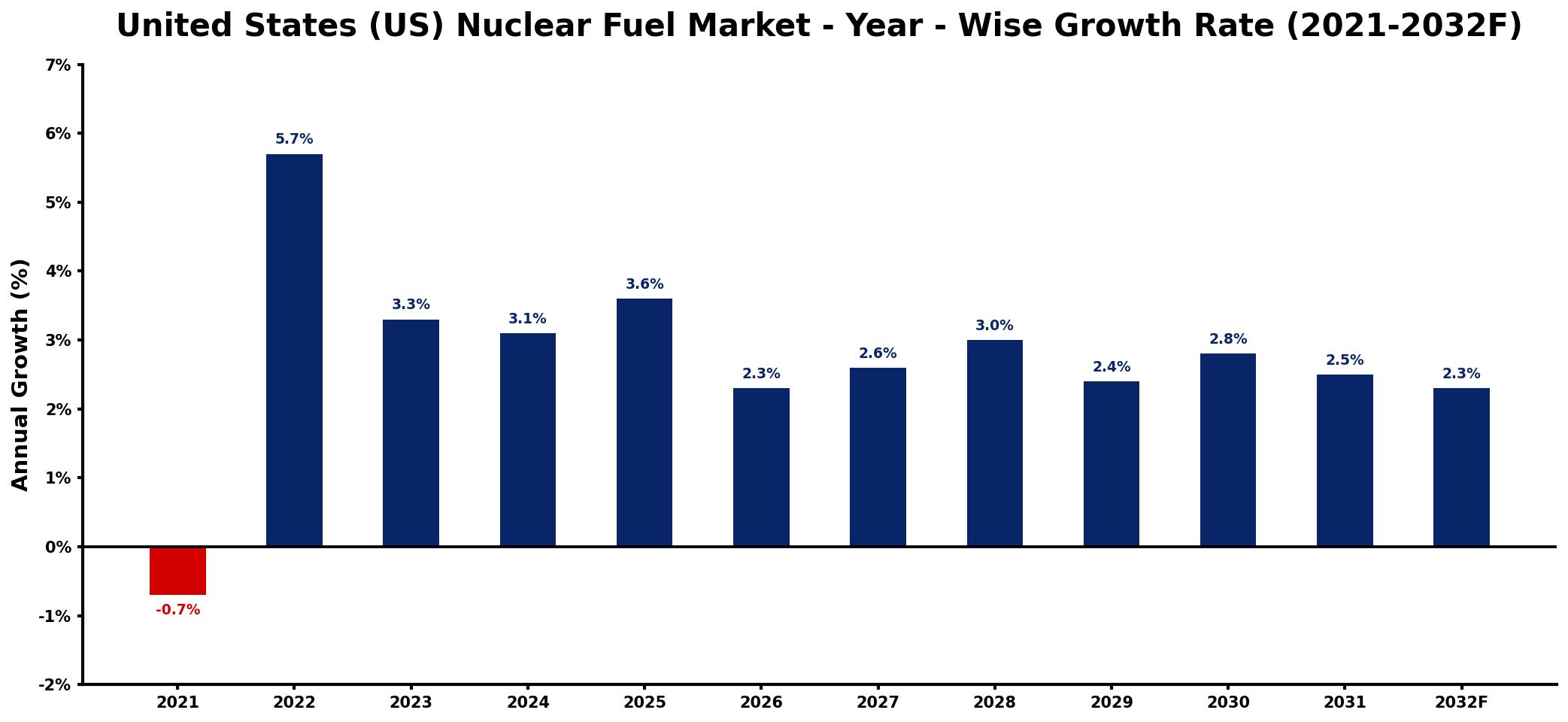
The table below presents the year‑wise growth rates along with the key drivers influencing the market
| Year | Growth Rate | Major Drivers |
| 2021 | -0.7% | decreased investment in energy projects |
| 2022 | 5.7% | increased demand for clean energy |
| 2023 | 3.3% | growing interest in alternative energy |
| 2024 | 3.1% | expansion of renewable energy initiatives |
| 2025 | 3.6% | rising government support for initiatives |
| 2026 | 2.3% | technological advancements enhancing efficiency |
| 2027 | 2.6% | greater focus on energy independence |
| 2028 | 3.0% | increased public awareness of sustainability |
| 2029 | 2.4% | development of advanced energy solutions |
| 2030 | 2.8% | expanding healthcare application demand |
| 2031 | 2.5% | growing collaboration among industries |
| 2032 | 2.3% | enhanced regulatory support for innovation |
Note: Market size estimations and growth projections presented in this report are based on 6Wresearch's proprietary forecasting methodology, utilizing the latest available industry data, government publications, and primary research inputs.
United States (US) Nuclear Fuel Market Synopsis
The nuclear fuel market is pivotal for the United States' energy generation, with a significant proportion of electricity derived from nuclear reactors. The market encompasses crucial processes, from uranium extraction to fuel fabrication, ensuring that power plants operate efficiently and sustainably.
Government regulations, global uranium prices, and innovative technologies play a substantial role in shaping market dynamics. As public and corporate entities increasingly emphasize environmental stewardship, the demand for nuclear energy as a stable, low-carbon source is more pronounced than ever.
United States (US) Nuclear Fuel Market Key Takeaways
- The US Nuclear Fuel Market is essential for maintaining energy reliability and sustainability.
- Advanced nuclear technologies, including small modular reactors (SMRs), are gaining traction.
- There is a significant focus on nuclear fuel recycling to enhance resource efficiency.
- Government policies are increasingly supporting domestic uranium production and innovation.
- Investment opportunities are emerging as demand for clean energy sources rises.
Evaluation of Restraints in United States (US) Nuclear Fuel Market
Despite its significance, the US Nuclear Fuel Market faces several constraints that can impede growth. Regulatory challenges often delay licensing for new nuclear facilities, while the high capital costs associated with building and maintaining these plants deter potential investments. Additionally, competition from rapidly advancing alternative energy sources such as natural gas and renewables creates an uncertain landscape. Public apprehension regarding nuclear safety and waste management further complicates the market environment, necessitating a balanced dialogue among stakeholders to address these concerns.
United States (US) Nuclear Fuel Market Trends
Current trends in the US Nuclear Fuel Market highlight a shift towards advanced nuclear technologies, such as small modular reactors (SMRs) and next-generation fuels that promise increased safety and efficiency. Additionally, a heightened interest in nuclear fuel recycling and reprocessing is gaining momentum as companies aim to minimize waste and maximize resource utilization. The ongoing evolution in cybersecurity practices reflects a growing recognition of the need for robust security measures within the nuclear fuel supply chain to address geopolitical risks and protect critical infrastructure.
United States (US) Nuclear Fuel Market Opportunities
Investment opportunities are abundant in the US Nuclear Fuel Market, particularly in uranium mining and fuel fabrication sectors. The surge in demand for nuclear energy as a clean power source opens doors for businesses engaged in the supply and fabrication of nuclear fuel. Additionally, as the government promotes domestic production to enhance energy security, investors can expect significant returns from well-positioned companies in the market. The potential for collaboration with technology innovators to explore advanced reactor designs further enhances growth prospects.
Government Initiatives in the United States (US) Nuclear Fuel Market
The US government has initiated various policies to fortify the nuclear fuel market. These initiatives include the Nuclear Energy Innovation Capabilities Act (NEICA), which accelerates the development of advanced reactors, and the Nuclear Energy Leadership Act (NELA), aimed at establishing a strategic uranium reserve. Furthermore, the Nuclear Fuel Working Group is focused on revitalizing domestic uranium mining and production. Through these policies, the government aims to enhance national security, promote technological advancements, and ensure a reliable domestic supply of nuclear fuel.
Future Insights of the United States (US) Nuclear Fuel Market
Looking ahead to 2026-2032, the US Nuclear Fuel Market is poised for moderate growth as the quest for clean energy intensifies. Factors such as governmental support for nuclear energy, combined with advancements in technology, are likely to drive demand. However, high operating costs and ongoing competition from alternative energy sources may challenge growth. Market consolidation can also be anticipated as companies strive for operational efficiencies. Overall, strategic investments and innovative solutions will be critical to sustaining the market's relevance in the evolving energy landscape.
United States (US) Nuclear Fuel Market Latest Developments (2025 - 2026)
Recent developments in the US Nuclear Fuel Market indicate a progressive shift toward greater efficiency and sustainability. Industry stakeholders are actively exploring partnerships aimed at enhancing the nuclear supply chain's security while integrating advanced technologies. Moreover, discussions surrounding the importance of nuclear power in achieving national energy goals have gained traction, reflecting a renewed focus on its role in the energy transition. As nuclear technologies evolve, opportunities for research and development collaborations continue to expand.
United States (US) Nuclear Fuel Market - Key Attractiveness of the Report
- 10 Years of Market Numbers
- Historical Data Starting from 2022 to 2025
- Base Year: 2025
- Forecast Data until 2032
- Key Performance Indicators Impacting the Market
- Major Upcoming Developments and Projects
Key Highlights of the Report:
- United States (US) Nuclear Fuel Market Outlook
- Market Size of United States (US) Nuclear Fuel Market, 2025
- Forecast of United States (US) Nuclear Fuel Market, 2032
- Historical Data and Forecast of United States (US) Nuclear Fuel Revenues & Volume for the Period 2022-2032F
- United States (US) Nuclear Fuel Market Trend Evolution
- United States (US) Nuclear Fuel Market Drivers and Challenges
- United States (US) Nuclear Fuel Price Trends
- United States (US) Nuclear Fuel Porter's Five Forces
- United States (US) Nuclear Fuel Industry Life Cycle
- Historical Data and Forecast of United States (US) Nuclear Fuel Market Revenues & Volume By Fuel Type for the Period 2022-2032F
- Historical Data and Forecast of United States (US) Nuclear Fuel Market Revenues & Volume By Uranium Fuel for the Period 2022-2032F
- Historical Data and Forecast of United States (US) Nuclear Fuel Market Revenues & Volume By Mixed Oxidenuclear Fuel for the Period 2022-2032F
- Historical Data and Forecast of United States (US) Nuclear Fuel Market Revenues & Volume By Reactor Type for the Period 2022-2032F
- Historical Data and Forecast of United States (US) Nuclear Fuel Market Revenues & Volume By Boiling Water Reactor for the Period 2022-2032F
- Historical Data and Forecast of United States (US) Nuclear Fuel Market Revenues & Volume By Pressurized Water Reactor for the Period 2022-2032F
- United States (US) Nuclear Fuel Import Export Trade Statistics
- Market Opportunity Assessment By Fuel Type
- Market Opportunity Assessment By Reactor Type
- United States (US) Nuclear Fuel Top Companies Market Share
- United States (US) Nuclear Fuel Competitive Benchmarking By Technical and Operational Parameters
- United States (US) Nuclear Fuel Company Profiles
- United States (US) Nuclear Fuel Key Strategic Recommendations






































