Azerbaijan Organic Cotton Market Size, Share & Growth Rate
The Azerbaijan Organic Cotton Market was estimated at USD 1093 Million in 2025 and is projected to reach USD 1863 Million by 2032, growing at a CAGR of 7.9% from 2026 to 2032. This impressive trajectory is fueled by a shift in consumer preferences towards sustainable textiles, reflecting a broader global movement. Furthermore, the Azerbaijani government's commitment to supporting organic farming, coupled with the countrys optimal agricultural conditions, positions the market well for future expansion.
Azerbaijan Organic Cotton Market Year-wise Growth Rate and Key Drivers
This graph highlights how the Azerbaijan Organic Cotton Market has steadily grown over the years, supported by major growth factors.
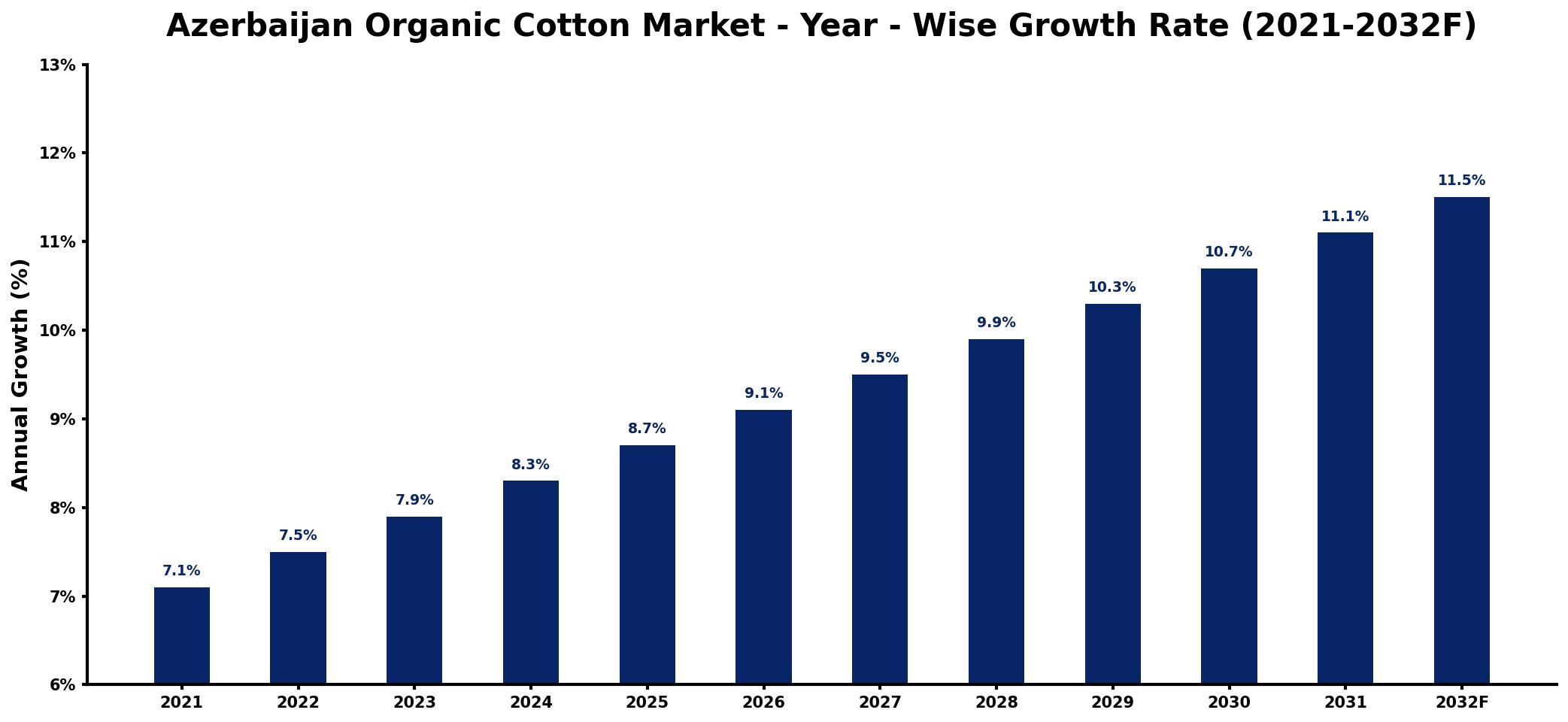
The table below presents the year‑wise growth rates along with the key drivers influencing the market
| Year | Growth Rate | Major Drivers |
| 2021 | 7.1% | rising consumer health consciousness |
| 2022 | 7.5% | increased investment in sustainability |
| 2023 | 7.9% | growing demand for eco-friendly textiles |
| 2024 | 8.3% | expansion of ethical fashion brands |
| 2025 | 8.7% | enhanced government support initiatives |
| 2026 | 9.1% | strengthened international trade partnerships |
| 2027 | 9.5% | higher consumer awareness campaigns |
| 2028 | 9.9% | development of innovative farming techniques |
| 2029 | 10.3% | growing popularity of natural fibers |
| 2030 | 10.7% | increased presence in retail markets |
| 2031 | 11.1% | stronger distribution network expansion |
| 2032 | 11.5% | rising interest in sustainable living |
Note: Market size estimations and growth projections presented in this report are based on 6Wresearch's proprietary forecasting methodology, utilizing the latest available industry data, government publications, and primary research inputs.
Azerbaijan Organic Cotton Market Synopsis
Recent momentum in the Azerbaijan Organic Cotton Market underscores a significant shift towards eco-conscious practices within the textile industry. As awareness surrounding the environmental impact of conventional cotton farming grows, Azerbaijan is poised to capitalize on its unique advantages in organic cotton production.
Looking ahead, the market is expected to experience a surge in both domestic and international demand, driven by strategic government initiatives and an increasing focus on sustainability. The organic cotton sector in Azerbaijan is not only gaining traction but is also establishing itself as a viable alternative in the global market.
Azerbaijan Organic Cotton Market Key Takeaways
- The market's growth is driven by increasing consumer preference for sustainable textiles.
- Government support through subsidies and training programs is fostering organic farming practices.
- Azerbaijans climate and soil conditions are highly conducive to organic cotton cultivation.
- Collaboration with international brands can enhance market access and growth potential.
- The focus on organic cotton aligns with global trends towards ethical and sustainable sourcing.
Evaluation of Restraints in Azerbaijan Organic Cotton Market
Despite promising growth, the Azerbaijan Organic Cotton Market faces notable restraints. Limited consumer awareness regarding the benefits of organic cotton presents a significant barrier, often resulting in lower demand relative to conventional options. Additionally, the absence of established certification bodies hampers efforts to validate organic practices and products, creating uncertainty for potential buyers. Farmers transitioning to organic methods may struggle with access to necessary resources and knowledge, further complicating the supply chain. Competitive pricing from conventional cotton also poses a challenge, requiring innovative strategies to differentiate organic offerings in the market.
Azerbaijan Organic Cotton Market Trends
Emerging trends in the Azerbaijan Organic Cotton Market reflect a growing consumer inclination towards sustainability and ethical sourcing. There is an observable shift in the textile industry as brands increasingly prioritize organic materials to meet the demands of environmentally conscious consumers. Additionally, investments in organic farming techniques and marketing strategies are gaining traction, aiming to build awareness and confidence in organic cotton products. As technology advances, methods to enhance production efficiency and sustainability are also becoming critical elements driving the market forward.
Azerbaijan Organic Cotton Market Opportunities
Investment opportunities in the Azerbaijan Organic Cotton Market are becoming increasingly appealing as global demand for eco-friendly textiles rises. Prospective investors can explore avenues such as establishing organic cotton farms, which leverage Azerbaijans fertile lands and favorable climate. Providing technical support to local farmers to adopt organic practices represents another significant opportunity, enhancing supply chain resilience. Setting up processing facilities for organic cotton and developing marketing channels tailored to sustainable products can further capitalize on the growing market interest. Collaborations with international sustainable fashion brands can open doors to wider market access, boosting growth potential.
Government Initiatives in the Azerbaijan Organic Cotton Market
The Azerbaijani government has actively fostered organic cotton cultivation through a variety of supportive policies. These initiatives include financial incentives and subsidies aimed at encouraging farmers to adopt organic methods. Additionally, technical assistance programs are being implemented to aid in the transition to organic practices, enhancing farmer capability. The establishment of certification standards aligns local production with international organic regulations, thereby increasing market credibility. Together, these efforts reflect a robust commitment to sustainable agriculture and the development of a thriving organic cotton sector.
Future Insights of the Azerbaijan Organic Cotton Market
The future outlook for the Azerbaijan Organic Cotton Market remains optimistic, bolstered by a continuous global shift towards sustainable products. As consumer awareness grows, the preference for organic cotton is expected to escalate, presenting significant opportunities for producers. The combination of favorable agricultural conditions, supportive government policies, and strategic market positioning will likely enable Azerbaijan to enhance its stature in the global organic cotton landscape. Proactive investments in education, certification, and marketing could further consolidate this growth trajectory from 2026 to 2032.
Azerbaijan Organic Cotton Market Latest Developments (2025 - 2026)
Recent developments in the Azerbaijan Organic Cotton Market indicate a growing commitment to sustainability within the textile industry. Increased collaboration between local farmers and international organic brands is facilitating knowledge transfer and enhancing production practices. The government's emphasis on organic certification has also gained momentum, aiming to standardize quality across the sector. Furthermore, awareness campaigns targeting consumers about the benefits of organic cotton are underway, contributing to the gradual growth of market demand.
Azerbaijan Organic Cotton Market - Key Attractiveness of the Report
- 10 Years of Market Numbers
- Historical Data Starting from 2022 to 2025
- Base Year: 2025
- Forecast Data until 2032
- Key Performance Indicators Impacting the Market
- Major Upcoming Developments and Projects
Key Highlights of the Report:
- Azerbaijan Organic Cotton Market Outlook
- Market Size of Azerbaijan Organic Cotton Market, 2025
- Forecast of Azerbaijan Organic Cotton Market, 2032
- Historical Data and Forecast of Azerbaijan Organic Cotton Revenues & Volume for the Period 2022-2032F
- Azerbaijan Organic Cotton Market Trend Evolution
- Azerbaijan Organic Cotton Market Drivers and Challenges
- Azerbaijan Organic Cotton Price Trends
- Azerbaijan Organic Cotton Porter's Five Forces
- Azerbaijan Organic Cotton Industry Life Cycle
- Historical Data and Forecast of Azerbaijan Organic Cotton Market Revenues & Volume By Type for the Period 2022-2032F
- Historical Data and Forecast of Azerbaijan Organic Cotton Market Revenues & Volume By Long-Staple Cotton for the Period 2022-2032F
- Historical Data and Forecast of Azerbaijan Organic Cotton Market Revenues & Volume By Short-Staple Cotton for the Period 2022-2032F
- Historical Data and Forecast of Azerbaijan Organic Cotton Market Revenues & Volume By Middle Staple Cotton for the Period 2022-2032F
- Historical Data and Forecast of Azerbaijan Organic Cotton Market Revenues & Volume By Extra-long Staple Cotton for the Period 2022-2032F
- Historical Data and Forecast of Azerbaijan Organic Cotton Market Revenues & Volume By Others for the Period 2022-2032F
- Historical Data and Forecast of Azerbaijan Organic Cotton Market Revenues & Volume By Quality Type for the Period 2022-2032F
- Historical Data and Forecast of Azerbaijan Organic Cotton Market Revenues & Volume By Supima/Pima for the Period 2022-2032F
- Historical Data and Forecast of Azerbaijan Organic Cotton Market Revenues & Volume By Upland for the Period 2022-2032F
- Historical Data and Forecast of Azerbaijan Organic Cotton Market Revenues & Volume By Giza for the Period 2022-2032F
- Historical Data and Forecast of Azerbaijan Organic Cotton Market Revenues & Volume By Others for the Period 2022-2032F
- Historical Data and Forecast of Azerbaijan Organic Cotton Market Revenues & Volume By Application for the Period 2022-2032F
- Historical Data and Forecast of Azerbaijan Organic Cotton Market Revenues & Volume By Apparel for the Period 2022-2032F
- Historical Data and Forecast of Azerbaijan Organic Cotton Market Revenues & Volume By Packaging for the Period 2022-2032F
- Historical Data and Forecast of Azerbaijan Organic Cotton Market Revenues & Volume By Others for the Period 2022-2032F
- Azerbaijan Organic Cotton Import Export Trade Statistics
- Market Opportunity Assessment By Type
- Market Opportunity Assessment By Quality Type
- Market Opportunity Assessment By Application
- Azerbaijan Organic Cotton Top Companies Market Share
- Azerbaijan Organic Cotton Competitive Benchmarking By Technical and Operational Parameters
- Azerbaijan Organic Cotton Company Profiles
- Azerbaijan Organic Cotton Key Strategic Recommendations






































