Azerbaijan Recycled Plastics Market Size, Share & Growth Rate
The Azerbaijan Recycled Plastics Market was estimated at USD 319 Million in 2025 and is projected to reach USD 562 Million by 2032, growing at a CAGR of 8.4% from 2026 to 2032. This upward trajectory is primarily fueled by heightened awareness of environmental sustainability and a surge in government support for recycling initiatives. As industries pivot towards eco-friendly solutions, the demand for recycled materials in key sectors like packaging and construction is expected to increase significantly.
Azerbaijan Recycled Plastics Market Year-wise Growth Rate and Key Drivers
This graph highlights how the Azerbaijan Recycled Plastics Market has steadily grown over the years, supported by major growth factors.
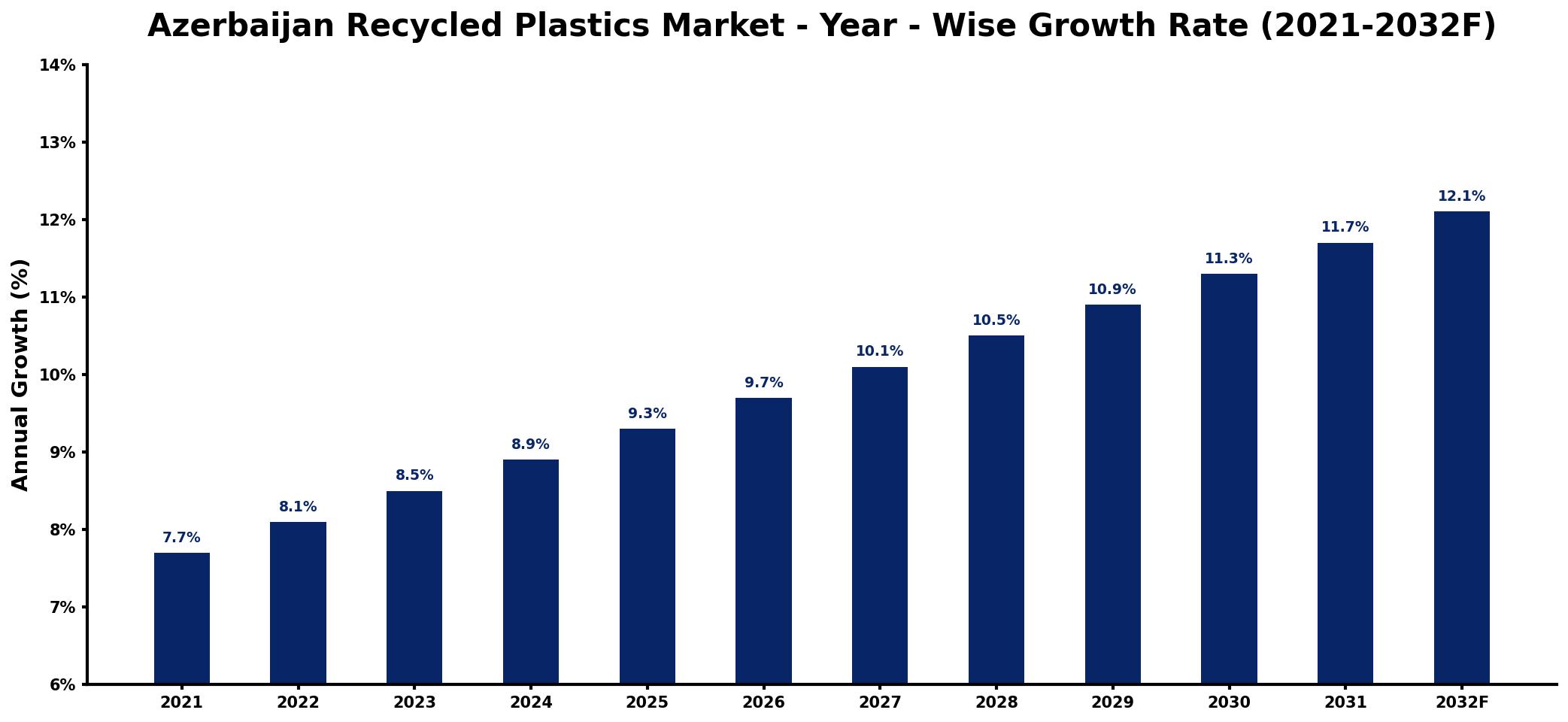
The table below presents the year‑wise growth rates along with the key drivers influencing the market
| Year | Growth Rate | Major Drivers |
| 2021 | 7.7% | increased consumer environmental awareness |
| 2022 | 8.1% | growing industrial sustainability initiatives |
| 2023 | 8.5% | expansion of waste management facilities |
| 2024 | 8.9% | rising demand for eco-friendly products |
| 2025 | 9.3% | government regulations promoting recycling |
| 2026 | 9.7% | innovation in recycling technologies |
| 2027 | 10.1% | increased investment in circular economy |
| 2028 | 10.5% | higher corporate social responsibility focus |
| 2029 | 10.9% | development of new recycling partnerships |
| 2030 | 11.3% | surge in global recycling markets |
| 2031 | 11.7% | expanding industrial usage applications |
| 2032 | 12.1% | enhanced public-private collaboration efforts |
Note: Market size estimations and growth projections presented in this report are based on 6Wresearch's proprietary forecasting methodology, utilizing the latest available industry data, government publications, and primary research inputs.
Azerbaijan Recycled Plastics Market Synopsis
The strongest force shaping the Azerbaijan Recycled Plastics Market today is the country's commitment to enhancing recycling practices as part of its broader environmental strategy. Government initiatives, including financial incentives for recycling and mandates for using recycled materials, are crucial in stimulating market growth.
This market is primarily dominated by PET and HDPE plastics, which are widely utilized across various industries, including packaging, construction, and automotive. The growing emphasis on sustainability has led to collaborations among government bodies, industry stakeholders, and non-profits, which are further propelling market expansion.
Azerbaijan Recycled Plastics Market Key Takeaways
- Growing consumer awareness of sustainability is driving demand for recycled plastics.
- Government initiatives are providing financial incentives and regulatory support for recycling practices.
- Technological advancements are enhancing the efficiency and quality of recycled plastic production.
- Strategic partnerships between stakeholders are fostering innovation in recycling processes.
- Increasing international demand for recycled materials presents export opportunities.
Evaluation of Restraints in Azerbaijan Recycled Plastics Market
Despite its promising outlook, the Azerbaijan Recycled Plastics Market faces several challenges that may impede growth. Limited infrastructure for the collection and sorting of recyclable materials hinders efficient recycling processes. Additionally, low public awareness and participation in recycling initiatives further restrict the market's potential. There is also a need for stronger government policies to effectively promote sustainable practices and incentivize businesses to invest in recycled solutions. Addressing these issues will be crucial for unlocking the full growth potential of the market.
Azerbaijan Recycled Plastics Market Trends
The current trends in the Azerbaijan Recycled Plastics Market indicate a shift towards eco-friendly production methods. Companies are increasingly adopting circular economy principles, which emphasize the reuse of materials. Additionally, advancements in recycling technologies are making it more economically viable to produce high-quality recycled plastics. Consumer preferences are also evolving, with more individuals favoring products made from recycled materials, further bolstering market growth.
Azerbaijan Recycled Plastics Market Opportunities
There are significant investment opportunities within the Azerbaijan Recycled Plastics Market, particularly in enhancing recycling infrastructure and establishing advanced sorting and processing technologies. As government policies favor sustainability, businesses that invest in recycling facilities stand to benefit immensely. Moreover, exporting recycled plastics to neighboring countries can open new revenue streams. Identifying local partnerships and developing reliable supply chains will be vital for tapping into this market's potential.
Government Initiatives in the Azerbaijan Recycled Plastics Market
The government of Azerbaijan has implemented various initiatives aimed at promoting the recycled plastics market. Key policies include the National Strategy on Waste Management, which seeks to enhance recycling rates and mitigate environmental impacts. Furthermore, financial incentives have been introduced to encourage companies engaged in recycling, alongside regulations that mandate the incorporation of recycled materials in specific industries. These measures underscore the government's commitment to fostering a circular economy and addressing plastic pollution.
Future Insights of the Azerbaijan Recycled Plastics Market
Looking ahead to 2026-2032, the Azerbaijan Recycled Plastics Market is set for considerable expansion. With ongoing governmental and societal focus on environmental sustainability, demand for recycled plastics is poised to rise across diverse sectors. Innovations in recycling technologies and increasing collaborations among public and private entities will likely drive market advancements. However, to fully realize this potential, challenges surrounding collection infrastructure and quality control must be effectively addressed.
Azerbaijan Recycled Plastics Market Latest Developments (2025 - 2026)
In recent months, the Azerbaijan Recycled Plastics Market has witnessed a notable shift towards more sustainable practices, with several initiatives launched to improve recycling efficiency. Stakeholders are increasingly collaborating to enhance infrastructure for material collection and sorting. Technological advancements in recycling processes are being adopted to produce higher quality outputs, meeting the rising consumer demand for eco-friendly products. Furthermore, discussions surrounding international partnerships for recycling initiatives have gained momentum.
Azerbaijan Recycled Plastics Market - Key Attractiveness of the Report
- 10 Years of Market Numbers
- Historical Data Starting from 2022 to 2025
- Base Year: 2025
- Forecast Data until 2032
- Key Performance Indicators Impacting the Market
- Major Upcoming Developments and Projects
Key Highlights of the Report:
- Azerbaijan Recycled Plastics Market Outlook
- Market Size of Azerbaijan Recycled Plastics Market, 2025
- Forecast of Azerbaijan Recycled Plastics Market, 2032
- Historical Data and Forecast of Azerbaijan Recycled Plastics Revenues & Volume for the Period 2022-2032F
- Azerbaijan Recycled Plastics Market Trend Evolution
- Azerbaijan Recycled Plastics Market Drivers and Challenges
- Azerbaijan Recycled Plastics Price Trends
- Azerbaijan Recycled Plastics Porter's Five Forces
- Azerbaijan Recycled Plastics Industry Life Cycle
- Historical Data and Forecast of Azerbaijan Recycled Plastics Market Revenues & Volume By Plastic Type for the Period 2022-2032F
- Historical Data and Forecast of Azerbaijan Recycled Plastics Market Revenues & Volume By Polyethylene Terephthalate (Pet) for the Period 2022-2032F
- Historical Data and Forecast of Azerbaijan Recycled Plastics Market Revenues & Volume By High Density Polyethylene (Hdpe) for the Period 2022-2032F
- Historical Data and Forecast of Azerbaijan Recycled Plastics Market Revenues & Volume By Polypropylene (Pp) for the Period 2022-2032F
- Historical Data and Forecast of Azerbaijan Recycled Plastics Market Revenues & Volume By Low Density Polyethylene (Ldpe) for the Period 2022-2032F
- Historical Data and Forecast of Azerbaijan Recycled Plastics Market Revenues & Volume By Others for the Period 2022-2032F
- Historical Data and Forecast of Azerbaijan Recycled Plastics Market Revenues & Volume By Application for the Period 2022-2032F
- Historical Data and Forecast of Azerbaijan Recycled Plastics Market Revenues & Volume By Non-food Contact Packaging for the Period 2022-2032F
- Historical Data and Forecast of Azerbaijan Recycled Plastics Market Revenues & Volume By Food Contact Packaging for the Period 2022-2032F
- Historical Data and Forecast of Azerbaijan Recycled Plastics Market Revenues & Volume By Construction for the Period 2022-2032F
- Historical Data and Forecast of Azerbaijan Recycled Plastics Market Revenues & Volume By Automotive for the Period 2022-2032F
- Historical Data and Forecast of Azerbaijan Recycled Plastics Market Revenues & Volume By Others for the Period 2022-2032F
- Historical Data and Forecast of Azerbaijan Recycled Plastics Market Revenues & Volume By Raw Material for the Period 2022-2032F
- Historical Data and Forecast of Azerbaijan Recycled Plastics Market Revenues & Volume By Plastic Bottles for the Period 2022-2032F
- Historical Data and Forecast of Azerbaijan Recycled Plastics Market Revenues & Volume By Plastic Films for the Period 2022-2032F
- Historical Data and Forecast of Azerbaijan Recycled Plastics Market Revenues & Volume By Rigid Plastic And Foam for the Period 2022-2032F
- Historical Data and Forecast of Azerbaijan Recycled Plastics Market Revenues & Volume By Fibres for the Period 2022-2032F
- Historical Data and Forecast of Azerbaijan Recycled Plastics Market Revenues & Volume By Others for the Period 2022-2032F
- Azerbaijan Recycled Plastics Import Export Trade Statistics
- Market Opportunity Assessment By Plastic Type
- Market Opportunity Assessment By Application
- Market Opportunity Assessment By Raw Material
- Azerbaijan Recycled Plastics Top Companies Market Share
- Azerbaijan Recycled Plastics Competitive Benchmarking By Technical and Operational Parameters
- Azerbaijan Recycled Plastics Company Profiles
- Azerbaijan Recycled Plastics Key Strategic Recommendations






































