Azerbaijan Smart Airport Market Size, Share & Growth Rate
The Azerbaijan Smart Airport Market was estimated at USD 715 Million in 2025 and is projected to reach USD 1294 Million by 2032, growing at a CAGR of 8.8% from 2026 to 2032. This significant growth trajectory is fueled by increasing air passenger traffic and rapid advancements in technology. Airports across Azerbaijan are actively embracing smart technologies, which are enhancing operational efficiencies and elevating the passenger experience, thereby catalyzing the expansion of the market.
Azerbaijan Smart Airport Market Year-wise Growth Rate and Key Drivers
This graph highlights how the Azerbaijan Smart Airport Market has steadily grown over the years, supported by major growth factors.
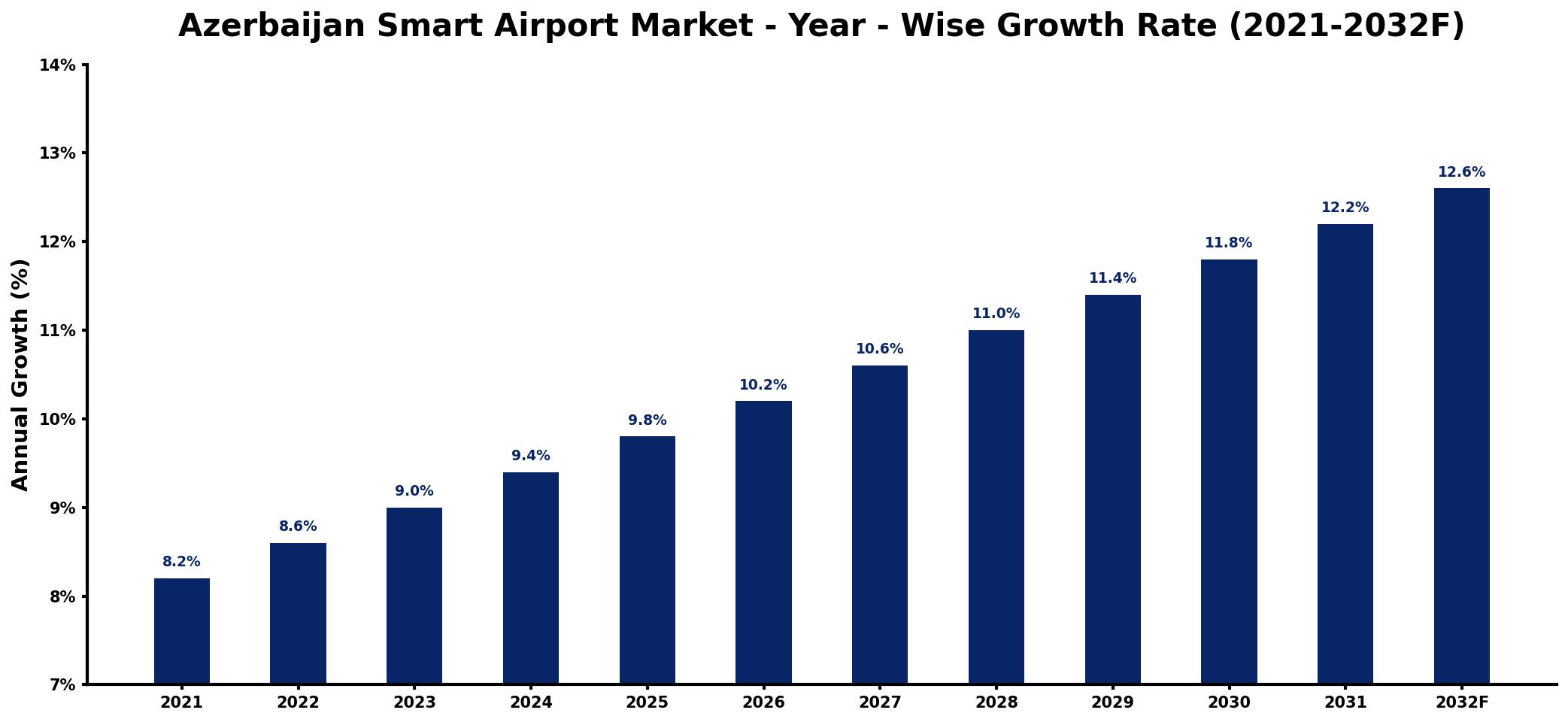
The table below presents the year‑wise growth rates along with the key drivers influencing the market
| Year | Growth Rate | Major Drivers |
| 2021 | 8.2% | increased passenger travel demand |
| 2022 | 8.6% | growing tourism sector investments |
| 2023 | 9.0% | technological innovation adoption surge |
| 2024 | 9.4% | enhanced infrastructure development initiatives |
| 2025 | 9.8% | rising global connectivity trends |
| 2026 | 10.2% | expansion of international routes |
| 2027 | 10.6% | growing focus on sustainability practices |
| 2028 | 11.0% | increased government funding allocations |
| 2029 | 11.4% | emerging market opportunities identified |
| 2030 | 11.8% | boost in public-private partnerships |
| 2031 | 12.2% | advancements in digital technologies |
| 2032 | 12.6% | growing demand for automation solutions |
Note: Market size estimations and growth projections presented in this report are based on 6Wresearch's proprietary forecasting methodology, utilizing the latest available industry data, government publications, and primary research inputs.
Azerbaijan Smart Airport Market Synopsis
Azerbaijan's airport landscape is evolving rapidly, characterized by the integration of smart technologies aimed at improving passenger flow and operational efficacy. The adoption of biometric identification systems, IoT devices, and smart security solutions is revolutionizing the travel experience in the region.
Major airports, such as Baku Heydar Aliyev International Airport, are leading the charge toward digital transformation. With the commitment to innovation and sustainability, Azerbaijan is positioning itself as a competitive player in the global aviation industry, further stimulating investments in smart infrastructure.
Azerbaijan Smart Airport Market Key Takeaways
- The market is driven by technological advancements and rising air traffic.
- Smart technologies are enhancing both operational efficiency and passenger experience.
- Investment in sustainability initiatives is becoming increasingly prioritized by airports.
- Implementation of AI and data analytics is optimizing airport operations.
- Government policies are fostering innovation and supporting infrastructure development.
Evaluation of Restraints in Azerbaijan Smart Airport Market
Despite the encouraging growth of the Azerbaijan Smart Airport Market, several challenges impede progress. The initial capital investment required for integrating advanced technologies is substantial, encompassing system upgrades, installations, and staff training. These financial barriers can hinder smaller regional airports from adopting necessary smart solutions. Moreover, the complexity of ensuring interoperability among varied technology providers can create additional operational hurdles. Lastly, concerns regarding cybersecurity remain prominent, as airports become increasingly susceptible to digital threats, necessitating comprehensive security strategies to protect sensitive passenger data.
Azerbaijan Smart Airport Market Trends
The Azerbaijan Smart Airport Market is witnessing notable trends, including the widespread implementation of biometric systems that facilitate seamless passenger check-ins. This shift is complemented by the use of IoT devices for real-time tracking of airport assets, ensuring that resources are managed more effectively. Additionally, airports are leveraging AI for predictive maintenance, enhancing operational reliability. Sustainability is also at the forefront, with initiatives aimed at minimizing environmental impacts while optimizing energy consumption. Overall, the market is gravitating toward smart ecosystems that prioritize efficiency, safety, and passenger satisfaction.
Azerbaijan Smart Airport Market Opportunities
Investors in the Azerbaijan Smart Airport Market will find a wealth of opportunities primarily in the realm of technological integration and infrastructure improvement. Key areas ripe for investment include advanced security systems, automated baggage handling, and personalized passenger services driven by AI. Furthermore, collaborations with local airport authorities and tech vendors will be crucial in modernizing existing facilities and enhancing overall service delivery. These strategic investments can lead to substantial long-term benefits, as the market anticipates continued growth driven by evolving passenger expectations.
Government Initiatives in the Azerbaijan Smart Airport Market
The Azerbaijani government is proactive in promoting the development of smart airports through various initiatives. The State Civil Aviation Administration has established regulations and standards aimed at enhancing safety and operational efficiency within airports. Investments in modernizing infrastructure, alongside the implementation of advanced technologies, reflect the governments commitment to improving the passenger experience. Additionally, specialized training programs offered by Azerbaijan's National Aviation Academy are helping to cultivate a skilled workforce for future smart airport environments, ensuring sustainability and growth in this sector.
Future Insights of the Azerbaijan Smart Airport Market
Looking ahead to 2026-2032, the Azerbaijan Smart Airport Market is set for robust growth, largely propelled by ongoing modernization efforts and increased technological adoption. With an emphasis on smart technologies like biometrics, IoT, and AI, airports are anticipated to become increasingly efficient and responsive to passenger needs. The trend toward digital transformation in the aviation sector is expected to gain momentum, further establishing Azerbaijan as a key player in smart airport solutions within the region. As passenger expectations evolve, the demand for innovative and connected airport experiences will likely drive continued investment in this dynamic market.
Azerbaijan Smart Airport Market Latest Developments (2025 - 2026)
Recent developments in the Azerbaijan Smart Airport Market indicate a strong focus on enhancing operational capabilities and passenger services. Airports are progressively implementing new technologies that streamline processes, such as self-service kiosks and improved security systems. Additionally, collaborations between government entities and private sector stakeholders are gaining traction, fostering an environment ripe for innovation. Efforts towards sustainable practices are also becoming more pronounced, with initiatives aimed at reducing the environmental footprint of airport operations.
Azerbaijan Smart Airport Market - Key Attractiveness of the Report
- 10 Years of Market Numbers
- Historical Data Starting from 2022 to 2025
- Base Year: 2025
- Forecast Data until 2032
- Key Performance Indicators Impacting the Market
- Major Upcoming Developments and Projects
Key Highlights of the Report:
- Azerbaijan Smart Airport Market Outlook
- Market Size of Azerbaijan Smart Airport Market, 2025
- Forecast of Azerbaijan Smart Airport Market, 2032
- Historical Data and Forecast of Azerbaijan Smart Airport Revenues & Volume for the Period 2022-2032F
- Azerbaijan Smart Airport Market Trend Evolution
- Azerbaijan Smart Airport Market Drivers and Challenges
- Azerbaijan Smart Airport Price Trends
- Azerbaijan Smart Airport Porter's Five Forces
- Azerbaijan Smart Airport Industry Life Cycle
- Historical Data and Forecast of Azerbaijan Smart Airport Market Revenues & Volume By System for the Period 2022-2032F
- Historical Data and Forecast of Azerbaijan Smart Airport Market Revenues & Volume By Communication and Network Systems for the Period 2022-2032F
- Historical Data and Forecast of Azerbaijan Smart Airport Market Revenues & Volume By Endpoint Devices for the Period 2022-2032F
- Historical Data and Forecast of Azerbaijan Smart Airport Market Revenues & Volume By Data Storage for the Period 2022-2032F
- Historical Data and Forecast of Azerbaijan Smart Airport Market Revenues & Volume By Software and Solutions for the Period 2022-2032F
- Historical Data and Forecast of Azerbaijan Smart Airport Market Revenues & Volume By End User for the Period 2022-2032F
- Historical Data and Forecast of Azerbaijan Smart Airport Market Revenues & Volume By Implementation for the Period 2022-2032F
- Historical Data and Forecast of Azerbaijan Smart Airport Market Revenues & Volume By Upgrades and Services for the Period 2022-2032F
- Historical Data and Forecast of Azerbaijan Smart Airport Market Revenues & Volume By Location for the Period 2022-2032F
- Historical Data and Forecast of Azerbaijan Smart Airport Market Revenues & Volume By Landside for the Period 2022-2032F
- Historical Data and Forecast of Azerbaijan Smart Airport Market Revenues & Volume By Airside for the Period 2022-2032F
- Historical Data and Forecast of Azerbaijan Smart Airport Market Revenues & Volume By Terminal Side for the Period 2022-2032F
- Azerbaijan Smart Airport Import Export Trade Statistics
- Market Opportunity Assessment By System
- Market Opportunity Assessment By End User
- Market Opportunity Assessment By Location
- Azerbaijan Smart Airport Top Companies Market Share
- Azerbaijan Smart Airport Competitive Benchmarking By Technical and Operational Parameters
- Azerbaijan Smart Airport Company Profiles
- Azerbaijan Smart Airport Key Strategic Recommendations






































