Azerbaijan Textile Yarn Market Summary
The azerbaijan textile yarn market was estimated at USD 1109 Million in 2025 and is projected to reach USD 2063 Million by 2032, growing at a CAGR of 10.7% from 2026 to 2032.
Azerbaijan Textile Yarn Market Year-wise Growth Rate and Key Drivers
This graph highlights how the Azerbaijan Textile Yarn Market has steadily grown over the past five years, supported by major growth factors.
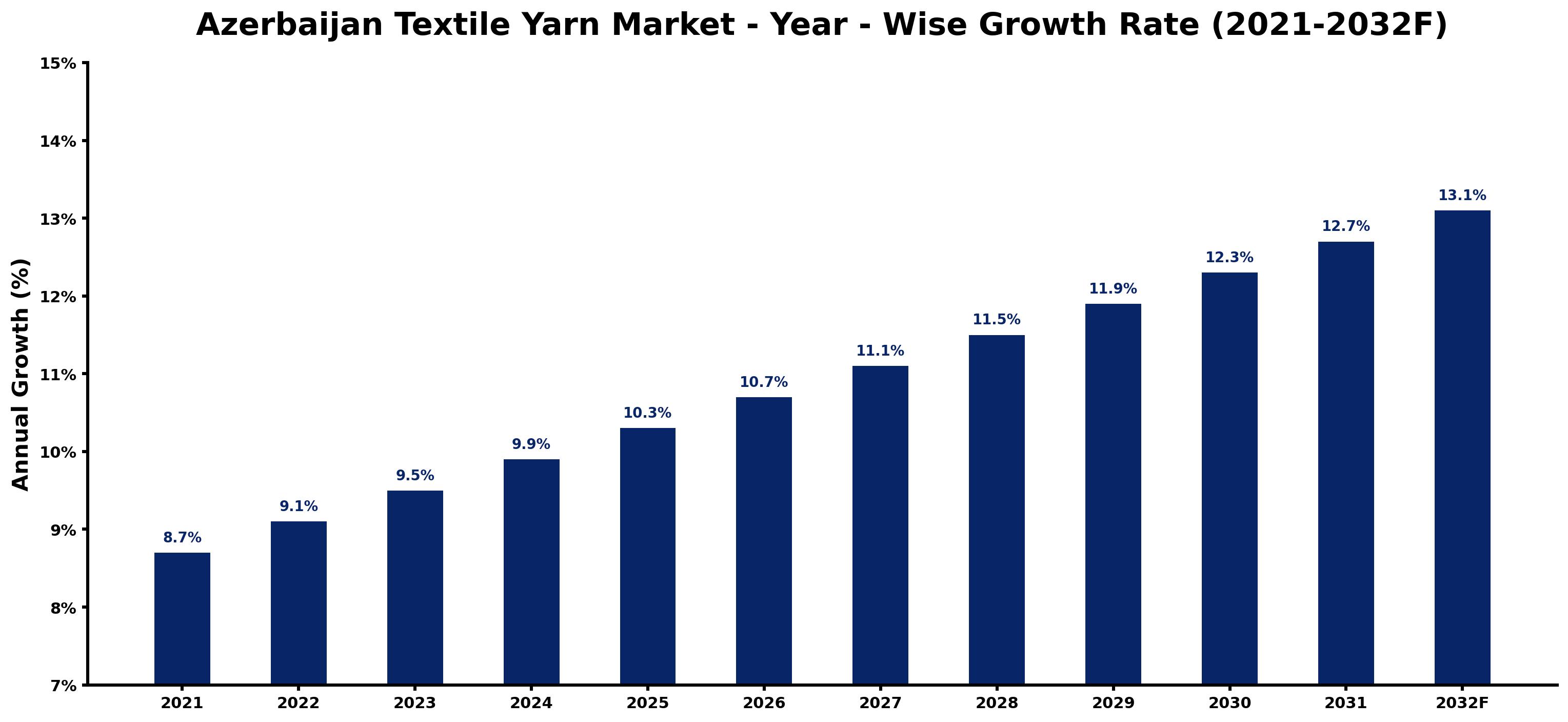
The table below presents the year wise growth rates along with the key drivers influencing the market
| Year | Growth Rate | Major Drivers |
| 2021 | 8.7% | The revival of local manufacturing spurred interest in affordable textile solutions. |
| 2022 | 9.1% | Regional trade agreements facilitated easier access to international raw materials. |
| 2023 | 9.5% | Sustainable practices became a focal point for local yarn producers and consumers. |
| 2024 | 9.9% | Emerging fashion trends highlighted the importance of high-quality textile products. |
| 2025 | 10.3% | Investment in technology improved production efficiency within the yarn manufacturing sector. |
| 2026 | 10.7% | Increased collaborations among local designers fostered a supportive creative ecosystem. |
| 2027 | 11.1% | The tourism sector's growth encouraged demand for locally made textile goods. |
| 2028 | 11.5% | Growing domestic consumption indicated a shift towards premium textile products. |
| 2029 | 11.9% | Export opportunities expanded through improved logistics and market accessibility. |
| 2030 | 12.3% | Innovation in yarn production techniques attracted interest from global investors. |
| 2031 | 12.7% | Consumer preferences leaned towards sustainable and ethically sourced textile options. |
| 2032 | 13.1% | Regional economic stability bolstered confidence in long-term textile industry investments. |
Note - Market size estimations and growth projections presented in this report are based on 6Wresearch's advanced forecasting approach, validated with industry datasets as of June 2026.
Azerbaijan Textile Yarn Market Synopsis
The Azerbaijan Textile Yarn Market is projected to reach 10.7% and witness significant growth during the forecast period (2026-2032). This market is gaining momentum, driven by the increasing demands from the textile and apparel sectors, which are crucial components of the national economy. The variety of yarn types available, including cotton, polyester, viscose, and their blends, positions Azerbaijan as a versatile hub capable of meeting diverse consumer needs. The strategic geographical location of Azerbaijan at the crossroads of Europe and Asia further enhances its potential to thrive within the global textile supply chain.
Azerbaijan Textile Yarn Market Growth Drivers
The growth trajectory of the Azerbaijan Textile Yarn Market is influenced by several factors. Firstly, expanding consumer preferences for a wide array of textile materials and innovative fabrics are driving demand. Secondly, government initiatives aimed at revitalizing the textile sector have resulted in increased foreign investments and modernization efforts. Thirdly, a focus on sustainability and environmentally friendly production methods is reshaping the offerings in the market, catering to the growing segment of eco-conscious consumers. Fourthly, improving production technologies are enabling manufacturers to enhance product quality and variety. Lastly, the increasing export of textile products to neighboring regions is bolstering the competitive landscape of the Azerbaijan Textile Yarn Market.
Azerbaijan Textile Yarn Market Trends and Opportunities
Emerging trends in the Azerbaijan Textile Yarn Market indicate a shift towards sustainable and innovative practices. The rising awareness among consumers regarding environmental impacts is fostering demand for eco-friendly yarns. Companies are investing in research and development to create yarns that minimize ecological footprints while meeting quality standards. Furthermore, customization is becoming an essential demand as businesses seek to cater to unique buyer specifications, which enhances user experience and satisfaction. Additionally, digitalization is reshaping the market landscape as more companies adopt online sales platforms, enabling them to reach broader markets and streamline operations. Collectively, these trends will shape the future direction of the Azerbaijan Textile Yarn Market, presenting numerous opportunities for growth.
Azerbaijan Textile Yarn Market Challenges and Restraints
Despite the growth potential, the Azerbaijan Textile Yarn Market faces several challenges that could hinder progress. Fluctuations in raw material prices pose a significant threat to profitability, affecting production costs and product pricing. Furthermore, competition from established low-cost producers in neighboring countries intensifies market pressure, making it challenging for local manufacturers to remain competitive. Limited access to advanced technologies and machinery restricts innovation and capacity expansion. Additionally, inadequate logistic and transportation infrastructure can lead to delays in product delivery and inefficiencies in distribution. Lastly, bureaucratic hurdles and regulatory complexities can impede operational efficiency and the overall growth of textile yarn producers in Azerbaijan.
Azerbaijan Textile Yarn Market Investment Opportunities
The Azerbaijan Textile Yarn Market presents a host of investment opportunities. As the local textile industry evolves, there is a growing demand for high-quality yarn products, making investments in production facilities highly attractive. The government's focus on modernization encourages partnerships and investments that can enhance production capabilities. Furthermore, the strategic position of Azerbaijan as a link between Europe and Asia offers substantial opportunities for exporting yarn, allowing businesses to tap into international markets. The emphasis on sustainable production methods not only attracts environmentally conscious consumers but also opens avenues for innovation in product development. The convergence of these factors indicates a promising landscape for investors in the Azerbaijan Textile Yarn Market.
Azerbaijan Textile Yarn Market Government Investment and Initiatives
The Azerbaijani government has implemented various policies to spur the growth of the Textile Yarn Market. These initiatives include financial incentives and subsidies aimed at supporting yarn producers. By promoting investments in the textile sector, the government is creating a conducive environment for development. Alongside these efforts, trade agreements have been established to facilitate exports, strengthening Azerbaijan's position in international markets. There are also regulations in place to ensure quality standards are adhered to, aligning local production with global best practices. Collectively, these initiatives not only enhance competitiveness but also foster innovation within the textile industry, paving the way for sustainable growth.
Azerbaijan Textile Yarn Market Latest Developments (May 2025 - June 2026)
Recent developments in the Azerbaijan Textile Yarn Market between May 2025 and June 2026 indicate a proactive shift towards modernization and sustainability. The focus on eco-friendly production practices has gained traction, aligning with global trends towards sustainable textiles. Additionally, various industry stakeholders are increasingly adopting digital technologies to enhance operational efficiencies and market reach. There is a noticeable increase in collaborations between local manufacturers and international firms, aimed at sharing best practices and advanced technologies. Furthermore, the government has ramped up its support through initiatives aimed at bolstering exports, promoting local products in international markets. Overall, these developments signal a transformative phase for the Azerbaijan Textile Yarn Market, characterized by innovation and growth.
Azerbaijan Textile Yarn Market - Key Attractiveness of the Report
- 10 Years of Market Numbers
- Historical Data Starting from 2022 to 2025
- Base Year: 2025
- Forecast Data until 2032
- Key Performance Indicators Impacting the Market
- Major Upcoming Developments and Projects
Key Highlights of the Report:
- Azerbaijan Textile Yarn Market Outlook
- Market Size of Azerbaijan Textile Yarn Market, 2025
- Forecast of Azerbaijan Textile Yarn Market, 2032F
- Historical Data and Forecast of Azerbaijan Textile Yarn Revenues & Volume for the Period 2022-2032F
- Azerbaijan Textile Yarn Market Trend Evolution
- Azerbaijan Textile Yarn Market Drivers and Challenges
- Azerbaijan Textile Yarn Price Trends
- Azerbaijan Textile Yarn Porter's Five Forces
- Azerbaijan Textile Yarn Industry Life Cycle
- Historical Data and Forecast of Azerbaijan Textile Yarn Market Revenues & Volume By Sources for the Period 2022-2032F
- Historical Data and Forecast of Azerbaijan Textile Yarn Market Revenues & Volume By Chemical for the Period 2022-2032F
- Historical Data and Forecast of Azerbaijan Textile Yarn Market Revenues & Volume By Animal for the Period 2022-2032F
- Historical Data and Forecast of Azerbaijan Textile Yarn Market Revenues & Volume By Plant for the Period 2022-2032F
- Historical Data and Forecast of Azerbaijan Textile Yarn Market Revenues & Volume By Others for the Period 2022-2032F
- Historical Data and Forecast of Azerbaijan Textile Yarn Market Revenues & Volume By Applications for the Period 2022-2032F
- Historical Data and Forecast of Azerbaijan Textile Yarn Market Revenues & Volume By Home Textile for the Period 2022-2032F
- Historical Data and Forecast of Azerbaijan Textile Yarn Market Revenues & Volume By Apparel for the Period 2022-2032F
- Historical Data and Forecast of Azerbaijan Textile Yarn Market Revenues & Volume By Industrial for the Period 2022-2032F
- Historical Data and Forecast of Azerbaijan Textile Yarn Market Revenues & Volume By Artificial Subtype for the Period 2022-2032F
- Historical Data and Forecast of Azerbaijan Textile Yarn Market Revenues & Volume By Viscose for the Period 2022-2032F
- Historical Data and Forecast of Azerbaijan Textile Yarn Market Revenues & Volume By Polyester for the Period 2022-2032F
- Historical Data and Forecast of Azerbaijan Textile Yarn Market Revenues & Volume By Acrylic for the Period 2022-2032F
- Historical Data and Forecast of Azerbaijan Textile Yarn Market Revenues & Volume By Nylon for the Period 2022-2032F
- Historical Data and Forecast of Azerbaijan Textile Yarn Market Revenues & Volume By Type for the Period 2022-2032F
- Historical Data and Forecast of Azerbaijan Textile Yarn Market Revenues & Volume By Artificial for the Period 2022-2032F
- Historical Data and Forecast of Azerbaijan Textile Yarn Market Revenues & Volume By Natural Type for the Period 2022-2032F
- Azerbaijan Textile Yarn Import Export Trade Statistics
- Market Opportunity Assessment By Sources
- Market Opportunity Assessment By Applications
- Market Opportunity Assessment By Artificial Subtype
- Market Opportunity Assessment By Type
- Azerbaijan Textile Yarn Top Companies Market Share
- Azerbaijan Textile Yarn Competitive Benchmarking By Technical and Operational Parameters
- Azerbaijan Textile Yarn Company Profiles
- Azerbaijan Textile Yarn Key Strategic Recommendations






































