Azerbaijan Toys and Games Market Size, Share & Growth Rate
The Azerbaijan Toys and Games Market was estimated at USD 1142 Million in 2025 and is projected to reach USD 1915 Million by 2032, growing at a CAGR of 7.7% from 2026 to 2032. This promising trajectory is driven by rising disposable incomes and an increasing understanding among parents of the critical role playtime plays in child development. Additionally, the proliferation of shopping malls and entertainment centers in urban areas further fuels this growth, making toys and games more accessible to families.
Azerbaijan Toys and Games Market Year-wise Growth Rate and Key Drivers
This graph highlights how the Azerbaijan Toys and Games Market has steadily grown over the years, supported by major growth factors.
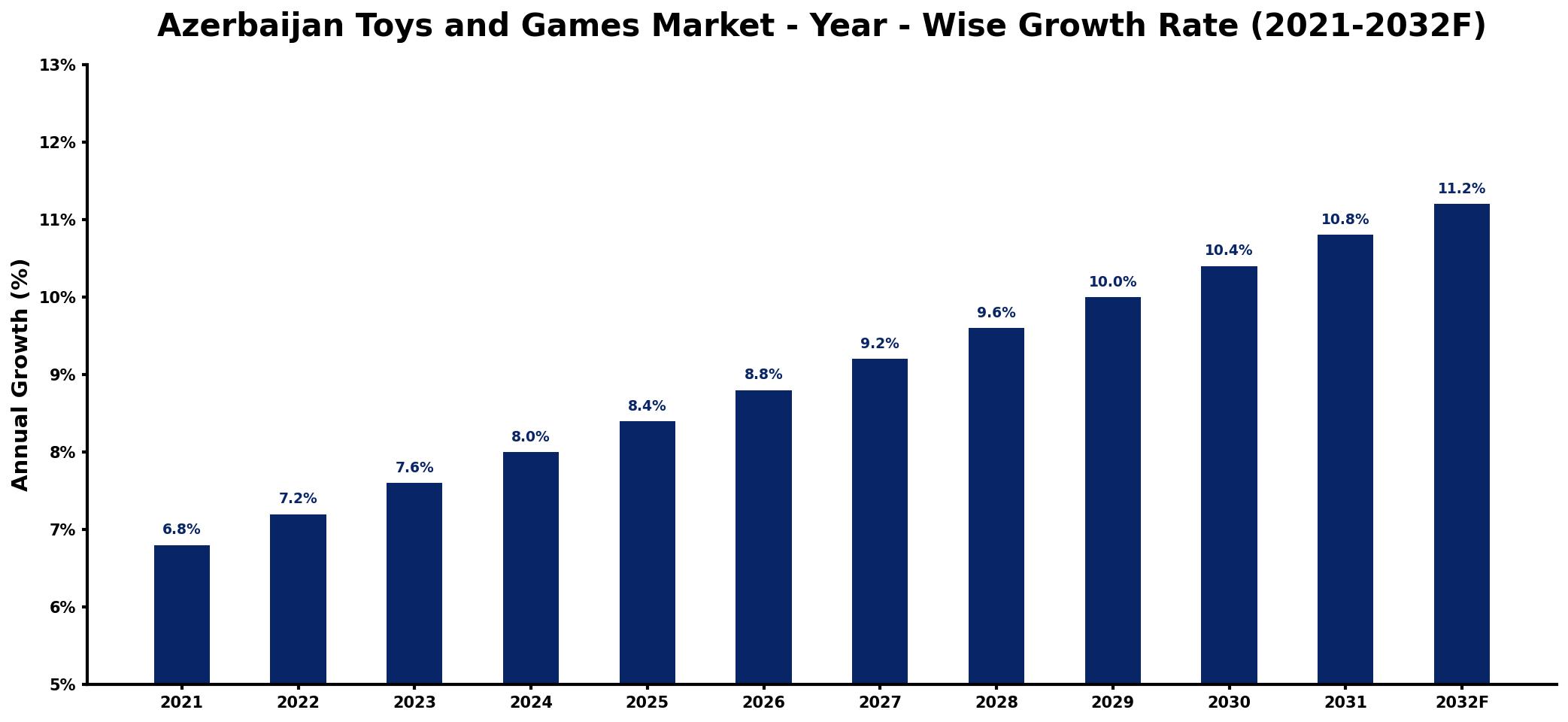
The table below presents the year‑wise growth rates along with the key drivers influencing the market
| Year | Growth Rate | Major Drivers |
| 2021 | 6.8% | Increase in disposable incomes |
| 2022 | 7.2% | Rise in urban population density |
| 2023 | 7.6% | Growing influence of social media |
| 2024 | 8.0% | Expansion of e-commerce platforms |
| 2025 | 8.4% | enhanced product quality standards |
| 2026 | 8.8% | Rising consumer interest in sustainability |
| 2027 | 9.2% | Growth of educational initiatives |
| 2028 | 9.6% | improved raw material availability |
| 2029 | 10.0% | growing regional consumption patterns |
| 2030 | 10.4% | Investment in local manufacturing capabilities |
| 2031 | 10.8% | Growth in digital marketing strategies |
| 2032 | 11.2% | strengthening international trade flows |
Note: Market size estimations and growth projections presented in this report are based on 6Wresearch's proprietary forecasting methodology, utilizing the latest available industry data, government publications, and primary research inputs.
Azerbaijan Toys and Games Market Synopsis
The strongest force shaping the Azerbaijan toys and games market is the heightened consumer awareness around the importance of play for children's development. As disposable incomes rise, parents are increasingly willing to invest in toys that not only entertain but also educate.
Simultaneously, a shift towards online retail channels is transforming how toys and games are sold. E-commerce platforms are gaining traction by offering a wider array of products and the convenience of home delivery, appealing especially to urban consumers who value ease of shopping.
Azerbaijan Toys and Games Market Key Takeaways
- The market is characterized by a blend of international and local brands catering to diverse age groups.
- Educational and STEM-based toys are increasingly favored for promoting skill development.
- Consumers are showing a preference for eco-friendly and sustainable toy options.
- Online retail is rapidly gaining ground as a primary purchasing channel.
- Government policies support local manufacturers while ensuring consumer safety.
Evaluation of Restraints in Azerbaijan Toys and Games Market
Despite its growth potential, the Azerbaijan toys and games market faces significant challenges that hinder its full realization. Import restrictions and regulatory hurdles limit the availability of high-quality products, while fluctuating exchange rates can affect pricing strategies. Moreover, competition from well-established international brands poses a challenge to local players. Cultural influences also dictate the types of toys that resonate with consumers, which necessitates a thorough understanding of local preferences for new entrants. To navigate these complexities effectively, a comprehensive understanding of the local market dynamics is crucial.
Azerbaijan Toys and Games Market Trends
The current trends in the Azerbaijan toys and games market are heavily influenced by the demand for educational and STEM-based toys. Parents are increasingly inclined towards products that not only entertain but also contribute to their childrens cognitive development. In addition, there is a growing interest in eco-friendly toys, reflecting a shift in consumer attitudes toward sustainability. Licensed merchandise from popular media also remains a strong sales driver, while the expansion of digital technology in gaming is reshaping traditional play patterns.
Azerbaijan Toys and Games Market Opportunities
There are abundant investment opportunities in the Azerbaijan toys and games market due to an expanding middle-class population and increasing consumer spending on children's products. Investors can capitalize on the rising popularity of e-commerce by exploring online retail ventures. Additionally, introducing educational toys that align with the market's focus on learning could prove beneficial. Collaborations with local manufacturers could also help foreign investors better understand consumer preferences and establish robust distribution networks.
Government Initiatives in the Azerbaijan Toys and Games Market
The Azerbaijani government has implemented various initiatives to enhance the toys and games market. Regulatory bodies such as the State Committee for Standardization, Metrology and Patents ensure consumer safety by establishing strict toy safety standards. Moreover, the Ministry of Economy plays a key role in overseeing import regulations and tariffs, facilitating local production while fostering fair competition. Through tax incentives and support for local manufacturers, the government aims to stimulate growth and innovation in this vital sector.
Future Insights of the Azerbaijan Toys and Games Market
Looking ahead to 2026-2032, the Azerbaijan toys and games market is poised for steady growth. The increasing disposable income and a larger population of children will likely propel demand. Parents' emphasis on educational and interactive toys is expected to shape product offerings. The digital landscape will also evolve, with more toys integrating technology to engage children. Although challenges such as regulatory constraints and international competition remain, the overall outlook is optimistic, focused on innovation and responsiveness to consumer needs.
Azerbaijan Toys and Games Market Latest Developments (2025 - 2026)
Recently, the Azerbaijan toys and games market has seen a notable surge in e-commerce activities, with various platforms enhancing their offerings to capture consumer interest. Additionally, new government initiatives aimed at promoting local toy manufacturers have gained traction, potentially altering the competitive landscape. As more shopping malls and entertainment centers open, the market is adapting to meet the evolving preferences of tech-savvy consumers, emphasizing both convenience and diversity in toy selections.
Azerbaijan Toys and Games Market - Key Attractiveness of the Report
- 10 Years of Market Numbers
- Historical Data Starting from 2022 to 2025
- Base Year: 2025
- Forecast Data until 2032
- Key Performance Indicators Impacting the Market
- Major Upcoming Developments and Projects
Key Highlights of the Report:
- Azerbaijan ToysandGames Market Outlook
- Market Size of Azerbaijan ToysandGames Market, 2025
- Forecast of Azerbaijan ToysandGames Market, 2032
- Historical Data and Forecast of Azerbaijan ToysandGames Revenues & Volume for the Period 2022-2032F
- Azerbaijan ToysandGames Market Trend Evolution
- Azerbaijan ToysandGames Market Drivers and Challenges
- Azerbaijan ToysandGames Price Trends
- Azerbaijan ToysandGames Porter's Five Forces
- Azerbaijan ToysandGames Industry Life Cycle
- Historical Data and Forecast of Azerbaijan ToysandGames Market Revenues & Volume By Product Type for the Period 2022-2032F
- Historical Data and Forecast of Azerbaijan ToysandGames Market Revenues & Volume By Games and Puzzles for the Period 2022-2032F
- Historical Data and Forecast of Azerbaijan ToysandGames Market Revenues & Volume By Video Games for the Period 2022-2032F
- Historical Data and Forecast of Azerbaijan ToysandGames Market Revenues & Volume By Construction Toys for the Period 2022-2032F
- Historical Data and Forecast of Azerbaijan ToysandGames Market Revenues & Volume By Dolls and Accessories for the Period 2022-2032F
- Historical Data and Forecast of Azerbaijan ToysandGames Market Revenues & Volume By Outdoor and Sports Toys for the Period 2022-2032F
- Historical Data and Forecast of Azerbaijan ToysandGames Market Revenues & Volume By Other for the Period 2022-2032F
- Historical Data and Forecast of Azerbaijan ToysandGames Market Revenues & Volume By Distribution Channel for the Period 2022-2032F
- Historical Data and Forecast of Azerbaijan ToysandGames Market Revenues & Volume By Online Channel for the Period 2022-2032F
- Historical Data and Forecast of Azerbaijan ToysandGames Market Revenues & Volume By Offline Channel for the Period 2022-2032F
- Azerbaijan ToysandGames Import Export Trade Statistics
- Market Opportunity Assessment By Product Type
- Market Opportunity Assessment By Distribution Channel
- Azerbaijan ToysandGames Top Companies Market Share
- Azerbaijan ToysandGames Competitive Benchmarking By Technical and Operational Parameters
- Azerbaijan ToysandGames Company Profiles
- Azerbaijan ToysandGames Key Strategic Recommendations






































