Tunisia Toys and Games Market Size, Share & Growth Rate
The Tunisia Toys and Games Market was estimated at USD 190 Million in 2025 and is projected to reach USD 258 Million by 2032, growing at a CAGR of 4.5% from 2026 to 2032. This growth trajectory is driven by an increasing disposable income among Tunisian families and a burgeoning young population that is fostering a greater demand for both educational and entertaining products. The shift towards online retail further augments this growth, as parents are increasingly turning to e-commerce platforms to purchase high-quality toys and games.
Tunisia Toys and Games Market Year-wise Growth Rate and Key Drivers
This graph highlights how the Tunisia Toys and Games Market has steadily grown over the years, supported by major growth factors.
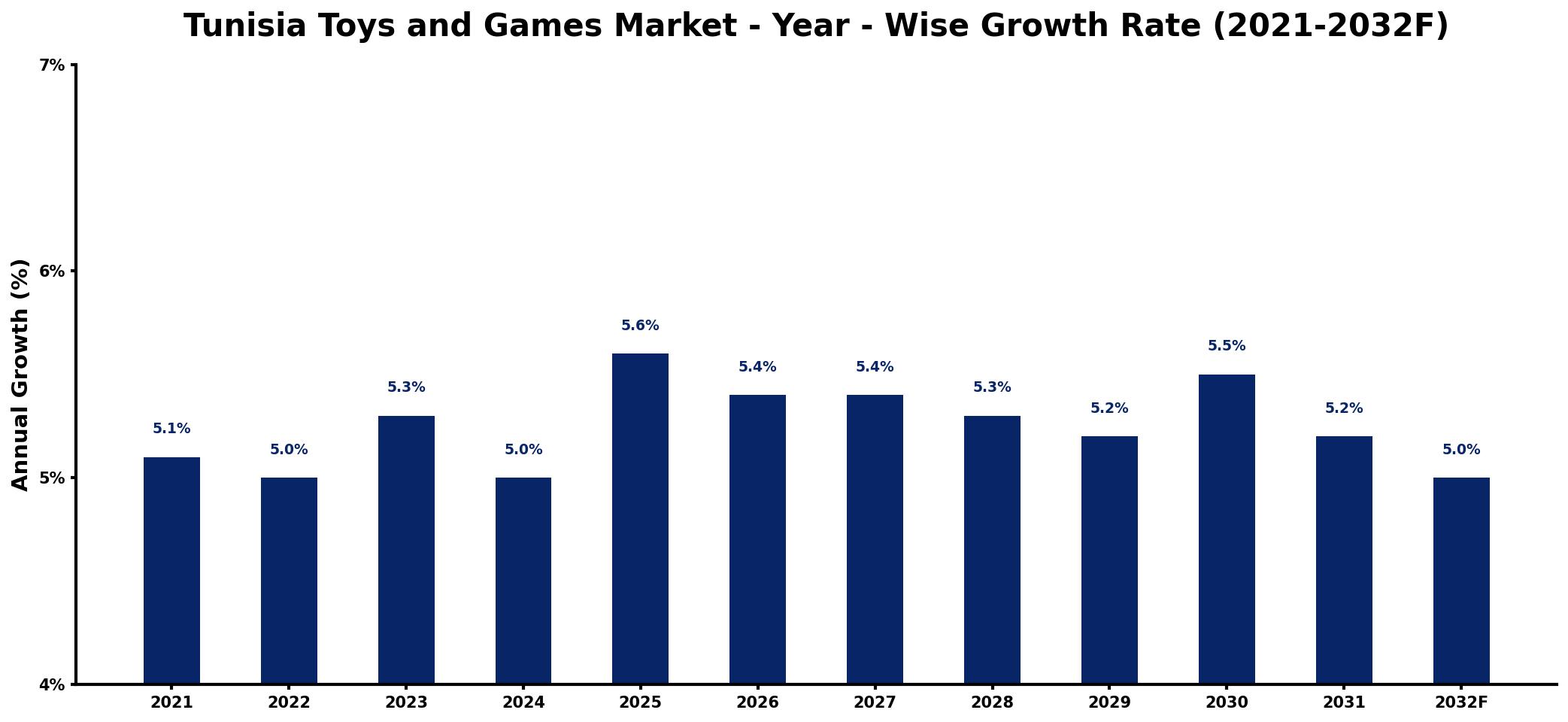
The table below presents the year‑wise growth rates along with the key drivers influencing the market
| Year | Growth Rate | Major Drivers |
| 2021 | 5.1% | Increased consumer spending power |
| 2022 | 5.0% | Growing online retail platforms |
| 2023 | 5.3% | Rising disposable income trends |
| 2024 | 5.0% | Expansion of retail distribution channels |
| 2025 | 5.6% | Surge in educational product demand |
| 2026 | 5.4% | Technological advancements in production |
| 2027 | 5.4% | Increased focus on sustainability practices |
| 2028 | 5.3% | stronger distribution network expansion |
| 2029 | 5.2% | Rise in family-oriented activities |
| 2030 | 5.5% | Enhanced product innovation strategies |
| 2031 | 5.2% | Strengthened international trade relations |
| 2032 | 5.0% | Growing market for eco-friendly products |
Note: Market size estimations and growth projections presented in this report are based on 6Wresearch's proprietary forecasting methodology, utilizing the latest available industry data, government publications, and primary research inputs.
Tunisia Toys and Games Market Synopsis
The strongest force shaping the Tunisia toys and games market today is the rising demand for educational and interactive toys. This trend reflects a deeper societal emphasis on promoting cognitive development and learning through play, with parents actively seeking toys that not only entertain but also educate.
Alongside educational toys, traditional toys such as dolls and board games remain in high demand, offering a balanced mix of nostalgia and innovation. Additionally, the increasing interest in locally inspired toys further enriches the market landscape, as families seek products that resonate with their cultural heritage.
Tunisia Toys and Games Market Key Takeaways
- The market is experiencing steady growth, driven by an increasing young population and rising disposable incomes.
- There is a notable shift towards e-commerce, as consumers prefer online retail for convenience and variety.
- Parents are increasingly prioritizing educational and STEM-focused toys that foster learning and creativity.
- Local culture and heritage are gaining prominence in toy design, reflecting consumers' desire for identity-driven products.
- Sustainability and eco-friendliness are becoming key considerations for both manufacturers and consumers.
Evaluation of Restraints in Tunisia Toys and Games Market
Despite the positive growth indicators, the Tunisia toys and games market faces significant constraints. A major limitation is the heavy reliance on imported products, which can be affected by currency fluctuations that influence pricing and availability. Additionally, the scarcity of locally produced toys means that the market is largely dictated by international brands, which may not always align with local consumer preferences. Regulatory challenges around importation and safety standards also create barriers to entry for new players looking to establish a foothold in this dynamic landscape.
Tunisia Toys and Games Market Trends
Several current and emerging trends are influencing the demand for toys and games in Tunisia. The rise in popularity of educational toys, especially those with a focus on STEM (science, technology, engineering, and mathematics) principles, indicates a shift towards products that promote critical thinking skills. Concurrently, online shopping is becoming the preferred method of purchasing toys, as consumers appreciate the convenience it offers. Sustainability is also a growing concern, with a noticeable increase in demand for eco-friendly toys that minimize environmental impact.
Tunisia Toys and Games Market Opportunities
The Tunisia toys and games market is ripe with investment opportunities, particularly for both local and international manufacturers. The increasing demand for high-quality, innovative toys presents an excellent avenue for investment. Additionally, there is significant potential in developing educational and interactive games that cater to the evolving preferences of Tunisian consumers. Collaborating with local manufacturers to create culturally relevant toys can enhance market penetration and profitability. The growing trend of e-commerce also opens doors for digital platforms and online gaming content, offering diverse revenue streams in this flourishing market.
Government Initiatives in the Tunisia Toys and Games Market
The Tunisian government plays a pivotal role in regulating the toys and games market, ensuring compliance with safety and quality standards. Regulations enforced by the Ministry of Trade and the National Institute of Standardization and Industrial Property (INNORPI) safeguard consumers, particularly children. These regulations not only ensure product safety but also encompass labeling, packaging, and advertising to enhance transparency and consumer protection. By adhering to international guidelines, including those set by the European Union, the government aims to foster a competitive and safe environment for both local and foreign players.
Future Insights of the Tunisia Toys and Games Market
Looking ahead, the Tunisia toys and games market is anticipated to continue its steady growth from 2026 to 2032. Factors such as increasing disposable income, a growing population of children, and the rising preference for educational toys are set to shape the future landscape. However, economic fluctuations and heightened competition from international brands will require companies to innovate and adapt continually. The focus on quality, sustainability, and meeting consumer preferences will be crucial for establishing a lasting presence in this evolving market.
Tunisia Toys and Games Market Latest Developments (2025 - 2026)
Recent developments in the Tunisia toys and games market indicate a noticeable increase in the introduction of educational products and interactive games. Companies are increasingly leveraging technology to enhance the play experience, with many seeking partnerships to produce locally inspired toys that resonate with Tunisian families. E-commerce platforms have expanded significantly, providing consumers with a wider range of products and facilitating easier access to international brands. Concurrently, there is a growing recognition of the importance of sustainable practices, leading many businesses to explore eco-friendly materials and manufacturing processes.
Tunisia Toys and Games Market - Key Attractiveness of the Report
- 10 Years of Market Numbers
- Historical Data Starting from 2022 to 2025
- Base Year: 2025
- Forecast Data until 2032
- Key Performance Indicators Impacting the Market
- Major Upcoming Developments and Projects
Key Highlights of the Report:
- Tunisia ToysandGames Market Outlook
- Market Size of Tunisia ToysandGames Market, 2025
- Forecast of Tunisia ToysandGames Market, 2032
- Historical Data and Forecast of Tunisia ToysandGames Revenues & Volume for the Period 2022-2032F
- Tunisia ToysandGames Market Trend Evolution
- Tunisia ToysandGames Market Drivers and Challenges
- Tunisia ToysandGames Price Trends
- Tunisia ToysandGames Porter's Five Forces
- Tunisia ToysandGames Industry Life Cycle
- Historical Data and Forecast of Tunisia ToysandGames Market Revenues & Volume By Product Type for the Period 2022-2032F
- Historical Data and Forecast of Tunisia ToysandGames Market Revenues & Volume By Games and Puzzles for the Period 2022-2032F
- Historical Data and Forecast of Tunisia ToysandGames Market Revenues & Volume By Video Games for the Period 2022-2032F
- Historical Data and Forecast of Tunisia ToysandGames Market Revenues & Volume By Construction Toys for the Period 2022-2032F
- Historical Data and Forecast of Tunisia ToysandGames Market Revenues & Volume By Dolls and Accessories for the Period 2022-2032F
- Historical Data and Forecast of Tunisia ToysandGames Market Revenues & Volume By Outdoor and Sports Toys for the Period 2022-2032F
- Historical Data and Forecast of Tunisia ToysandGames Market Revenues & Volume By Other for the Period 2022-2032F
- Historical Data and Forecast of Tunisia ToysandGames Market Revenues & Volume By Distribution Channel for the Period 2022-2032F
- Historical Data and Forecast of Tunisia ToysandGames Market Revenues & Volume By Online Channel for the Period 2022-2032F
- Historical Data and Forecast of Tunisia ToysandGames Market Revenues & Volume By Offline Channel for the Period 2022-2032F
- Tunisia ToysandGames Import Export Trade Statistics
- Market Opportunity Assessment By Product Type
- Market Opportunity Assessment By Distribution Channel
- Tunisia ToysandGames Top Companies Market Share
- Tunisia ToysandGames Competitive Benchmarking By Technical and Operational Parameters
- Tunisia ToysandGames Company Profiles
- Tunisia ToysandGames Key Strategic Recommendations






































