Azerbaijan Two Wheeler Market Summary
The azerbaijan two wheeler market was estimated at USD 492 Million in 2025 and is projected to reach USD 857 Million by 2032, growing at a CAGR of 9.5% from 2026 to 2032.
Azerbaijan Two Wheeler Market Year-wise Growth Rate and Key Drivers
This graph highlights how the Azerbaijan Two Wheeler Market has steadily grown over the past five years, supported by major growth factors.
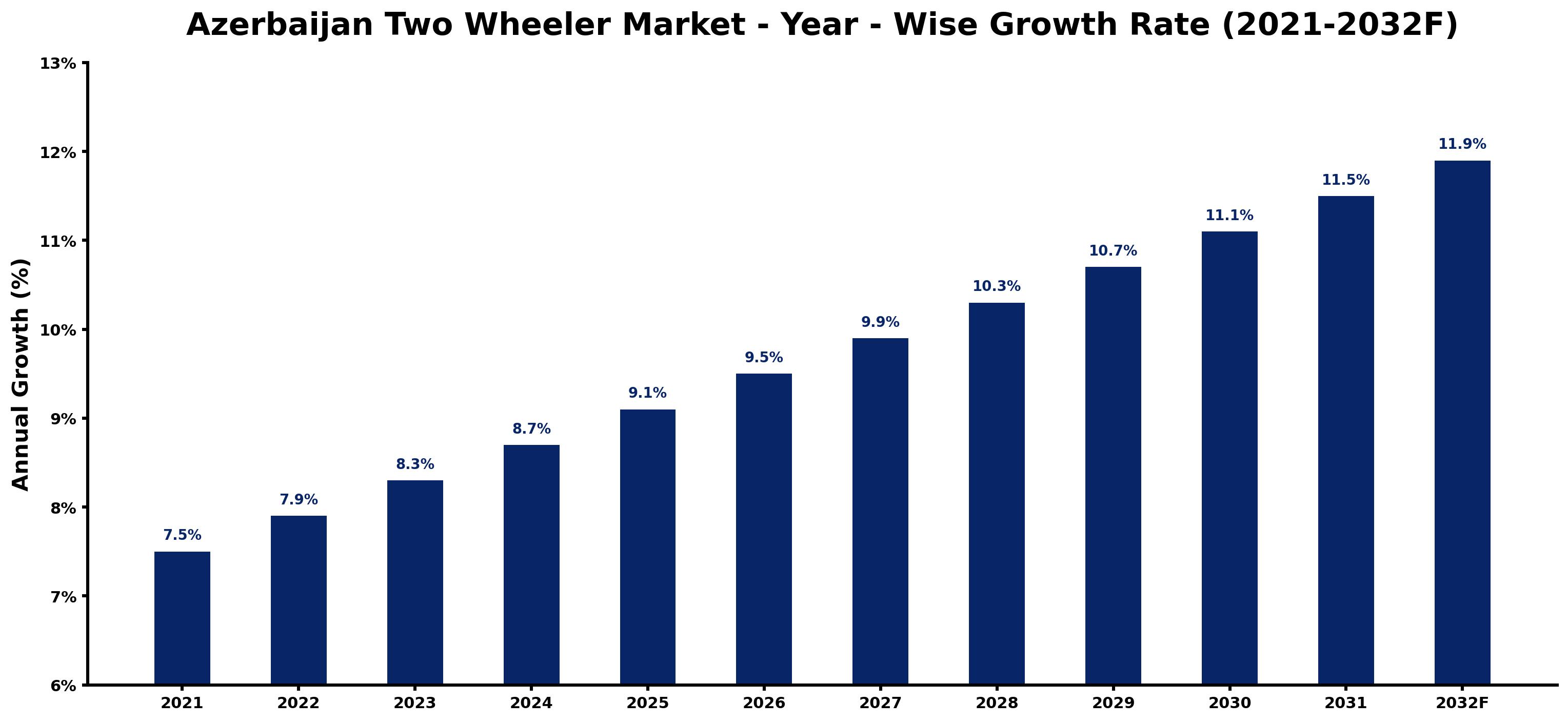
The table below presents the year wise growth rates along with the key drivers influencing the market
| Year | Growth Rate | Major Drivers |
| 2021 | 7.5% | Post-pandemic recovery strategies fostered interest in affordable transportation solutions. |
| 2022 | 7.9% | Urbanization continued, resulting in higher demand for two-wheelers in cities. |
| 2023 | 8.3% | Affordable financing options emerged, making two-wheelers accessible to wider demographics. |
| 2024 | 8.7% | Local manufacturers began to enhance quality, appealing to discerning consumers. |
| 2025 | 9.1% | Fuel price fluctuations prompted consumers to explore alternative commuting methods. |
| 2026 | 9.5% | Introduction of electric two-wheelers aligned with global sustainability trends. |
| 2027 | 9.9% | Infrastructure improvements expanded safe riding environments, boosting consumer confidence. |
| 2028 | 10.3% | Consumer preferences shifted toward smart technologies integrated into two-wheelers. |
| 2029 | 10.7% | Increased tourism initiatives encouraged rental services of two-wheelers in urban areas. |
| 2030 | 11.1% | Youth culture embraced two-wheelers, emphasizing style and convenience in purchases. |
| 2031 | 11.5% | Environmental awareness campaigns positioned two-wheelers as eco-friendly travel options. |
| 2032 | 11.9% | Post-COVID economic recovery led to accelerated urban mobility projects nationwide. |
Note - Market size estimations and growth projections presented in this report are based on 6Wresearch's advanced forecasting approach, validated with industry datasets as of June 2026.
Azerbaijan Two Wheeler Market Synopsis
The Azerbaijan Two Wheeler Market is projected to reach 9.5% and witness significant growth during the forecast period (2026-2032). This robust expansion can be attributed to a myriad of factors, including the increasing demand for cost-effective transportation solutions, rapid urbanization trends, and rising disposable incomes among the population. The convergence of these elements fosters an environment ripe for the growth of the two-wheeler market, making it an attractive sector for both consumers and investors alike.
Azerbaijan Two Wheeler Market Growth Drivers
Several key drivers are propelling the Azerbaijan two-wheeler market towards significant growth. First and foremost, the urbanization rates in Azerbaijan are accelerating, prompting a need for convenient mobility solutions that two-wheelers provide. As more individuals migrate to urban centers, the accessibility of public transport may not keep pace with the growing population, making two-wheelers an appealing choice.
Additionally, the increasing disposable income of the middle-class population leads to a greater demand for personal vehicles, including two-wheelers. The rising purchasing power allows consumers to opt for two-wheelers that offer not only cost efficiency but also improved convenience. Furthermore, the proliferation of e-commerce and delivery services in urban areas has intensified the demand for two-wheelers as a reliable mode of transport for business operations.
Moreover, the shift towards sustainable and eco-friendly transportation solutions is influencing consumer preferences. Electric two-wheelers are becoming increasingly popular due to their lower operational costs and eco-friendliness, aligning well with the growing global emphasis on sustainability. This trend is further supported by government incentives and public awareness campaigns promoting electric vehicles.
In conclusion, the amalgamation of urbanization, rising disposable incomes, and a growing inclination toward environmentally friendly modes of transportation will significantly influence the trajectory of the Azerbaijan two-wheeler market during the forecast period.
Azerbaijan Two Wheeler Market Government Investment and Initiatives
The government of Azerbaijan plays a crucial role in shaping the landscape of the two-wheeler market through various investments and initiatives aimed at enhancing mobility and supporting environmentally sustainable practices. Recent policies introduced by the government focus on promoting electric vehicles (EVs) as part of their commitment to reducing carbon emissions and improving urban air quality.
Tax reductions and subsidies for electric two-wheelers have been implemented, making them more financially accessible to a broader segment of the population. These government initiatives encourage consumers to opt for electric vehicles over traditional petrol or diesel models, thereby facilitating a shift towards greener transportation solutions.
Furthermore, investments in infrastructure are being prioritized to accommodate the increase in two-wheeler usage, including the development of dedicated lanes and parking facilities. Such investments not only enhance the safety and convenience for two-wheeler users but also promote the adoption of this form of transportation in urban environments.
The government's commitment to fostering a supportive environment for two-wheeler manufacturers also presents opportunities for local production. This will not only create jobs but also help stabilize the market by reducing reliance on imported vehicles.
Overall, the proactive approach of the Azerbaijan government in investing in infrastructure and promoting electric vehicle initiatives is pivotal in driving the growth of the two-wheeler market, ultimately enhancing mobility while addressing environmental concerns.
Azerbaijan Two Wheeler Market Latest Developments (May 2025 - June 2026)
In the period between May 2025 and June 2026, the Azerbaijan two-wheeler market witnessed noteworthy developments that reflect the evolving dynamics of the industry. The introduction of new regulations aimed at enhancing safety standards for two-wheelers took center stage, with the government rolling out mandatory safety features for newly manufactured models. This move aims to reduce accidents and improve rider safety across urban centers.
Additionally, advancements in battery technology have emerged as a prominent trend, leading to the launch of more efficient electric two-wheelers. As manufacturers focus on enhancing battery life and reducing charging times, consumers are increasingly inclined to consider electric models as viable alternatives to traditional vehicles.
Moreover, local manufacturers have begun collaborating with international technology firms to integrate smart technologies into their two-wheeler offerings. These technological enhancements include features such as GPS navigation, mobile connectivity, and advanced safety systems that appeal to tech-savvy consumers.
Additionally, increasing consumer awareness and education regarding the benefits of electric two-wheelers have resulted in a notable uptick in sales, particularly in urban areas where residents utilize them for commuting and local errands.
Looking ahead, these developments signify a transformative phase in the Azerbaijan two-wheeler market, with a clear trajectory toward more innovative, efficient, and consumer-friendly solutions.
Azerbaijan Two Wheeler Market - Key Attractiveness of the Report
- 10 Years of Market Numbers
- Historical Data Starting from 2022 to 2025
- Base Year: 2025
- Forecast Data until 2032
- Key Performance Indicators Impacting the Market
- Major Upcoming Developments and Projects
Key Highlights of the Report:
- Azerbaijan Two Wheeler Market Outlook
- Market Size of Azerbaijan Two Wheeler Market, 2025
- Forecast of Azerbaijan Two Wheeler Market, 2032F
- Historical Data and Forecast of Azerbaijan Two Wheeler Revenues & Volume for the Period 2022-2032F
- Azerbaijan Two Wheeler Market Trend Evolution
- Azerbaijan Two Wheeler Market Drivers and Challenges
- Azerbaijan Two Wheeler Price Trends
- Azerbaijan Two Wheeler Porter's Five Forces
- Azerbaijan Two Wheeler Industry Life Cycle
- Historical Data and Forecast of Azerbaijan Two Wheeler Market Revenues & Volume By Vehicle Type for the Period 2022-2032F
- Historical Data and Forecast of Azerbaijan Two Wheeler Market Revenues & Volume By Motorcycle for the Period 2022-2032F
- Historical Data and Forecast of Azerbaijan Two Wheeler Market Revenues & Volume By Scooter/Moped for the Period 2022-2032F
- Historical Data and Forecast of Azerbaijan Two Wheeler Market Revenues & Volume By Engine Capacity for the Period 2022-2032F
- Historical Data and Forecast of Azerbaijan Two Wheeler Market Revenues & Volume By Up to 125cc for the Period 2022-2032F
- Historical Data and Forecast of Azerbaijan Two Wheeler Market Revenues & Volume By 126-250cc for the Period 2022-2032F
- Historical Data and Forecast of Azerbaijan Two Wheeler Market Revenues & Volume By 251-500cc for the Period 2022-2032F
- Historical Data and Forecast of Azerbaijan Two Wheeler Market Revenues & Volume By Above 500cc for the Period 2022-2032F
- Azerbaijan Two Wheeler Import Export Trade Statistics
- Market Opportunity Assessment By Vehicle Type
- Market Opportunity Assessment By Engine Capacity
- Azerbaijan Two Wheeler Top Companies Market Share
- Azerbaijan Two Wheeler Competitive Benchmarking By Technical and Operational Parameters
- Azerbaijan Two Wheeler Company Profiles
- Azerbaijan Two Wheeler Key Strategic Recommendations






































