Azerbaijan Wheat Starch Market Size, Share & Growth Rate
The Azerbaijan Wheat Starch Market was estimated at USD 426 Million in 2025 and is projected to reach USD 718 Million by 2032, growing at a CAGR of 7.7% from 2026 to 2032. This growth trajectory is primarily fueled by the robust demand for wheat starch across various sectors, particularly food and beverage, pharmaceuticals, and textiles. The increasing consumer preference for clean label products and the shift towards gluten-free formulations further underscore the significant market potential in Azerbaijan.
Azerbaijan Wheat Starch Market Year-wise Growth Rate and Key Drivers
This graph highlights how the Azerbaijan Wheat Starch Market has steadily grown over the years, supported by major growth factors.
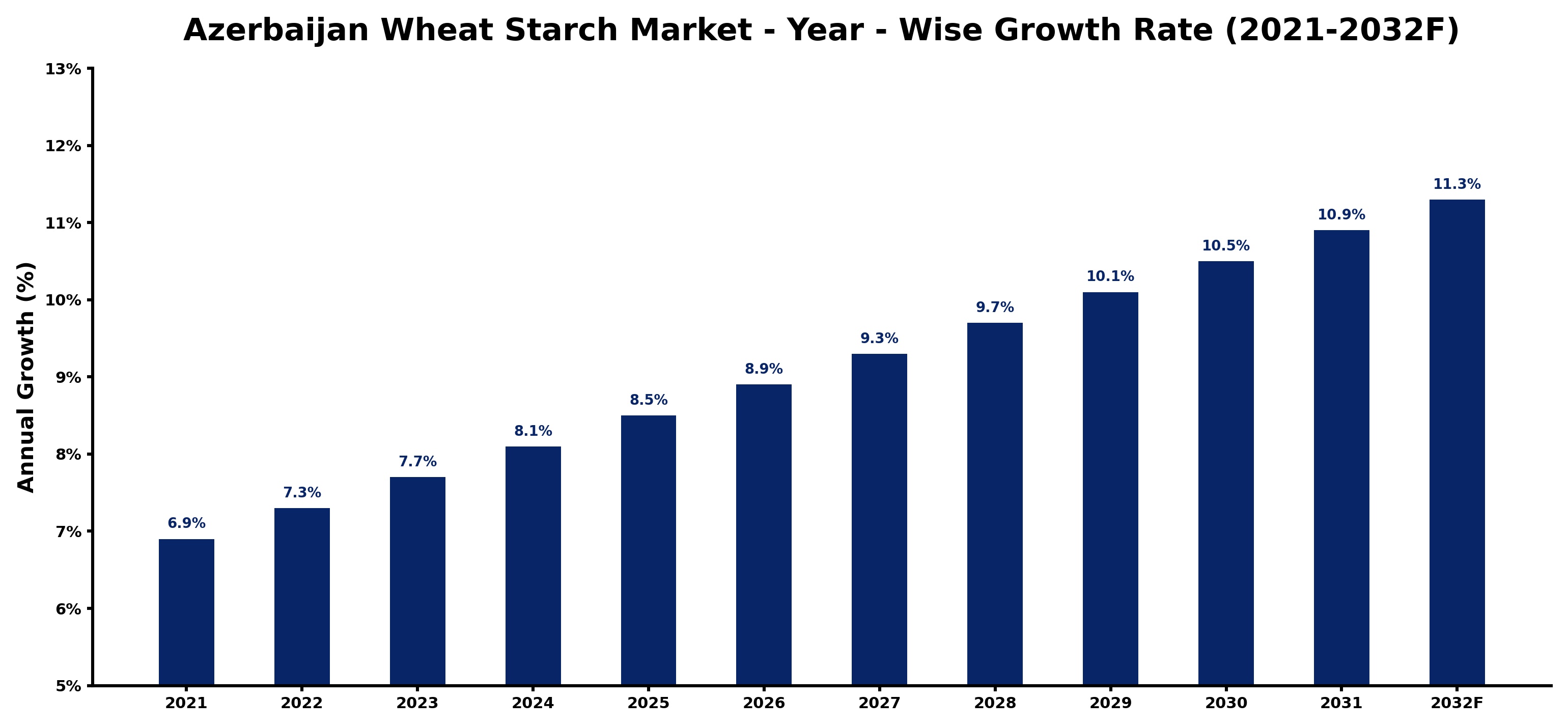
The table below presents the year‑wise growth rates along with the key drivers influencing the market
| Year | Growth Rate | Major Drivers |
| 2021 | 6.9% | Rising demand for gluten alternatives |
| 2022 | 7.3% | Increased industrial applications emerged |
| 2023 | 7.7% | Health trends favoring natural ingredients |
| 2024 | 8.1% | Food innovation driving starch usage |
| 2025 | 8.5% | Export opportunities expanding markets |
| 2026 | 8.9% | Consumer preference for local products |
| 2027 | 9.3% | Investment in processing technologies |
| 2028 | 9.7% | Sustainability initiatives boosting production |
| 2029 | 10.1% | Culinary trends embracing starch versatility |
| 2030 | 10.5% | New product launches stimulating interest |
| 2031 | 10.9% | Partnerships enhancing supply chain efficiency |
| 2032 | 11.3% | Technological advancements improving quality |
Note - Market size estimations and growth projections presented in this report are based on 6Wresearch’s advanced forecasting approach, validated with industry datasets as of June 2026.
Azerbaijan Wheat Starch Market Synopsis
Recent growth in the Azerbaijan wheat starch market highlights a burgeoning interest among manufacturers to innovate and meet the rising demand from consumers. As the market transitions towards natural and organic offerings, companies are adjusting their strategies to remain competitive. This shift signifies a fundamental change in consumer behavior, aligning with global trends towards healthier and cleaner food ingredients.
Looking ahead, the Azerbaijan wheat starch market is set to benefit from government support aimed at boosting local agricultural production. Initiatives designed to enhance self-sufficiency in wheat cultivation could strengthen domestic supply chains and ultimately bolster the market's growth. However, it remains essential for stakeholders to navigate the challenges posed by reliance on imported raw materials.
Azerbaijan Wheat Starch Market Key Takeaways
- The market is expected to experience steady growth due to diverse applications in food, pharmaceuticals, and textiles.
- Increasing consumer preference for gluten-free and organic products is reshaping product offerings in the market.
- Government initiatives are enhancing agricultural productivity, which could reduce import dependence.
- Challenges such as fluctuating raw material prices could impact pricing dynamics in the near future.
- Continued investment in research and development will be crucial for market innovation and growth.
Evaluation of Restraints in Azerbaijan Wheat Starch Market
Several constraints are currently impacting the Azerbaijan wheat starch market. The limited domestic production capacity necessitates substantial reliance on imports, making the market susceptible to fluctuations in global prices and currency values. This dependency can create supply chain vulnerabilities, hindering timely access to wheat starch and potentially driving up costs. Moreover, a lack of consumer awareness regarding the benefits and applications of wheat starch can impede demand growth, alongside regulatory barriers that complicate compliance with international quality standards.
Azerbaijan Wheat Starch Market Trends
The current trends in the Azerbaijan wheat starch market are largely influenced by a growing focus on health and wellness. Consumers are increasingly leaning towards products labeled as gluten-free, non-GMO, and natural. This trend is driving manufacturers to explore innovative solutions and alternative applications of wheat starch. Furthermore, there's an observable shift toward environmentally sustainable practices, urging market participants to consider the ecological impact of their production processes.
Azerbaijan Wheat Starch Market Opportunities
The Azerbaijan wheat starch market is brimming with investment opportunities, especially in response to the rising demand across various sectors. With the population's increasing disposable income, the consumption of wheat-based products is expected to surge. Furthermore, the government's ongoing commitment to agricultural development, along with investments in food processing infrastructure, presents a favorable landscape for potential investors looking to establish or expand wheat starch production facilities.
Government Initiatives in the Azerbaijan Wheat Starch Market
The Azerbaijani government is actively supporting the wheat starch market through various initiatives aimed at bolstering local production capabilities. These include implementing import tariffs and subsidies to encourage domestic farmers, as well as regulatory frameworks designed to uphold quality standards for food products. By promoting sustainable agricultural practices, the government seeks to enhance the competitiveness of local producers and reduce dependency on imported wheat starch.
Future Insights of the Azerbaijan Wheat Starch Market
The future outlook for the Azerbaijan wheat starch market is positive, backed by a growing consumer base that values health-conscious ingredients. The rising demand for natural food additives will likely continue to propel the market forward. Moreover, as local agricultural practices become more sustainable and efficient, the production of wheat starch could see a significant boost. Challenges such as price volatility may persist, but the overall trajectory points towards a robust market expansion in the years to come.
Azerbaijan Wheat Starch Market Latest Developments (May 2025 - June 2026)
Recent developments in the Azerbaijan wheat starch market reflect a strategic focus on product innovation and market penetration. Industry players are increasingly investing in marketing initiatives to educate consumers about the benefits of wheat starch and its applications. Concurrently, there is heightened collaboration between agricultural sectors and food manufacturers to enhance supply chain efficiency, which is expected to streamline the sourcing of raw materials and improve product availability.
Azerbaijan Wheat Starch Market - Key Attractiveness of the Report
- 10 Years of Market Numbers
- Historical Data Starting from 2022 to 2025
- Base Year: 2025
- Forecast Data until 2032
- Key Performance Indicators Impacting the Market
- Major Upcoming Developments and Projects
Key Highlights of the Report:
- Azerbaijan Wheat Starch Market Outlook
- Market Size of Azerbaijan Wheat Starch Market, 2025
- Forecast of Azerbaijan Wheat Starch Market, 2032
- Historical Data and Forecast of Azerbaijan Wheat Starch Revenues & Volume for the Period 2022-2032F
- Azerbaijan Wheat Starch Market Trend Evolution
- Azerbaijan Wheat Starch Market Drivers and Challenges
- Azerbaijan Wheat Starch Price Trends
- Azerbaijan Wheat Starch Porter's Five Forces
- Azerbaijan Wheat Starch Industry Life Cycle
- Historical Data and Forecast of Azerbaijan Wheat Starch Market Revenues & Volume By Type for the Period 2022-2032F
- Historical Data and Forecast of Azerbaijan Wheat Starch Market Revenues & Volume By Native Wheat Starch for the Period 2022-2032F
- Historical Data and Forecast of Azerbaijan Wheat Starch Market Revenues & Volume By Modified Wheat Starch for the Period 2022-2032F
- Historical Data and Forecast of Azerbaijan Wheat Starch Market Revenues & Volume By Grade for the Period 2022-2032F
- Historical Data and Forecast of Azerbaijan Wheat Starch Market Revenues & Volume By Food Grade for the Period 2022-2032F
- Historical Data and Forecast of Azerbaijan Wheat Starch Market Revenues & Volume By Industrial Grade for the Period 2022-2032F
- Historical Data and Forecast of Azerbaijan Wheat Starch Market Revenues & Volume By End-Users Industry for the Period 2022-2032F
- Historical Data and Forecast of Azerbaijan Wheat Starch Market Revenues & Volume By Food and Beverages for the Period 2022-2032F
- Historical Data and Forecast of Azerbaijan Wheat Starch Market Revenues & Volume By Cosmetics for the Period 2022-2032F
- Historical Data and Forecast of Azerbaijan Wheat Starch Market Revenues & Volume By Others for the Period 2022-2032F
- Azerbaijan Wheat Starch Import Export Trade Statistics
- Market Opportunity Assessment By Type
- Market Opportunity Assessment By Grade
- Market Opportunity Assessment By End-Users Industry
- Azerbaijan Wheat Starch Top Companies Market Share
- Azerbaijan Wheat Starch Competitive Benchmarking By Technical and Operational Parameters
- Azerbaijan Wheat Starch Company Profiles
- Azerbaijan Wheat Starch Key Strategic Recommendations






































