Bahrain Air Traffic Control (ATC) Equipment Market Size, Share & Growth Rate
The Bahrain Air Traffic Control (ATC) Equipment Market was estimated at USD 313 Million in 2025 and is projected to reach USD 566 Million by 2032, growing at a CAGR of 8.8% from 2026 to 2032. This growth trajectory is primarily driven by the continuous modernization efforts of Bahrain International Airport, which is evolving to meet the demands of rising air traffic in the Gulf region. Enhanced focus on aviation safety, coupled with the integration of advanced technologies, is further fueling investments in state-of-the-art radar and communication systems.
Bahrain Air Traffic Control (ATC) Equipment Market Year-wise Growth Rate and Key Drivers
This graph highlights how the Bahrain Air Traffic Control (ATC) Equipment Market has steadily grown over the years, supported by major growth factors.
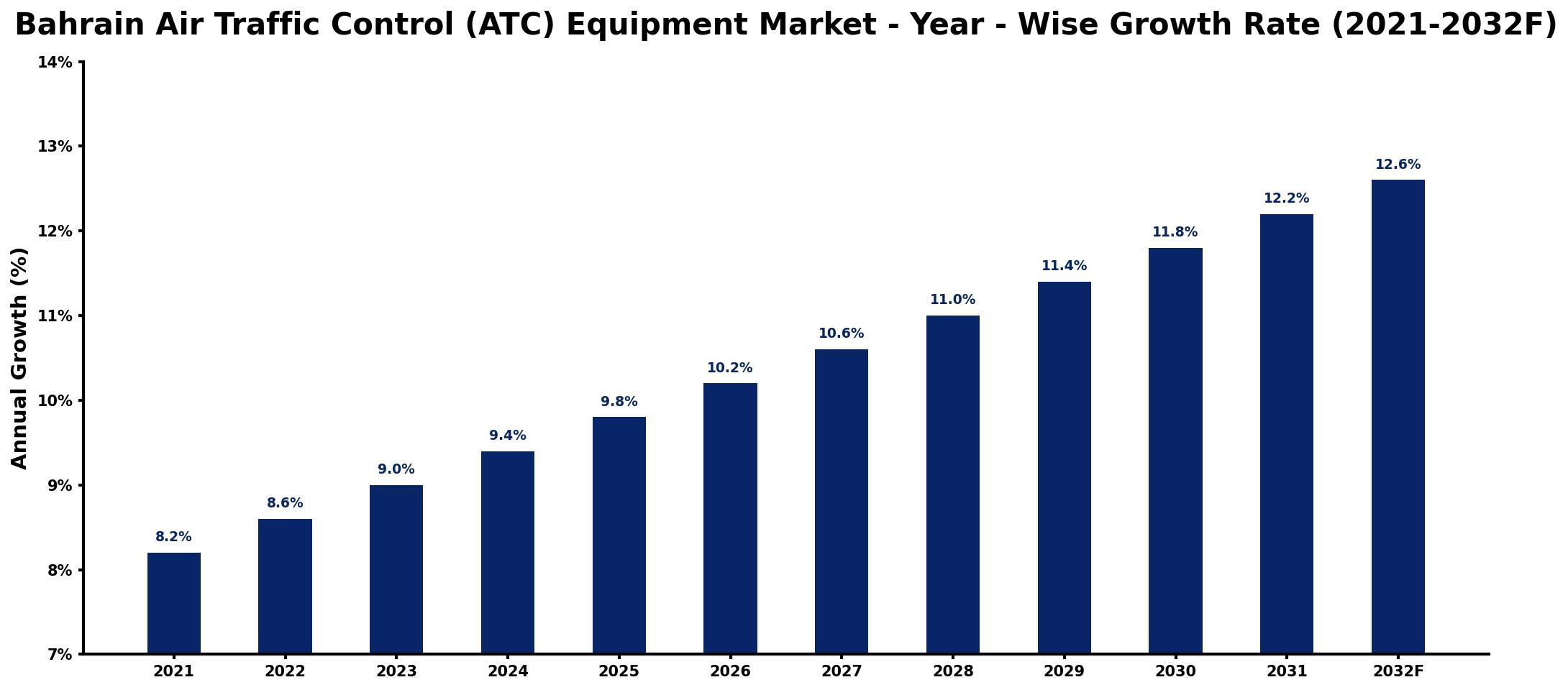
The table below presents the year‑wise growth rates along with the key drivers influencing the market
| Year | Growth Rate | Major Drivers |
| 2021 | 8.2% | Increased aviation sector investments |
| 2022 | 8.6% | Growing regional travel demand |
| 2023 | 9.0% | increased pharmaceutical industry usage |
| 2024 | 9.4% | Rising safety regulation standards |
| 2025 | 9.8% | Technological advancements in navigation |
| 2026 | 10.2% | Emergence of smart technologies |
| 2027 | 10.6% | Collaboration with international agencies |
| 2028 | 11.0% | Boost in tourism initiatives |
| 2029 | 11.4% | Enhancement of training programs |
| 2030 | 11.8% | Focus on sustainability initiatives |
| 2031 | 12.2% | Development of new flight routes |
| 2032 | 12.6% | Integration of AI technologies |
Note: Market size estimations and growth projections presented in this report are based on 6Wresearch's proprietary forecasting methodology, utilizing the latest available industry data, government publications, and primary research inputs.
Bahrain Air Traffic Control (ATC) Equipment Market Synopsis
The most significant force shaping the Bahrain ATC equipment market is the modernization initiative by the Civil Aviation Authority. This drive aims to upgrade existing radar systems and improve communication tools to comply with international aviation standards. The initiative is crucial, given Bahrain's role as a key transit hub within the Gulf Cooperation Council (GCC).
Moreover, the increase in air traffic for both passenger and cargo services has necessitated the investment in real-time data integration and automation tools. With Bahrain International Airport expanding, the demand for sophisticated ATC equipment will only intensify, thereby presenting unique opportunities for growth.
Bahrain Air Traffic Control (ATC) Equipment Market Key Takeaways
- The market is projected to grow at a CAGR of 8.8% from 2026 to 2032, driven by modernization efforts.
- Investment in advanced radar systems and communication tools is critical for compliance with global standards.
- Emerging technologies like AI-driven traffic monitoring are being evaluated for future implementation.
- Training and skilled personnel remain vital for effective operation of modern ATC systems.
- Partnerships with global manufacturers present opportunities for enhancing local capabilities.
Evaluation of Restraints in Bahrain Air Traffic Control (ATC) Equipment Market
Despite the promising growth outlook, the Bahrain ATC equipment market faces significant restraints. The highly concentrated demand, often tied to the periodic modernization cycles of Bahrain International Airport, limits the frequency of procurement opportunities. Furthermore, high procurement costs and complex technical specifications restrict supplier options. The reliance on foreign vendors for upgrades leads to extended delivery timelines, which can be a bottleneck in operational efficiency. Additionally, the shortage of skilled ATC personnel, particularly for newer systems, poses challenges in fully leveraging advanced technologies.
Bahrain Air Traffic Control (ATC) Equipment Market Trends
Current trends in the Bahrain ATC equipment market include a marked shift towards automation and AI integration. As air traffic increases, the emphasis on real-time data processing and predictive analytics grows, positioning these technologies as essential for efficient airspace management. Furthermore, the exploration of remote tower capabilities is indicative of the industry's movement towards innovative solutions that enhance operational flexibility and safety. The focus on cybersecurity is also becoming paramount as concerns around data integrity and system vulnerabilities escalate.
Bahrain Air Traffic Control (ATC) Equipment Market Opportunities
As Bahrain continues to solidify its status as a regional aviation hub, numerous growth and investment opportunities are emerging in the ATC equipment sector. The ongoing modernization of Bahrain International Airport is a substantial driver for demand in advanced radar, surveillance, and communication systems. Investors can tap into partnerships with global avionics manufacturers, while local authorities seek collaboration for developing innovative ATC automation tools. Additionally, the shift towards AI-driven solutions opens new avenues for enhancing safety and operational efficiency.
Government Initiatives in the Bahrain Air Traffic Control (ATC) Equipment Market
The Bahrain ATC equipment market benefits from strong government backing through comprehensive civil aviation policies and international compliance initiatives. The government actively collaborates with organizations like the International Civil Aviation Organization (ICAO) to ensure that the nations airspace management systems are both modernized and secure. Investments in upgrading ATC infrastructure, including essential radar and communication technologies, reflect the administrations commitment to maintaining a high standard of aviation safety and efficiency.
Future Insights of the Bahrain Air Traffic Control (ATC) Equipment Market
Looking ahead to the period of 2026-2032, the Bahrain ATC equipment market is positioned for robust growth, fueled by the anticipated increases in regional air traffic and ongoing infrastructure developments. The push towards higher safety standards and global compliance will necessitate continuous upgrades in technology. Consequently, suppliers of next-generation ATC equipment can expect favorable conditions, as demand for innovative solutions and training initiatives will likely escalate in this rapidly evolving landscape.
Bahrain Air Traffic Control (ATC) Equipment Market Latest Developments (2025 - 2026)
Recent developments within the Bahrain ATC equipment market indicate a strong focus on integrating AI and automation into existing systems. Collaborative projects between local aviation authorities and international technology providers are under exploration, aiming to enhance operational safety and efficiency. Moreover, discussions on implementing remote tower capabilities are gaining traction, reflecting the commitment to innovative solutions. Ongoing training programs for personnel are being prioritized to ensure adept handling of the latest radar and communication technologies.
Bahrain Air Traffic Control (ATC) Equipment Market - Key Attractiveness of the Report
- 10 Years of Market Numbers
- Historical Data Starting from 2022 to 2025
- Base Year: 2025
- Forecast Data until 2032
- Key Performance Indicators Impacting the Market
- Major Upcoming Developments and Projects
Key Highlights of the Report:
- Bahrain Air Traffic Control (ATC) Equipment Market Outlook
- Market Size of Bahrain Air Traffic Control (ATC) Equipment Market, 2025
- Forecast of Bahrain Air Traffic Control (ATC) Equipment Market, 2032
- Historical Data and Forecast of Bahrain Air Traffic Control (ATC) Equipment Revenues & Volume for the Period 2022-2032F
- Bahrain Air Traffic Control (ATC) Equipment Market Trend Evolution
- Bahrain Air Traffic Control (ATC) Equipment Market Drivers and Challenges
- Bahrain Air Traffic Control (ATC) Equipment Price Trends
- Bahrain Air Traffic Control (ATC) Equipment Porter's Five Forces
- Bahrain Air Traffic Control (ATC) Equipment Industry Life Cycle
- Historical Data and Forecast of Bahrain Air Traffic Control (ATC) Equipment Market Revenues & Volume By Product for the Period 2022-2032F
- Historical Data and Forecast of Bahrain Air Traffic Control (ATC) Equipment Market Revenues & Volume By Communications Equipment for the Period 2022-2032F
- Historical Data and Forecast of Bahrain Air Traffic Control (ATC) Equipment Market Revenues & Volume By Navigation Equipment for the Period 2022-2032F
- Historical Data and Forecast of Bahrain Air Traffic Control (ATC) Equipment Market Revenues & Volume By Surveillance Equipment for the Period 2022-2032F
- Historical Data and Forecast of Bahrain Air Traffic Control (ATC) Equipment Market Revenues & Volume By Air Traffic Control Equipment Application Outlook (USD Million, 2023-2032) for the Period 2022-2032F
- Historical Data and Forecast of Bahrain Air Traffic Control (ATC) Equipment Market Revenues & Volume By Commercial Aircraft for the Period 2022-2032F
- Historical Data and Forecast of Bahrain Air Traffic Control (ATC) Equipment Market Revenues & Volume By Private Aircraft for the Period 2022-2032F
- Historical Data and Forecast of Bahrain Air Traffic Control (ATC) Equipment Market Revenues & Volume By Military Aircraft for the Period 2022-2032F
- Bahrain Air Traffic Control (ATC) Equipment Import Export Trade Statistics
- Market Opportunity Assessment By Product
- Bahrain Air Traffic Control (ATC) Equipment Top Companies Market Share
- Bahrain Air Traffic Control (ATC) Equipment Competitive Benchmarking By Technical and Operational Parameters
- Bahrain Air Traffic Control (ATC) Equipment Company Profiles
- Bahrain Air Traffic Control (ATC) Equipment Key Strategic Recommendations






































