Bahrain Alternative Building Materials Market: Import Trend Analysis
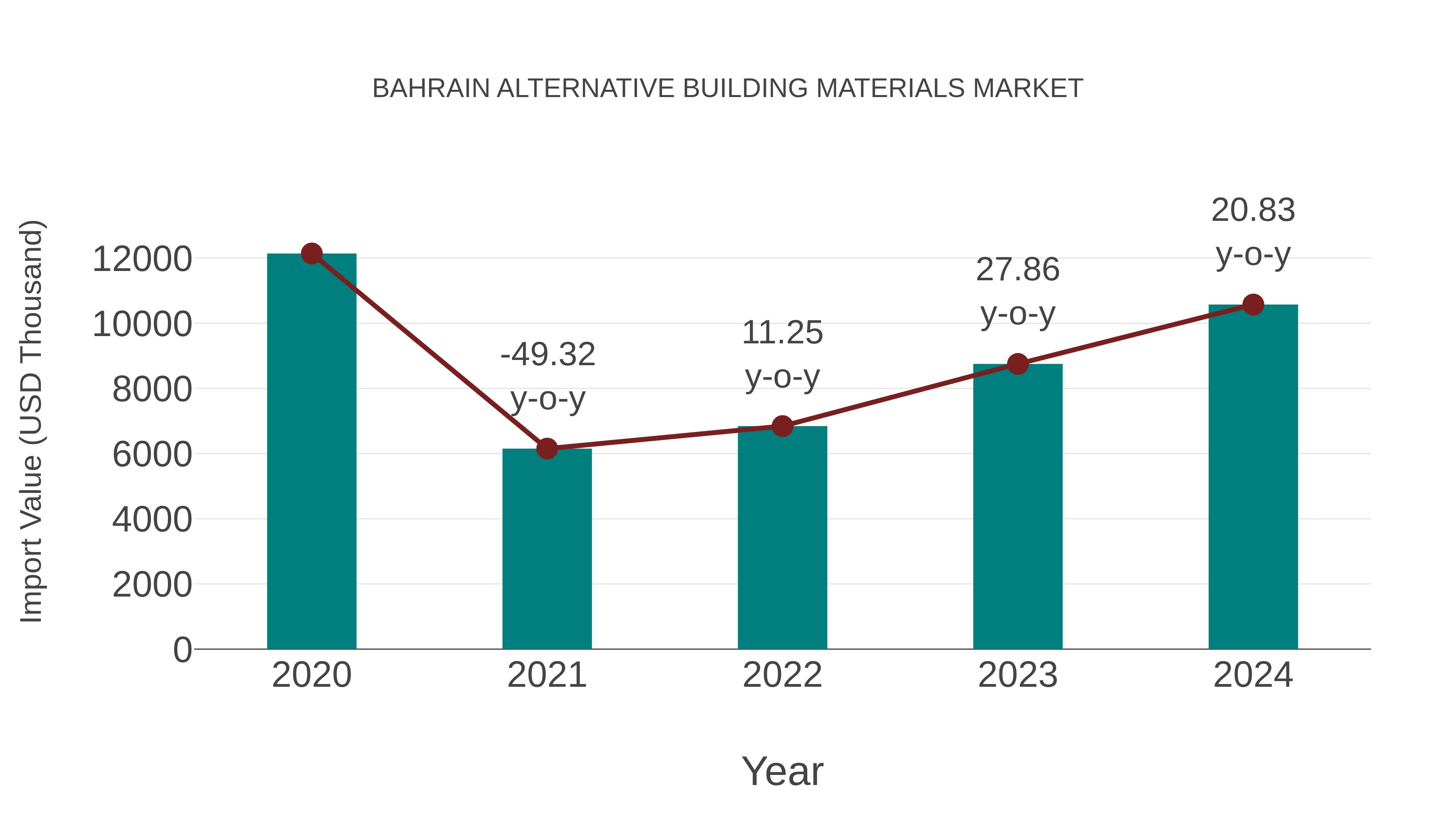
In the Bahrain alternative building materials market, the import trend showed a notable growth rate of 20.83% from 2023 to 2024. However, the compound annual growth rate (CAGR) from 2020 to 2024 was -3.39%. This decline in CAGR could be attributed to shifts in demand patterns or changes in trade policies impacting market stability.
Bahrain Alternative Building Materials Market Synopsis
The Alternative Building Materials Market in Bahrain is witnessing increasing momentum as the country explores sustainable and cost-effective construction solutions. Materials such as fly ash bricks, recycled aggregates, aerated concrete blocks, and bamboo composites are being considered to reduce the environmental footprint of new projects. Government initiatives promoting green building practices and LEED certification are driving adoption, especially in large-scale developments and eco-conscious residential projects.
Trends of the market
The market for alternative building materials in Bahrain is rapidly evolving, driven by sustainability goals, rising construction costs, and the need for climate-resilient infrastructure. There is a clear trend toward using recycled aggregates, fly ash bricks, geopolymer concrete, and bio-based insulation. Government policies encouraging green certifications and energy-efficient buildings are also pushing developers to explore innovative and less carbon-intensive materials.
Challenges of the market
The market for alternative building materials in Bahrain faces obstacles due to traditional preferences in the construction industry and a conservative approach toward adopting new technologies. Although sustainable building is gaining attention, high costs, limited supply chains, and a lack of incentives slow down the transition. The absence of localized production of materials like hempcrete, recycled composites, or green insulation products further restricts scalability. Regulatory gaps and insufficient awareness among contractors and developers also pose barriers.
Investment opportunities in the Market
As Bahrain pushes for sustainable construction, alternative materials such as fly ash bricks, AAC blocks, hempcrete, and recycled aggregates are gaining traction. Investment potential includes manufacturing eco-friendly construction products, supplying green building materials to developers, and partnering with regulatory bodies to promote sustainable certifications and incentives.
Government Policy of the market
Bahrains construction sector is undergoing a transformation towards sustainability, boosting the demand for alternative building materials such as recycled aggregates, geopolymer concrete, and insulation made from natural fibers. Government-led initiatives under the Bahrain Green Building Code and National Energy Efficiency Action Plan (NEEAP) actively promote the adoption of such materials. Developers working on government-backed projects are encouraged to meet green certification standards, while the Ministry of Works provides incentives and technical guidance to integrate innovative materials into both public and private infrastructure projects.
Key Highlights of the Report:
- Bahrain Alternative Building Materials Market Outlook
- Market Size of Bahrain Alternative Building Materials Market, 2025
- Forecast of Bahrain Alternative Building Materials Market, 2032
- Historical Data and Forecast of Bahrain Alternative Building Materials Revenues & Volume for the Period 2022 - 2032F
- Bahrain Alternative Building Materials Market Trend Evolution
- Bahrain Alternative Building Materials Market Drivers and Challenges
- Bahrain Alternative Building Materials Price Trends
- Bahrain Alternative Building Materials Porter's Five Forces
- Bahrain Alternative Building Materials Industry Life Cycle
- Historical Data and Forecast of Bahrain Alternative Building Materials Market Revenues & Volume By Material for the Period 2022 - 2032F
- Historical Data and Forecast of Bahrain Alternative Building Materials Market Revenues & Volume By Bamboo for the Period 2022 - 2032F
- Historical Data and Forecast of Bahrain Alternative Building Materials Market Revenues & Volume By Recycled Plastic for the Period 2022 - 2032F
- Historical Data and Forecast of Bahrain Alternative Building Materials Market Revenues & Volume By Wood for the Period 2022 - 2032F
- Historical Data and Forecast of Bahrain Alternative Building Materials Market Revenues & Volume By Others for the Period 2022 - 2032F
- Historical Data and Forecast of Bahrain Alternative Building Materials Market Revenues & Volume By End User for the Period 2022 - 2032F
- Historical Data and Forecast of Bahrain Alternative Building Materials Market Revenues & Volume By Residential for the Period 2022 - 2032F
- Historical Data and Forecast of Bahrain Alternative Building Materials Market Revenues & Volume By Non-residential for the Period 2022 - 2032F
- Historical Data and Forecast of Bahrain Alternative Building Materials Market Revenues & Volume By Application for the Period 2022 - 2032F
- Historical Data and Forecast of Bahrain Alternative Building Materials Market Revenues & Volume By Construction for the Period 2022 - 2032F
- Historical Data and Forecast of Bahrain Alternative Building Materials Market Revenues & Volume By Furniture for the Period 2022 - 2032F
- Historical Data and Forecast of Bahrain Alternative Building Materials Market Revenues & Volume By Flooring for the Period 2022 - 2032F
- Bahrain Alternative Building Materials Import Export Trade Statistics
- Market Opportunity Assessment By Material
- Market Opportunity Assessment By End User
- Market Opportunity Assessment By Application
- Bahrain Alternative Building Materials Top Companies Market Share
- Bahrain Alternative Building Materials Competitive Benchmarking By Technical and Operational Parameters
- Bahrain Alternative Building Materials Company Profiles
- Bahrain Alternative Building Materials Key Strategic Recommendations






































