Bahrain Auto Parts And Accessories Market Size, Share & Growth Rate
The Bahrain Auto Parts And Accessories Market was estimated at USD 467 Million in 2025 and is projected to reach USD 878 Million by 2032, growing at a CAGR of 9.4% from 2026 to 2032. This robust growth trajectory is driven by a growing vehicle ownership base and a strong consumer inclination towards customization and performance enhancements. Coupled with the rise of e-commerce platforms, the market is experiencing enhanced accessibility, allowing consumers to effortlessly obtain a wide array of auto components.
Bahrain Auto Parts And Accessories Market Year-wise Growth Rate and Key Drivers
This graph highlights how the Bahrain Auto Parts And Accessories Market has steadily grown over the years, supported by major growth factors.
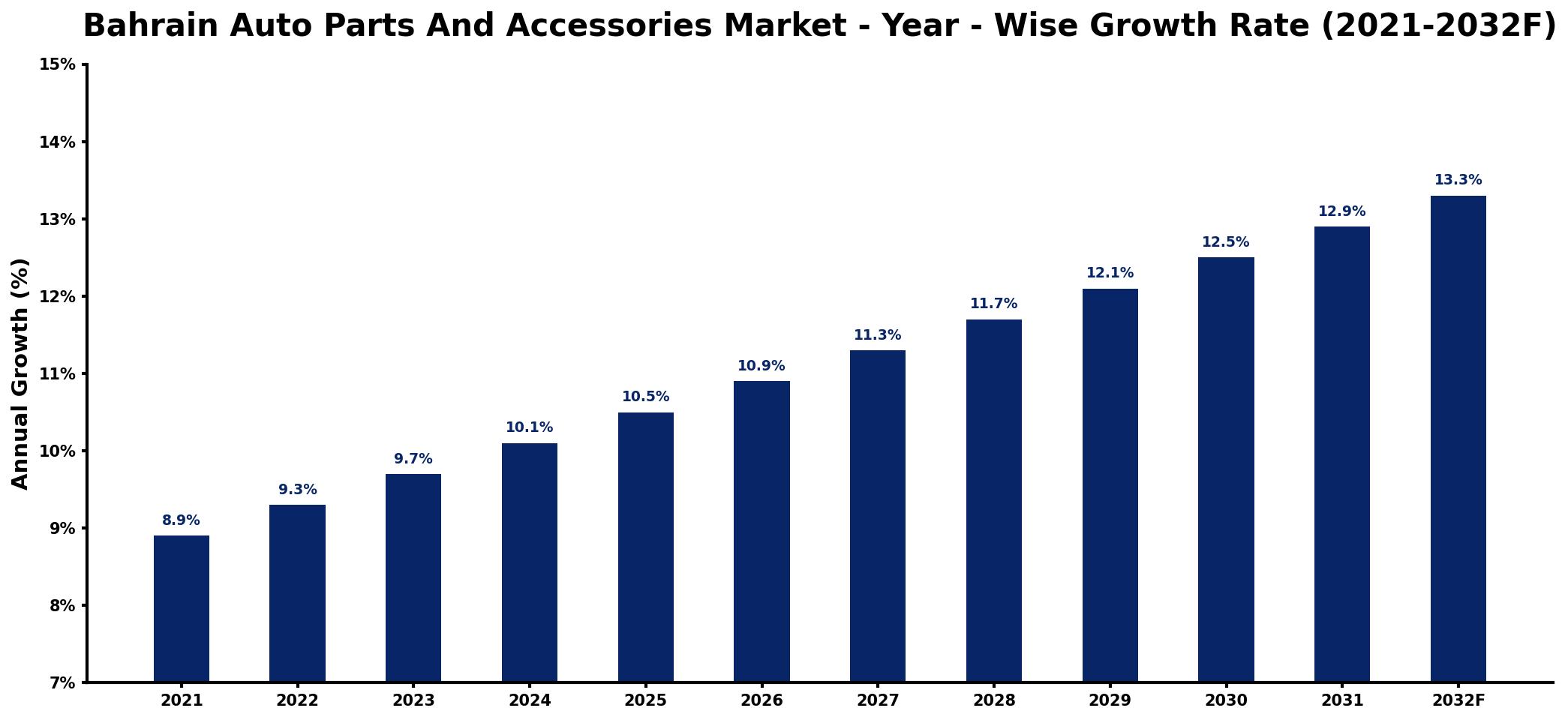
The table below presents the year‑wise growth rates along with the key drivers influencing the market
| Year | Growth Rate | Major Drivers |
| 2021 | 8.9% | Rising consumer vehicle ownership rates |
| 2022 | 9.3% | Increased demand for vehicle maintenance |
| 2023 | 9.7% | Growth in e-commerce distribution channels |
| 2024 | 10.1% | Expansion of local manufacturing facilities |
| 2025 | 10.5% | Boost in government infrastructure projects |
| 2026 | 10.9% | Increase in electric vehicle adoption |
| 2027 | 11.3% | Surge in online retail platforms |
| 2028 | 11.7% | increased capital investment inflows |
| 2029 | 12.1% | Rise in vehicle customization trends |
| 2030 | 12.5% | strengthening underlying market demand |
| 2031 | 12.9% | Increased foreign investment opportunities |
| 2032 | 13.3% | stronger distribution network expansion |
Note: Market size estimations and growth projections presented in this report are based on 6Wresearch's proprietary forecasting methodology, utilizing the latest available industry data, government publications, and primary research inputs.
Bahrain Auto Parts And Accessories Market Synopsis
Bahrain's auto parts and accessories market stands as a pivotal segment of the nation's vibrant automotive landscape, characterized by a deep-seated car culture. The increasing number of vehicles on the roads is creating significant demand across both OEMs and the aftermarket, ranging from engine components to aesthetic modifications.
Amid a burgeoning demand for both performance upgrades and essential maintenance parts, the aftermarket segment particularly thrives. The market is marked by the influence of global manufacturers who capitalize on Bahrain's strategic position within the GCC, ensuring consumers have access to a wide selection of automotive products.
Bahrain Auto Parts And Accessories Market Key Takeaways
- Growing vehicle ownership and demand for customization are key drivers of market expansion.
- The rise of e-commerce has transformed consumer access to auto parts, enhancing availability and transparency.
- A notable shift towards electric and hybrid vehicles is influencing the range of available products.
- Government initiatives are supporting the aftermarket trade through reduced tariffs and simplified import processes.
- The market presents significant investment opportunities, particularly in e-commerce and specialized retail.
Evaluation of Restraints in Bahrain Auto Parts And Accessories Market
Despite the market's positive outlook, several constraints hinder its full potential. High import tariffs and logistical costs create challenges for local suppliers, often making it difficult to compete with international firms that offer lower pricing. This scenario results in a saturated environment where both OEM and aftermarket products vie for consumer attention. Furthermore, fluctuations in the global economy can impact discretionary spending on automotive accessories, which may further constrain growth. Additionally, shifting consumer preferences towards eco-friendly and technologically advanced products necessitate adaptation from traditional suppliers, adding another layer of complexity to the market landscape.
Bahrain Auto Parts And Accessories Market Trends
Current trends in the Bahrain auto parts and accessories market showcase a growing appetite for vehicle customization and performance enhancement, particularly within the aftermarket segment. Consumers increasingly seek components that improve both the aesthetics and functionality of their vehicles. Simultaneously, the emergence of electric and hybrid vehicles is reshaping demand, prompting suppliers to innovate and broaden their product offerings. Moreover, the impact of digital commerce continues to grow, with online platforms providing consumers unprecedented access to a diverse range of auto components and enhancing pricing transparency.
Bahrain Auto Parts And Accessories Market Opportunities
As the vehicle population in Bahrain continues to grow, so too does the potential for investment within the auto parts and accessories market. Opportunities abound for entrants looking to explore wholesale distribution, e-commerce platforms, or specialized retail stores dedicated to aftermarket parts and tech enhancements. Additionally, the increasing consumer demand for vehicle customization presents a fertile ground for businesses catering to this niche, particularly as awareness of personalized modifications rises. With a focus on tech add-ons and styling accessories, stakeholders can tap into a dynamic market ripe for growth.
Government Initiatives in the Bahrain Auto Parts And Accessories Market
The Bahraini government plays a crucial role in fostering the growth of the auto parts and accessories market through various supportive initiatives. Trade policies are designed to facilitate aftermarket commerce by reducing tariffs and streamlining import processes, making it easier for businesses to operate within the sector. Additionally, stringent quality and safety regulations are enforced, ensuring that all imported accessories comply with GCC automotive standards. Such measures not only bolster market growth but also enhance consumer confidence in the quality and safety of automotive products available in Bahrain.
Future Insights of the Bahrain Auto Parts And Accessories Market
Looking ahead to the period from 2026 to 2032, the Bahrain Auto Parts and Accessories Market is poised for significant growth. With the consistent increase in vehicle ownership, coupled with a growing desire for vehicle personalization, the market is expected to flourish. The trend towards electric and hybrid vehicles will further compel suppliers to innovate, adapting their product lines to meet the evolving demands of consumers. Enhanced digital platforms will likely continue to transform purchasing behaviors, paving the way for a more accessible and diverse market environment.
Bahrain Auto Parts And Accessories Market Latest Developments (2025 - 2026)
Recent developments within the Bahrain auto parts and accessories market indicate a strategic shift towards the integration of technology in automotive products. Stakeholders are increasingly focusing on innovations that enhance vehicle performance and functionality. E-commerce platforms are also expanding their reach, providing consumers with more options than ever before while improving the transparency of pricing and product availability. As industry dynamics evolve, the emphasis on consumer education regarding new technologies is becoming a critical aspect of driving market engagement.
Bahrain Auto Parts And Accessories Market - Key Attractiveness of the Report
- 10 Years of Market Numbers
- Historical Data Starting from 2022 to 2025
- Base Year: 2025
- Forecast Data until 2032
- Key Performance Indicators Impacting the Market
- Major Upcoming Developments and Projects
Key Highlights of the Report:
- Bahrain Auto Parts And Accessories Market Outlook
- Market Size of Bahrain Auto Parts And Accessories Market, 2025
- Forecast of Bahrain Auto Parts And Accessories Market, 2032
- Historical Data and Forecast of Bahrain Auto Parts And Accessories Revenues & Volume for the Period 2022-2032F
- Bahrain Auto Parts And Accessories Market Trend Evolution
- Bahrain Auto Parts And Accessories Market Drivers and Challenges
- Bahrain Auto Parts And Accessories Price Trends
- Bahrain Auto Parts And Accessories Porter's Five Forces
- Bahrain Auto Parts And Accessories Industry Life Cycle
- Historical Data and Forecast of Bahrain Auto Parts And Accessories Market Revenues & Volume By Product for the Period 2022-2032F
- Historical Data and Forecast of Bahrain Auto Parts And Accessories Market Revenues & Volume By Driveline & Powertrain for the Period 2022-2032F
- Historical Data and Forecast of Bahrain Auto Parts And Accessories Market Revenues & Volume By Interiors & Exteriors for the Period 2022-2032F
- Historical Data and Forecast of Bahrain Auto Parts And Accessories Market Revenues & Volume By Electronics for the Period 2022-2032F
- Historical Data and Forecast of Bahrain Auto Parts And Accessories Market Revenues & Volume By Bodies & Chassis for the Period 2022-2032F
- Historical Data and Forecast of Bahrain Auto Parts And Accessories Market Revenues & Volume By Wheel & Tires for the Period 2022-2032F
- Historical Data and Forecast of Bahrain Auto Parts And Accessories Market Revenues & Volume By Others for the Period 2022-2032F
- Historical Data and Forecast of Bahrain Auto Parts And Accessories Market Revenues & Volume By Application for the Period 2022-2032F
- Historical Data and Forecast of Bahrain Auto Parts And Accessories Market Revenues & Volume By OEMs for the Period 2022-2032F
- Historical Data and Forecast of Bahrain Auto Parts And Accessories Market Revenues & Volume By Aftermarket for the Period 2022-2032F
- Bahrain Auto Parts And Accessories Import Export Trade Statistics
- Market Opportunity Assessment By Product
- Market Opportunity Assessment By Application
- Bahrain Auto Parts And Accessories Top Companies Market Share
- Bahrain Auto Parts And Accessories Competitive Benchmarking By Technical and Operational Parameters
- Bahrain Auto Parts And Accessories Company Profiles
- Bahrain Auto Parts And Accessories Key Strategic Recommendations






































