Bahrain Cold Chain Market Size, Share & Growth Rate
The Bahrain Cold Chain Market was estimated at USD 1072 Million in 2025 and is projected to reach USD 1888 Million by 2032, growing at a CAGR of 8.4% from 2026 to 2032. This impressive trajectory is largely fueled by the booming pharmaceuticals, dairy, and fresh produce sectors, where temperature-controlled logistics are paramount. The increasing importation of perishable goods and the expansion of e-commerce grocery platforms are also significant contributors to this growing demand.
Bahrain Cold Chain Market Year-wise Growth Rate and Key Drivers
This graph highlights how the Bahrain Cold Chain Market has steadily grown over the years, supported by major growth factors.
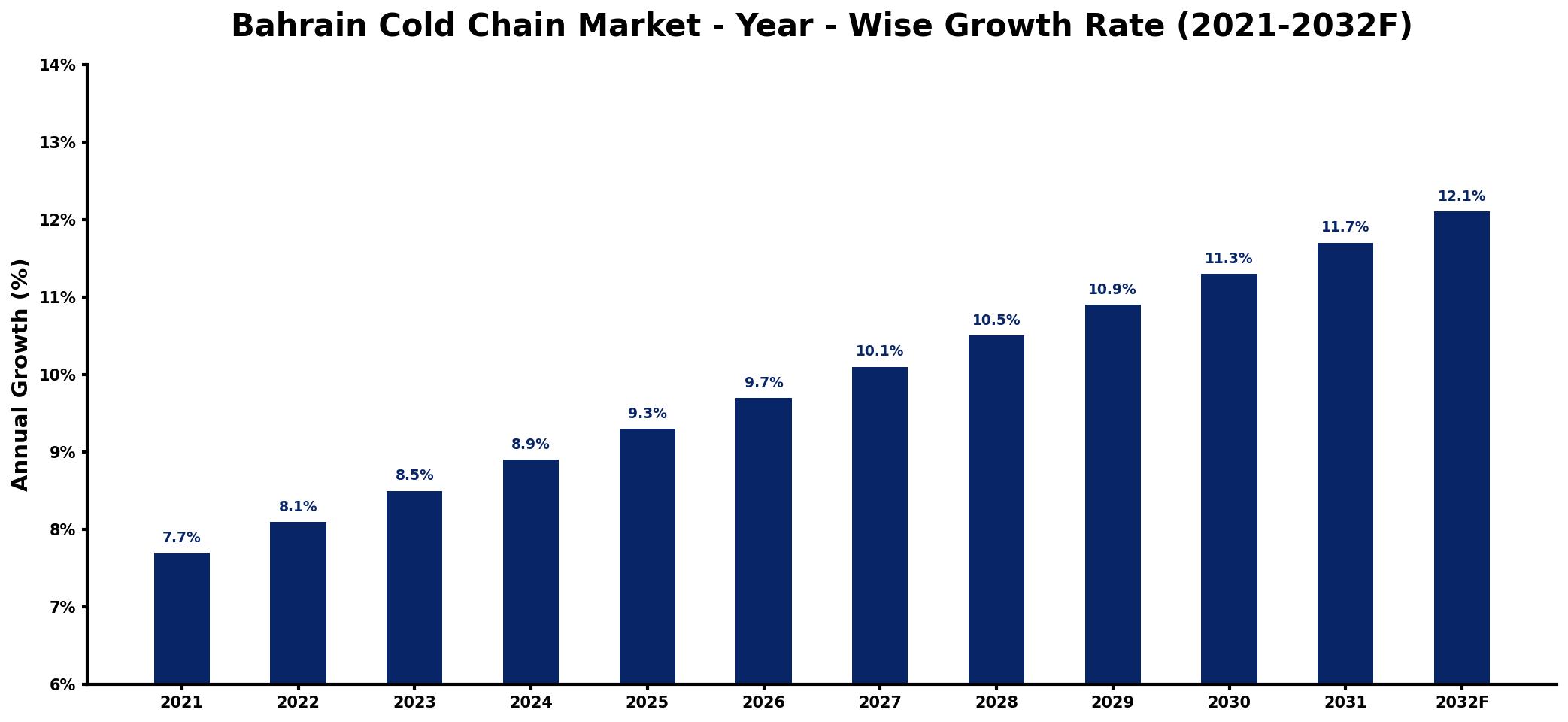
The table below presents the year‑wise growth rates along with the key drivers influencing the market
| Year | Growth Rate | Major Drivers |
| 2021 | 7.7% | Increased demand for pharmaceuticals |
| 2022 | 8.1% | Expansion of e-commerce logistics |
| 2023 | 8.5% | Growth in perishable food imports |
| 2024 | 8.9% | Rising consumer health awareness |
| 2025 | 9.3% | Investments in logistics infrastructure |
| 2026 | 9.7% | Technological advancements in monitoring |
| 2027 | 10.1% | Emergence of new market players |
| 2028 | 10.5% | Enhanced regulatory compliance requirements |
| 2029 | 10.9% | Growing demand for organic products |
| 2030 | 11.3% | Increased focus on sustainability practices |
| 2031 | 11.7% | Development of regional trade agreements |
| 2032 | 12.1% | increased production capacity utilization |
Note: Market size estimations and growth projections presented in this report are based on 6Wresearch's proprietary forecasting methodology, utilizing the latest available industry data, government publications, and primary research inputs.
Bahrain Cold Chain Market Synopsis
The cold chain market in Bahrain has witnessed notable momentum recently, reflecting a robust response to evolving consumer needs and regulatory demands. However, as we look ahead, this market is expected to undergo transformative growth, driven by continued investments in infrastructure and technology.
Efforts from both public and private sectors aim to enhance the efficiency and reliability of temperature-sensitive logistics, which are crucial in safeguarding product integrity across various industries. The commitment to modernizing cold storage facilities and refrigerated transport systems indicates a promising future for the Bahrain Cold Chain Market.
Bahrain Cold Chain Market Key Takeaways
- The Bahrain Cold Chain Market is witnessing rapid growth across pharmaceuticals, dairy, and fresh produce sectors.
- Strategic investments in cold storage infrastructure are essential for maintaining product quality and regulatory compliance.
- Digital monitoring and energy efficiency are emerging focal points in the logistics landscape.
- Government initiatives are designed to bolster food security and modernize cold chain logistics.
- The rise of e-commerce grocery platforms significantly contributes to the demand for temperature-sensitive logistics.
Evaluation of Restraints in Bahrain Cold Chain Market
Despite its growth, the Bahrain Cold Chain Market faces significant hurdles that impede its full potential. Infrastructure limitations continue to pose a challenge, particularly regarding refrigeration and transportation capabilities. These constraints make it difficult to ensure the integrity of temperature-sensitive products in the food, pharmaceutical, and healthcare sectors. Additionally, the burden of rising energy costs associated with refrigeration further complicates operations, while the need for compliance with international standards adds another layer of complexity for market participants. The increasing demand for global supply chains necessitates continuous investment in advanced cold chain technologies to meet these challenges.
Bahrain Cold Chain Market Trends
Emerging trends in the Bahrain Cold Chain Market reflect a significant shift towards digitalization and sustainability. Companies are increasingly adopting advanced technologies for real-time temperature monitoring and tracking, which enhances product safety and compliance. Moreover, there is a growing emphasis on energy-efficient solutions that mitigate operational costs while addressing environmental concerns. The integration of artificial intelligence and IoT in logistics is likely to reshape the cold chain landscape, making it more responsive and adaptive to market needs.
Bahrain Cold Chain Market Opportunities
The expanding demand for temperature-sensitive products creates numerous growth opportunities within the Bahrain Cold Chain Market. Investors can explore establishing state-of-the-art cold chain facilities that cater to both local and regional markets. Additionally, there is ample scope for offering technology-driven solutions aimed at optimizing temperature monitoring, increasing energy efficiency, and enhancing product safety. With government backing for initiatives that focus on food security and infrastructure modernization, the potential for successful investments in this space is significant.
Government Initiatives in the Bahrain Cold Chain Market
The role of the government in the Bahrain Cold Chain Market is pivotal, as various initiatives seek to strengthen the country's food safety, pharmaceuticals, and agricultural sectors. Policies aimed at improving infrastructure for temperature-controlled logistics are being implemented to minimize food wastage and ensure the efficacy of medications. Support for investments in modern refrigerated storage, transportation, and digital tracking systems is also a priority. Notably, Bahrain's National Food Security Strategy is aligned with bolstering cold chain logistics to enhance supply chain resilience and sustainability.
Future Insights of the Bahrain Cold Chain Market
Looking ahead to 2026-2032, the Bahrain Cold Chain Market is poised for substantial growth, propelled by ongoing investments and technological advancements. The convergence of increased consumer demand for perishable goods and the continuous push for food safety will shape the direction of this sector. As stakeholders prioritize sustainability and efficiency, the adoption of cutting-edge solutions will drive operational excellence and position the market for a robust future.
Bahrain Cold Chain Market Latest Developments (2025 - 2026)
In recent months, the Bahrain Cold Chain Market has seen a flurry of activity as industry players focus on enhancing their logistics capabilities. Investments in state-of-the-art refrigerated transport and advanced cold storage facilities are increasing, reflecting a proactive approach to meet the demands of an evolving market landscape. Furthermore, there is a marked trend towards adopting innovative digital solutions to improve tracking and monitoring systems, ensuring product integrity throughout the supply chain.
Bahrain Cold Chain Market - Key Attractiveness of the Report
- 10 Years of Market Numbers
- Historical Data Starting from 2022 to 2025
- Base Year: 2025
- Forecast Data until 2032
- Key Performance Indicators Impacting the Market
- Major Upcoming Developments and Projects
Key Highlights of the Report:
- Bahrain Cold Chain Market Outlook
- Market Size of Bahrain Cold Chain Market, 2025
- Forecast of Bahrain Cold Chain Market, 2032
- Historical Data and Forecast of Bahrain Cold Chain Revenues & Volume for the Period 2022-2032F
- Bahrain Cold Chain Market Trend Evolution
- Bahrain Cold Chain Market Drivers and Challenges
- Bahrain Cold Chain Price Trends
- Bahrain Cold Chain Porter's Five Forces
- Bahrain Cold Chain Industry Life Cycle
- Historical Data and Forecast of Bahrain Cold Chain Market Revenues & Volume By Temperature Type for the Period 2022-2032F
- Historical Data and Forecast of Bahrain Cold Chain Market Revenues & Volume By Frozen for the Period 2022-2032F
- Historical Data and Forecast of Bahrain Cold Chain Market Revenues & Volume By Chilled for the Period 2022-2032F
- Historical Data and Forecast of Bahrain Cold Chain Market Revenues & Volume By Type for the Period 2022-2032F
- Historical Data and Forecast of Bahrain Cold Chain Market Revenues & Volume By Refrigerated warehousing for the Period 2022-2032F
- Historical Data and Forecast of Bahrain Cold Chain Market Revenues & Volume By Refrigerated transport for the Period 2022-2032F
- Historical Data and Forecast of Bahrain Cold Chain Market Revenues & Volume By Application for the Period 2022-2032F
- Historical Data and Forecast of Bahrain Cold Chain Market Revenues & Volume By Dairy & frozen desserts for the Period 2022-2032F
- Historical Data and Forecast of Bahrain Cold Chain Market Revenues & Volume By Fish, meat, and seafood products for the Period 2022-2032F
- Historical Data and Forecast of Bahrain Cold Chain Market Revenues & Volume By Bakery & confectionery products for the Period 2022-2032F
- Historical Data and Forecast of Bahrain Cold Chain Market Revenues & Volume By Fruits & vegetables for the Period 2022-2032F
- Historical Data and Forecast of Bahrain Cold Chain Market Revenues & Volume By Others for the Period 2022-2032F
- Bahrain Cold Chain Import Export Trade Statistics
- Market Opportunity Assessment By Temperature Type
- Market Opportunity Assessment By Type
- Market Opportunity Assessment By Application
- Bahrain Cold Chain Top Companies Market Share
- Bahrain Cold Chain Competitive Benchmarking By Technical and Operational Parameters
- Bahrain Cold Chain Company Profiles
- Bahrain Cold Chain Key Strategic Recommendations






































