Bahrain Dill Seed Oil Market Size, Share & Growth Rate
The Bahrain Dill Seed Oil Market was estimated at USD 947 Million in 2025 and is projected to reach USD 1641 Million by 2032, growing at a CAGR of 8.2% from 2026 to 2032. This robust growth trajectory is primarily driven by the rising consumer preference for natural essential oils across various sectors including food, pharmaceuticals, and cosmetics. As health-conscious consumers increasingly seek out natural ingredients, the demand for dill seed oil as a flavor enhancer and medicinal oil is set to expand significantly.
Bahrain Dill Seed Oil Market Year-wise Growth Rate and Key Drivers
This graph highlights how the Bahrain Dill Seed Oil Market has steadily grown over the years, supported by major growth factors.
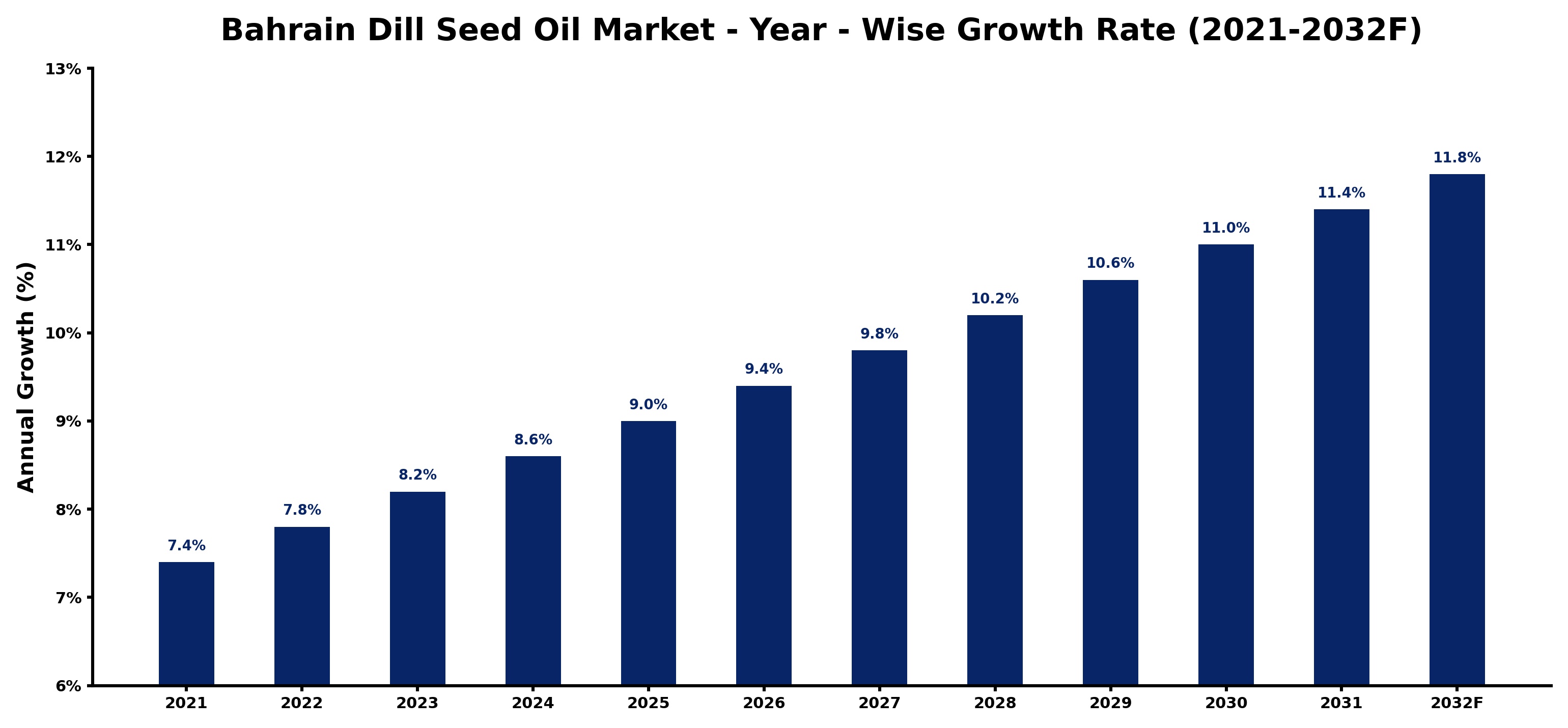
The table below presents the year‑wise growth rates along with the key drivers influencing the market
| Year | Growth Rate | Major Drivers |
| 2021 | 7.4% | Increasing industrial automation investments |
| 2022 | 7.8% | Expansion of transportation and logistics networks |
| 2023 | 8.2% | Government infrastructure modernization initiatives |
| 2024 | 8.6% | Increasing industrial automation investments |
| 2025 | 9.0% | Increasing adoption of advanced technologies |
| 2026 | 9.4% | Expansion of commercial construction activities |
| 2027 | 9.8% | Growing urbanization and commercial development |
| 2028 | 10.2% | Rising electricity demand across industries |
| 2029 | 10.6% | Growing urbanization and commercial development |
| 2030 | 11.0% | Expansion of commercial construction activities |
| 2031 | 11.4% | Rapid growth in telecom and data center sectors |
| 2032 | 11.8% | Growing renewable energy integration projects |
Note - Market size estimations and growth projections presented in this report are based on 6Wresearch’s advanced forecasting approach, validated with industry datasets as of June 2026.
Bahrain Dill Seed Oil Market Synopsis
In Bahrain, dill seed oil is gaining recognition for its diverse applications in culinary uses, as well as its medicinal benefits, particularly in digestive health. With increasing awareness of natural remedies, this oil is becoming a staple in both home kitchens and herbal healthcare practices.
Furthermore, the essential oil's role in the personal care sector cannot be overstated. As consumers gravitate towards organic and natural skincare products, the incorporation of dill seed oil into formulations is expected to drive its market presence. This is particularly significant as Bahrain's cosmetics industry continues to evolve towards more holistic offerings.
Bahrain Dill Seed Oil Market Key Takeaways
- The market is experiencing an upward trend due to increased consumer interest in natural and herbal products.
- Demand is significantly influenced by the oil's applications in the food, pharmaceutical, and cosmetics sectors.
- Growing awareness around the health benefits of dill seed oil is fostering a more informed consumer base.
- Investment opportunities exist particularly in supplying therapeutic-grade oil for herbal remedies.
- Government support for local agriculture and essential oil industries aids market growth.
Evaluation of Restraints in Bahrain Dill Seed Oil Market
Despite its promising potential, the Bahrain dill seed oil market faces notable challenges. The market is constrained by a limited consumer base, as dill seed oil remains largely unfamiliar to the general public outside niche markets like aromatherapy. Additionally, the high cost of production paired with a scarcity of raw dill seeds complicates supply chain efficiency. The market's dependency on imports also raises vulnerability to supply disruptions, while insufficient consumer education about the benefits of dill seed oil inhibits broader acceptance and usage.
Bahrain Dill Seed Oil Market Trends
One of the prevailing trends in the Bahrain dill seed oil market is the increasing popularity of natural products, driven by health-conscious consumers. This trend is reflected in the rising use of dill seed oil in food preservation and flavoring, as well as its incorporation into cosmetic formulations. Additionally, the growing trend of integrating wellness practices into daily routines is paving the way for greater utilization of dill seed oil in holistic health applications, including aromatherapy and stress relief.
Bahrain Dill Seed Oil Market Opportunities
The opportunities for investment in the Bahrain dill seed oil market are promising. As the food and beverage sector continues to flourish, the need for natural flavoring agents will likely increase, providing a ripe environment for dill seed oil producers. Moreover, tapping into the pharmaceutical sector for therapeutic applications can open new pathways for growth. With consumers increasingly favoring organic and natural products, the potential for new product development using dill seed oil in personal care and wellness categories is significant.
Government Initiatives in the Bahrain Dill Seed Oil Market
The Bahraini government is actively fostering the growth of the dill seed oil market through policies aimed at enhancing local agriculture and supporting the essential oils industry. Regulations are in place to ensure quality, safety, and authenticity in essential oil production, aligning with international standards. Additionally, initiatives promoting the use of natural and organic products, along with support for small to medium-sized enterprises (SMEs), contribute positively to market development.
Future Insights of the Bahrain Dill Seed Oil Market
Looking ahead to 2026-2032, the Bahrain dill seed oil market is poised for substantial growth. The expanding consumer awareness of health benefits associated with natural oils will likely drive demand. Moreover, as the food and personal care industries continue to evolve towards more natural formulations, dill seed oil is expected to find an increasingly prominent place. Strengthening local production capabilities and enhancing consumer education will be critical for realizing the market's full potential.
Bahrain Dill Seed Oil Market Latest Developments (May 2025 - June 2026)
Recent developments in the Bahrain dill seed oil market have indicated a positive trend toward increased consumer engagement and awareness. Industry stakeholders are focusing on educational campaigns that highlight the benefits of dill seed oil in various applications. Concurrently, there is a concerted effort to enhance the supply chain for raw materials, which may lead to reduced costs and better availability. These developments align with broader global trends toward sustainability and health consciousness.
Bahrain Dill Seed Oil Market - Key Attractiveness of the Report
- 10 Years of Market Numbers
- Historical Data Starting from 2022 to 2025
- Base Year: 2025
- Forecast Data until 2032
- Key Performance Indicators Impacting the Market
- Major Upcoming Developments and Projects
Key Highlights of the Report:
- Bahrain Dill Seed Oil Market Outlook
- Market Size of Bahrain Dill Seed Oil Market, 2025
- Forecast of Bahrain Dill Seed Oil Market, 2032
- Historical Data and Forecast of Bahrain Dill Seed Oil Revenues & Volume for the Period 2022-2032F
- Bahrain Dill Seed Oil Market Trend Evolution
- Bahrain Dill Seed Oil Market Drivers and Challenges
- Bahrain Dill Seed Oil Price Trends
- Bahrain Dill Seed Oil Porter's Five Forces
- Bahrain Dill Seed Oil Industry Life Cycle
- Historical Data and Forecast of Bahrain Dill Seed Oil Market Revenues & Volume By Type for the Period 2022-2032F
- Historical Data and Forecast of Bahrain Dill Seed Oil Market Revenues & Volume By Anethum Graveolens Seed Oil for the Period 2022-2032F
- Historical Data and Forecast of Bahrain Dill Seed Oil Market Revenues & Volume By Anethum Sowa Seed Oil for the Period 2022-2032F
- Historical Data and Forecast of Bahrain Dill Seed Oil Market Revenues & Volume By Application for the Period 2022-2032F
- Historical Data and Forecast of Bahrain Dill Seed Oil Market Revenues & Volume By Flavor for the Period 2022-2032F
- Historical Data and Forecast of Bahrain Dill Seed Oil Market Revenues & Volume By Fragrance for the Period 2022-2032F
- Historical Data and Forecast of Bahrain Dill Seed Oil Market Revenues & Volume By Pharmaceutical for the Period 2022-2032F
- Historical Data and Forecast of Bahrain Dill Seed Oil Market Revenues & Volume By Skincare for the Period 2022-2032F
- Historical Data and Forecast of Bahrain Dill Seed Oil Market Revenues & Volume By Aromatherapy for the Period 2022-2032F
- Bahrain Dill Seed Oil Import Export Trade Statistics
- Market Opportunity Assessment By Type
- Market Opportunity Assessment By Application
- Bahrain Dill Seed Oil Top Companies Market Share
- Bahrain Dill Seed Oil Competitive Benchmarking By Technical and Operational Parameters
- Bahrain Dill Seed Oil Company Profiles
- Bahrain Dill Seed Oil Key Strategic Recommendations






































