Oman Dill Seed Oil Market Size, Share & Growth Rate
The Oman Dill Seed Oil Market was estimated at USD 439 Million in 2025 and is projected to reach USD 626 Million by 2032, growing at a CAGR of 5.2% from 2026 to 2032. This growth trajectory is largely driven by the increasing demand for natural health products, particularly in the pharmaceutical and cosmetics industries. As consumers become more health-conscious and seek out organic alternatives, the appeal of dill seed oil is expected to expand further.
Oman Dill Seed Oil Market Year-wise Growth Rate and Key Drivers
This graph highlights how the Oman Dill Seed Oil Market has steadily grown over the years, supported by major growth factors.
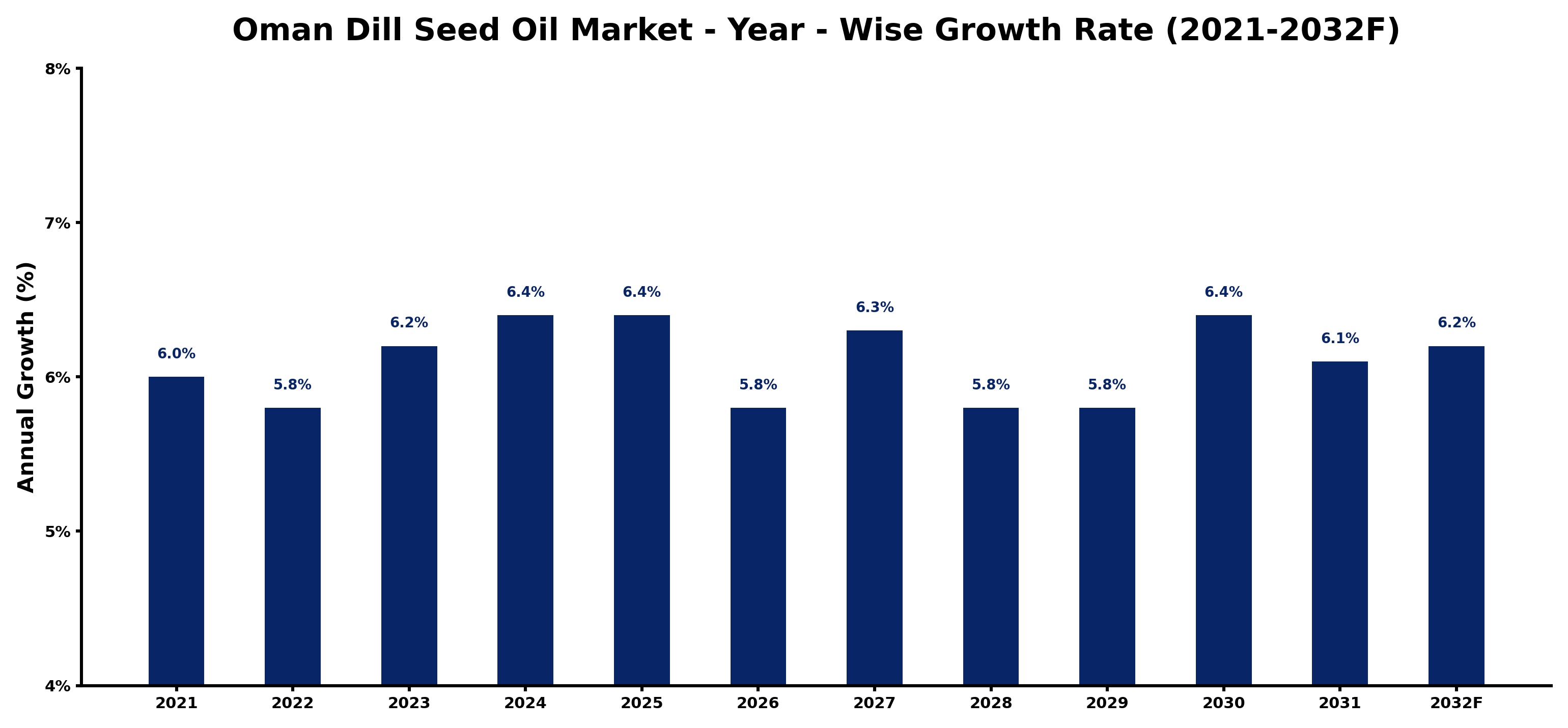
The table below presents the year‑wise growth rates along with the key drivers influencing the market
| Year | Growth Rate | Major Drivers |
| 2021 | 6.0% | Government infrastructure modernization initiatives |
| 2022 | 5.8% | Expansion of manufacturing activities |
| 2023 | 6.2% | Expansion of manufacturing activities |
| 2024 | 6.4% | Rapid growth in telecom and data center sectors |
| 2025 | 6.4% | Growing renewable energy integration projects |
| 2026 | 5.8% | Expansion of commercial construction activities |
| 2027 | 6.3% | Increasing industrial automation investments |
| 2028 | 5.8% | Government infrastructure modernization initiatives |
| 2029 | 5.8% | Growing urbanization and commercial development |
| 2030 | 6.4% | Expansion of manufacturing activities |
| 2031 | 6.1% | Growing renewable energy integration projects |
| 2032 | 6.2% | Increasing adoption of advanced technologies |
Note - Market size estimations and growth projections presented in this report are based on 6Wresearch's advanced forecasting approach, validated with industry datasets as of June 2026.
Oman Dill Seed Oil Market Synopsis
Currently, the most influential force shaping the Oman Dill Seed Oil Market is the growing awareness of the numerous health benefits associated with dill seed oil consumption. This awareness is translating into increased interest among consumers, which in turn propels demand across various sectors including food, personal care, and wellness.
Moreover, the market is characterized by a rising trend towards natural and organic products. Consumers are moving away from synthetic alternatives, favoring dill seed oil for its anti-inflammatory and antimicrobial properties, further solidifying its role in diverse product formulations.
Oman Dill Seed Oil Market Key Takeaways
- Demand for dill seed oil is being significantly driven by health-conscious consumers seeking natural products.
- Consumer awareness regarding the health benefits of dill seed oil is pivotal to market growth.
- Oman's strategic location enhances its potential for exports to international markets.
- Investment opportunities exist in production facilities and distribution channels due to market expansion.
- Government initiatives are fostering the essential oil sector, supporting local producers and enhancing quality.
Evaluation of Restraints in Oman Dill Seed Oil Market
Despite the positive outlook, several factors are limiting the Oman Dill Seed Oil Market's full potential. A significant challenge is the limited consumer awareness regarding the myriad benefits of dill seed oil, which can affect overall demand. Additionally, the market faces competition from more established essential oils that have a stronger market presence. Supply chain disruptions, such as inconsistent quality and raw material price fluctuations, also pose risks to market stability. Lastly, regulatory constraints and the lack of standardization in production practices can hinder growth and complicate market entry for new players.
Oman Dill Seed Oil Market Trends
A noticeable trend in the Oman Dill Seed Oil Market is the push towards product innovation and diversification. Manufacturers are increasingly exploring new formulations and applications for dill seed oil, which cater to a broader spectrum of consumer preferences. Additionally, the rise of aromatherapy as a popular wellness practice is further amplifying demand for this essential oil. Moreover, a shift towards sustainable sourcing practices is becoming a focal point, influencing both production methods and marketing strategies.
Oman Dill Seed Oil Market Opportunities
There exists a wealth of investment opportunities in the Oman Dill Seed Oil Market. As the appetite for natural and organic ingredients continues to surge, investors can benefit from establishing production facilities or forming partnerships with local farmers for sustainable sourcing. Expanding distribution networks is crucial to tap into the growing global demand. Oman's geographic advantages facilitate access to international markets, providing additional prospects for exporting high-quality dill seed oil. Comprehensive market research will be essential for investors to navigate consumer preferences effectively.
Government Initiatives in the Oman Dill Seed Oil Market
Oman's government has implemented several initiatives aimed at bolstering the essential oils sector, particularly dill seed oil. Support includes subsidies for local producers, training programs to enhance production efficiency, and infrastructure development to improve supply chains. Additionally, regulations are in place to uphold product quality and safety standards, ensuring compliance with international norms. Research and development efforts are also encouraged, fostering innovation and competitive positioning within the global market.
Future Insights of the Oman Dill Seed Oil Market
Looking ahead to 2026-2032, the outlook for the Oman Dill Seed Oil Market is bright. The anticipated increase in health consciousness and preference for natural products is likely to drive further demand for dill seed oil. Its varied applications in pharmaceuticals, cosmetics, and food will solidify its importance in these sectors. While challenges such as price volatility and consumer education remain, strategic marketing, product diversification, and enhanced distribution will help fuel the market's growth trajectory, establishing Oman as a significant player in the global essential oils market.
Oman Dill Seed Oil Market Latest Developments (May 2025 - June 2026)
Recent developments in the Oman Dill Seed Oil Market indicate a robust shift towards sustainable production practices, with an increasing number of companies exploring eco-friendly extraction methods. Moreover, collaboration between local farmers and producers has strengthened supply chains, ensuring quality consistency. Additionally, there has been a notable rise in consumer education campaigns focused on the benefits of dill seed oil, enhancing market penetration and consumer acceptance.
Oman Dill Seed Oil Market - Key Attractiveness of the Report
- 10 Years of Market Numbers
- Historical Data Starting from 2022 to 2025
- Base Year: 2025
- Forecast Data until 2032
- Key Performance Indicators Impacting the Market
- Major Upcoming Developments and Projects
Key Highlights of the Report:
- Oman Dill Seed Oil Market Outlook
- Market Size of Oman Dill Seed Oil Market, 2025
- Forecast of Oman Dill Seed Oil Market, 2032
- Historical Data and Forecast of Oman Dill Seed Oil Revenues & Volume for the Period 2022-2032F
- Oman Dill Seed Oil Market Trend Evolution
- Oman Dill Seed Oil Market Drivers and Challenges
- Oman Dill Seed Oil Price Trends
- Oman Dill Seed Oil Porter's Five Forces
- Oman Dill Seed Oil Industry Life Cycle
- Historical Data and Forecast of Oman Dill Seed Oil Market Revenues & Volume By Type for the Period 2022-2032F
- Historical Data and Forecast of Oman Dill Seed Oil Market Revenues & Volume By Anethum Graveolens Seed Oil for the Period 2022-2032F
- Historical Data and Forecast of Oman Dill Seed Oil Market Revenues & Volume By Anethum Sowa Seed Oil for the Period 2022-2032F
- Historical Data and Forecast of Oman Dill Seed Oil Market Revenues & Volume By Application for the Period 2022-2032F
- Historical Data and Forecast of Oman Dill Seed Oil Market Revenues & Volume By Flavor for the Period 2022-2032F
- Historical Data and Forecast of Oman Dill Seed Oil Market Revenues & Volume By Fragrance for the Period 2022-2032F
- Historical Data and Forecast of Oman Dill Seed Oil Market Revenues & Volume By Pharmaceutical for the Period 2022-2032F
- Historical Data and Forecast of Oman Dill Seed Oil Market Revenues & Volume By Skincare for the Period 2022-2032F
- Historical Data and Forecast of Oman Dill Seed Oil Market Revenues & Volume By Aromatherapy for the Period 2022-2032F
- Oman Dill Seed Oil Import Export Trade Statistics
- Market Opportunity Assessment By Type
- Market Opportunity Assessment By Application
- Oman Dill Seed Oil Top Companies Market Share
- Oman Dill Seed Oil Competitive Benchmarking By Technical and Operational Parameters
- Oman Dill Seed Oil Company Profiles
- Oman Dill Seed Oil Key Strategic Recommendations






































