Iraq Dill Seed Oil Market Size, Share & Growth Rate
The Iraq Dill Seed Oil Market was estimated at USD 383 Million in 2025 and is projected to reach USD 535 Million by 2032, growing at a CAGR of 4.9% from 2026 to 2032. This growth trajectory is primarily driven by an increasing consumer awareness regarding the health benefits of dill seed oil, alongside a growing inclination towards natural and organic products. As consumers in Iraq become more health-conscious, the demand for dill seed oil in culinary and therapeutic applications is also expected to rise.
Iraq Dill Seed Oil Market Year-wise Growth Rate and Key Drivers
This graph highlights how the Iraq Dill Seed Oil Market has steadily grown over the years, supported by major growth factors.
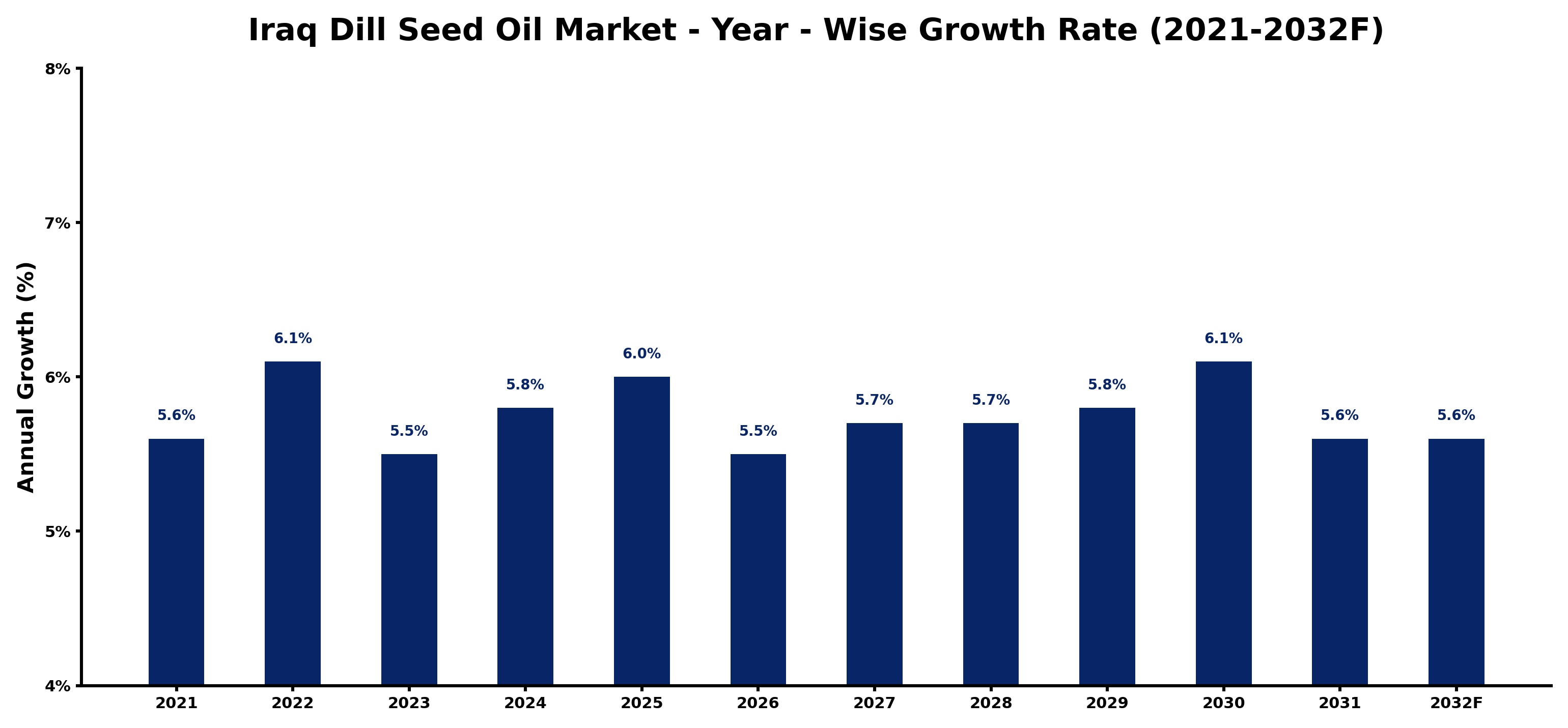
The table below presents the year‑wise growth rates along with the key drivers influencing the market
| Year | Growth Rate | Major Drivers |
| 2021 | 5.6% | Expansion of transportation and logistics networks |
| 2022 | 6.1% | Rising electricity demand across industries |
| 2023 | 5.5% | Increasing adoption of advanced technologies |
| 2024 | 5.8% | Growing urbanization and commercial development |
| 2025 | 6.0% | Expansion of commercial construction activities |
| 2026 | 5.5% | Increasing adoption of advanced technologies |
| 2027 | 5.7% | Expansion of manufacturing activities |
| 2028 | 5.7% | Increasing industrial infrastructure investments |
| 2029 | 5.8% | Rapid growth in telecom and data center sectors |
| 2030 | 6.1% | Increasing smart city development projects |
| 2031 | 5.6% | Rapid growth in telecom and data center sectors |
| 2032 | 5.6% | Government infrastructure modernization initiatives |
Note - Market size estimations and growth projections presented in this report are based on 6Wresearch’s advanced forecasting approach, validated with industry datasets as of June 2026.
Iraq Dill Seed Oil Market Synopsis
Recent momentum in the Iraq Dill Seed Oil market reflects a transition towards natural health solutions, with an increasing number of consumers opting for organic products. However, despite the current upward trend, challenges such as limited raw material availability and counterfeit products continue to pose risks that could impact future growth.
Looking ahead, the market is anticipated to flourish, fueled by a rise in health consciousness among consumers and an expanding appreciation for the medicinal properties of dill seed oil. With the integration of ethical sourcing practices and innovative product development, the future of this market appears promising.
Iraq Dill Seed Oil Market Key Takeaways
- Growing consumer awareness of the health benefits of dill seed oil is boosting demand across multiple sectors.
- The shift towards organic and natural products is significantly impacting market dynamics.
- Challenges related to raw material sourcing and product quality persist but are being addressed through investment in local agriculture.
- Government initiatives are aimed at enhancing production capabilities and market access for dill seed oil producers.
- Investment opportunities abound, particularly in production facilities and sustainable practices.
Evaluation of Restraints in Iraq Dill Seed Oil Market
The Iraq Dill Seed Oil market is currently hampered by several constraints that inhibit its growth potential. A significant barrier is the limited awareness among consumers regarding the benefits of dill seed oil, which impacts market penetration. Furthermore, the lack of standardized quality control measures leads to inconsistencies in product quality, deterring some potential buyers. Political instability and security concerns in Iraq also disrupt supply chains, affecting both production and distribution processes. Finally, competition from other essential oils and synthetic alternatives challenges the market's capacity to attract consumers.
Iraq Dill Seed Oil Market Trends
Current trends in the Iraq Dill Seed Oil market are characterized by an increased demand for organic and natural products, fueled by health-conscious consumer behavior. The growing popularity of essential oils across various sectors, including cosmetics, pharmaceuticals, and food & beverage, underscores a significant market shift. Additionally, the move towards sustainable practices is encouraging manufacturers to adopt eco-friendly production methods. Innovations in product formulations and packaging are also enhancing the appeal of dill seed oil, emphasizing quality and authenticity.
Iraq Dill Seed Oil Market Opportunities
The Iraq Dill Seed Oil market presents numerous investment opportunities, particularly in the context of rising consumer demand for natural and organic products. Investing in the production and processing of dill seed oil can be highly lucrative, given its recognized health benefits and versatility in various applications, including aromatherapy. Moreover, there is a notable trend towards clean label products, which aligns well with the market's focus on dill seed oil. Strategic partnerships with local farmers can also ensure a consistent supply of high-quality raw materials, further enhancing market potential.
Government Initiatives in the Iraq Dill Seed Oil Market
Government policies in Iraq are increasingly aimed at promoting agricultural growth and enhancing export opportunities for dill seed oil. Various incentives have been introduced to encourage farmers to cultivate dill seeds, alongside infrastructure improvements for transportation and storage. Furthermore, the government is committed to ensuring product quality and safety through regulatory measures, which include production standards and labeling requirements. These initiatives are crucial for boosting the competitiveness of the Iraq Dill Seed Oil market on both domestic and international fronts.
Future Insights of the Iraq Dill Seed Oil Market
The future outlook for the Iraq Dill Seed Oil market appears optimistic as consumer awareness about the oil's health benefits continues to grow. The expanding trend towards natural remedies and aromatherapy is expected to bolster demand across various industries, including cosmetics and food. Furthermore, ongoing research and development efforts are likely to enhance the quality and efficacy of dill seed oil, ensuring its relevance in the evolving market landscape. Despite potential challenges such as fluctuating raw material prices, the overall trajectory points toward a robust growth phase for the market from 2026 to 2032.
Iraq Dill Seed Oil Market Latest Developments (May 2025 - June 2026)
In recent months, the Iraq Dill Seed Oil market has witnessed a notable shift towards more sustainable practices, with several producers adopting eco-friendly production methods. This transition is complemented by an increase in collaborative efforts between farmers and manufacturers aimed at improving product quality and availability. Furthermore, educational initiatives are being implemented to raise consumer awareness about the benefits of dill seed oil, thereby enhancing market acceptance. These developments signal a positive direction for the industry as it adapts to changing consumer preferences and market dynamics.
Iraq Dill Seed Oil Market - Key Attractiveness of the Report
- 10 Years of Market Numbers
- Historical Data Starting from 2022 to 2025
- Base Year: 2025
- Forecast Data until 2032
- Key Performance Indicators Impacting the Market
- Major Upcoming Developments and Projects
Key Highlights of the Report:
- Iraq Dill Seed Oil Market Outlook
- Market Size of Iraq Dill Seed Oil Market, 2025
- Forecast of Iraq Dill Seed Oil Market, 2032
- Historical Data and Forecast of Iraq Dill Seed Oil Revenues & Volume for the Period 2022-2032F
- Iraq Dill Seed Oil Market Trend Evolution
- Iraq Dill Seed Oil Market Drivers and Challenges
- Iraq Dill Seed Oil Price Trends
- Iraq Dill Seed Oil Porter's Five Forces
- Iraq Dill Seed Oil Industry Life Cycle
- Historical Data and Forecast of Iraq Dill Seed Oil Market Revenues & Volume By Type for the Period 2022-2032F
- Historical Data and Forecast of Iraq Dill Seed Oil Market Revenues & Volume By Anethum Graveolens Seed Oil for the Period 2022-2032F
- Historical Data and Forecast of Iraq Dill Seed Oil Market Revenues & Volume By Anethum Sowa Seed Oil for the Period 2022-2032F
- Historical Data and Forecast of Iraq Dill Seed Oil Market Revenues & Volume By Application for the Period 2022-2032F
- Historical Data and Forecast of Iraq Dill Seed Oil Market Revenues & Volume By Flavor for the Period 2022-2032F
- Historical Data and Forecast of Iraq Dill Seed Oil Market Revenues & Volume By Fragrance for the Period 2022-2032F
- Historical Data and Forecast of Iraq Dill Seed Oil Market Revenues & Volume By Pharmaceutical for the Period 2022-2032F
- Historical Data and Forecast of Iraq Dill Seed Oil Market Revenues & Volume By Skincare for the Period 2022-2032F
- Historical Data and Forecast of Iraq Dill Seed Oil Market Revenues & Volume By Aromatherapy for the Period 2022-2032F
- Iraq Dill Seed Oil Import Export Trade Statistics
- Market Opportunity Assessment By Type
- Market Opportunity Assessment By Application
- Iraq Dill Seed Oil Top Companies Market Share
- Iraq Dill Seed Oil Competitive Benchmarking By Technical and Operational Parameters
- Iraq Dill Seed Oil Company Profiles
- Iraq Dill Seed Oil Key Strategic Recommendations






































