Qatar Dill Seed Oil Market Size, Share & Growth Rate
The Qatar Dill Seed Oil Market was estimated at USD 256 Million in 2025 and is projected to reach USD 334 Million by 2032, growing at a CAGR of 3.9% from 2026 to 2032. This growth trajectory is primarily fueled by an increasing consumer preference for natural remedies and herbal products, as well as rising disposable incomes. The culinary applications of dill seed oil and its recognized health benefits are also significant contributors to this upward trend.
Qatar Dill Seed Oil Market Year-wise Growth Rate and Key Drivers
This graph highlights how the Qatar Dill Seed Oil Market has steadily grown over the years, supported by major growth factors.
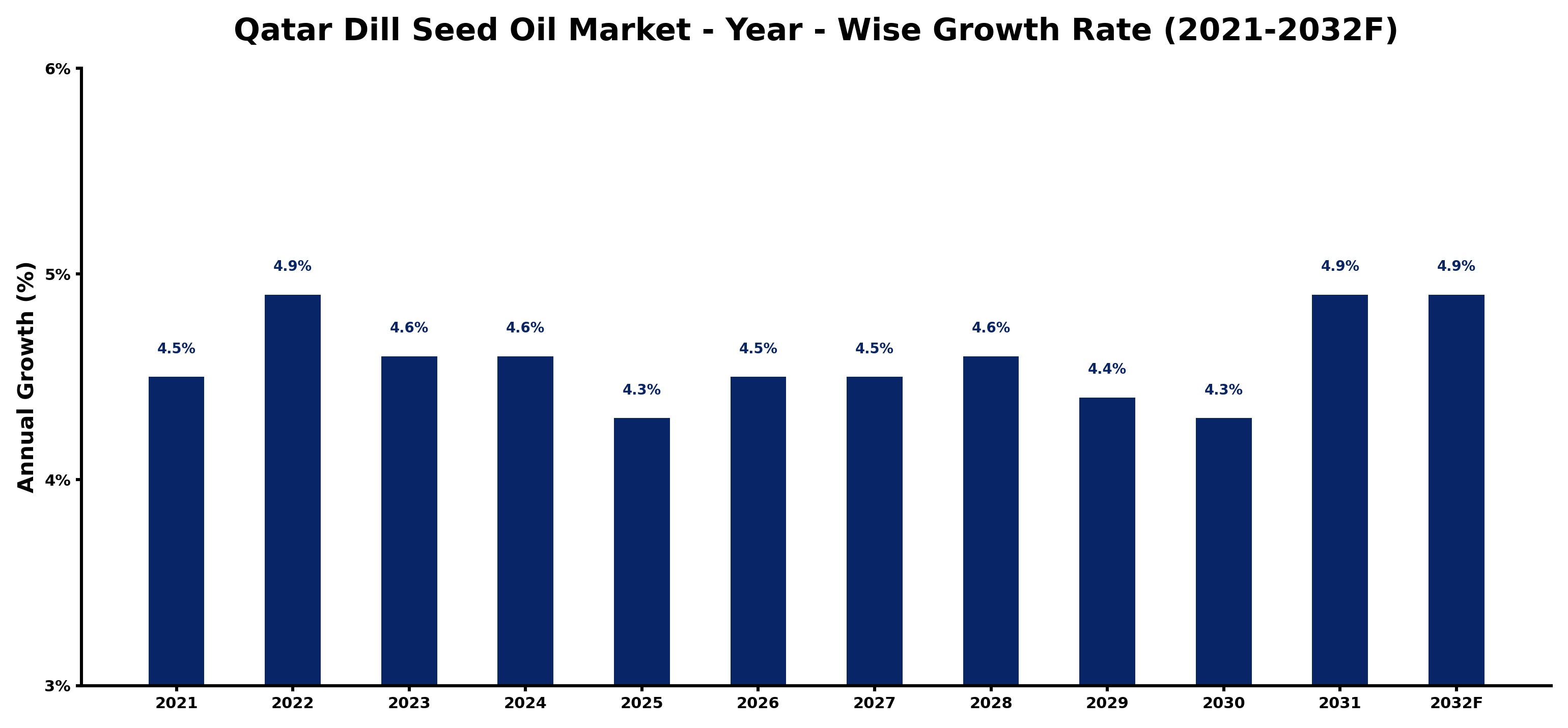
The table below presents the year‑wise growth rates along with the key drivers influencing the market
| Year | Growth Rate | Major Drivers |
| 2021 | 4.5% | Increasing industrial infrastructure investments |
| 2022 | 4.9% | Increasing smart city development projects |
| 2023 | 4.6% | Rising electricity demand across industries |
| 2024 | 4.6% | Expansion of transportation and logistics networks |
| 2025 | 4.3% | Increasing industrial automation investments |
| 2026 | 4.5% | Increasing adoption of advanced technologies |
| 2027 | 4.5% | Growing renewable energy integration projects |
| 2028 | 4.6% | Expansion of transportation and logistics networks |
| 2029 | 4.4% | Growing renewable energy integration projects |
| 2030 | 4.3% | Expansion of manufacturing activities |
| 2031 | 4.9% | Increasing industrial infrastructure investments |
| 2032 | 4.9% | Growing renewable energy integration projects |
Note - Market size estimations and growth projections presented in this report are based on 6Wresearch’s advanced forecasting approach, validated with industry datasets as of June 2026.
Qatar Dill Seed Oil Market Synopsis
Consumer awareness regarding health and wellness is the most potent force driving the Qatar dill seed oil market today. With its anti-inflammatory and antimicrobial properties, dill seed oil is increasingly sought after for both medicinal and culinary uses. This dual utility positions it favorably in a market that values holistic health solutions.
Moreover, the traditional herbal practices prevalent in Qatar further bolster the demand for dill seed oil. As more consumers opt for natural and organic ingredients, the market is poised for robust expansion, particularly among wellness-focused product lines.
Qatar Dill Seed Oil Market Key Takeaways
- The market is projected to grow significantly, achieving a CAGR of 3.9% from 2026 to 2032.
- Consumer interest in natural remedies is a primary driver for increased consumption.
- Dill seed oil's versatility in culinary and medicinal applications enhances its market appeal.
- There is a strong connection between the growth of the market and rising disposable incomes.
- Awareness initiatives are essential to improve consumer familiarity with dill seed oil.
Evaluation of Restraints in Qatar Dill Seed Oil Market
Despite its potential, the Qatar dill seed oil market faces certain restraints. One significant challenge is the limited consumer recognition compared to more established essential oils, which can hinder wider adoption. Furthermore, ensuring a consistent supply of high-quality dill seeds for oil extraction can pose logistical challenges for producers. Effective marketing strategies and educational efforts will be essential for overcoming these barriers, helping consumers understand the unique benefits and uses of dill seed oil.
Qatar Dill Seed Oil Market Trends
Current trends indicate a growing inclination towards sustainable and organic products within the Qatar dill seed oil market. As consumers increasingly seek environmentally friendly options, the demand for ethically sourced dill seed oil is expected to rise. Additionally, there is a notable trend in the integration of dill seed oil into personal care and wellness products, reflecting broader consumer health trends.
Qatar Dill Seed Oil Market Opportunities
The market presents multiple avenues for growth, particularly in the realm of herbal and wellness products. As the popularity of natural ingredients surges, companies that innovate by creating unique formulations or blends incorporating dill seed oil may find lucrative opportunities. Furthermore, expanding distribution channels into retail and e-commerce will be vital in capturing a larger consumer base.
Government Initiatives in the Qatar Dill Seed Oil Market
The Qatari government has shown interest in promoting the local agricultural sector, which could benefit the dill seed oil market. Policies aimed at supporting sustainable farming practices and boosting local production are likely to enhance the supply chain for dill seeds, ultimately benefiting oil extraction. Additionally, initiatives promoting health and wellness awareness could further increase consumer interest in natural products like dill seed oil.
Future Insights of the Qatar Dill Seed Oil Market
Looking ahead to the period from 2026 to 2032, the Qatar dill seed oil market is poised for substantial growth driven by health trends and increased consumer education. The ongoing shift towards holistic health approaches will likely sustain the demand for natural remedies. As companies expand their product offerings and enhance marketing efforts, we expect to see a more robust market presence for dill seed oil, solidifying its role in both culinary and wellness sectors.
Qatar Dill Seed Oil Market Latest Developments (May 2025 - June 2026)
Recent developments in the Qatar dill seed oil market include increased collaborations among producers and retailers aimed at enhancing product visibility. Furthermore, brands are launching marketing campaigns to educate consumers about the benefits of dill seed oil. The food and beverage sector is also observing an uptick in the usage of dill seed oil as more restaurants incorporate it into their culinary offerings, reflecting evolving consumer preferences.
Qatar Dill Seed Oil Market - Key Attractiveness of the Report
- 10 Years of Market Numbers
- Historical Data Starting from 2022 to 2025
- Base Year: 2025
- Forecast Data until 2032
- Key Performance Indicators Impacting the Market
- Major Upcoming Developments and Projects
Key Highlights of the Report:
- Qatar Dill Seed Oil Market Outlook
- Market Size of Qatar Dill Seed Oil Market, 2025
- Forecast of Qatar Dill Seed Oil Market, 2032
- Historical Data and Forecast of Qatar Dill Seed Oil Revenues & Volume for the Period 2022-2032F
- Qatar Dill Seed Oil Market Trend Evolution
- Qatar Dill Seed Oil Market Drivers and Challenges
- Qatar Dill Seed Oil Price Trends
- Qatar Dill Seed Oil Porter's Five Forces
- Qatar Dill Seed Oil Industry Life Cycle
- Historical Data and Forecast of Qatar Dill Seed Oil Market Revenues & Volume By Type for the Period 2022-2032F
- Historical Data and Forecast of Qatar Dill Seed Oil Market Revenues & Volume By Anethum Graveolens Seed Oil for the Period 2022-2032F
- Historical Data and Forecast of Qatar Dill Seed Oil Market Revenues & Volume By Anethum Sowa Seed Oil for the Period 2022-2032F
- Historical Data and Forecast of Qatar Dill Seed Oil Market Revenues & Volume By Application for the Period 2022-2032F
- Historical Data and Forecast of Qatar Dill Seed Oil Market Revenues & Volume By Flavor for the Period 2022-2032F
- Historical Data and Forecast of Qatar Dill Seed Oil Market Revenues & Volume By Fragrance for the Period 2022-2032F
- Historical Data and Forecast of Qatar Dill Seed Oil Market Revenues & Volume By Pharmaceutical for the Period 2022-2032F
- Historical Data and Forecast of Qatar Dill Seed Oil Market Revenues & Volume By Skincare for the Period 2022-2032F
- Historical Data and Forecast of Qatar Dill Seed Oil Market Revenues & Volume By Aromatherapy for the Period 2022-2032F
- Qatar Dill Seed Oil Import Export Trade Statistics
- Market Opportunity Assessment By Type
- Market Opportunity Assessment By Application
- Qatar Dill Seed Oil Top Companies Market Share
- Qatar Dill Seed Oil Competitive Benchmarking By Technical and Operational Parameters
- Qatar Dill Seed Oil Company Profiles
- Qatar Dill Seed Oil Key Strategic Recommendations






































