Bahrain Electrical and electronics Market Summary
The bahrain electrical and electronics market was estimated at USD 372 Million in 2025 and is projected to reach USD 662 Million by 2032, growing at a CAGR of 9.9% from 2026 to 2032.
Bahrain Electrical and electronics Market Year-wise Growth Rate and Key Drivers
This graph highlights how the Bahrain Electrical and electronics Market has steadily grown over the past five years, supported by major growth factors.
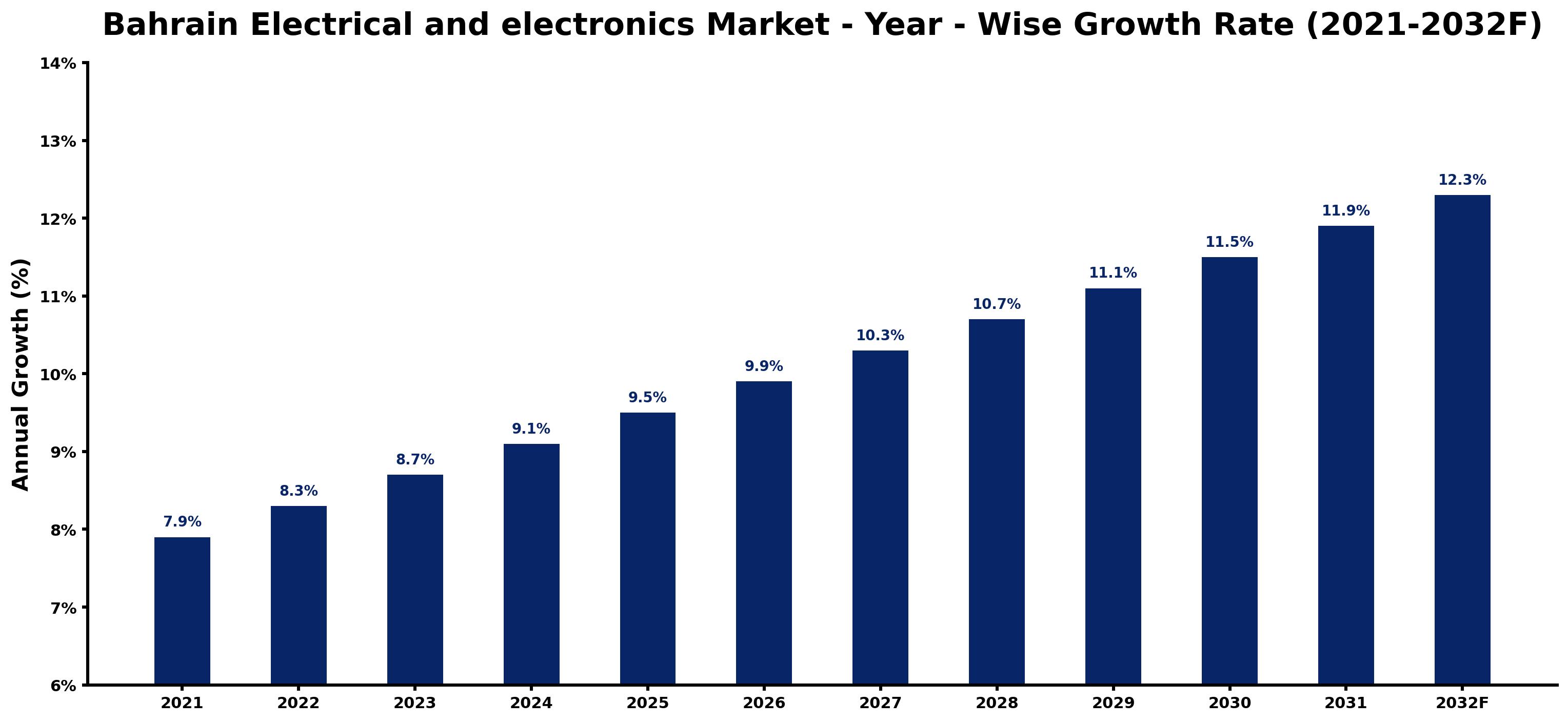
The table below presents the year wise growth rates along with the key drivers influencing the market
| Year | Growth Rate | Major Drivers |
| 2021 | 7.9% | Post-lockdown retail projects spurred significant investment in electrical infrastructure upgrades. |
| 2022 | 8.3% | Legacy copper grid failures prompted urgent modernization efforts across the electrical sector. |
| 2023 | 8.7% | Enterprise budgets prioritizing energy efficiency led to increased demand for smart technologies. |
| 2024 | 9.1% | Local manufacturers started producing more energy-efficient electronics to meet consumer expectations. |
| 2025 | 9.5% | Increased construction pipelines for residential and commercial buildings enhanced electrical market opportunities. |
| 2026 | 9.9% | The focus on sustainability pushed manufacturers to innovate in renewable energy solutions. |
| 2027 | 10.3% | Smart city initiatives in Bahrain catalyzed investments in integrated electronic systems and sensors. |
| 2028 | 10.7% | Emerging technologies in automation transformed operational protocols across various electrical industries. |
| 2029 | 11.1% | Consumer preferences shifted towards advanced electronics, emphasizing smart home integration and security. |
| 2030 | 11.5% | Increased regional partnerships fostered collaborative efforts in developing cutting-edge electrical technologies. |
| 2031 | 11.9% | Rising urbanization trends necessitated expansion of electrical services in densely populated areas. |
| 2032 | 12.3% | Digital transformation across sectors paved the way for innovative electrical and electronics solutions. |
Note - Market size estimations and growth projections presented in this report are based on 6Wresearch's advanced forecasting approach, validated with industry datasets as of June 2026.
Bahrain Electrical and electronics Market Synopsis
The Bahrain Electrical and electronics Market is projected to reach 9.9% and witness significant growth during the forecast period (2026-2032). This market encompasses a diverse range of products, including consumer electronics, industrial equipment, and essential electrical infrastructure. The increasing adoption of smart technologies, the Internet of Things (IoT), and renewable energy initiatives are important catalysts driving this growth. As Bahrain continues its modernization efforts, the demand for sophisticated electrical and electronics solutions is expected to surge across both consumer and industrial sectors.
Bahrain Electrical and electronics Market Growth Drivers
Numerous factors are propelling the Bahrain Electrical and electronics Market towards substantial growth. Key drivers include the following:
- Growing consumer demand for electronic devices, particularly smartphones, laptops, and other home appliances, is significantly increasing market activity.
- The expansion of the industrial sector in Bahrain is creating an increased need for advanced electrical equipment and systems.
- Digital transformation across various industries, including telecommunications and energy, is promoting the integration of smart technologies and innovative electrical solutions.
- The ongoing shift towards renewable energy sources is spurring demand for energy-efficient electrical and electronic products.
- The government's initiatives to enhance infrastructure and technological capabilities are expected to further promote growth in this sector.
Bahrain Electrical and electronics Market Challenges and Restraints
Despite its growth potential, the Bahrain Electrical and electronics Market faces several challenges that may hinder its advancement:
- A heavy reliance on imported components exposes the market to supply chain vulnerabilities, impacting product availability and pricing stability.
- The limited scale of local manufacturing capabilities restricts competitiveness against larger international brands that provide lower-cost options.
- The rapid pace of technological advancements requires continuous investment in research and development, which can be particularly challenging for smaller enterprises.
- Regulatory requirements around energy efficiency and safety necessitate ongoing updates to product lines, which can increase operational costs.
- Market participants must navigate the complexities of evolving consumer preferences, which can shift rapidly in the fast-paced electronics landscape.
Bahrain Electrical and electronics Market Investment Opportunities
Investors have ample opportunities within the Bahrain Electrical and electronics Market, stemming from various factors:
- The demand for energy-efficient products is paving the way for investments in innovative manufacturing practices and advanced technologies.
- With ongoing construction projects across residential and commercial sectors, there is a growing need for electrical components, making this a lucrative area for investment.
- The rising trend of smart homes and IoT applications is creating opportunities for businesses that focus on smart technologies and compatible devices.
- Opportunities exist in the distribution and retail of consumer electronics, driven by increasing local consumer spending on electronics.
- The government's support for local manufacturing initiatives presents attractive conditions for businesses looking to establish a production base in Bahrain.
Bahrain Electrical and electronics Market Government Investment and Initiatives
The Bahraini government plays a crucial role in shaping the electrical and electronics market through various policies and initiatives aimed at fostering growth and innovation:
- Government policies are designed to ensure that local manufacturing adheres to international safety and performance standards, promoting higher quality products.
- Significant public spending is directed towards infrastructure development, creating a solid foundation for increased demand for electrical and electronics solutions.
- Tax incentives are provided to encourage local production and attract foreign investment in advanced manufacturing technologies, enhancing local capabilities.
- The government actively supports research and development initiatives within the technology sector, thereby fostering innovation and competitive strengths.
- Import regulations are enforced to ensure that foreign products meet requisite safety and quality standards, thus promoting a trustworthy market environment.
Bahrain Electrical and electronics Market Latest Developments (May 2025 - June 2026)
Recent developments in the Bahrain Electrical and electronics Market indicate a dynamic landscape influenced by technological advancements and regulatory changes. The period from May 2025 to June 2026 has seen heightened government focus on sustainability, which is driving innovations towards greener technologies. Increased investments in smart city projects are also prominent, highlighting a significant shift towards integrated urban solutions. Moreover, consumer electronics continue to evolve with trends leaning towards automation and connectivity, reflecting the global trajectory in the electronics sector. Supplier networks are adapting to enhance resilience against external disruptions, showcasing a proactive approach to mitigating supply chain vulnerabilities.
Bahrain Electrical and electronics Market - Key Attractiveness of the Report
- 10 Years of Market Numbers
- Historical Data Starting from 2022 to 2025
- Base Year: 2025
- Forecast Data until 2032
- Key Performance Indicators Impacting the Market
- Major Upcoming Developments and Projects
Key Highlights of the Report:
- Bahrain Electrical and electronics Market Outlook
- Market Size of Bahrain Electrical and electronics Market, 2025
- Forecast of Bahrain Electrical and electronics Market, 2032F
- Historical Data and Forecast of Bahrain Electrical and electronics Revenues & Volume for the Period 2022-2032F
- Bahrain Electrical and electronics Market Trend Evolution
- Bahrain Electrical and electronics Market Drivers and Challenges
- Bahrain Electrical and electronics Price Trends
- Bahrain Electrical and electronics Porter's Five Forces
- Bahrain Electrical and electronics Industry Life Cycle
- Historical Data and Forecast of Bahrain Electrical and electronics Market Revenues & Volume By Type for the Period 2022-2032F
- Historical Data and Forecast of Bahrain Electrical and electronics Market Revenues & Volume By Electric Motors for the Period 2022-2032F
- Historical Data and Forecast of Bahrain Electrical and electronics Market Revenues & Volume By Primary And Storage Batteries for the Period 2022-2032F
- Historical Data and Forecast of Bahrain Electrical and electronics Market Revenues & Volume By Generators for the Period 2022-2032F
- Historical Data and Forecast of Bahrain Electrical and electronics Market Revenues & Volume By Semiconductors for the Period 2022-2032F
- Historical Data and Forecast of Bahrain Electrical and electronics Market Revenues & Volume By Household Appliances for the Period 2022-2032F
- Historical Data and Forecast of Bahrain Electrical and electronics Market Revenues & Volume By Applications for the Period 2022-2032F
- Historical Data and Forecast of Bahrain Electrical and electronics Market Revenues & Volume By Online for the Period 2022-2032F
- Historical Data and Forecast of Bahrain Electrical and electronics Market Revenues & Volume By Offline for the Period 2022-2032F
- Bahrain Electrical and electronics Import Export Trade Statistics
- Market Opportunity Assessment By Type
- Market Opportunity Assessment By Applications
- Bahrain Electrical and electronics Top Companies Market Share
- Bahrain Electrical and electronics Competitive Benchmarking By Technical and Operational Parameters
- Bahrain Electrical and electronics Company Profiles
- Bahrain Electrical and electronics Key Strategic Recommendations






































