Bahrain Electro-Diagnostic Devices Market Size, Share & Growth Rate
The Bahrain Electro-Diagnostic Devices Market was estimated at USD 432 Million in 2025 and is projected to reach USD 765 Million by 2032, growing at a CAGR of 8.5% from 2026 to 2032. This upward trajectory is fueled by an increasing demand for advanced diagnostic tools in neurology and cardiology, driven by technological advancements and the growing emphasis on precision medicine. The rise in healthcare modernization initiatives and awareness of early interventions further bolster the market's growth prospects.
Bahrain Electro-Diagnostic Devices Market Year-wise Growth Rate and Key Drivers
This graph highlights how the Bahrain Electro-Diagnostic Devices Market has steadily grown over the years, supported by major growth factors.
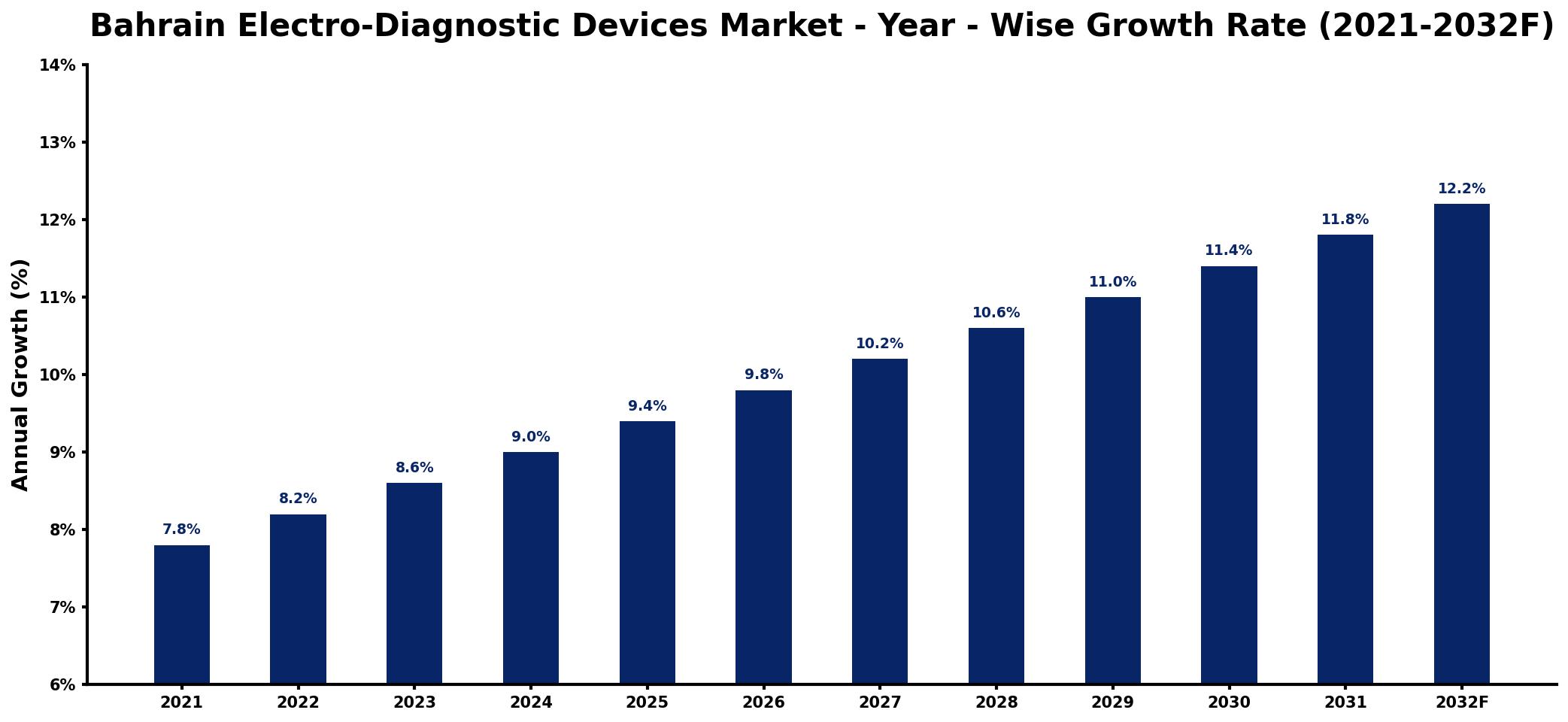
The table below presents the year‑wise growth rates along with the key drivers influencing the market
| Year | Growth Rate | Major Drivers |
| 2021 | 7.8% | Rising healthcare expenditure growth |
| 2022 | 8.2% | Increased government healthcare investments |
| 2023 | 8.6% | Growing aging population needs |
| 2024 | 9.0% | Technological advancements in healthcare |
| 2025 | 9.4% | Expanding telehealth service adoption |
| 2026 | 9.8% | Surge in chronic disease prevalence |
| 2027 | 10.2% | Enhanced healthcare infrastructure development |
| 2028 | 10.6% | Growing medical research funding |
| 2029 | 11.0% | Increased health awareness campaigns |
| 2030 | 11.4% | Rising demand for preventive care |
| 2031 | 11.8% | Expansion of healthcare insurance coverage |
| 2032 | 12.2% | Innovations in patient monitoring solutions |
Note: Market size estimations and growth projections presented in this report are based on 6Wresearch's proprietary forecasting methodology, utilizing the latest available industry data, government publications, and primary research inputs.
Bahrain Electro-Diagnostic Devices Market Synopsis
Recently, the Bahrain electro-diagnostic devices market has gained significant momentum, primarily due to advancements in the healthcare sector. With a push towards modernizing diagnostic capabilities, devices like EMG and EEG are seeing increased adoption across hospitals and specialized clinics. Looking ahead, the market is poised for robust growth, supported by innovations in AI and cloud-based technologies that improve diagnostic accuracy and efficiency.
As the healthcare landscape evolves, the Bahrain electro-diagnostic devices market is becoming more integral to patient care strategies. The growing recognition of conditions such as epilepsy and neuropathy is driving healthcare providers to invest in these critical diagnostic tools, ensuring better outcomes through timely interventions.
Bahrain Electro-Diagnostic Devices Market Key Takeaways
- The market is witnessing significant growth due to advancements in diagnostic technologies and increased demand for precision medicine.
- Devices like EMG and EEG are becoming essential in the diagnosis and monitoring of neurological and muscular disorders.
- Integration of AI and cloud computing is enhancing the efficiency and accuracy of diagnostics.
- Healthcare modernization initiatives in Bahrain are encouraging investments in high-tech medical equipment.
- Awareness and early intervention programs for neurological conditions are driving market demand.
Evaluation of Restraints in Bahrain Electro-Diagnostic Devices Market
Despite the promising growth, several challenges are present in the Bahrain electro-diagnostic devices market. The high costs associated with advanced diagnostic equipment can be a barrier for many healthcare providers. Additionally, there is a pressing need for specialized professionals who can operate these sophisticated devices effectively, which may not be readily available in the local market. The limited presence of service centers also adds to the operational challenges, potentially hindering the seamless integration of new technologies into existing healthcare frameworks. Moreover, increased competition from international suppliers may elevate costs and create disparities for local providers trying to invest in advanced diagnostic capabilities.
Bahrain Electro-Diagnostic Devices Market Trends
Current trends in the Bahrain electro-diagnostic devices market indicate a strong shift towards incorporating AI for enhanced pattern recognition, which significantly improves diagnostic processes. Cloud-based health records are also gaining traction, enabling remote analysis and improving access to essential diagnostic information. These technological advancements not only streamline operations but also foster a more collaborative approach in patient care, facilitating timely decisions based on real-time data. Furthermore, the growing emphasis on preventive healthcare is reshaping the demand for electro-diagnostic devices, as healthcare providers focus on identifying conditions at earlier stages.
Bahrain Electro-Diagnostic Devices Market Opportunities
The Bahrain electro-diagnostic devices market presents numerous investment opportunities for stakeholders looking to capitalize on the increasing demand for advanced diagnostic technologies. Strategic partnerships with hospitals and neurology clinics can pave the way for introducing high-tech devices, particularly if they include training and support services. Additionally, offering leasing options for expensive diagnostic equipment can make these technologies more accessible to smaller healthcare facilities. The rise in academic institutions focusing on neurology and rehabilitation also signals potential growth avenues for collaborations in research and development.
Government Initiatives in the Bahrain Electro-Diagnostic Devices Market
The Bahraini government is actively promoting the modernization of its healthcare system under the National Health Plan, which includes significant investments in medical technology. Favorable import policies for high-tech medical equipment are designed to facilitate procurement by public health institutions. These initiatives not only enhance diagnostic capabilities but also contribute to improved healthcare outcomes across the nation, creating an enabling environment for the electro-diagnostic devices market to flourish.
Future Insights of the Bahrain Electro-Diagnostic Devices Market
Looking ahead to the period between 2026 and 2032, the Bahrain electro-diagnostic devices market is expected to continue its robust expansion driven by ongoing technological advancements and increasing healthcare investments. The integration of AI and machine learning in diagnostic processes is poised to revolutionize patient care, allowing for more accurate and efficient assessments. Additionally, as healthcare providers embrace digital health solutions, the demand for interoperable and cloud-based diagnostic platforms will likely rise, shaping the future landscape of the market.
Bahrain Electro-Diagnostic Devices Market Latest Developments (2025 - 2026)
In recent months, the Bahrain electro-diagnostic devices market has seen a surge in collaborations aimed at enhancing diagnostic capabilities. Many hospitals and clinics are investing in upgrading their existing equipment with state-of-the-art technologies. Moreover, ongoing training programs for healthcare professionals are being implemented to ensure they are equipped to utilize advanced diagnostic tools effectively. This dynamic environment indicates a strong commitment to improving the quality of patient care through technological innovation.
Bahrain Electro-Diagnostic Devices Market - Key Attractiveness of the Report
- 10 Years of Market Numbers
- Historical Data Starting from 2022 to 2025
- Base Year: 2025
- Forecast Data until 2032
- Key Performance Indicators Impacting the Market
- Major Upcoming Developments and Projects
Key Highlights of the Report:
- Bahrain Electro-Diagnostic Devices Market Outlook
- Market Size of Bahrain Electro-Diagnostic Devices Market, 2025
- Forecast of Bahrain Electro-Diagnostic Devices Market, 2032
- Historical Data and Forecast of Bahrain Electro-Diagnostic Devices Revenues & Volume for the Period 2022-2032F
- Bahrain Electro-Diagnostic Devices Market Trend Evolution
- Bahrain Electro-Diagnostic Devices Market Drivers and Challenges
- Bahrain Electro-Diagnostic Devices Price Trends
- Bahrain Electro-Diagnostic Devices Porter's Five Forces
- Bahrain Electro-Diagnostic Devices Industry Life Cycle
- Historical Data and Forecast of Bahrain Electro-Diagnostic Devices Market Revenues & Volume By Type for the Period 2022-2032F
- Historical Data and Forecast of Bahrain Electro-Diagnostic Devices Market Revenues & Volume By Electromyogram (EMG) for the Period 2022-2032F
- Historical Data and Forecast of Bahrain Electro-Diagnostic Devices Market Revenues & Volume By Nerve Conduction (NCS) for the Period 2022-2032F
- Historical Data and Forecast of Bahrain Electro-Diagnostic Devices Market Revenues & Volume By Electrocardiography (ECG) for the Period 2022-2032F
- Historical Data and Forecast of Bahrain Electro-Diagnostic Devices Market Revenues & Volume By Electroencephalography (EEG) for the Period 2022-2032F
- Historical Data and Forecast of Bahrain Electro-Diagnostic Devices Market Revenues & Volume By Electroretinography (ERG) for the Period 2022-2032F
- Historical Data and Forecast of Bahrain Electro-Diagnostic Devices Market Revenues & Volume By Electrogastrography (EGG) for the Period 2022-2032F
- Historical Data and Forecast of Bahrain Electro-Diagnostic Devices Market Revenues & Volume By Others for the Period 2022-2032F
- Historical Data and Forecast of Bahrain Electro-Diagnostic Devices Market Revenues & Volume By Application for the Period 2022-2032F
- Historical Data and Forecast of Bahrain Electro-Diagnostic Devices Market Revenues & Volume By Hospitals for the Period 2022-2032F
- Historical Data and Forecast of Bahrain Electro-Diagnostic Devices Market Revenues & Volume By Clinics for the Period 2022-2032F
- Historical Data and Forecast of Bahrain Electro-Diagnostic Devices Market Revenues & Volume By Diagnostic Centers for the Period 2022-2032F
- Historical Data and Forecast of Bahrain Electro-Diagnostic Devices Market Revenues & Volume By Others for the Period 2022-2032F
- Bahrain Electro-Diagnostic Devices Import Export Trade Statistics
- Market Opportunity Assessment By Type
- Market Opportunity Assessment By Application
- Bahrain Electro-Diagnostic Devices Top Companies Market Share
- Bahrain Electro-Diagnostic Devices Competitive Benchmarking By Technical and Operational Parameters
- Bahrain Electro-Diagnostic Devices Company Profiles
- Bahrain Electro-Diagnostic Devices Key Strategic Recommendations






































