Bahrain Glass Lens Market Size, Share & Growth Rate
The Bahrain Glass Lens Market was estimated at USD 1223 Million in 2025 and is projected to reach USD 2250 Million by 2032, growing at a CAGR of 9.1% from 2026 to 2032. This growth trajectory is primarily fueled by the rising demand for optical devices and an increased focus on vision care, particularly in light of the growing prevalence of myopia and the impacts of extended screen time. Furthermore, the burgeoning interest in photography, both amateur and professional, adds another layer of demand for high-quality glass lenses in the region.
Bahrain Glass Lens Market Year-wise Growth Rate and Key Drivers
This graph highlights how the Bahrain Glass Lens Market has steadily grown over the years, supported by major growth factors.
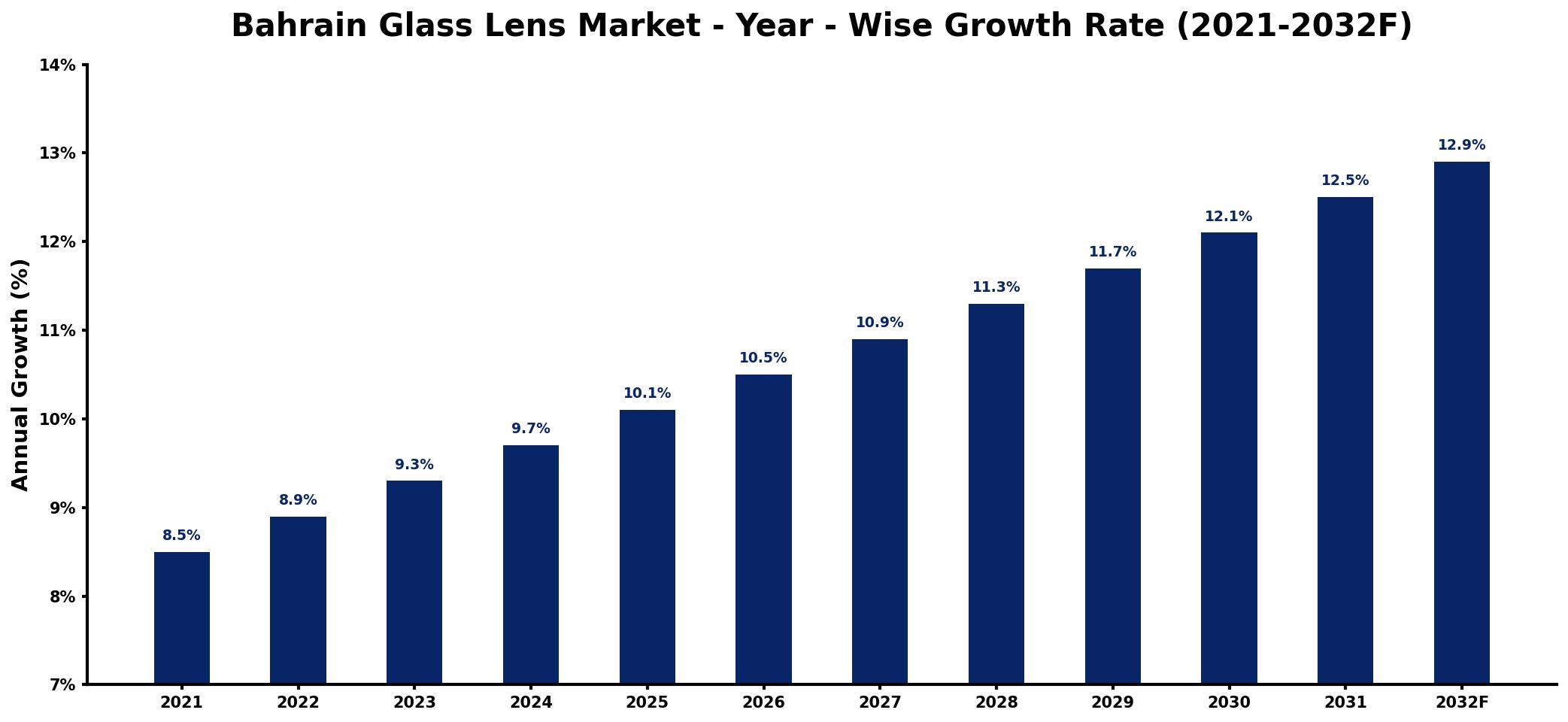
The table below presents the year‑wise growth rates along with the key drivers influencing the market
| Year | Growth Rate | Major Drivers |
| 2021 | 8.5% | rising consumer health awareness |
| 2022 | 8.9% | increased adoption of eyewear |
| 2023 | 9.3% | growing online retail platforms |
| 2024 | 9.7% | expansion of optical clinics |
| 2025 | 10.1% | increased fashion eyewear trends |
| 2026 | 10.5% | advancements in prescription technology |
| 2027 | 10.9% | growing demand for UV protection |
| 2028 | 11.3% | increased focus on sustainability |
| 2029 | 11.7% | rising disposable income levels |
| 2030 | 12.1% | growth in aging population segment |
| 2031 | 12.5% | surge in digital device usage |
| 2032 | 12.9% | expanding industrial usage applications |
Note: Market size estimations and growth projections presented in this report are based on 6Wresearch's proprietary forecasting methodology, utilizing the latest available industry data, government publications, and primary research inputs.
Bahrain Glass Lens Market Synopsis
The most significant force currently shaping the Bahrain Glass Lens Market is the heightened consumer awareness regarding vision health and the critical role that quality lenses play in achieving optimal eye care. As more residents prioritize their visual wellness, the market sees a corresponding surge in the demand for corrective eyewear and high-precision optical devices.
Additionally, the market benefits from innovations in lens technology, particularly advancements in coatings that enhance performance and user comfort. The embrace of digital devices has further catalyzed the need for effective blue light filtering solutions in lenses, reflecting shifting consumer preferences towards enhanced functionality and comfort.
Bahrain Glass Lens Market Key Takeaways
- The market is driven by a significant uptick in demand for optical devices, including eyewear and cameras.
- Innovative lens technologies, such as anti-reflective coatings and blue light filters, are gaining traction among consumers.
- Increasing awareness of vision care is prompting a rise in the prescription glass segment.
- The camera lens sector, particularly for mobile devices, is a growing segment of market demand.
- Investment opportunities exist in importing specialty lenses and partnering with local optometric facilities.
Evaluation of Restraints in Bahrain Glass Lens Market
Despite its promising growth, the Bahrain Glass Lens Market faces several restraints that hinder its expansion. One primary challenge is the stiff competition from plastic lenses, which are often cheaper and lighter, making them a preferred choice for consumers. Additionally, high import duties on specialty lenses can deter potential investors and limit the availability of advanced products in the market. The need for cutting-edge manufacturing technologies remains a barrier, as local production capabilities struggle to keep pace with international standards. Concerns over counterfeit products further complicate the landscape, as they undermine brand trust and impact overall market quality perception.
Bahrain Glass Lens Market Trends
Several trends are currently reshaping the Bahrain Glass Lens Market. Notably, the shift towards personalized eyewear solutions is gaining momentum, driven by technological advancements and consumer demand for tailored products. Furthermore, the integration of smart technologies in eyewear, such as augmented reality, is becoming increasingly relevant, reflecting broader tech adoption in consumer goods. Sustainability trends also play a role, with manufacturers exploring eco-friendly materials and production processes to cater to environmentally conscious consumers.
Bahrain Glass Lens Market Opportunities
The Bahrain Glass Lens Market offers numerous growth and investment opportunities. Importing high-quality lenses for prescription glasses, cameras, and scientific instruments presents a viable avenue for investors. Partnering with local ophthalmic laboratories can facilitate the provision of bespoke prescription lenses to retail chains and optometrists. Additionally, the increasing adoption of photography—both in personal and professional spheres—creates room for innovations in lens design and functionality, thus inviting further investment into the market.
Government Initiatives in the Bahrain Glass Lens Market
The Bahrain government plays a crucial role in supporting the glass lens market through various initiatives. Under the Ministry of Industry and Commerce, policies are in place to promote the production of high-quality optical products that adhere to the Gulf Standardization Organization (GSO) norms. Additionally, government subsidies on medical imports and investments aimed at enhancing local optical retail infrastructure serve to bolster the markets growth and accessibility.
Future Insights of the Bahrain Glass Lens Market
Looking ahead to the period between 2026 and 2032, the Bahrain Glass Lens Market is positioned for robust growth driven by ongoing consumer awareness regarding vision care and advancements in lens technology. As the prevalence of eye conditions like myopia continues to rise, the demand for corrective eyewear will likely escalate. Furthermore, the integration of smart technologies and the continuous development of innovative lens coatings will further enhance the attractiveness of glass lenses, propelling market growth into the next decade.
Bahrain Glass Lens Market Latest Developments (2025 - 2026)
Recent developments in the Bahrain Glass Lens Market indicate a strong push towards innovation in product offerings, particularly focusing on enhanced optical performance and user comfort. Industry players are increasingly investing in research and development to explore new materials and coatings that improve lens functionality. Moreover, the emphasis on local partnerships and collaborations is becoming a strategic priority to enhance the supply chain and ensure access to the latest technologies and manufacturing processes.
Bahrain Glass Lens Market - Key Attractiveness of the Report
- 10 Years of Market Numbers
- Historical Data Starting from 2022 to 2025
- Base Year: 2025
- Forecast Data until 2032
- Key Performance Indicators Impacting the Market
- Major Upcoming Developments and Projects
Key Highlights of the Report:
- Bahrain Glass Lens Market Outlook
- Market Size of Bahrain Glass Lens Market, 2025
- Forecast of Bahrain Glass Lens Market, 2032
- Historical Data and Forecast of Bahrain Glass Lens Revenues & Volume for the Period 2022-2032F
- Bahrain Glass Lens Market Trend Evolution
- Bahrain Glass Lens Market Drivers and Challenges
- Bahrain Glass Lens Price Trends
- Bahrain Glass Lens Porter's Five Forces
- Bahrain Glass Lens Industry Life Cycle
- Historical Data and Forecast of Bahrain Glass Lens Market Revenues & Volume By Product Type for the Period 2022-2032F
- Historical Data and Forecast of Bahrain Glass Lens Market Revenues & Volume By Single Vision Lenses for the Period 2022-2032F
- Historical Data and Forecast of Bahrain Glass Lens Market Revenues & Volume By Progressive Lenses for the Period 2022-2032F
- Historical Data and Forecast of Bahrain Glass Lens Market Revenues & Volume By Bifocal and Trifocal Lenses for the Period 2022-2032F
- Historical Data and Forecast of Bahrain Glass Lens Market Revenues & Volume By Photochromic Lenses for the Period 2022-2032F
- Historical Data and Forecast of Bahrain Glass Lens Market Revenues & Volume By Polarized Lenses for the Period 2022-2032F
- Historical Data and Forecast of Bahrain Glass Lens Market Revenues & Volume By Others for the Period 2022-2032F
- Historical Data and Forecast of Bahrain Glass Lens Market Revenues & Volume By Coating for the Period 2022-2032F
- Historical Data and Forecast of Bahrain Glass Lens Market Revenues & Volume By Anti-Reflective for the Period 2022-2032F
- Historical Data and Forecast of Bahrain Glass Lens Market Revenues & Volume By Blue Light Reduction for the Period 2022-2032F
- Historical Data and Forecast of Bahrain Glass Lens Market Revenues & Volume By Scratch-Resistant for the Period 2022-2032F
- Historical Data and Forecast of Bahrain Glass Lens Market Revenues & Volume By UV Protection for the Period 2022-2032F
- Historical Data and Forecast of Bahrain Glass Lens Market Revenues & Volume By Distribution Channel for the Period 2022-2032F
- Historical Data and Forecast of Bahrain Glass Lens Market Revenues & Volume By Offline for the Period 2022-2032F
- Historical Data and Forecast of Bahrain Glass Lens Market Revenues & Volume By Online for the Period 2022-2032F
- Bahrain Glass Lens Import Export Trade Statistics
- Market Opportunity Assessment By Product Type
- Market Opportunity Assessment By Coating
- Market Opportunity Assessment By Distribution Channel
- Bahrain Glass Lens Top Companies Market Share
- Bahrain Glass Lens Competitive Benchmarking By Technical and Operational Parameters
- Bahrain Glass Lens Company Profiles
- Bahrain Glass Lens Key Strategic Recommendations






































