Bahrain LTE IoT Market Size & Growth Rate (2026-2032)
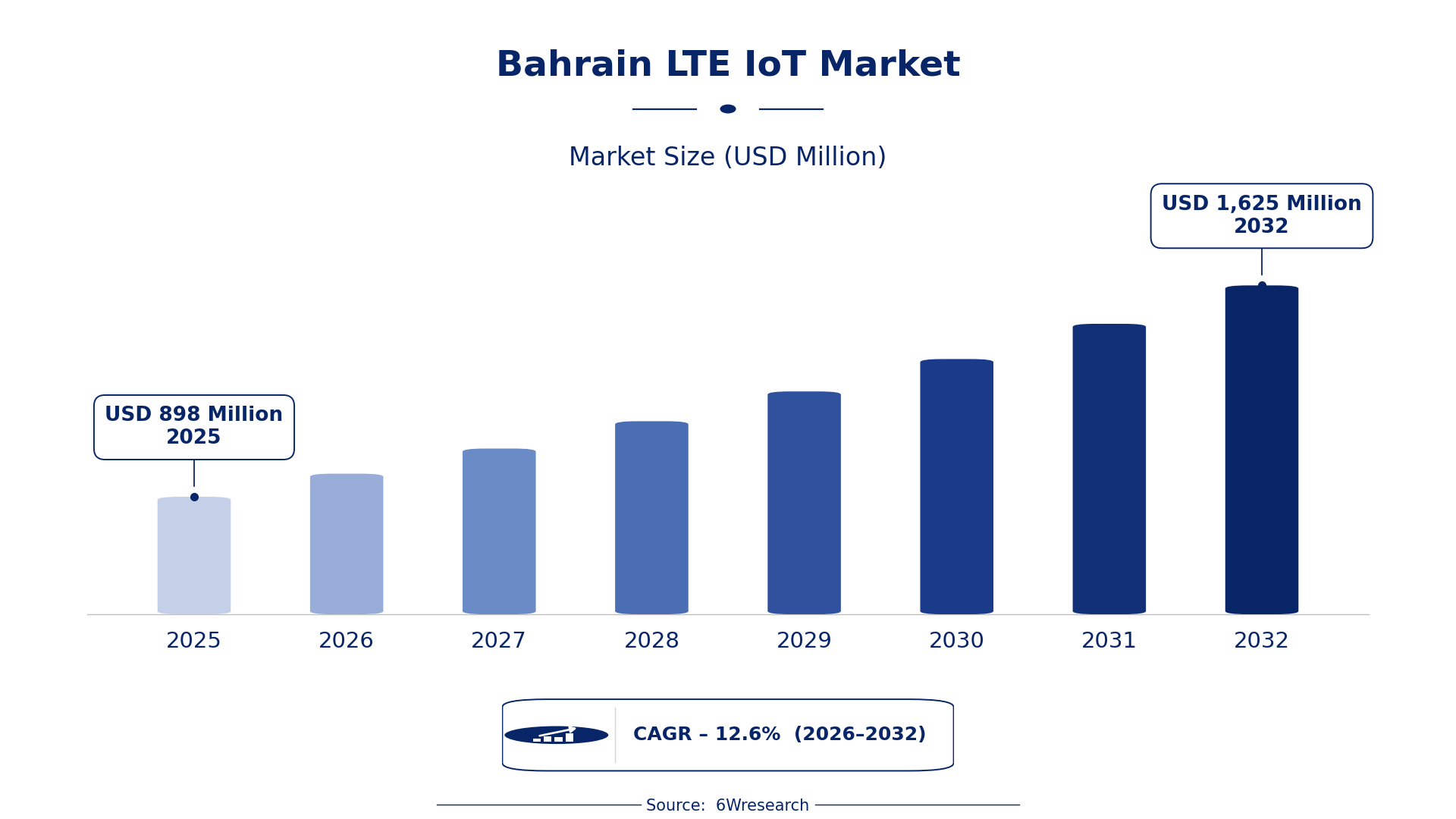
The Bahrain LTE IoT Market was estimated at USD 898 Million in 2025 and is projected to reach USD 1625 Million by 2032, growing at a CAGR of 12.6% from 2026 to 2032.
Bahrain LTE IoT Market Synopsis
In recent years, the Bahrain LTE IoT Market has experienced notable advancements, driven primarily by the adoption of NB-IoT and LTE-M technologies. These solutions cater to the needs of various sectors, including smart metering and asset tracking, offering both cost-efficiency and scalability essential for large-scale deployments.
Government initiatives aimed at fostering smart city projects have further accelerated market growth. As industries embrace these technologies, the demand for low-power, wide-area connectivity is set to expand, establishing a solid foundation for Bahrain’s connected ecosystem.
Bahrain LTE IoT Market Year-wise Growth Rate and Key Drivers
This graph illustrates the annual growth rates of the Bahrain LTE IoT Market from 2021 to 2032, highlighting a steady upward trajectory and projected expansion over the forecast period.
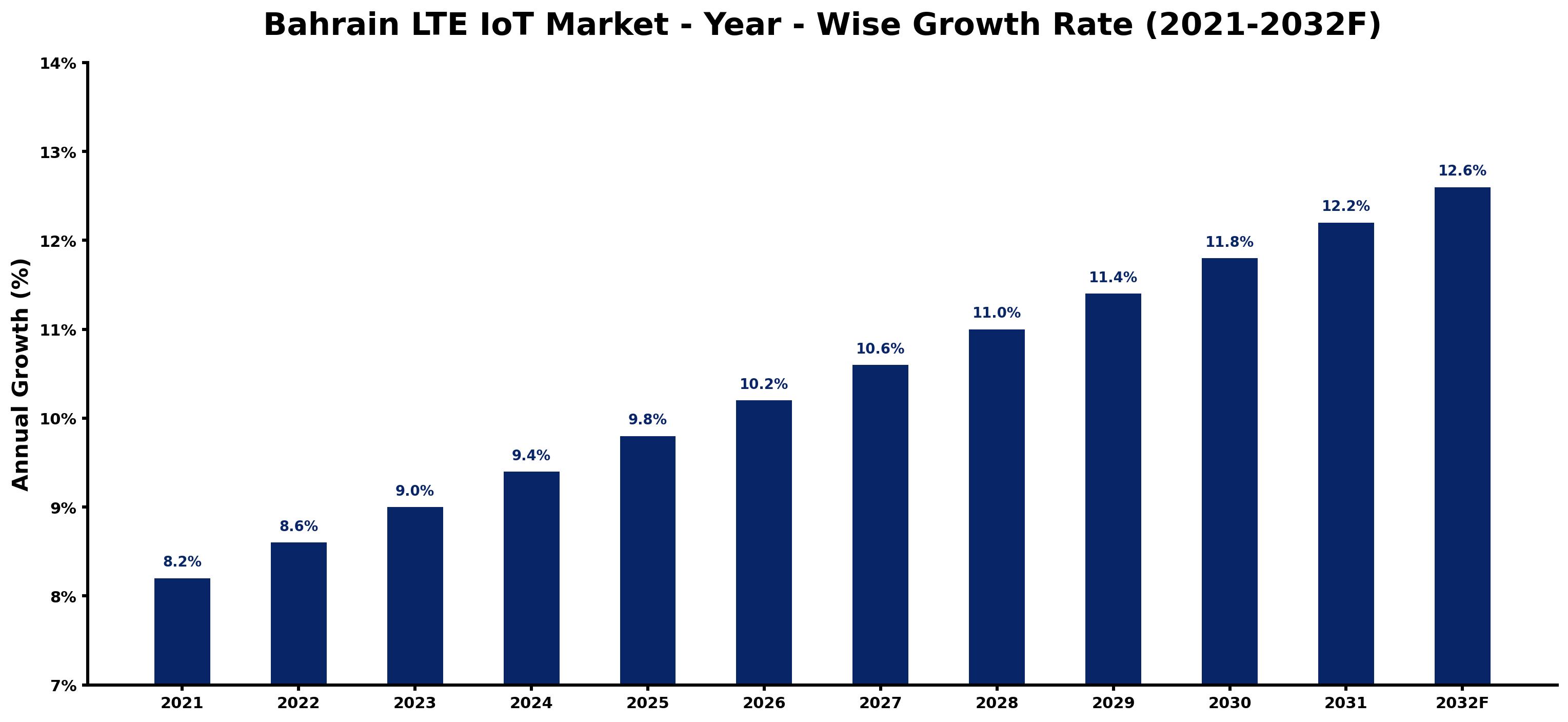
The table below presents the year‑wise growth rates along with the key drivers influencing the market
| Year | Growth Rate | Major Drivers |
| 2021 | 8.2% | Government's National Broadband Strategy promoting IoT adoption. |
| 2022 | 8.6% | Increased investment in smart city projects by the government. |
| 2023 | 9.0% | Regulatory framework supporting innovative IoT business models. |
| 2024 | 9.4% | Growing smartphone penetration enhancing IoT connectivity. |
| 2025 | 9.8% | Partnerships between telecoms and tech firms for IoT solutions. |
| 2026 | 10.2% | Bahrain's Vision 2030 focusing on digital transformation. |
| 2027 | 10.6% | Launch of 5G infrastructure boosting LTE IoT services. |
| 2028 | 11.0% | Rising adoption of telehealth services leveraging IoT technology. |
| 2029 | 11.4% | Demand for enhanced cybersecurity measures in IoT applications. |
| 2030 | 11.8% | Increased agricultural technology initiatives for efficiency improvements. |
| 2031 | 12.2% | Emergence of smart home technologies driving consumer interest. |
| 2032 | 12.6% | Support from Bahrain's Economic Development Board for innovation. |
Note: Market size estimations and growth projections presented in this report are based on 6Wresearch's proprietary forecasting methodology, utilizing the latest available industry data, government publications, and primary research inputs.
Bahrain LTE IoT Market Key Takeaways
Below are some of the specific key takeaways from the market, including:
- The Bahrain LTE IoT Market is witnessing steady growth, driven by industrial automation and smart city initiatives.
- Government support is pivotal for the widespread adoption of LTE IoT technologies across various sectors.
- Challenges, such as high infrastructure costs and security concerns, are slowing down market penetration.
- Investment opportunities are emerging as businesses seek reliable and scalable IoT solutions.
- Telecom operators are actively expanding their LTE IoT coverage to meet growing demands.
Evaluation of Restraints in Bahrain LTE IoT Market
Despite the promising growth trajectory, the Bahrain LTE IoT Market faces several constraints. High infrastructure costs, especially for businesses not traditionally tied to tech, remain a significant barrier. Many companies hesitate to invest in advanced IoT solutions when older, cheaper technologies are still viable. In addition, network reliability, particularly in rural areas, poses challenges for extensive deployments. Concerns about the security of sensitive data transmitted through IoT networks add another layer of complexity to market dynamics. Furthermore, the lack of standardization across platforms leads to interoperability issues that can further hinder adoption.
Bahrain LTE IoT Market Trends
Several current trends are shaping the Bahrain LTE IoT Market. As industries increasingly automate their operations, the need for reliable connectivity is surging. This demand is being met through the expansion of LTE-M and NB-IoT technologies, allowing organizations to implement smart metering, asset tracking, and environmental monitoring effectively. Additionally, the government's push for smart city developments is creating an ecosystem that encourages IoT adoption.
Bahrain LTE IoT Market Opportunities
The growing interest in the Bahrain LTE IoT Market presents numerous investment opportunities. Industries such as utilities, transportation, and smart cities are increasingly adopting connected solutions, paving the way for businesses to invest in LTE modules and connectivity platforms. Collaborations with telecom operators and device manufacturers can lead to significant advancements in IoT deployments, further enhancing market growth prospects.
Government Initiatives in the Bahrain LTE IoT Market
The Bahraini government is actively promoting the adoption of IoT technologies as a strategic priority. With a focus on digital transformation, various policies and initiatives aim to facilitate the integration of LTE-based IoT solutions. Regulatory frameworks support this shift, ensuring that the necessary infrastructure is established to support the growing demands of various sectors.
- A national digital infrastructure upgrade programme was successfully completed in late 2023, enhancing connectivity for IoT applications.
- A regulatory framework introduced in 2024 is mandating open standards for IoT platforms to ensure compatibility across devices.
- Currently underway is a public-private partnership initiative aiming to expand LTE-M coverage across rural areas.
- Planned for 2025 is a spectrum allocation process that will specifically cater to NB-IoT applications in smart metering and logistics.
- The government has also launched pilot grants for businesses investing in IoT solutions, incentivizing innovation in this space.
Future Insights of the Bahrain LTE IoT Market
Looking ahead to 2026-2032, the Bahrain LTE IoT Market is set to evolve significantly. The continued focus on smart city projects and industrial automation will drive demand for reliable connectivity. With ongoing government support and increasing private sector investment, the market will likely witness innovative IoT applications that can further enhance productivity and operational efficiency across various sectors.
Bahrain LTE IoT Market Latest Developments
In the past year, the Bahrain LTE IoT Market has seen a flurry of activity, reflecting a growing appetite for connectivity solutions. Key initiatives and projects have been launched to address both consumer and industrial needs, signaling a commitment to advancing the country's IoT capabilities.
- A leading regional operator launched an LTE-M pilot program in Q1 2024, aimed at smart metering solutions for utilities.
- By mid-2024, a major technology vendor announced a partnership with local authorities to enhance environmental monitoring using IoT sensors.
- A public initiative that began in early 2024 is underway to deploy NB-IoT infrastructure in underserved urban areas.
- In late 2023, a new service upgrade was rolled out, improving data security protocols for IoT devices across the region.
- Looking ahead, an upcoming project in 2025 is set to expand the rollout of IoT devices in the transportation sector to enhance logistics efficiency.
Bahrain LTE IoT Market - Key Attractiveness of the Report
- 10 Years of Market Numbers
- Historical Data Starting from 2022 to 2025
- Base Year: 2025
- Forecast Data until 2032
- Key Performance Indicators Impacting the Market
- Major Upcoming Developments and Projects
Key Highlights of the Report:
- Bahrain LTE IoT Market Outlook
- Market Size of Bahrain LTE IoT Market, 2025
- Forecast of Bahrain LTE IoT Market, 2032
- Historical Data and Forecast of Bahrain LTE IoT Revenues & Volume for the Period 2022-2032F
- Bahrain LTE IoT Market Trend Evolution
- Bahrain LTE IoT Market Drivers and Challenges
- Bahrain LTE IoT Price Trends
- Bahrain LTE IoT Porter's Five Forces
- Bahrain LTE IoT Industry Life Cycle
- Historical Data and Forecast of Bahrain LTE IoT Market Revenues & Volume By Technology for the Period 2022-2032F
- Historical Data and Forecast of Bahrain LTE IoT Market Revenues & Volume By NB-IoT for the Period 2022-2032F
- Historical Data and Forecast of Bahrain LTE IoT Market Revenues & Volume By LTE-M for the Period 2022-2032F
- Historical Data and Forecast of Bahrain LTE IoT Market Revenues & Volume By Service for the Period 2022-2032F
- Historical Data and Forecast of Bahrain LTE IoT Market Revenues & Volume By Professional Services for the Period 2022-2032F
- Historical Data and Forecast of Bahrain LTE IoT Market Revenues & Volume By Managed Services for the Period 2022-2032F
- Historical Data and Forecast of Bahrain LTE IoT Market Revenues & Volume By Industry for the Period 2022-2032F
- Historical Data and Forecast of Bahrain LTE IoT Market Revenues & Volume By Manufacturing for the Period 2022-2032F
- Historical Data and Forecast of Bahrain LTE IoT Market Revenues & Volume By Energy and utilities for the Period 2022-2032F
- Historical Data and Forecast of Bahrain LTE IoT Market Revenues & Volume By Transportation and logistics for the Period 2022-2032F
- Historical Data and Forecast of Bahrain LTE IoT Market Revenues & Volume By Healthcare for the Period 2022-2032F
- Historical Data and Forecast of Bahrain LTE IoT Market Revenues & Volume By Agriculture for the Period 2022-2032F
- Bahrain LTE IoT Import Export Trade Statistics
- Market Opportunity Assessment By Technology
- Market Opportunity Assessment By Service
- Market Opportunity Assessment By Industry
- Bahrain LTE IoT Top Companies Market Share
- Bahrain LTE IoT Competitive Benchmarking By Technical and Operational Parameters
- Bahrain LTE IoT Company Profiles
- Bahrain LTE IoT Key Strategic Recommendations






































