Bahrain Passwordless Authentication Market Size & Growth Rate (2026-2032)
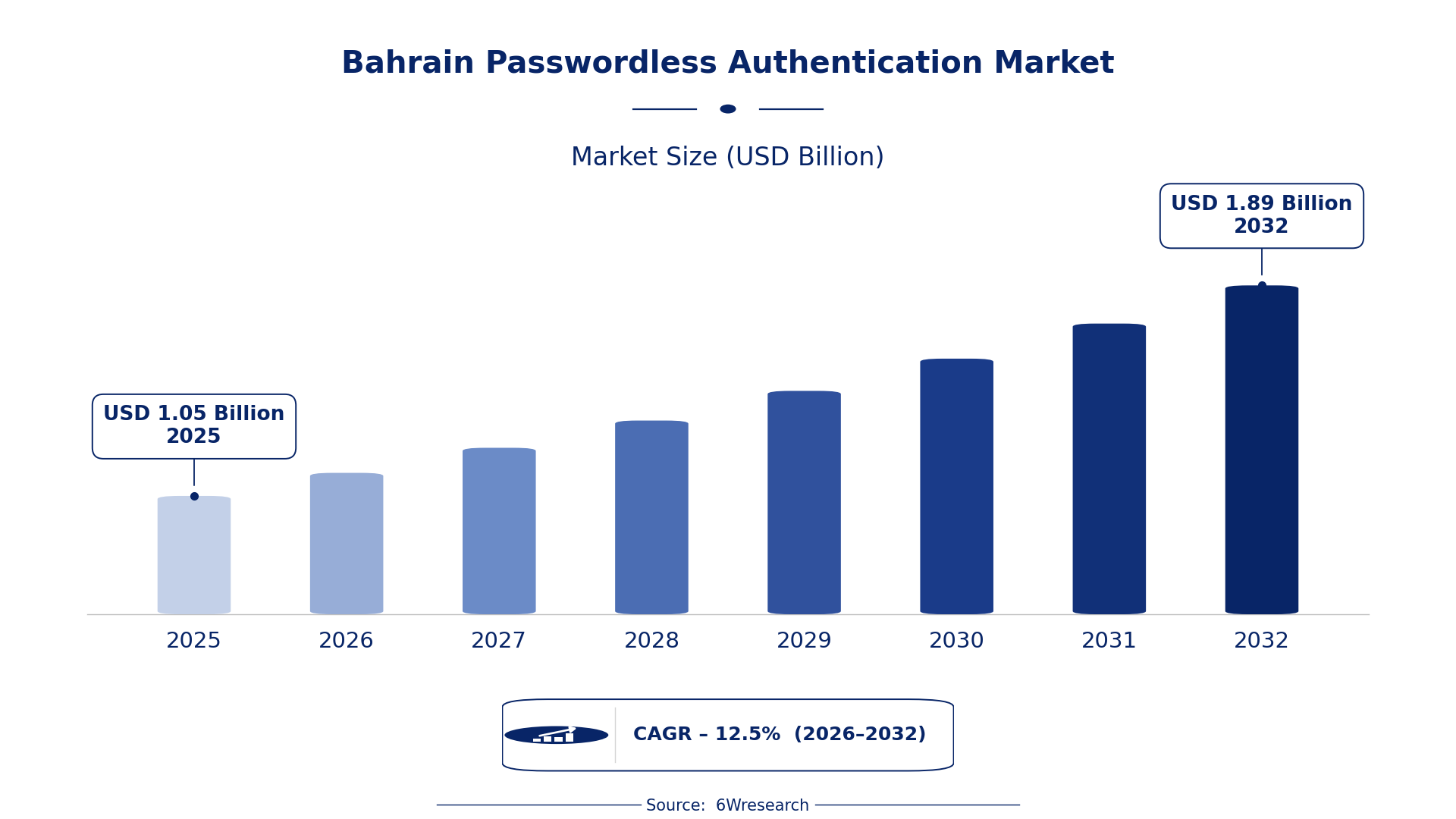
The Bahrain Passwordless Authentication Market was estimated at USD 1048 Million in 2025 and is projected to reach USD 1887 Million by 2032, growing at a CAGR of 12.5% from 2026 to 2032.
Bahrain Passwordless Authentication Market Synopsis
The primary driver behind the Bahrain Passwordless Authentication Market is the increasing urgency to enhance user security alongside the demand for a smoother digital experience. Organizations across various sectors, particularly in banking and government, are recognizing the necessity of adopting advanced authentication methods to combat the rising tide of password breaches and phishing attacks.
As more companies embrace passwordless solutions, the focus shifts toward biometric-based and token-based systems. The zero-trust architecture trend is nudging traditional businesses to abandon outdated password practices, ultimately leading to lower operational costs and improved productivity, thereby setting a course for substantial growth in this market.
Bahrain Passwordless Authentication Market Year-wise Growth Rate and Key Drivers
This graph illustrates the annual growth rates of the Bahrain Passwordless Authentication Market from 2021 to 2032, highlighting a steady upward trajectory and projected expansion over the forecast period.
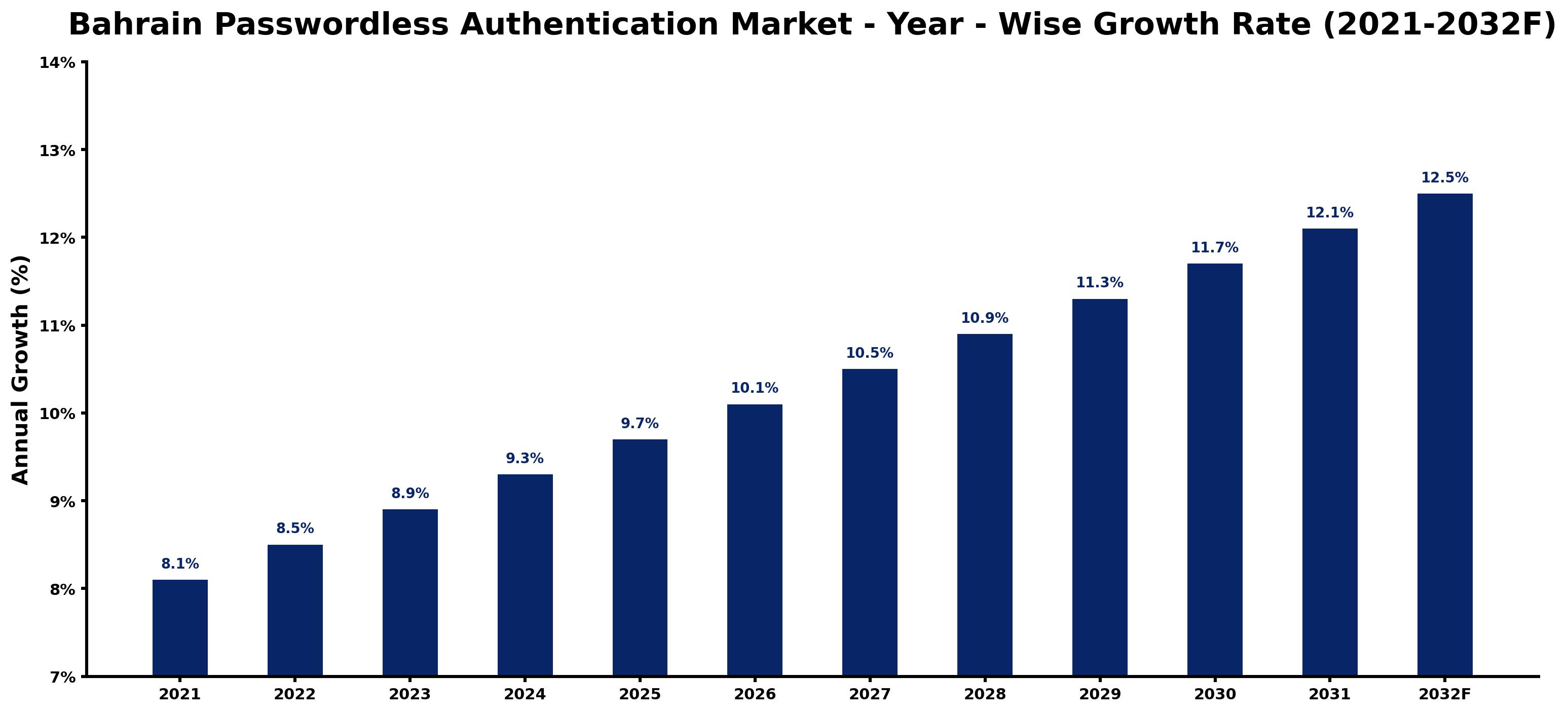
The table below presents the year‑wise growth rates along with the key drivers influencing the market
| Year | Growth Rate | Major Drivers |
| 2021 | 8.1% | Central Bank of Bahrain promotes secure digital transactions. |
| 2022 | 8.5% | Bahrain privacy law boosts demand for secure authentication. |
| 2023 | 8.9% | Government drives fintech innovations, increasing passwordless adoption. |
| 2024 | 9.3% | Growing e-commerce sector demands advanced security measures. |
| 2025 | 9.7% | Bahrain Economic Vision 2030 supports digital identity frameworks. |
| 2026 | 10.1% | Increased cyber threats prompt shift to passwordless solutions. |
| 2027 | 10.5% | Rise in remote work necessitates secure access methods. |
| 2028 | 10.9% | Bahraini startups focusing on innovative security technologies. |
| 2029 | 11.3% | Implementation of e-Government services drives authentication needs. |
| 2030 | 11.7% | Local cybersecurity regulations encourage passwordless technology uptake. |
| 2031 | 12.1% | Bahrain's digital literacy initiatives enhance awareness of passwordless. |
| 2032 | 12.5% | Investment in blockchain accelerates demand for secure logins. |
Note: Market size estimations and growth projections presented in this report are based on 6Wresearch's proprietary forecasting methodology, utilizing the latest available industry data, government publications, and primary research inputs.
Bahrain Passwordless Authentication Market Key Takeaways
Below are some of the specific key takeaways from the market, including:
- Organizations are prioritizing biometrics and token-based systems to enhance user security.
- The transition to passwordless methods is reducing operational costs significantly.
- There is a strong government backing for passwordless authentication in public sectors.
- The rise of zero-trust architectures is accelerating the move away from traditional passwords.
- User acceptance remains a crucial factor in successful implementation of passwordless technologies.
Evaluation of Restraints in Bahrain Passwordless Authentication Market
While the Bahrain Passwordless Authentication Market shows promising growth, several limitations impede its rapid expansion. Organizations are often reluctant to abandon traditional password systems due to concerns about the compatibility of new technologies with their existing legacy infrastructure. The transition to biometric or token-based systems typically requires substantial adjustments in security protocols and user workflows, which can deter many businesses.
Moreover, user acceptance poses a significant challenge; individuals may express apprehension towards adopting new methods, particularly biometrics, due to privacy and data protection worries. These factors introduce complexity in integrating passwordless solutions with existing multi-factor authentication systems, adding another layer of difficulty to deployment efforts.
Bahrain Passwordless Authentication Market Trends
Emerging trends in the Bahrain Passwordless Authentication Market highlight a shift toward enhanced user experience and stronger security measures. The integration of biometric authentication technologies, such as facial recognition and fingerprint scanning, is gaining traction as organizations prioritize frictionless interactions. Additionally, the use of hardware tokens and magic link logins is on the rise, particularly in sectors like banking and telecommunications.
As the need for cybersecurity intensifies, businesses are increasingly adopting passwordless solutions, aligning with global movements toward zero-trust security frameworks. This paradigm shift underscores the necessity for organizations to adapt and adopt these technologies, reinforcing security and improving overall efficiency.
Bahrain Passwordless Authentication Market Opportunities
The landscape for investment in Bahrain’s passwordless authentication sector is rich with opportunities. Enterprises seeking to bolster security while enhancing user experience present a lucrative avenue for innovation. Biometric authentication technologies, along with one-time codes and mobile device-based verification, stand out as key areas ripe for development.
With strong adoption rates in banking, telecom, and government services, this market is becoming a significant priority within IT security budgets. Investors should target companies that are focused on creating scalable and user-friendly solutions, which address credential-based vulnerabilities and align with the broader shift toward modern security frameworks.
Government Initiatives in the Bahrain Passwordless Authentication Market
Bahrain's government is committed to modernizing digital identity frameworks, providing crucial support for passwordless authentication in public sector applications. This strategic focus aims to significantly enhance security protocols while simultaneously reducing fraud and phishing risks across various governmental platforms. Regulatory compliance now increasingly includes passwordless solutions, reflecting the government's intent to phase out traditional passwords.
- A regulatory framework was introduced in early 2025 mandating the implementation of passwordless solutions in public sector agencies.
- Ongoing initiatives to upgrade national digital identity systems include increased support for biometric and token-based authentication methods.
- Current efforts are underway to integrate passwordless technologies into healthcare services to enhance patient data protection.
- A planned public-private partnership is expected to roll out by 2028, aimed at expanding the infrastructure necessary for widespread passwordless solutions.
Future Insights of the Bahrain Passwordless Authentication Market
The Bahrain Passwordless Authentication Market is set for significant evolution between 2026 and 2032. As organizations increasingly prioritize security and user convenience, passwordless technologies will likely become commonplace. The ongoing support from government policy will further stimulate this growth, positioning Bahrain as a regional leader in authentication innovation.
As companies continue to invest in modern security frameworks, we can anticipate broader acceptance of passwordless systems. This transition will not only enhance security protocols but also drive operational efficiencies across multiple sectors, paving the way for a more secure digital future.
Bahrain Passwordless Authentication Market Latest Developments
In the past 12-14 months, the Bahrain Passwordless Authentication Market has witnessed a flurry of activity, driven by technological advancements and government initiatives. Organizations are keenly exploring passwordless options, resulting in partnerships and technological rollouts aimed at enhancing digital security.
- A leading regional technology vendor launched a new biometric authentication solution in early 2025, targeting the banking sector.
- Ongoing partnerships between telecom providers and cybersecurity firms are enhancing the integration of passwordless technologies into mobile networks, with developments starting in mid-2025.
- By the end of 2025, a major financial institution is expected to complete the rollout of a passwordless system designed to streamline customer access to digital banking services.
- Upcoming initiatives in late 2026 will focus on expanding passwordless authentication into government services, aligning with national policy directives.
Bahrain Passwordless Authentication Market - Key Attractiveness of the Report
- 10 Years of Market Numbers
- Historical Data Starting from 2022 to 2025
- Base Year: 2025
- Forecast Data until 2032
- Key Performance Indicators Impacting the Market
- Major Upcoming Developments and Projects
Key Highlights of the Report:
- Bahrain Passwordless Authentication Market Outlook
- Market Size of Bahrain Passwordless Authentication Market, 2025
- Forecast of Bahrain Passwordless Authentication Market, 2032
- Historical Data and Forecast of Bahrain Passwordless Authentication Revenues & Volume for the Period 2022-2032F
- Bahrain Passwordless Authentication Market Trend Evolution
- Bahrain Passwordless Authentication Market Drivers and Challenges
- Bahrain Passwordless Authentication Price Trends
- Bahrain Passwordless Authentication Porter's Five Forces
- Bahrain Passwordless Authentication Industry Life Cycle
- Historical Data and Forecast of Bahrain Passwordless Authentication Market Revenues & Volume By Offering for the Period 2022-2032F
- Historical Data and Forecast of Bahrain Passwordless Authentication Market Revenues & Volume By Hardware for the Period 2022-2032F
- Historical Data and Forecast of Bahrain Passwordless Authentication Market Revenues & Volume By Software for the Period 2022-2032F
- Historical Data and Forecast of Bahrain Passwordless Authentication Market Revenues & Volume By Services for the Period 2022-2032F
- Historical Data and Forecast of Bahrain Passwordless Authentication Market Revenues & Volume By Motility for the Period 2022-2032F
- Historical Data and Forecast of Bahrain Passwordless Authentication Market Revenues & Volume By Fixed/Rack Mounted for the Period 2022-2032F
- Historical Data and Forecast of Bahrain Passwordless Authentication Market Revenues & Volume By Mobile/Portable for the Period 2022-2032F
- Historical Data and Forecast of Bahrain Passwordless Authentication Market Revenues & Volume By Authentication Type for the Period 2022-2032F
- Historical Data and Forecast of Bahrain Passwordless Authentication Market Revenues & Volume By Single-factor for the Period 2022-2032F
- Historical Data and Forecast of Bahrain Passwordless Authentication Market Revenues & Volume By Multi-factor for the Period 2022-2032F
- Historical Data and Forecast of Bahrain Passwordless Authentication Market Revenues & Volume By End User for the Period 2022-2032F
- Historical Data and Forecast of Bahrain Passwordless Authentication Market Revenues & Volume By BFSI for the Period 2022-2032F
- Historical Data and Forecast of Bahrain Passwordless Authentication Market Revenues & Volume By IT and ITeS for the Period 2022-2032F
- Historical Data and Forecast of Bahrain Passwordless Authentication Market Revenues & Volume By Government and Law Enforcement for the Period 2022-2032F
- Historical Data and Forecast of Bahrain Passwordless Authentication Market Revenues & Volume By Healthcare for the Period 2022-2032F
- Historical Data and Forecast of Bahrain Passwordless Authentication Market Revenues & Volume By Manufacturing for the Period 2022-2032F
- Historical Data and Forecast of Bahrain Passwordless Authentication Market Revenues & Volume By Retail and Consumer Electronics for the Period 2022-2032F
- Historical Data and Forecast of Bahrain Passwordless Authentication Market Revenues & Volume By Travel and Hospitality for the Period 2022-2032F
- Historical Data and Forecast of Bahrain Passwordless Authentication Market Revenues & Volume By Other Verticals (Education; Energy and Utilities; Aerospace and Defense; Media and Entertainment; Online Gaming; and Transportation and Logistics) for the Period 2022-2032F
- Bahrain Passwordless Authentication Import Export Trade Statistics
- Market Opportunity Assessment By Offering
- Market Opportunity Assessment By Motility
- Market Opportunity Assessment By Authentication Type
- Market Opportunity Assessment By End User
- Bahrain Passwordless Authentication Top Companies Market Share
- Bahrain Passwordless Authentication Competitive Benchmarking By Technical and Operational Parameters
- Bahrain Passwordless Authentication Company Profiles
- Bahrain Passwordless Authentication Key Strategic Recommendations






































