Bahrain Planting Equipment Market Size, Share & Growth Rate
The Bahrain Planting Equipment Market was estimated at USD 355 Million in 2025 and is projected to reach USD 667 Million by 2032, growing at a CAGR of 9.4% from 2026 to 2032. This growth trajectory is driven primarily by the agricultural sector's focus on modernization and the increasing adoption of mechanized farming practices. As Bahrain navigates its arid climate, investing in efficient planting tools such as seed drills and planters has become imperative for enhancing crop yields and ensuring food security.
Bahrain Planting Equipment Market Year-wise Growth Rate and Key Drivers
This graph highlights how the Bahrain Planting Equipment Market has steadily grown over the years, supported by major growth factors.
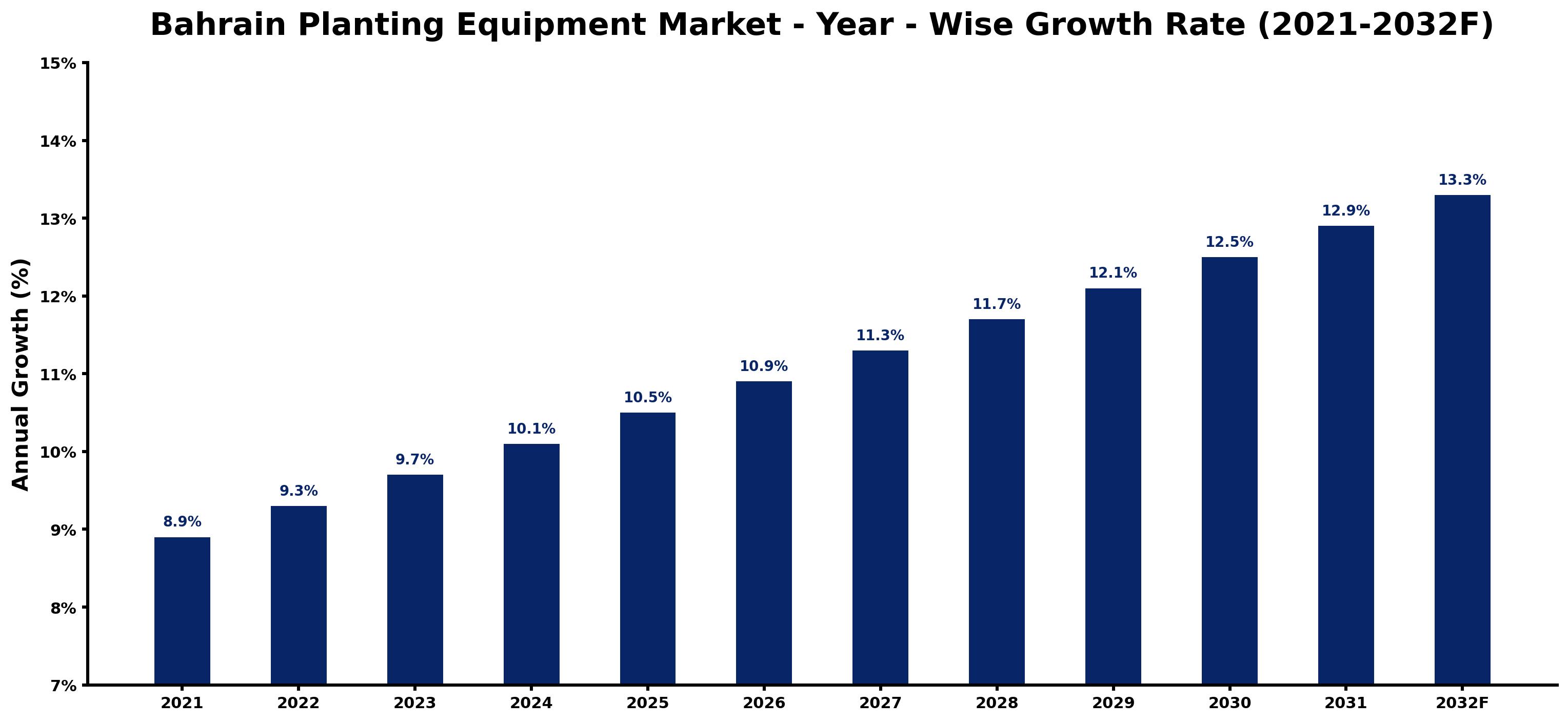
The table below presents the year‑wise growth rates along with the key drivers influencing the market
| Year | Growth Rate | Major Drivers |
| 2021 | 8.9% | Rising electricity demand across industries |
| 2022 | 9.3% | Increasing adoption of advanced technologies |
| 2023 | 9.7% | Growing urbanization and commercial development |
| 2024 | 10.1% | Increasing industrial infrastructure investments |
| 2025 | 10.5% | Rising electricity demand across industries |
| 2026 | 10.9% | Increasing industrial automation investments |
| 2027 | 11.3% | Rising electricity demand across industries |
| 2028 | 11.7% | Expansion of transportation and logistics networks |
| 2029 | 12.1% | Increasing smart city development projects |
| 2030 | 12.5% | Expansion of transportation and logistics networks |
| 2031 | 12.9% | Expansion of commercial construction activities |
| 2032 | 13.3% | Growing urbanization and commercial development |
Note - Market size estimations and growth projections presented in this report are based on 6Wresearch’s advanced forecasting approach, validated with industry datasets as of June 2026.
Bahrain Planting Equipment Market Synopsis
Bahrain's agricultural landscape is evolving, with a noticeable shift towards modern practices aimed at maximizing output amid environmental challenges. This push is significantly increasing the demand for advanced planting equipment, which is seen as essential in transitioning from traditional to mechanized farming.
As farmers increasingly recognize the benefits of precision agriculture, the deployment of technology-driven planting solutions is becoming more prevalent. The government's favorable stance towards mechanization further reinforces this trend, thereby creating a promising future for the planting equipment market in Bahrain.
Bahrain Planting Equipment Market Key Takeaways
- The market is expected to experience robust growth, reaching USD 667 Million by 2032.
- Demand is fueled by increasing adoption of modern agricultural technologies and mechanization.
- Government incentives are enhancing investment in advanced planting machinery.
- Farmers are transitioning towards precision agriculture, further driving equipment innovation.
- Challenges related to arid climate and limited agricultural land persist but are being addressed through technology.
Evaluation of Restraints in Bahrain Planting Equipment Market
Despite the promising growth prospects, several constraints hinder the expansion of the planting equipment market in Bahrain. The country's limited arable land and arid conditions discourage large-scale mechanization, resulting in a reliance on traditional farming methods. Additionally, the high costs associated with importing advanced planting equipment pose significant barriers to adoption. The lack of technical expertise and training for operating such machinery further complicates the landscape, as farmers may hesitate to invest in costly technology without adequate support and knowledge.
Bahrain Planting Equipment Market Trends
Emerging trends in the Bahrain planting equipment market indicate a marked shift towards precision agriculture. This trend emphasizes the use of advanced, technology-driven tools that allow for more accurate sowing and resource management. Farmers are increasingly investing in equipment that not only boosts efficiency but also minimizes waste and labor costs. Additionally, a growing interest in sustainable practices is pushing manufacturers to develop eco-friendly equipment options that align with global agricultural trends.
Bahrain Planting Equipment Market Opportunities
The planting equipment market presents numerous growth opportunities, particularly for investors focusing on innovative, precision-controlled machinery. By providing solutions tailored to the unique challenges faced by Bahraini farmers, there is substantial potential to enhance productivity and crop yields. Additionally, as government initiatives promote agricultural modernization, the landscape is ripe for investment in advanced technologies that can further transform the sector.
Government Initiatives in the Bahrain Planting Equipment Market
The Bahraini government is actively promoting agricultural modernization through various policies aimed at enhancing productivity and encouraging mechanized farming practices. Subsidies and incentives are being offered to farmers to facilitate their transition to advanced agricultural machinery, which in turn supports the planting equipment market. This governmental support plays a crucial role in fostering a more sustainable agricultural ecosystem in Bahrain.
Future Insights of the Bahrain Planting Equipment Market
Looking ahead to 2026-2032, the Bahrain planting equipment market is poised for significant advancements, driven by technological innovation and a continued push towards efficiency. The increasing awareness among farmers of the benefits of mechanized practices, combined with supportive government policies, will likely catalyze further growth. Enhanced collaboration between technology providers and farmers will also be vital in overcoming current barriers and maximizing the potential of the planting equipment market.
Bahrain Planting Equipment Market Latest Developments (May 2025 - June 2026)
Recent developments in the Bahrain planting equipment market have focused on the integration of smart technology in agricultural practices. Innovations such as automated seed drills and precision planters are gaining traction, allowing for greater efficiency and reduced waste. Additionally, industry stakeholders are beginning to explore partnerships to foster knowledge exchange and improve access to advanced training, which is crucial for maximizing the effectiveness of modern planting equipment.
Bahrain Planting Equipment Market - Key Attractiveness of the Report
- 10 Years of Market Numbers
- Historical Data Starting from 2022 to 2025
- Base Year: 2025
- Forecast Data until 2032
- Key Performance Indicators Impacting the Market
- Major Upcoming Developments and Projects
Key Highlights of the Report:
- Bahrain Planting Equipment Market Outlook
- Market Size of Bahrain Planting Equipment Market, 2025
- Forecast of Bahrain Planting Equipment Market, 2032
- Historical Data and Forecast of Bahrain Planting Equipment Revenues & Volume for the Period 2022-2032F
- Bahrain Planting Equipment Market Trend Evolution
- Bahrain Planting Equipment Market Drivers and Challenges
- Bahrain Planting Equipment Price Trends
- Bahrain Planting Equipment Porter's Five Forces
- Bahrain Planting Equipment Industry Life Cycle
- Historical Data and Forecast of Bahrain Planting Equipment Market Revenues & Volume By Type for the Period 2022-2032F
- Historical Data and Forecast of Bahrain Planting Equipment Market Revenues & Volume By Air seeders for the Period 2022-2032F
- Historical Data and Forecast of Bahrain Planting Equipment Market Revenues & Volume By Seed drills for the Period 2022-2032F
- Historical Data and Forecast of Bahrain Planting Equipment Market Revenues & Volume By Planters for the Period 2022-2032F
- Historical Data and Forecast of Bahrain Planting Equipment Market Revenues & Volume By Others for the Period 2022-2032F
- Historical Data and Forecast of Bahrain Planting Equipment Market Revenues & Volume By Design for the Period 2022-2032F
- Historical Data and Forecast of Bahrain Planting Equipment Market Revenues & Volume By Mechanical for the Period 2022-2032F
- Historical Data and Forecast of Bahrain Planting Equipment Market Revenues & Volume By Automatic for the Period 2022-2032F
- Historical Data and Forecast of Bahrain Planting Equipment Market Revenues & Volume By Crop Type for the Period 2022-2032F
- Historical Data and Forecast of Bahrain Planting Equipment Market Revenues & Volume By Cereals & grains for the Period 2022-2032F
- Historical Data and Forecast of Bahrain Planting Equipment Market Revenues & Volume By Oilseeds & pulses for the Period 2022-2032F
- Historical Data and Forecast of Bahrain Planting Equipment Market Revenues & Volume By Fruits & vegetables for the Period 2022-2032F
- Historical Data and Forecast of Bahrain Planting Equipment Market Revenues & Volume By Others for the Period 2022-2032F
- Bahrain Planting Equipment Import Export Trade Statistics
- Market Opportunity Assessment By Type
- Market Opportunity Assessment By Design
- Market Opportunity Assessment By Crop Type
- Bahrain Planting Equipment Top Companies Market Share
- Bahrain Planting Equipment Competitive Benchmarking By Technical and Operational Parameters
- Bahrain Planting Equipment Company Profiles
- Bahrain Planting Equipment Key Strategic Recommendations






































