Bahrain Refrigeration and Heating Equipment Market Summary
The bahrain refrigeration and heating equipment market was estimated at USD 1015 Million in 2025 and is projected to reach USD 1778 Million by 2032, growing at a CAGR of 9.6% from 2026 to 2032.
Bahrain Refrigeration and Heating Equipment Market Year-wise Growth Rate and Key Drivers
This graph highlights how the Bahrain Refrigeration and Heating Equipment Market has steadily grown over the past five years, supported by major growth factors.
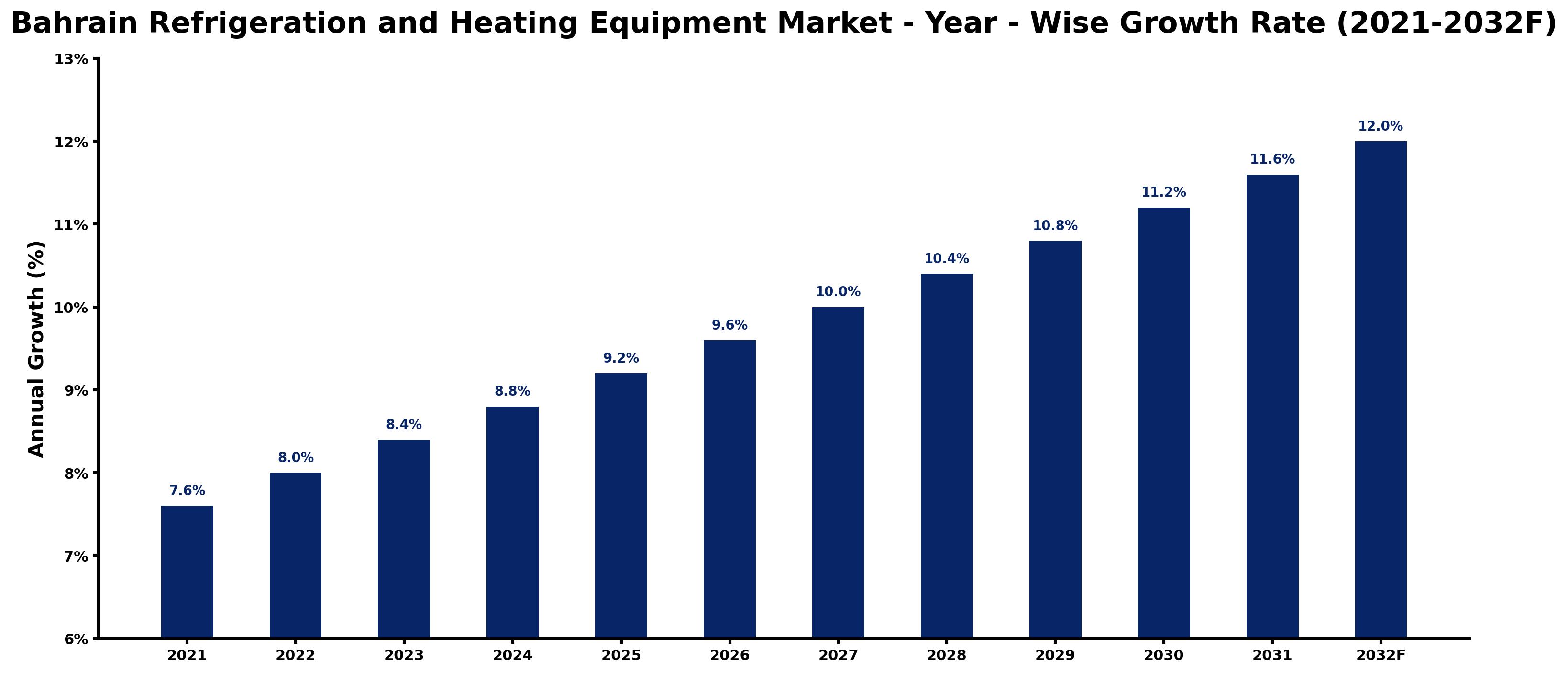
The table below presents the year wise growth rates along with the key drivers influencing the market
| Year | Growth Rate | Major Drivers |
| 2021 | 7.6% | The pandemic led to increased focus on ventilation systems in commercial spaces. |
| 2022 | 8.0% | Investment in luxury residential projects boosted demand for high-efficiency HVAC systems. |
| 2023 | 8.4% | Growing awareness about indoor air quality is prompting upgrades in existing equipment. |
| 2024 | 8.8% | Bahrain's construction boom enhances the demand for robust heating solutions in buildings. |
| 2025 | 9.2% | Emerging trends in smart home technology drive interest in integrated heating systems. |
| 2026 | 9.6% | The local manufacturing sector starts meeting more refrigerant and heating equipment needs. |
| 2027 | 10.0% | Regional climate changes necessitate advanced cooling technologies across various sectors. |
| 2028 | 10.4% | Sustainability initiatives prompt retrofitting of older systems with energy-efficient models. |
| 2029 | 10.8% | Partnerships with international brands lead to innovative product offerings in the market. |
| 2030 | 11.2% | An increase in tourism fuels demand for commercial refrigeration in hospitality sectors. |
| 2031 | 11.6% | The electric vehicle market's growth influences heating system adaptations in garages. |
| 2032 | 12.0% | Consumer preferences shift towards eco-friendly solutions, reshaping the equipment landscape. |
Note - Market size estimations and growth projections presented in this report are based on 6Wresearch's advanced forecasting approach, validated with industry datasets as of June 2026.
Bahrain Refrigeration and Heating Equipment Market Synopsis
The Bahrain Refrigeration and Heating Equipment Market is projected to reach 9.6% and witness significant growth during the forecast period (2026-2032). This growth is primarily driven by the rising demand for efficient cooling and heating solutions across various sectors, including food and beverage, pharmaceuticals, and retail. Additionally, investments in infrastructure, especially cold storage facilities, have surged, necessitating advanced refrigeration systems that align with sustainability goals.
Bahrain Refrigeration and Heating Equipment Market Growth Drivers
The Bahrain Refrigeration and Heating Equipment Market is positively affected by several key factors:
- Increasing demand for refrigeration and heating systems stems from the growing food and beverage industry, which requires precise temperature control to ensure product quality and safety.
- Rapid advancements in technology are creating opportunities for innovative and energy-efficient refrigeration solutions, allowing businesses to reduce operational costs while meeting regulatory standards.
- The expansion of the healthcare and hospitality sectors has amplified the need for reliable refrigeration systems, as these industries require specialized temperature management for sensitive products.
- Sustainability and energy conservation initiatives are gaining traction, prompting both consumers and businesses to seek high-efficiency equipment that minimizes energy consumption and carbon footprints.
- The overall economic growth in Bahrain is leading to increased investments in manufacturing and retail, which in turn boosts the demand for superior refrigeration and heating technologies.
Bahrain Refrigeration and Heating Equipment Market Challenges and Restraints
Despite the positive outlook, the Bahrain Refrigeration and Heating Equipment Market faces several challenges:
- Traditional refrigeration systems often exhibit high energy consumption, necessitating a transition towards more energy-efficient alternatives that may involve significant upfront investments.
- The volatility of raw material prices, particularly steel and aluminum, can disrupt production costs, impacting pricing strategies for local manufacturers.
- Intense competition from established international brands makes it challenging for local players to maintain market share and develop competitive pricing models.
- Manufacturers are required to invest heavily in research and development to adhere to evolving regulatory standards focused on energy efficiency and environmental sustainability.
- Market participants may struggle with the integration of innovative technologies due to existing infrastructure limitations or lack of expertise in advanced systems.
Bahrain Refrigeration and Heating Equipment Market Investment Opportunities
The Bahrain Refrigeration and Heating Equipment Market presents several lucrative investment opportunities:
- Opportunities exist in producing and distributing energy-efficient refrigeration and heating systems tailored to the needs of supermarkets, hotels, and large-scale commercial kitchens.
- Investors can capitalize on the growing trend of eco-friendly technologies that align with Bahrain's sustainability goals, contributing to reduced energy consumption.
- The continuous expansion of the retail and hospitality sectors is prompting demand for advanced climate control solutions, creating potential for innovative product offerings.
- Investments in R&D for smart refrigeration technologies can yield high returns, given the increasing focus on automation and monitoring systems in temperature control.
- Partnerships with local businesses and government entities can facilitate market entry and expansion, positioning new entrants to leverage existing networks and relationships.
Bahrain Refrigeration and Heating Equipment Market Government Investment and Initiatives
The Bahraini government plays a pivotal role in fostering the growth of the refrigeration and heating equipment sector through various initiatives:
- Regulatory measures have been introduced to promote energy efficiency, ensuring that all refrigeration and heating equipment complies with stringent environmental standards.
- Government investments in infrastructure, including cold storage facilities, directly enhance the market by creating a demand for modern refrigeration solutions.
- Incentives for businesses adopting sustainable practices are being implemented, encouraging the use of energy-efficient technologies that minimize environmental impact.
- Public spending on health and food safety initiatives is driving demand for reliable refrigeration systems, particularly in the food and beverage sector.
- Collaboration between the government and private sectors facilitates knowledge transfer and investment in innovative technologies, further strengthening the market position of Bahrain.
Bahrain Refrigeration and Heating Equipment Market Latest Developments (May 2025 - June 2026)
Recent developments in the Bahrain Refrigeration and Heating Equipment Market indicate a strategic shift towards energy efficiency and sustainability:
- Industry stakeholders have been increasingly prioritizing the development of eco-friendly refrigeration technologies that reduce energy consumption and align with global sustainability goals.
- There has been a notable rise in partnerships aimed at enhancing local manufacturing capabilities, particularly in response to fluctuating international raw material prices.
- Investments in smart technology integration have emerged, with a focus on automation and real-time monitoring solutions to improve operational efficiency.
- The government has accelerated its focus on enforcing regulations that mandate energy efficiency in new systems, prompting manufacturers to adapt quickly to maintain compliance.
- Consumer awareness around sustainability issues has surged, leading to a greater demand for high-efficiency heating and cooling equipment across both residential and commercial applications.
Bahrain Refrigeration and Heating Equipment Market - Key Attractiveness of the Report
- 10 Years of Market Numbers
- Historical Data Starting from 2022 to 2025
- Base Year: 2025
- Forecast Data until 2032
- Key Performance Indicators Impacting the Market
- Major Upcoming Developments and Projects
Key Highlights of the Report:
- Bahrain Refrigeration and Heating Equipment Market Outlook
- Market Size of Bahrain Refrigeration and Heating Equipment Market, 2025
- Forecast of Bahrain Refrigeration and Heating Equipment Market, 2032F
- Historical Data and Forecast of Bahrain Refrigeration and Heating Equipment Revenues & Volume for the Period 2022-2032F
- Bahrain Refrigeration and Heating Equipment Market Trend Evolution
- Bahrain Refrigeration and Heating Equipment Market Drivers and Challenges
- Bahrain Refrigeration and Heating Equipment Price Trends
- Bahrain Refrigeration and Heating Equipment Porter's Five Forces
- Bahrain Refrigeration and Heating Equipment Industry Life Cycle
- Historical Data and Forecast of Bahrain Refrigeration and Heating Equipment Market Revenues & Volume By Heating equipments for the Period 2022-2032F
- Historical Data and Forecast of Bahrain Refrigeration and Heating Equipment Market Revenues & Volume By Heating Pumps for the Period 2022-2032F
- Historical Data and Forecast of Bahrain Refrigeration and Heating Equipment Market Revenues & Volume By Furnaces for the Period 2022-2032F
- Historical Data and Forecast of Bahrain Refrigeration and Heating Equipment Market Revenues & Volume By Boilers for the Period 2022-2032F
- Historical Data and Forecast of Bahrain Refrigeration and Heating Equipment Market Revenues & Volume By Space heaters for the Period 2022-2032F
- Historical Data and Forecast of Bahrain Refrigeration and Heating Equipment Market Revenues & Volume By Unitary heaters for the Period 2022-2032F
- Historical Data and Forecast of Bahrain Refrigeration and Heating Equipment Market Revenues & Volume By Others for the Period 2022-2032F
- Historical Data and Forecast of Bahrain Refrigeration and Heating Equipment Market Revenues & Volume By Cooling Equipments for the Period 2022-2032F
- Historical Data and Forecast of Bahrain Refrigeration and Heating Equipment Market Revenues & Volume By Cooling towers for the Period 2022-2032F
- Historical Data and Forecast of Bahrain Refrigeration and Heating Equipment Market Revenues & Volume By Chillers for the Period 2022-2032F
- Historical Data and Forecast of Bahrain Refrigeration and Heating Equipment Market Revenues & Volume By Coolers for the Period 2022-2032F
- Historical Data and Forecast of Bahrain Refrigeration and Heating Equipment Market Revenues & Volume By Air conditioners for the Period 2022-2032F
- Historical Data and Forecast of Bahrain Refrigeration and Heating Equipment Market Revenues & Volume By Others for the Period 2022-2032F
- Historical Data and Forecast of Bahrain Refrigeration and Heating Equipment Market Revenues & Volume By General Components for the Period 2022-2032F
- Historical Data and Forecast of Bahrain Refrigeration and Heating Equipment Market Revenues & Volume By Condensers for the Period 2022-2032F
- Historical Data and Forecast of Bahrain Refrigeration and Heating Equipment Market Revenues & Volume By Compressors for the Period 2022-2032F
- Historical Data and Forecast of Bahrain Refrigeration and Heating Equipment Market Revenues & Volume By Radiators for the Period 2022-2032F
- Historical Data and Forecast of Bahrain Refrigeration and Heating Equipment Market Revenues & Volume By Sensors for the Period 2022-2032F
- Historical Data and Forecast of Bahrain Refrigeration and Heating Equipment Market Revenues & Volume By Transducers for the Period 2022-2032F
- Historical Data and Forecast of Bahrain Refrigeration and Heating Equipment Market Revenues & Volume By Others for the Period 2022-2032F
- Historical Data and Forecast of Bahrain Refrigeration and Heating Equipment Market Revenues & Volume By End-User Industries for the Period 2022-2032F
- Historical Data and Forecast of Bahrain Refrigeration and Heating Equipment Market Revenues & Volume By Residential for the Period 2022-2032F
- Historical Data and Forecast of Bahrain Refrigeration and Heating Equipment Market Revenues & Volume By Commercial for the Period 2022-2032F
- Historical Data and Forecast of Bahrain Refrigeration and Heating Equipment Market Revenues & Volume By Healthcare Industry for the Period 2022-2032F
- Historical Data and Forecast of Bahrain Refrigeration and Heating Equipment Market Revenues & Volume By Educational and government institutions for the Period 2022-2032F
- Historical Data and Forecast of Bahrain Refrigeration and Heating Equipment Market Revenues & Volume By Others for the Period 2022-2032F
- Bahrain Refrigeration and Heating Equipment Import Export Trade Statistics
- Market Opportunity Assessment By Heating equipments
- Market Opportunity Assessment By Cooling Equipments
- Market Opportunity Assessment By General Components
- Market Opportunity Assessment By End-User Industries
- Bahrain Refrigeration and Heating Equipment Top Companies Market Share
- Bahrain Refrigeration and Heating Equipment Competitive Benchmarking By Technical and Operational Parameters
- Bahrain Refrigeration and Heating Equipment Company Profiles
- Bahrain Refrigeration and Heating Equipment Key Strategic Recommendations






































