Bahrain Rolling Mill Components and Ancillary Equipment Market Size, Share & Growth Rate
The Bahrain Rolling Mill Components and Ancillary Equipment Market was estimated at USD 812 Million in 2025 and is projected to reach USD 1510 Million by 2032, growing at a CAGR of 9.3% from 2026 to 2032. This growth trajectory is largely fueled by the robust expansion of the metal processing industries in Bahrain, particularly in construction, automotive, and aerospace sectors. The push for modernization and energy efficiency in rolling mill operations is also prompting manufacturers to invest in advanced components and ancillary equipment to enhance productivity and minimize environmental impact.
Bahrain Rolling Mill Components and Ancillary Equipment Market Year-wise Growth Rate and Key Drivers
This graph highlights how the Bahrain Rolling Mill Components and Ancillary Equipment Market has steadily grown over the years, supported by major growth factors.
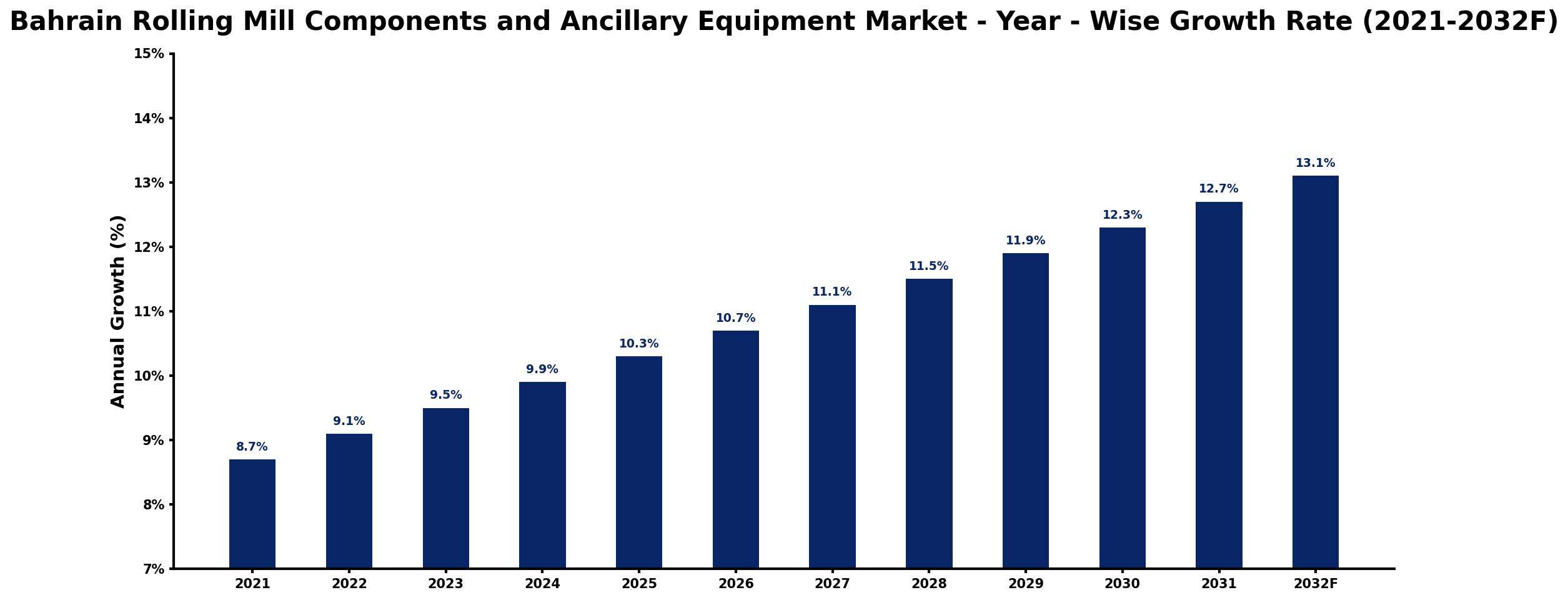
The table below presents the year‑wise growth rates along with the key drivers influencing the market
| Year | Growth Rate | Major Drivers |
| 2021 | 8.7% | Increased construction sector investments |
| 2022 | 9.1% | Rising demand for steel products |
| 2023 | 9.5% | Expansion of manufacturing facilities |
| 2024 | 9.9% | Growing infrastructure development projects |
| 2025 | 10.3% | Surge in renewable energy initiatives |
| 2026 | 10.7% | Boost in automotive production rates |
| 2027 | 11.1% | Increase in export opportunities |
| 2028 | 11.5% | Technological advancements in production |
| 2029 | 11.9% | Strengthening regional trade agreements |
| 2030 | 12.3% | Growing urbanization and population |
| 2031 | 12.7% | Investment in smart technologies |
| 2032 | 13.1% | Rise in green construction practices |
Note: Market size estimations and growth projections presented in this report are based on 6Wresearch's proprietary forecasting methodology, utilizing the latest available industry data, government publications, and primary research inputs.
Bahrain Rolling Mill Components and Ancillary Equipment Market Synopsis
As Bahrain progresses through a phase of rapid industrialization, the demand for rolling mill components and ancillary equipment has risen sharply. These components are vital for the production of metal sheets, bars, and rods, which are essential in various applications across multiple sectors.
The market is characterized by a diverse range of products, including but not limited to rollers, gearboxes, and hydraulic controls. This range is critical for optimizing the efficiency and longevity of rolling mill operations, which are paramount for meeting the growing demands of the Bahraini economy.
Bahrain Rolling Mill Components and Ancillary Equipment Market Key Takeaways
- The market is poised for significant growth, driven by advances in automation and energy-efficient technologies.
- Investment in high-performance rolling mill components is essential for local metal production and fabrication industries.
- Real-time monitoring and digitally controlled systems are emerging as key trends in improving mill efficiency.
- Despite growth, market size remains constrained by limited domestic manufacturing capabilities.
- Government initiatives continue to bolster industrial growth and support infrastructure development, fueling further demand.
Evaluation of Restraints in Bahrain Rolling Mill Components and Ancillary Equipment Market
Despite the positive growth outlook, the Bahrain Rolling Mill Components and Ancillary Equipment Market faces several restraints. The primary constraint is the limited scale of the local steel and metalworking industries, which restricts overall market size. This situation is exacerbated by the heavy reliance on imports, leading to increased costs and reduced competitiveness for local suppliers. Additionally, the lack of domestic manufacturing capacity means that local industries remain vulnerable to fluctuations in international supply and pricing, further hindering growth prospects.
Bahrain Rolling Mill Components and Ancillary Equipment Market Trends
Several key trends are shaping the Bahrain Rolling Mill Components and Ancillary Equipment Market. The shift towards automated and digitally controlled rolling mills is gaining traction, as manufacturers seek to improve precision and reduce waste in their processes. Additionally, energy-efficient solutions are becoming increasingly important, aligning with global sustainability efforts. The integration of advanced cooling systems and hydraulic controls is also on the rise, reflecting the industry's focus on operational efficiency and reduced environmental impact.
Bahrain Rolling Mill Components and Ancillary Equipment Market Opportunities
Significant opportunities exist within the Bahrain market for investments in rolling mill components and ancillary equipment. As local industries continue to modernize, there is an urgent need for high-quality, durable equipment that can withstand the demands of contemporary metal production. Furthermore, the government's ongoing investments in infrastructure and support for industrial growth present a conducive environment for companies looking to enter or expand within the market.
Government Initiatives in the Bahrain Rolling Mill Components and Ancillary Equipment Market
The Bahraini government has implemented various initiatives aimed at boosting the industrial sector, particularly in steel and aluminum production. These include infrastructure investments, trade facilitation policies, and energy subsidies designed to lower operational costs for manufacturers. Strategic efforts to promote the development of downstream sectors further stimulate the demand for advanced rolling mill technology and maintenance solutions, highlighting the government's commitment to supporting industry growth.
Future Insights of the Bahrain Rolling Mill Components and Ancillary Equipment Market
Looking ahead, the Bahrain Rolling Mill Components and Ancillary Equipment Market is expected to undergo transformative changes from 2026 to 2032. The emphasis on automation and sustainability will likely continue to drive the adoption of innovative technologies, enhancing both productivity and environmental stewardship. Moreover, as domestic manufacturing capabilities improve, the market may see reduced dependency on imports, fostering a more competitive landscape and increasing local investment opportunities.
Bahrain Rolling Mill Components and Ancillary Equipment Market Latest Developments (2025 - 2026)
Recent developments within the Bahrain Rolling Mill Components and Ancillary Equipment Market indicate a trend toward heightened investment in advanced manufacturing technologies. Increased collaboration between local industries and international technology providers is also being observed, aimed at enhancing operational efficiency and reducing costs. As the market evolves, companies are seeking to capitalize on the growing demand for more energy-efficient and automated solutions in rolling mill operations.
Bahrain Rolling Mill Components and Ancillary Equipment Market - Key Attractiveness of the Report
- 10 Years of Market Numbers
- Historical Data Starting from 2022 to 2025
- Base Year: 2025
- Forecast Data until 2032
- Key Performance Indicators Impacting the Market
- Major Upcoming Developments and Projects
Key Highlights of the Report:
- Bahrain Rolling Mill Components and Ancillary Equipment Market Outlook
- Market Size of Bahrain Rolling Mill Components and Ancillary Equipment Market, 2025
- Forecast of Bahrain Rolling Mill Components and Ancillary Equipment Market, 2032
- Historical Data and Forecast of Bahrain Rolling Mill Components and Ancillary Equipment Revenues & Volume for the Period 2022-2032F
- Bahrain Rolling Mill Components and Ancillary Equipment Market Trend Evolution
- Bahrain Rolling Mill Components and Ancillary Equipment Market Drivers and Challenges
- Bahrain Rolling Mill Components and Ancillary Equipment Price Trends
- Bahrain Rolling Mill Components and Ancillary Equipment Porter's Five Forces
- Bahrain Rolling Mill Components and Ancillary Equipment Industry Life Cycle
- Historical Data and Forecast of Bahrain Rolling Mill Components and Ancillary Equipment Market Revenues & Volume By Product for the Period 2022-2032F
- Historical Data and Forecast of Bahrain Rolling Mill Components and Ancillary Equipment Market Revenues & Volume By Iron Rolls for the Period 2022-2032F
- Historical Data and Forecast of Bahrain Rolling Mill Components and Ancillary Equipment Market Revenues & Volume By Steel Rolls for the Period 2022-2032F
- Historical Data and Forecast of Bahrain Rolling Mill Components and Ancillary Equipment Market Revenues & Volume By Others for the Period 2022-2032F
- Historical Data and Forecast of Bahrain Rolling Mill Components and Ancillary Equipment Market Revenues & Volume By End User for the Period 2022-2032F
- Historical Data and Forecast of Bahrain Rolling Mill Components and Ancillary Equipment Market Revenues & Volume By Oil & Gas for the Period 2022-2032F
- Historical Data and Forecast of Bahrain Rolling Mill Components and Ancillary Equipment Market Revenues & Volume By Industrial for the Period 2022-2032F
- Historical Data and Forecast of Bahrain Rolling Mill Components and Ancillary Equipment Market Revenues & Volume By Automotive for the Period 2022-2032F
- Historical Data and Forecast of Bahrain Rolling Mill Components and Ancillary Equipment Market Revenues & Volume By Mining for the Period 2022-2032F
- Historical Data and Forecast of Bahrain Rolling Mill Components and Ancillary Equipment Market Revenues & Volume By Others for the Period 2022-2032F
- Bahrain Rolling Mill Components and Ancillary Equipment Import Export Trade Statistics
- Market Opportunity Assessment By Product
- Market Opportunity Assessment By End User
- Bahrain Rolling Mill Components and Ancillary Equipment Top Companies Market Share
- Bahrain Rolling Mill Components and Ancillary Equipment Competitive Benchmarking By Technical and Operational Parameters
- Bahrain Rolling Mill Components and Ancillary Equipment Company Profiles
- Bahrain Rolling Mill Components and Ancillary Equipment Key Strategic Recommendations






































