Global Rolling Mill Components and Ancillary Equipment Market Highlights
| Market Size (2025) | USD 1500 Billion |
| Forecast Size (2032) | USD 2300 Billion |
| CAGR | 6.00% |
| Base Year | 2025 |
| Forecast Period | 2026-2032 |
| Largest Region | Asia Pacific |
| Fastest Growing Region | LATAM |
| Largest Segment | Steel Rolls |
| Fastest Growing Segment | Iron Rolls |
| Leading Companies | SMS group, Danieli, Primetals Technologies, UEC, AIC |
Global Rolling Mill Components and Ancillary Equipment Market Size & Growth Rate (2026-2032)
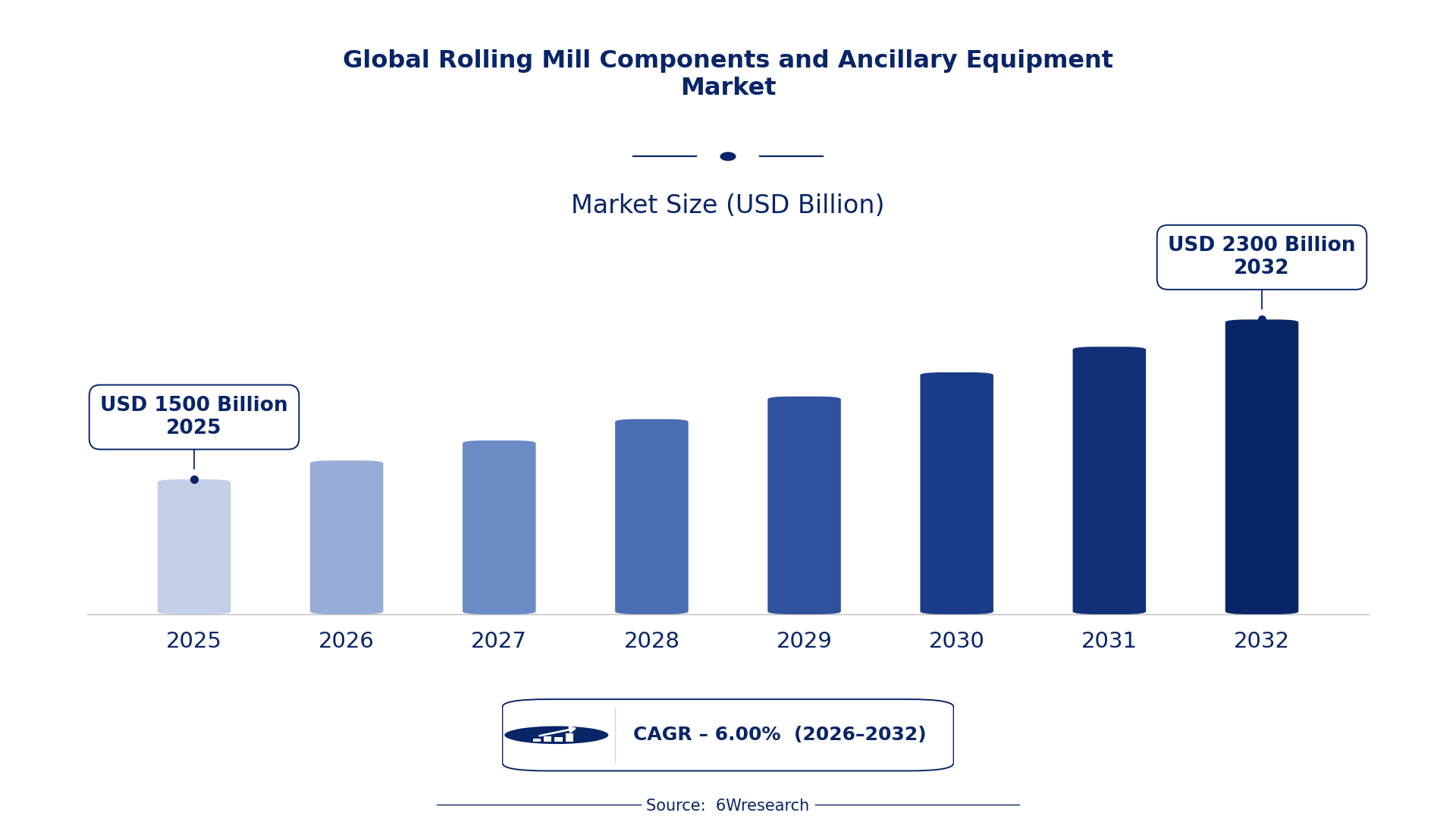
The Global Rolling Mill Components and Ancillary Equipment Market was estimated at USD 1500 Billion in 2025 and is projected to reach USD 2300 Billion by 2032, growing at a CAGR of 6.00% from 2026 to 2032.
Global Rolling Mill Components and Ancillary Equipment Market Synopsis
As industries expand, the Global Rolling Mill Components and Ancillary Equipment Market is fundamentally changing, driven by a surge in demand from sectors such as automotive and construction. Current trends showcase an increasing prioritization of efficiency, prompting manufacturers to invest heavily in advanced rolling mill technology, ensuring better overall quality of processed metals.
The interplay of digitalization and manufacturing processes is also noteworthy. The introduction of smart technologies, including IoT-driven predictive maintenance and automation, revolutionizes operational practices. As a result, companies are not just enhancing output; they are also significantly optimizing resource utilization and minimizing waste.
Global Rolling Mill Components and Ancillary Equipment Market Year-wise Growth Rate and Key Drivers
This graph illustrates the annual growth rates of the Global Rolling Mill Components and Ancillary Equipment Market from 2022 to 2032, highlighting a steady upward trajectory and projected expansion over the forecast period.
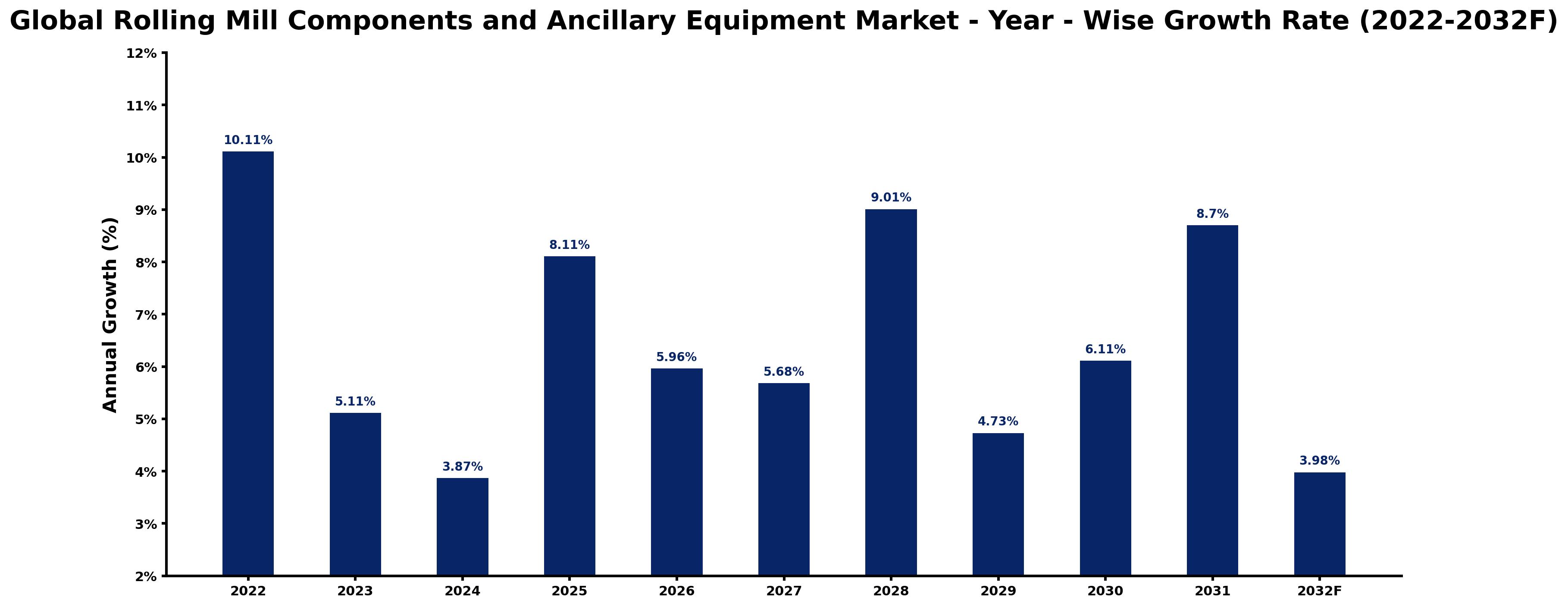
The table below presents the year‑wise growth rates along with the key drivers influencing the market
| Year | Growth Rate (%) | Major Drivers |
| 2022 | 10.11 | A shift toward stricter environmental regulations changes the adoption of rolling mill components. |
| 2023 | 5.11 | Investing in advanced ancillary equipment enhances mill operational efficiencies for manufacturers. |
| 2024 | 3.87 | Increased competition among heavy machinery suppliers drives innovation in rolling mills. |
| 2025 | 8.11 | Manufacturers adapt to altered supply chain dynamics by optimizing rolling mill operations. |
| 2026 | 5.96 | Steel producers increasingly utilize automated systems to improve rolling mill equipment efficiency. |
| 2027 | 5.68 | As raw material costs fluctuate, manufacturers reassess their heavy machinery fleets for cost-effectiveness. |
| 2028 | 9.01 | Automated rolling processes gain traction as regional demand for mill components surges. |
| 2029 | 4.73 | Foundry operators prioritize innovative rolling mill technologies to remain competitive in the market. |
| 2030 | 6.11 | In the context of sustainability, organizations seek eco-friendly rolling mill components to meet regulatory standards. |
| 2031 | 8.7 | A growing skilled labor force drives advancements in rolling mill equipment capabilities and efficiency. |
| 2032 | 3.98 | Changing consumer preferences toward sustainable products influence rolling mill component designs and innovations. |
Note - Market size estimations and growth projections presented in this report are based on 6Wresearch's proprietary research methodology, combining internal industry data, secondary research, and primary validation, updated periodically to reflect current market conditions. As markets evolve rapidly, figures for certain industries may vary slightly and are intended as informed estimates rather than absolute figures. For the most current market sizing, we recommend validating figures with a 6Wresearch analyst.
Global Rolling Mill Components and Ancillary Equipment Market Key Takeaways
Below are some of the specific key takeaways from the market, including:
- The Asia-Pacific region is expected to capture over 50% of the market share by 2025 due to its dense industrial manufacturing base.
- Steel Rolls account for approximately 65% of segment share in 2025, largely due to their widespread application in construction.
- The introduction of tax incentives in various regions is projected to encourage new investments exceeding $200 million by 2026.
- With a CAGR of 7.5%, Iron Rolls are anticipated to be the fastest-growing segment through 2032, driven by their rising demand in renewable energy applications.
Evaluation of Restraints in Global Rolling Mill Components and Ancillary Equipment Market
A notable constraint hampering market progress is the fluctuation in raw material prices, such as steel and iron, which can vary by over 20% within a year, impacting overall margins. Regulatory challenges also play a significant role; stringent environmental policies mandate significant investments in compliance. For example, compliance with the European Union's REACH regulation incurs costs that can exceed $1 million annually for medium-sized enterprises, putting additional financial strain on manufacturers.
Global Rolling Mill Components and Ancillary Equipment Market Trends
One of the most illustrative trends presently is the rise of automation in the manufacturing process. Companies like SMS group have integrated intelligent control systems into their rolling mills, enhancing predictive maintenance capabilities and reducing downtime. For instance, operations using these automated systems have reported efficiency increases of around 25% over manual processes since 2021.
Another trend involves the emphasis on energy-efficient solutions. For example, many manufacturers are now developing energy-saving drives that optimize energy use during production. Such innovations not only reduce operating costs but also align with global sustainability goals, contributing to the overall appeal and long-term feasibility of advanced rolling mill technologies.
Global Rolling Mill Components and Ancillary Equipment Market Opportunities
The market presents several future revenue opportunities, particularly in the renewable energy sector. For example, companies focusing on manufacturing components for wind turbines are likely to expand, as demand for carbon-neutral energy rises. According to reports, investments in this area could surpass $150 million globally by 2028.
Similarly, innovations in battery manufacturing processes indicate a significant shift. Industry players such as Primetals Technologies have recently patented new rolling techniques to produce battery casings that enhance efficiency by 20%, showcasing a lucrative avenue for investment and expansion.
Global Rolling Mill Components and Ancillary Equipment Market by Product
Steel Rolls lead the product segment, capturing approximately 65% share in 2025 due to their extensive applications across various industries. Iron Rolls are projected to experience rapid growth, estimated at a CAGR of 8.5% from 2026 to 2032, as they are increasingly utilized in new manufacturing processes within the renewable sector. The rising demand for eco-friendly materials significantly bolsters their market position, appealing to manufacturers striving for sustainability in production.
Global Rolling Mill Components and Ancillary Equipment Market by End User
The Automotive sector is the largest end user, commanding a share of approximately 40% in 2025 as the automotive manufacturing industry increasingly adopts advanced rolling mill technologies for efficiency and quality assurance. However, the Mining industry is emerging as the fastest-growing end user, expected to witness a CAGR of 8.0% from 2026 to 2032, driven by expanding exploration and production activities that specifically require more advanced milling techniques to cope with increasing complexities in resource extraction.
Global Rolling Mill Components and Ancillary Equipment Market by Region
The Asia Pacific region holds a dominant position, with over 50% share in 2025, mainly fueled by a robust ecosystem of steel manufacturers and ongoing industrialization projects. Conversely, LATAM is anticipated to be the fastest-growing region, expected to achieve a CAGR of 7.5% from 2026 to 2032, as nations within this region capitalize on their mineral resources to enhance manufacturing capabilities, thus leveraging their local production strengths.
Government Initiatives in the Global Rolling Mill Components and Ancillary Equipment Market
An evolving regulatory landscape is shaping the Global Rolling Mill Components and Ancillary Equipment Market. Governments are establishing frameworks that promote tech adoption, sustainability, and investment in local manufacturing. These initiatives aim to not only enhance production standards but also ensure compliance with environmental regulations.
- U.S. Department of Energy, "Manufacturing USA Initiative", 2014 — This initiative promotes advanced manufacturing and emphasizes automation, benefiting companies developing rolling mill components.
- Indian Ministry of Steel, "National Steel Policy 2017", 2017 — Aimed at boosting the domestic steel industry while promoting sustainable practices, enhancing capacity within the rolling mill sector.
- European Commission, "Green Deal", 2020 — This comprehensive policy aims to reduce carbon emissions, incentivizing manufacturers to adopt eco-friendly rolling mill technologies.
- Chinese Ministry of Industry and Information Technology, "Made in China 2025", 2015 — A key initiative that aims to modernize China's manufacturing base, specifically boosting the rolling mill component sector.
Future Insights of the Global Rolling Mill Components and Ancillary Equipment Market
The landscape of the Global Rolling Mill Components and Ancillary Equipment Market is shifting as manufacturers edge toward advanced automation and digital integration. Companies like SMS group are actively working on implementing AI-driven systems that facilitate real-time monitoring of rolling processes, thereby optimizing performance and minimizing waste. This trajectory suggests that by 2032, the competitive advantage will increasingly rely on technological sophistication and the ability to leverage data analytics for operational efficiency.
Global Rolling Mill Components and Ancillary Equipment Market Latest Developments
Recent advancements in the Global Rolling Mill Components and Ancillary Equipment Market reflect a commitment to innovation, efficiency, and sustainability. Here are some noteworthy developments:
- In September 2023, Danieli announced the successful integration of IoT features into its rolling mill lines, enhancing predictive maintenance capabilities and reducing downtime.
- Recently, in August 2023, Primetals Technologies launched a new energy-efficient hydraulic system, aimed at reducing power consumption by around 15% in manufacturing processes.
- In July 2023, AIC completed the acquisition of a local firm specializing in automated solutions, enhancing its technological capacity and market positioning.
- Upcoming in 2024, UEC is set to unveil a series of advanced rolling equipment designed specifically for the renewable energy sector, targeting increased demand from wind turbine manufacturers.
Global Rolling Mill Components and Ancillary Equipment Market Key Players and Industry Positioning
The competitive structure of the Global Rolling Mill Components and Ancillary Equipment Market is moderately consolidated, with several key players dominating market share. However, a significant number of regional and niche players also contribute to innovation, particularly in specialized applications like renewable energy and automation technologies.
| Leading Company | Core Strength | Strategic Focus |
|---|---|---|
| SMS group | Expertise in automation and digital technologies | Enhancing predictive maintenance through IoT |
| Danieli | Strong portfolio in energy-efficient solutions | Focus on eco-friendly production practices |
| Primetals Technologies | Cutting-edge technology in metal processing | Investment in automation for better efficiency |
| UEC | Diverse product range with a regional manufacturing focus | Expanding into renewable energy components |
| AIC | Leadership in advanced metallurgy | Strategic innovations for niche applications |
As market dynamics evolve, these key players are expected to adapt their strategies to maintain competitiveness, leveraging both technological advancement and market responsiveness.
Key Attractiveness of the Report
- 10 Years of Market Numbers
- Historical Data Starting from 2022 to 2025
- Base Year: 2025
- Forecast Data until 2032
- Key Performance Indicators Impacting the Market
- Major Upcoming Developments and Projects
Key Highlights of the Report:
- Global Rolling Mill Components and Ancillary Equipment Market Outlook
- Market Size of Global Rolling Mill Components and Ancillary Equipment Market, 2025
- Forecast of Global Rolling Mill Components and Ancillary Equipment Market, 2032
- Historical Data and Forecast of Global Rolling Mill Components and Ancillary Equipment Revenues & Volume for the Period 2022-2032
- Global Rolling Mill Components and Ancillary Equipment Market Trend Evolution
- Global Rolling Mill Components and Ancillary Equipment Market Drivers and Challenges
- Global Rolling Mill Components and Ancillary Equipment Price Trends
- Global Rolling Mill Components and Ancillary Equipment Porter's Five Forces
- Global Rolling Mill Components and Ancillary Equipment Industry Life Cycle
- Historical Data and Forecast of Global Rolling Mill Components and Ancillary Equipment Market Revenues & Volume
- Historical Data and Forecast of Global Rolling Mill Components and Ancillary Equipment Market Revenues & Volume By Product for the Period 2022-2032
- Historical Data and Forecast of Global Rolling Mill Components and Ancillary Equipment Market Revenues & Volume By Iron Rolls for the Period 2022-2032
- Historical Data and Forecast of Global Rolling Mill Components and Ancillary Equipment Market Revenues & Volume By Steel Rolls for the Period 2022-2032
- Historical Data and Forecast of Global Rolling Mill Components and Ancillary Equipment Market Revenues & Volume By Others for the Period 2022-2032
- Historical Data and Forecast of Global Rolling Mill Components and Ancillary Equipment Market Revenues & Volume By End User for the Period 2022-2032
- Historical Data and Forecast of Global Rolling Mill Components and Ancillary Equipment Market Revenues & Volume By Oil & Gas for the Period 2022-2032
- Historical Data and Forecast of Global Rolling Mill Components and Ancillary Equipment Market Revenues & Volume By Industrial for the Period 2022-2032
- Historical Data and Forecast of Global Rolling Mill Components and Ancillary Equipment Market Revenues & Volume By Automotive for the Period 2022-2032
- Historical Data and Forecast of Global Rolling Mill Components and Ancillary Equipment Market Revenues & Volume By Mining for the Period 2022-2032
- Historical Data and Forecast of Global Rolling Mill Components and Ancillary Equipment Market Revenues & Volume By Others for the Period 2022-2032
- Historical Data and Forecast of North America Rolling Mill Components and Ancillary Equipment Market Revenues & Volume By Product for the Period 2022-2032
- Historical Data and Forecast of North America Rolling Mill Components and Ancillary Equipment Market Revenues & Volume By Iron Rolls for the Period 2022-2032
- Historical Data and Forecast of North America Rolling Mill Components and Ancillary Equipment Market Revenues & Volume By Steel Rolls for the Period 2022-2032
- Historical Data and Forecast of North America Rolling Mill Components and Ancillary Equipment Market Revenues & Volume By Others for the Period 2022-2032
- Historical Data and Forecast of North America Rolling Mill Components and Ancillary Equipment Market Revenues & Volume By End User for the Period 2022-2032
- Historical Data and Forecast of North America Rolling Mill Components and Ancillary Equipment Market Revenues & Volume By Oil & Gas for the Period 2022-2032
- Historical Data and Forecast of North America Rolling Mill Components and Ancillary Equipment Market Revenues & Volume By Industrial for the Period 2022-2032
- Historical Data and Forecast of North America Rolling Mill Components and Ancillary Equipment Market Revenues & Volume By Automotive for the Period 2022-2032
- Historical Data and Forecast of North America Rolling Mill Components and Ancillary Equipment Market Revenues & Volume By Mining for the Period 2022-2032
- Historical Data and Forecast of North America Rolling Mill Components and Ancillary Equipment Market Revenues & Volume By Others for the Period 2022-2032
- Historical Data and Forecast of United States of America Rolling Mill Components and Ancillary Equipment Market Revenues & Volume for the Period 2022-2032
- Historical Data and Forecast of Canada Rolling Mill Components and Ancillary Equipment Market Revenues & Volume for the Period 2022-2032
- Historical Data and Forecast of Rest of North America Rolling Mill Components and Ancillary Equipment Market Revenues & Volume for the Period 2022-2032
- Historical Data and Forecast of Latin America (LATAM) Rolling Mill Components and Ancillary Equipment Market Revenues & Volume By Product for the Period 2022-2032
- Historical Data and Forecast of Latin America (LATAM) Rolling Mill Components and Ancillary Equipment Market Revenues & Volume By Iron Rolls for the Period 2022-2032
- Historical Data and Forecast of Latin America (LATAM) Rolling Mill Components and Ancillary Equipment Market Revenues & Volume By Steel Rolls for the Period 2022-2032
- Historical Data and Forecast of Latin America (LATAM) Rolling Mill Components and Ancillary Equipment Market Revenues & Volume By Others for the Period 2022-2032
- Historical Data and Forecast of Latin America (LATAM) Rolling Mill Components and Ancillary Equipment Market Revenues & Volume By End User for the Period 2022-2032
- Historical Data and Forecast of Latin America (LATAM) Rolling Mill Components and Ancillary Equipment Market Revenues & Volume By Oil & Gas for the Period 2022-2032
- Historical Data and Forecast of Latin America (LATAM) Rolling Mill Components and Ancillary Equipment Market Revenues & Volume By Industrial for the Period 2022-2032
- Historical Data and Forecast of Latin America (LATAM) Rolling Mill Components and Ancillary Equipment Market Revenues & Volume By Automotive for the Period 2022-2032
- Historical Data and Forecast of Latin America (LATAM) Rolling Mill Components and Ancillary Equipment Market Revenues & Volume By Mining for the Period 2022-2032
- Historical Data and Forecast of Latin America (LATAM) Rolling Mill Components and Ancillary Equipment Market Revenues & Volume By Others for the Period 2022-2032
- Historical Data and Forecast of Brazil Rolling Mill Components and Ancillary Equipment Market Revenues & Volume for the Period 2022-2032
- Historical Data and Forecast of Mexico Rolling Mill Components and Ancillary Equipment Market Revenues & Volume for the Period 2022-2032
- Historical Data and Forecast of Argentina Rolling Mill Components and Ancillary Equipment Market Revenues & Volume for the Period 2022-2032
- Historical Data and Forecast of Rest of LATAM Rolling Mill Components and Ancillary Equipment Market Revenues & Volume for the Period 2022-2032
- Historical Data and Forecast of Asia Rolling Mill Components and Ancillary Equipment Market Revenues & Volume By Product for the Period 2022-2032
- Historical Data and Forecast of Asia Rolling Mill Components and Ancillary Equipment Market Revenues & Volume By Iron Rolls for the Period 2022-2032
- Historical Data and Forecast of Asia Rolling Mill Components and Ancillary Equipment Market Revenues & Volume By Steel Rolls for the Period 2022-2032
- Historical Data and Forecast of Asia Rolling Mill Components and Ancillary Equipment Market Revenues & Volume By Others for the Period 2022-2032
- Historical Data and Forecast of Asia Rolling Mill Components and Ancillary Equipment Market Revenues & Volume By End User for the Period 2022-2032
- Historical Data and Forecast of Asia Rolling Mill Components and Ancillary Equipment Market Revenues & Volume By Oil & Gas for the Period 2022-2032
- Historical Data and Forecast of Asia Rolling Mill Components and Ancillary Equipment Market Revenues & Volume By Industrial for the Period 2022-2032
- Historical Data and Forecast of Asia Rolling Mill Components and Ancillary Equipment Market Revenues & Volume By Automotive for the Period 2022-2032
- Historical Data and Forecast of Asia Rolling Mill Components and Ancillary Equipment Market Revenues & Volume By Mining for the Period 2022-2032
- Historical Data and Forecast of Asia Rolling Mill Components and Ancillary Equipment Market Revenues & Volume By Others for the Period 2022-2032
- Historical Data and Forecast of China Rolling Mill Components and Ancillary Equipment Market Revenues & Volume for the Period 2022-2032
- Historical Data and Forecast of India Rolling Mill Components and Ancillary Equipment Market Revenues & Volume for the Period 2022-2032
- Historical Data and Forecast of Japan Rolling Mill Components and Ancillary Equipment Market Revenues & Volume for the Period 2022-2032
- Historical Data and Forecast of Rest of Asia Rolling Mill Components and Ancillary Equipment Market Revenues & Volume for the Period 2022-2032
- Historical Data and Forecast of Africa Rolling Mill Components and Ancillary Equipment Market Revenues & Volume By Product for the Period 2022-2032
- Historical Data and Forecast of Africa Rolling Mill Components and Ancillary Equipment Market Revenues & Volume By Iron Rolls for the Period 2022-2032
- Historical Data and Forecast of Africa Rolling Mill Components and Ancillary Equipment Market Revenues & Volume By Steel Rolls for the Period 2022-2032
- Historical Data and Forecast of Africa Rolling Mill Components and Ancillary Equipment Market Revenues & Volume By Others for the Period 2022-2032
- Historical Data and Forecast of Africa Rolling Mill Components and Ancillary Equipment Market Revenues & Volume By End User for the Period 2022-2032
- Historical Data and Forecast of Africa Rolling Mill Components and Ancillary Equipment Market Revenues & Volume By Oil & Gas for the Period 2022-2032
- Historical Data and Forecast of Africa Rolling Mill Components and Ancillary Equipment Market Revenues & Volume By Industrial for the Period 2022-2032
- Historical Data and Forecast of Africa Rolling Mill Components and Ancillary Equipment Market Revenues & Volume By Automotive for the Period 2022-2032
- Historical Data and Forecast of Africa Rolling Mill Components and Ancillary Equipment Market Revenues & Volume By Mining for the Period 2022-2032
- Historical Data and Forecast of Africa Rolling Mill Components and Ancillary Equipment Market Revenues & Volume By Others for the Period 2022-2032
- Historical Data and Forecast of South Africa Rolling Mill Components and Ancillary Equipment Market Revenues & Volume for the Period 2022-2032
- Historical Data and Forecast of Nigeria Rolling Mill Components and Ancillary Equipment Market Revenues & Volume for the Period 2022-2032
- Historical Data and Forecast of Egypt Rolling Mill Components and Ancillary Equipment Market Revenues & Volume for the Period 2022-2032
- Historical Data and Forecast of Rest of Africa Rolling Mill Components and Ancillary Equipment Market Revenues & Volume for the Period 2022-2032
- Historical Data and Forecast of Europe Rolling Mill Components and Ancillary Equipment Market Revenues & Volume By Product for the Period 2022-2032
- Historical Data and Forecast of Europe Rolling Mill Components and Ancillary Equipment Market Revenues & Volume By Iron Rolls for the Period 2022-2032
- Historical Data and Forecast of Europe Rolling Mill Components and Ancillary Equipment Market Revenues & Volume By Steel Rolls for the Period 2022-2032
- Historical Data and Forecast of Europe Rolling Mill Components and Ancillary Equipment Market Revenues & Volume By Others for the Period 2022-2032
- Historical Data and Forecast of Europe Rolling Mill Components and Ancillary Equipment Market Revenues & Volume By End User for the Period 2022-2032
- Historical Data and Forecast of Europe Rolling Mill Components and Ancillary Equipment Market Revenues & Volume By Oil & Gas for the Period 2022-2032
- Historical Data and Forecast of Europe Rolling Mill Components and Ancillary Equipment Market Revenues & Volume By Industrial for the Period 2022-2032
- Historical Data and Forecast of Europe Rolling Mill Components and Ancillary Equipment Market Revenues & Volume By Automotive for the Period 2022-2032
- Historical Data and Forecast of Europe Rolling Mill Components and Ancillary Equipment Market Revenues & Volume By Mining for the Period 2022-2032
- Historical Data and Forecast of Europe Rolling Mill Components and Ancillary Equipment Market Revenues & Volume By Others for the Period 2022-2032
- Historical Data and Forecast of United Kingdom Rolling Mill Components and Ancillary Equipment Market Revenues & Volume for the Period 2022-2032
- Historical Data and Forecast of France Rolling Mill Components and Ancillary Equipment Market Revenues & Volume for the Period 2022-2032
- Historical Data and Forecast of Germany Rolling Mill Components and Ancillary Equipment Market Revenues & Volume for the Period 2022-2032
- Historical Data and Forecast of Rest of Europe Rolling Mill Components and Ancillary Equipment Market Revenues & Volume for the Period 2022-2032
- Historical Data and Forecast of Middle East Rolling Mill Components and Ancillary Equipment Market Revenues & Volume By Product for the Period 2022-2032
- Historical Data and Forecast of Middle East Rolling Mill Components and Ancillary Equipment Market Revenues & Volume By Iron Rolls for the Period 2022-2032
- Historical Data and Forecast of Middle East Rolling Mill Components and Ancillary Equipment Market Revenues & Volume By Steel Rolls for the Period 2022-2032
- Historical Data and Forecast of Middle East Rolling Mill Components and Ancillary Equipment Market Revenues & Volume By Others for the Period 2022-2032
- Historical Data and Forecast of Middle East Rolling Mill Components and Ancillary Equipment Market Revenues & Volume By End User for the Period 2022-2032
- Historical Data and Forecast of Middle East Rolling Mill Components and Ancillary Equipment Market Revenues & Volume By Oil & Gas for the Period 2022-2032
- Historical Data and Forecast of Middle East Rolling Mill Components and Ancillary Equipment Market Revenues & Volume By Industrial for the Period 2022-2032
- Historical Data and Forecast of Middle East Rolling Mill Components and Ancillary Equipment Market Revenues & Volume By Automotive for the Period 2022-2032
- Historical Data and Forecast of Middle East Rolling Mill Components and Ancillary Equipment Market Revenues & Volume By Mining for the Period 2022-2032
- Historical Data and Forecast of Middle East Rolling Mill Components and Ancillary Equipment Market Revenues & Volume By Others for the Period 2022-2032
- Historical Data and Forecast of Saudi Arabia Rolling Mill Components and Ancillary Equipment Market Revenues & Volume for the Period 2022-2032
- Historical Data and Forecast of UAE Rolling Mill Components and Ancillary Equipment Market Revenues & Volume for the Period 2022-2032
- Historical Data and Forecast of Turkey Rolling Mill Components and Ancillary Equipment Market Revenues & Volume for the Period 2022-2032
- Historical Data and Forecast of Rest of Middle East Rolling Mill Components and Ancillary Equipment Market Revenues & Volume for the Period 2022-2032
- Global Rolling Mill Components and Ancillary Equipment Market - Key Performance Indicators
- Global Rolling Mill Components and Ancillary Equipment Market - Import Export Trade Statistics
- Global Rolling Mill Components and Ancillary Equipment Market - Opportunity Assessment By Countries
- Global Rolling Mill Components and Ancillary Equipment Market - Opportunity Assessment By Product
- Global Rolling Mill Components and Ancillary Equipment Market - Opportunity Assessment By End User
- Global Rolling Mill Components and Ancillary Equipment Market - Top Companies Market Share
- Global Rolling Mill Components and Ancillary Equipment Market - Top Companies Profiles
- Global Rolling Mill Components and Ancillary Equipment Market - Comparison of Players in Technical and Operating Parameters
- Global Rolling Mill Components and Ancillary Equipment Market - Strategic Recommendations
Markets Covered
The Global Rolling Mill Components and Ancillary Equipment Market report provides a detailed analysis of the following market segments:
By Regions and Countries:
- North America
- Europe
- LATAM
- Middle East
- Asia
- Africa
By Product:
- Iron Rolls
- Steel Rolls
- Others
By End User:
- Oil & Gas
- Industrial
- Automotive
- Mining
- Others






































