Germany Rolling Mill Components And Ancillary Equipment Market Size (2020-2030)
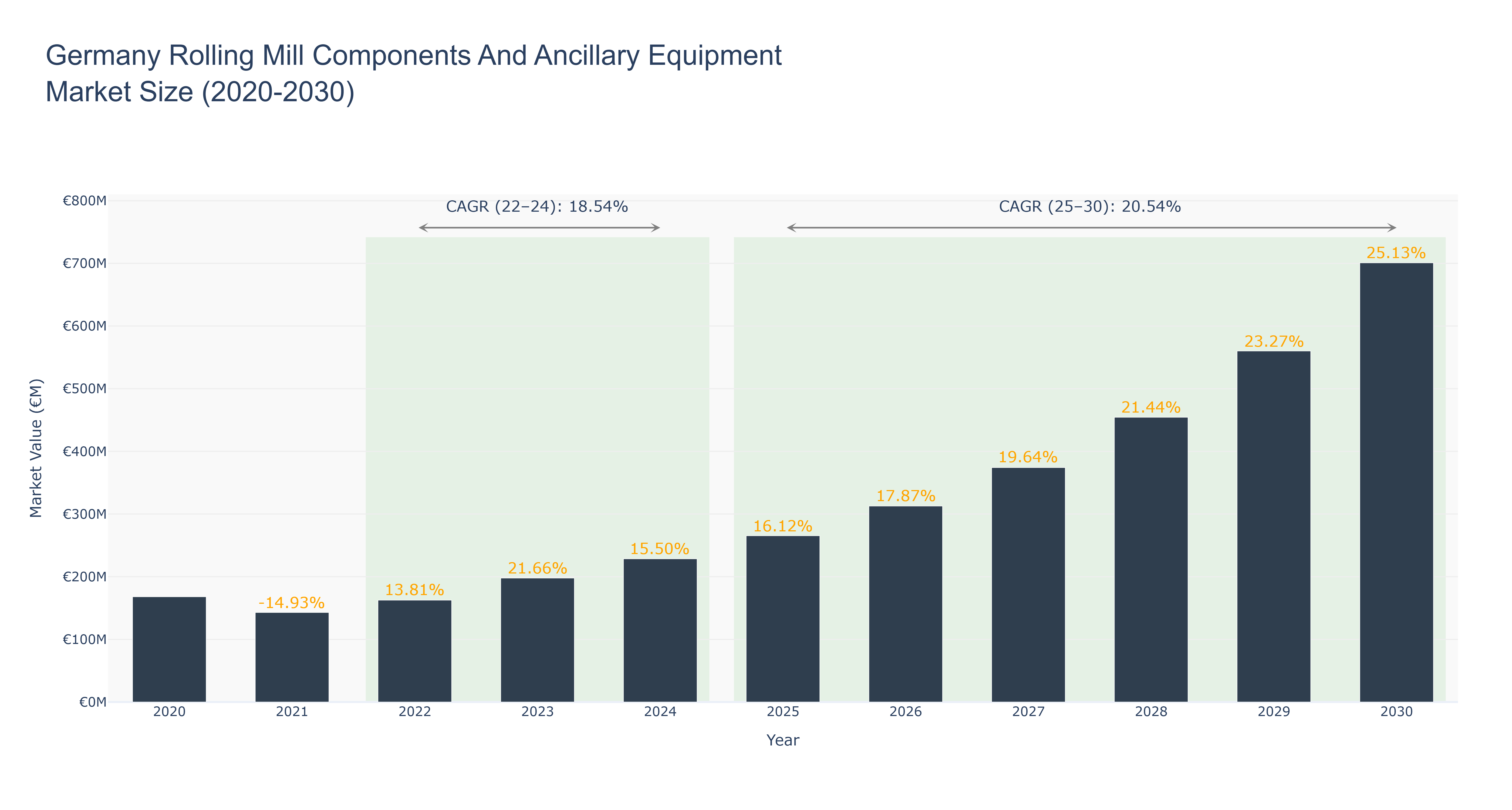
Germany Rolling Mill Components And Ancillary Equipment Market has shown a promising trend over the years. The peak market size of €700.90 million is forecasted for 2030 with a steady growth trajectory. The market size has increased from €167.96 million in 2020 to €228.50 million in 2024, indicating a consistent upward trend. The CAGR for the period 2022-24 stands at 18.54%, while for 2025-30, it is projected at 20.54%. The market's growth can be attributed to increasing industrialization, technological advancements, and a growing demand for rolling mill components. Recent developments in the market include collaborations with leading manufacturers to enhance product offerings and expand market reach. Future developments may involve investments in research and development to introduce innovative solutions catering to evolving industry needs.
Germany Rolling Mill Components And Ancillary Equipment Market: Production & Trade Performance (2019-2025)
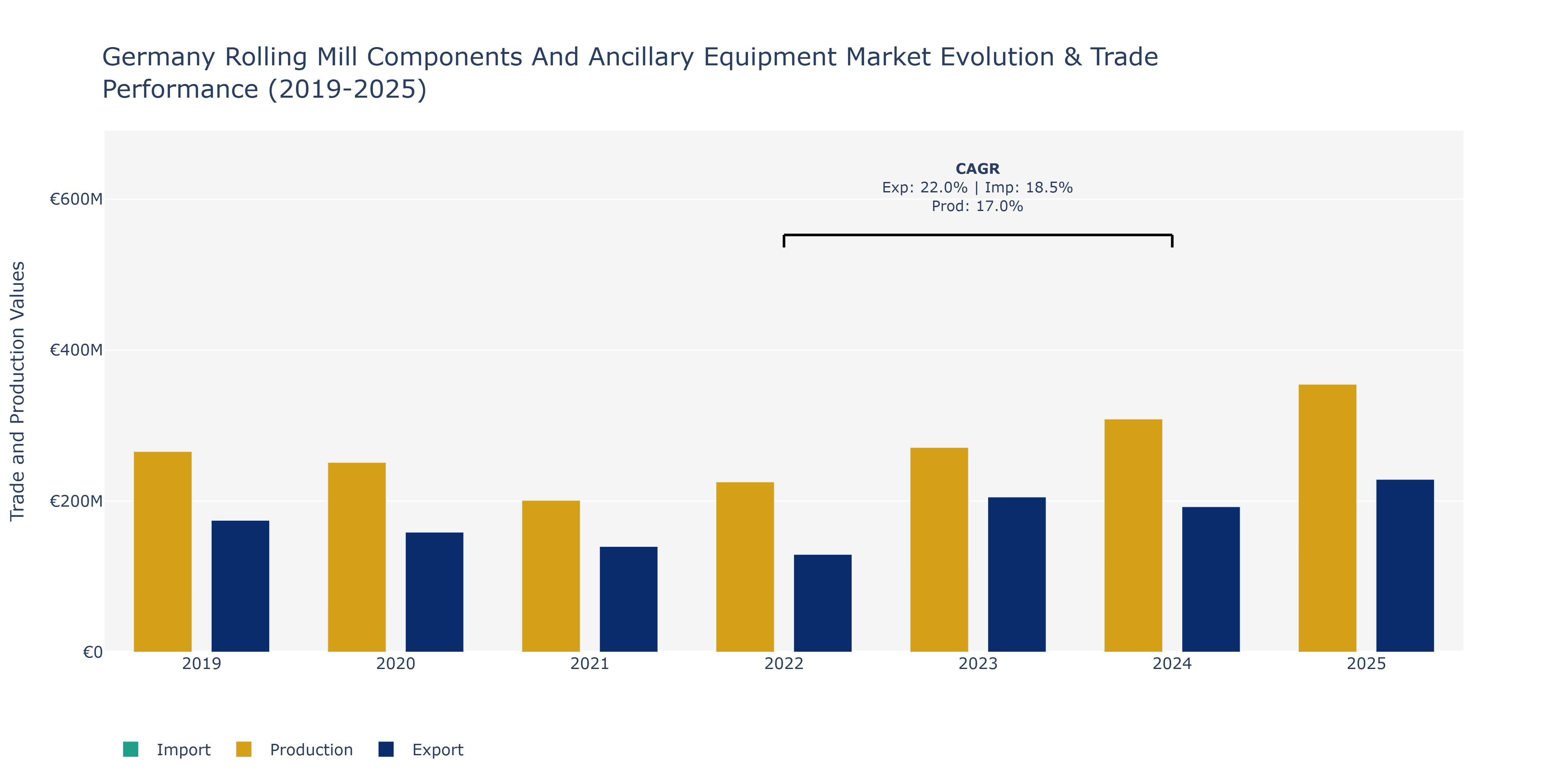
Between 2019 and 2025, Germany's Rolling Mill Components And Ancillary Equipment Market exhibited noteworthy dynamics in exports, imports, and production. Exports demonstrated a fluctuating pattern, with a peak in 2025 at approximately €228.68 million. Conversely, imports showed a decreasing trend from 2019 to 2021 before experiencing a sudden surge in 2023, reaching around €110.0 million. Production displayed a steady growth trajectory, hitting its peak in 2025 at roughly €354.7 million. These fluctuations could be attributed to various factors, such as evolving global demand for steel products and machinery, technological advancements in the manufacturing sector, and shifts in trade policies impacting import volumes. The consistent growth in production indicates Germany's strong manufacturing capabilities and its position as a key player in the market. To sustain and enhance market competitiveness, industry players may need to focus on innovation, sustainability, and efficient supply chain management strategies.
Key Highlights of the Report:
- Germany Rolling Mill Components and Ancillary Equipment Market Outlook
- Market Size of Germany Rolling Mill Components and Ancillary Equipment Market, 2025
- Forecast of Germany Rolling Mill Components and Ancillary Equipment Market, 2032
- Historical Data and Forecast of Germany Rolling Mill Components and Ancillary Equipment Revenues & Volume for the Period 2022-2032F
- Germany Rolling Mill Components and Ancillary Equipment Market Trend Evolution
- Germany Rolling Mill Components and Ancillary Equipment Market Drivers and Challenges
- Germany Rolling Mill Components and Ancillary Equipment Price Trends
- Germany Rolling Mill Components and Ancillary Equipment Porter's Five Forces
- Germany Rolling Mill Components and Ancillary Equipment Industry Life Cycle
- Historical Data and Forecast of Germany Rolling Mill Components and Ancillary Equipment Market Revenues & Volume By Product for the Period 2022-2032F
- Historical Data and Forecast of Germany Rolling Mill Components and Ancillary Equipment Market Revenues & Volume By Iron Rolls for the Period 2022-2032F
- Historical Data and Forecast of Germany Rolling Mill Components and Ancillary Equipment Market Revenues & Volume By Steel Rolls for the Period 2022-2032F
- Historical Data and Forecast of Germany Rolling Mill Components and Ancillary Equipment Market Revenues & Volume By Others for the Period 2022-2032F
- Historical Data and Forecast of Germany Rolling Mill Components and Ancillary Equipment Market Revenues & Volume By End User for the Period 2022-2032F
- Historical Data and Forecast of Germany Rolling Mill Components and Ancillary Equipment Market Revenues & Volume By Oil & Gas for the Period 2022-2032F
- Historical Data and Forecast of Germany Rolling Mill Components and Ancillary Equipment Market Revenues & Volume By Industrial for the Period 2022-2032F
- Historical Data and Forecast of Germany Rolling Mill Components and Ancillary Equipment Market Revenues & Volume By Automotive for the Period 2022-2032F
- Historical Data and Forecast of Germany Rolling Mill Components and Ancillary Equipment Market Revenues & Volume By Mining for the Period 2022-2032F
- Historical Data and Forecast of Germany Rolling Mill Components and Ancillary Equipment Market Revenues & Volume By Others for the Period 2022-2032F
- Germany Rolling Mill Components and Ancillary Equipment Import Export Trade Statistics
- Market Opportunity Assessment By Product
- Market Opportunity Assessment By End User
- Germany Rolling Mill Components and Ancillary Equipment Top Companies Market Share
- Germany Rolling Mill Components and Ancillary Equipment Competitive Benchmarking By Technical and Operational Parameters
- Germany Rolling Mill Components and Ancillary Equipment Company Profiles
- Germany Rolling Mill Components and Ancillary Equipment Key Strategic Recommendations






































