Kenya Rolling Mill Components and Ancillary Equipment Market Growth Rate Analysis (2021-2031)
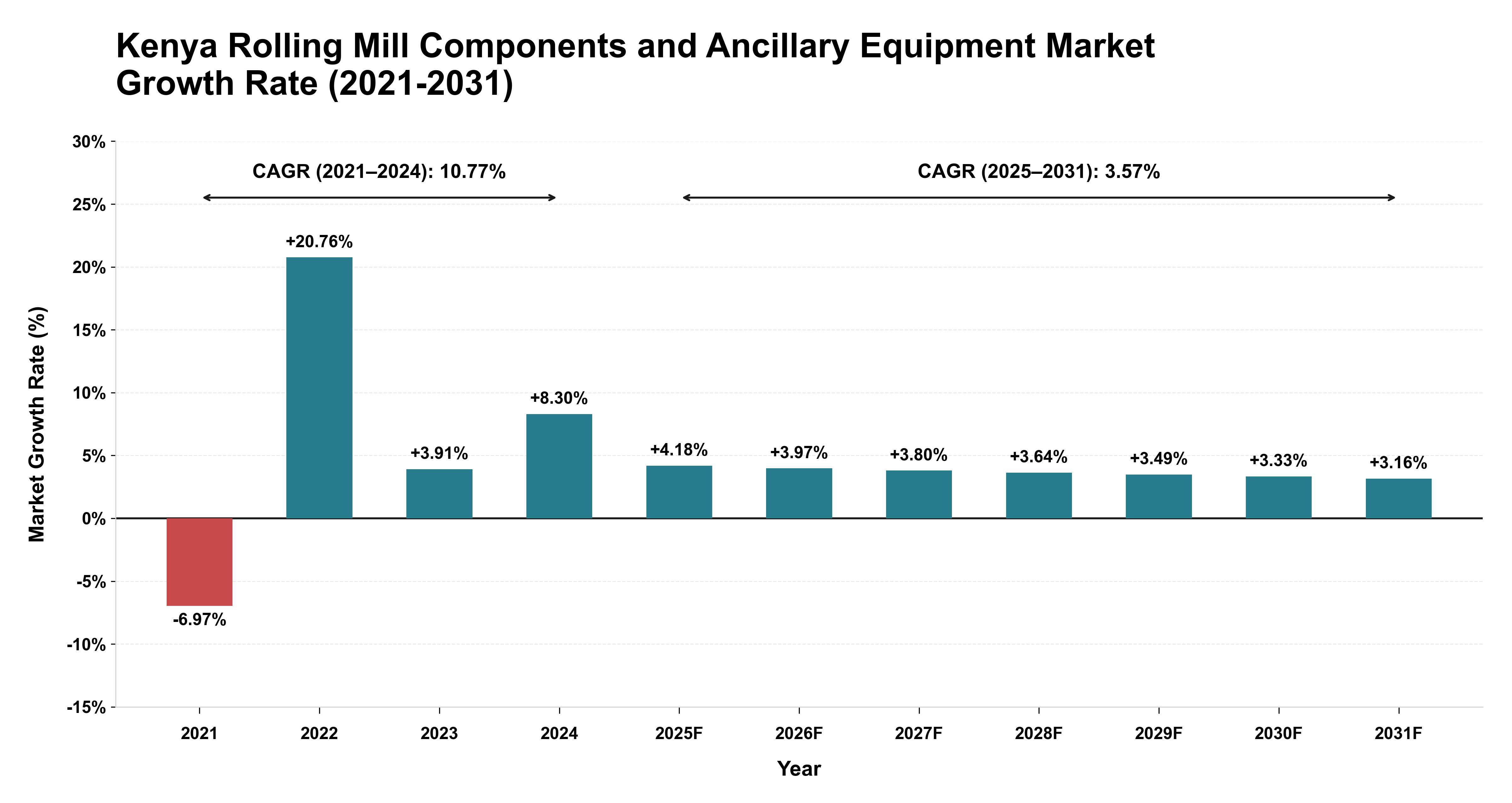
The Kenya Rolling Mill Components and Ancillary Equipment Market experienced a turbulent period from 2021 to 2024, marked by a negative growth rate in 2021 followed by a significant rebound in 2022 at 20.76%. This erratic behavior stabilized over the subsequent years, with growth rates of 3.91% in 2023 and 8.30% in 2024, resulting in an overall CAGR of 10.77%. Looking ahead to the forecast period from 2025 to 2031, the market is expected to undergo a phase of structural consolidation, with the growth rate gradually slowing down to a more sustainable level of 3.57%. The consistent single-digit growth rates projected for the coming years indicate a period of stabilization following the initial post-recovery volatility, reflecting a mature and balanced market environment for rolling mill components and ancillary equipment in Kenya.
Key Highlights of the Report:
- Kenya Rolling Mill Components and Ancillary Equipment Market Outlook
- Market Size of Kenya Rolling Mill Components and Ancillary Equipment Market, 2024
- Forecast of Kenya Rolling Mill Components and Ancillary Equipment Market, 2031
- Historical Data and Forecast of Kenya Rolling Mill Components and Ancillary Equipment Revenues & Volume for the Period 2021 - 2031
- Kenya Rolling Mill Components and Ancillary Equipment Market Trend Evolution
- Kenya Rolling Mill Components and Ancillary Equipment Market Drivers and Challenges
- Kenya Rolling Mill Components and Ancillary Equipment Price Trends
- Kenya Rolling Mill Components and Ancillary Equipment Porter's Five Forces
- Kenya Rolling Mill Components and Ancillary Equipment Industry Life Cycle
- Historical Data and Forecast of Kenya Rolling Mill Components and Ancillary Equipment Market Revenues & Volume By Product for the Period 2021 - 2031
- Historical Data and Forecast of Kenya Rolling Mill Components and Ancillary Equipment Market Revenues & Volume By Iron Rolls for the Period 2021 - 2031
- Historical Data and Forecast of Kenya Rolling Mill Components and Ancillary Equipment Market Revenues & Volume By Steel Rolls for the Period 2021 - 2031
- Historical Data and Forecast of Kenya Rolling Mill Components and Ancillary Equipment Market Revenues & Volume By Others for the Period 2021 - 2031
- Historical Data and Forecast of Kenya Rolling Mill Components and Ancillary Equipment Market Revenues & Volume By End User for the Period 2021 - 2031
- Historical Data and Forecast of Kenya Rolling Mill Components and Ancillary Equipment Market Revenues & Volume By Oil & Gas for the Period 2021 - 2031
- Historical Data and Forecast of Kenya Rolling Mill Components and Ancillary Equipment Market Revenues & Volume By Industrial for the Period 2021 - 2031
- Historical Data and Forecast of Kenya Rolling Mill Components and Ancillary Equipment Market Revenues & Volume By Automotive for the Period 2021 - 2031
- Historical Data and Forecast of Kenya Rolling Mill Components and Ancillary Equipment Market Revenues & Volume By Mining for the Period 2021 - 2031
- Historical Data and Forecast of Kenya Rolling Mill Components and Ancillary Equipment Market Revenues & Volume By Others for the Period 2021 - 2031
- Kenya Rolling Mill Components and Ancillary Equipment Import Export Trade Statistics
- Market Opportunity Assessment By Product
- Market Opportunity Assessment By End User
- Kenya Rolling Mill Components and Ancillary Equipment Top Companies Market Share
- Kenya Rolling Mill Components and Ancillary Equipment Competitive Benchmarking By Technical and Operational Parameters
- Kenya Rolling Mill Components and Ancillary Equipment Company Profiles
- Kenya Rolling Mill Components and Ancillary Equipment Key Strategic Recommendations






































