Saudi Arabia Rolling Mill Components and Ancillary Equipment Market Size, Share & Growth Rate
The Saudi Arabia Rolling Mill Components and Ancillary Equipment Market was estimated at USD 256 Million in 2025 and is projected to reach USD 328 Million by 2032, growing at a CAGR of 3.6% from 2026 to 2032. This growth trajectory is largely propelled by the burgeoning steel and metal production sector, which demands high-quality equipment for efficient rolling operations. Additionally, strategic investments in infrastructure and industrial projects are fueling the need for advanced rolling mill components.
Saudi Arabia Rolling Mill Components and Ancillary Equipment Market Year-wise Growth Rate and Key Drivers
This graph highlights how the Saudi Arabia Rolling Mill Components and Ancillary Equipment Market has steadily grown over the years, supported by major growth factors.
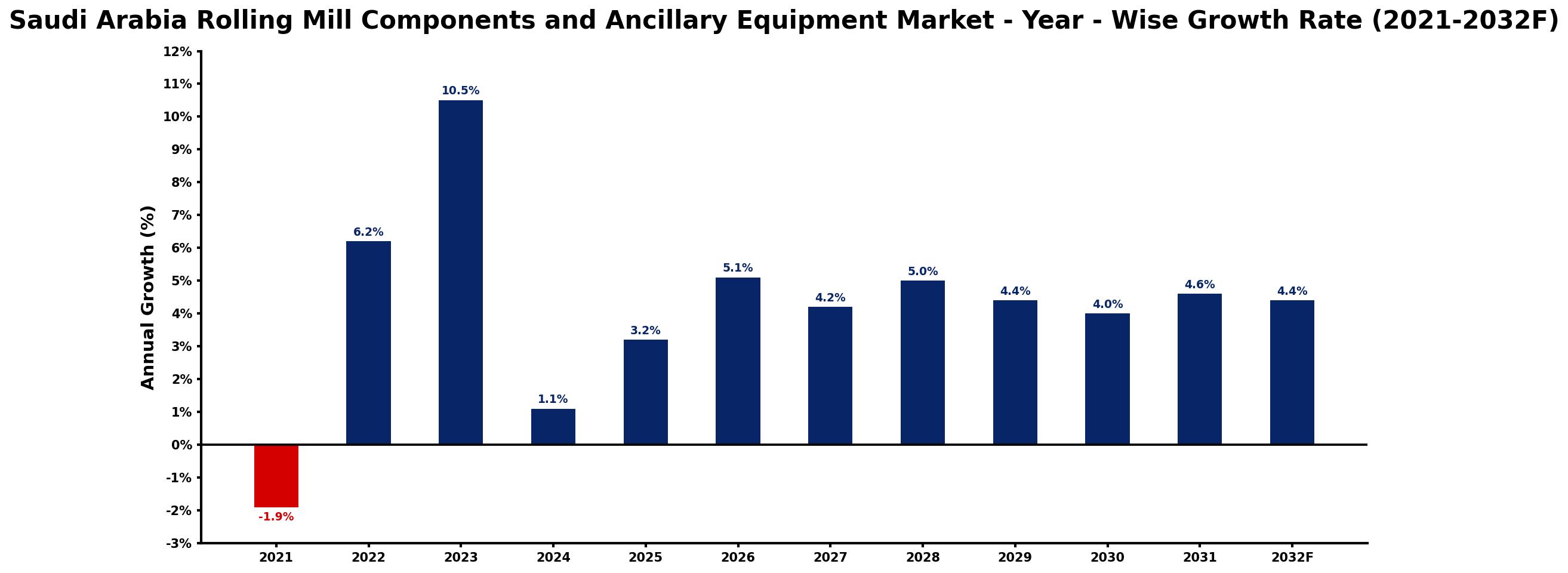
The table below presents the year‑wise growth rates along with the key drivers influencing the market
| Year | Growth Rate | Major Drivers |
| 2021 | -1.9% | Lower construction activity levels |
| 2022 | 6.2% | Increased infrastructure development projects |
| 2023 | 10.5% | Rising demand for steel products |
| 2024 | 1.1% | Expansion of manufacturing capabilities |
| 2025 | 3.2% | Growing investments in industrial sectors |
| 2026 | 5.1% | Surge in renewable energy projects |
| 2027 | 4.2% | Enhanced technological advancements adoption |
| 2028 | 5.0% | Strengthened regional trade agreements |
| 2029 | 4.4% | Increased foreign direct investments |
| 2030 | 4.0% | Boost in housing construction initiatives |
| 2031 | 4.6% | Rising automotive production requirements |
| 2032 | 4.4% | Growing demand for sustainable practices |
Note: Market size estimations and growth projections presented in this report are based on 6Wresearch's proprietary forecasting methodology, utilizing the latest available industry data, government publications, and primary research inputs.
Saudi Arabia Rolling Mill Components and Ancillary Equipment Market Synopsis
The Saudi Arabia market for rolling mill components and ancillary equipment has witnessed significant momentum, primarily driven by the countrys commitment to boosting its industrial capacity. Recent collaborations between local manufacturers and international suppliers underscore a dynamic shift towards innovation and self-sufficiency in steel production.
Looking ahead, the market is positioned for robust growth, as the governments vision for economic diversification intensifies the demand for state-of-the-art rolling mill solutions. This evolution not only highlights the increasing reliance on advanced technology but also emphasizes the critical role these components play in ensuring seamless operations in the steel manufacturing process.
Saudi Arabia Rolling Mill Components and Ancillary Equipment Market Key Takeaways
- Robust market growth driven by rising steel production and industrial investments.
- Innovative partnerships between local and international players enhancing equipment standards.
- Increasing need for automation solutions and cooling systems to improve operational efficiency.
- Resurgence in demand post-COVID-19 as infrastructure projects resume across sectors.
- Emerging trends focus on sustainability and compliance with environmental regulations.
Evaluation of Restraints in Saudi Arabia Rolling Mill Components and Ancillary Equipment Market
Despite promising growth, the Saudi Arabia Rolling Mill Components and Ancillary Equipment market faces notable restraints. A critical challenge is the continual need for innovation to adapt to evolving industry standards and stringent environmental regulations. Furthermore, fluctuations in steel prices create economic uncertainties, impacting investment decisions and operational costs. Another significant hurdle is the reliance on imports for specialized components, which introduces supply chain vulnerabilities and potential disruptions.
Saudi Arabia Rolling Mill Components and Ancillary Equipment Market Trends
Current trends indicate a pronounced shift towards automation and digitalization within the rolling mill sector. Advanced technologies, such as IoT and AI, are increasingly integrated into rolling mill operations to enhance efficiency and reduce downtime. Additionally, the focus on sustainability is prompting manufacturers to seek eco-friendly solutions and equipment that comply with environmental standards, paving the way for innovation in the market.
Saudi Arabia Rolling Mill Components and Ancillary Equipment Market Opportunities
The Saudi Arabia Rolling Mill Components and Ancillary Equipment market presents significant opportunities for growth and investment. As the government pushes for diversification and expansion of the industrial sector, there is a pronounced need for advanced rolling mill components that enhance production capabilities. The growing emphasis on sustainability also opens avenues for developing innovative, eco-friendly solutions that align with global standards, making it a pivotal time for stakeholders to invest in research and development.
Government Initiatives in the Saudi Arabia Rolling Mill Components and Ancillary Equipment Market
The Saudi government has implemented several initiatives aimed at bolstering the industrial sector, which directly benefits the rolling mill components market. Increased public spending on infrastructure projects and initiatives under the Vision 2030 framework are designed to create a more self-sufficient steel production industry. These efforts include providing incentives for local manufacturing, promoting partnerships between public and private sectors, and facilitating technology transfer to enhance the competitiveness of the domestic market.
Future Insights of the Saudi Arabia Rolling Mill Components and Ancillary Equipment Market
From 2026 to 2032, the Saudi Arabia Rolling Mill Components and Ancillary Equipment market is poised for transformative growth. The continuous advancements in technology, coupled with an increasing focus on operational efficiency, will be key drivers of this growth. As local manufacturers enhance their capabilities and the government continues to foster an environment conducive to industrial growth, stakeholders can anticipate a thriving market characterized by innovation and resilience.
Saudi Arabia Rolling Mill Components and Ancillary Equipment Market Latest Developments (2025 - 2026)
In recent months, the market has seen a notable uptick in developments geared toward enhancing production efficiency and equipment quality. Companies are increasingly investing in automation technologies to streamline operations and reduce manual intervention. Additionally, efforts to align product offerings with sustainability goals have gained traction, reflecting a commitment to environmental stewardship while meeting market demands.
Saudi Arabia Rolling Mill Components and Ancillary Equipment Market - Key Attractiveness of the Report
- 10 Years of Market Numbers
- Historical Data Starting from 2022 to 2025
- Base Year: 2025
- Forecast Data until 2032
- Key Performance Indicators Impacting the Market
- Major Upcoming Developments and Projects
Key Highlights of the Report:
- Saudi Arabia Rolling Mill Components and Ancillary Equipment Market Outlook
- Market Size of Saudi Arabia Rolling Mill Components and Ancillary Equipment Market, 2025
- Forecast of Saudi Arabia Rolling Mill Components and Ancillary Equipment Market, 2032
- Historical Data and Forecast of Saudi Arabia Rolling Mill Components and Ancillary Equipment Revenues & Volume for the Period 2022-2032F
- Saudi Arabia Rolling Mill Components and Ancillary Equipment Market Trend Evolution
- Saudi Arabia Rolling Mill Components and Ancillary Equipment Market Drivers and Challenges
- Saudi Arabia Rolling Mill Components and Ancillary Equipment Price Trends
- Saudi Arabia Rolling Mill Components and Ancillary Equipment Porter's Five Forces
- Saudi Arabia Rolling Mill Components and Ancillary Equipment Industry Life Cycle
- Historical Data and Forecast of Saudi Arabia Rolling Mill Components and Ancillary Equipment Market Revenues & Volume By Product for the Period 2022-2032F
- Historical Data and Forecast of Saudi Arabia Rolling Mill Components and Ancillary Equipment Market Revenues & Volume By Iron Rolls for the Period 2022-2032F
- Historical Data and Forecast of Saudi Arabia Rolling Mill Components and Ancillary Equipment Market Revenues & Volume By Steel Rolls for the Period 2022-2032F
- Historical Data and Forecast of Saudi Arabia Rolling Mill Components and Ancillary Equipment Market Revenues & Volume By Others for the Period 2022-2032F
- Historical Data and Forecast of Saudi Arabia Rolling Mill Components and Ancillary Equipment Market Revenues & Volume By End User for the Period 2022-2032F
- Historical Data and Forecast of Saudi Arabia Rolling Mill Components and Ancillary Equipment Market Revenues & Volume By Oil & Gas for the Period 2022-2032F
- Historical Data and Forecast of Saudi Arabia Rolling Mill Components and Ancillary Equipment Market Revenues & Volume By Industrial for the Period 2022-2032F
- Historical Data and Forecast of Saudi Arabia Rolling Mill Components and Ancillary Equipment Market Revenues & Volume By Automotive for the Period 2022-2032F
- Historical Data and Forecast of Saudi Arabia Rolling Mill Components and Ancillary Equipment Market Revenues & Volume By Mining for the Period 2022-2032F
- Historical Data and Forecast of Saudi Arabia Rolling Mill Components and Ancillary Equipment Market Revenues & Volume By Others for the Period 2022-2032F
- Saudi Arabia Rolling Mill Components and Ancillary Equipment Import Export Trade Statistics
- Market Opportunity Assessment By Product
- Market Opportunity Assessment By End User
- Saudi Arabia Rolling Mill Components and Ancillary Equipment Top Companies Market Share
- Saudi Arabia Rolling Mill Components and Ancillary Equipment Competitive Benchmarking By Technical and Operational Parameters
- Saudi Arabia Rolling Mill Components and Ancillary Equipment Company Profiles
- Saudi Arabia Rolling Mill Components and Ancillary Equipment Key Strategic Recommendations






































