Bahrain Security Analytics Market Size & Growth Rate (2026-2032)
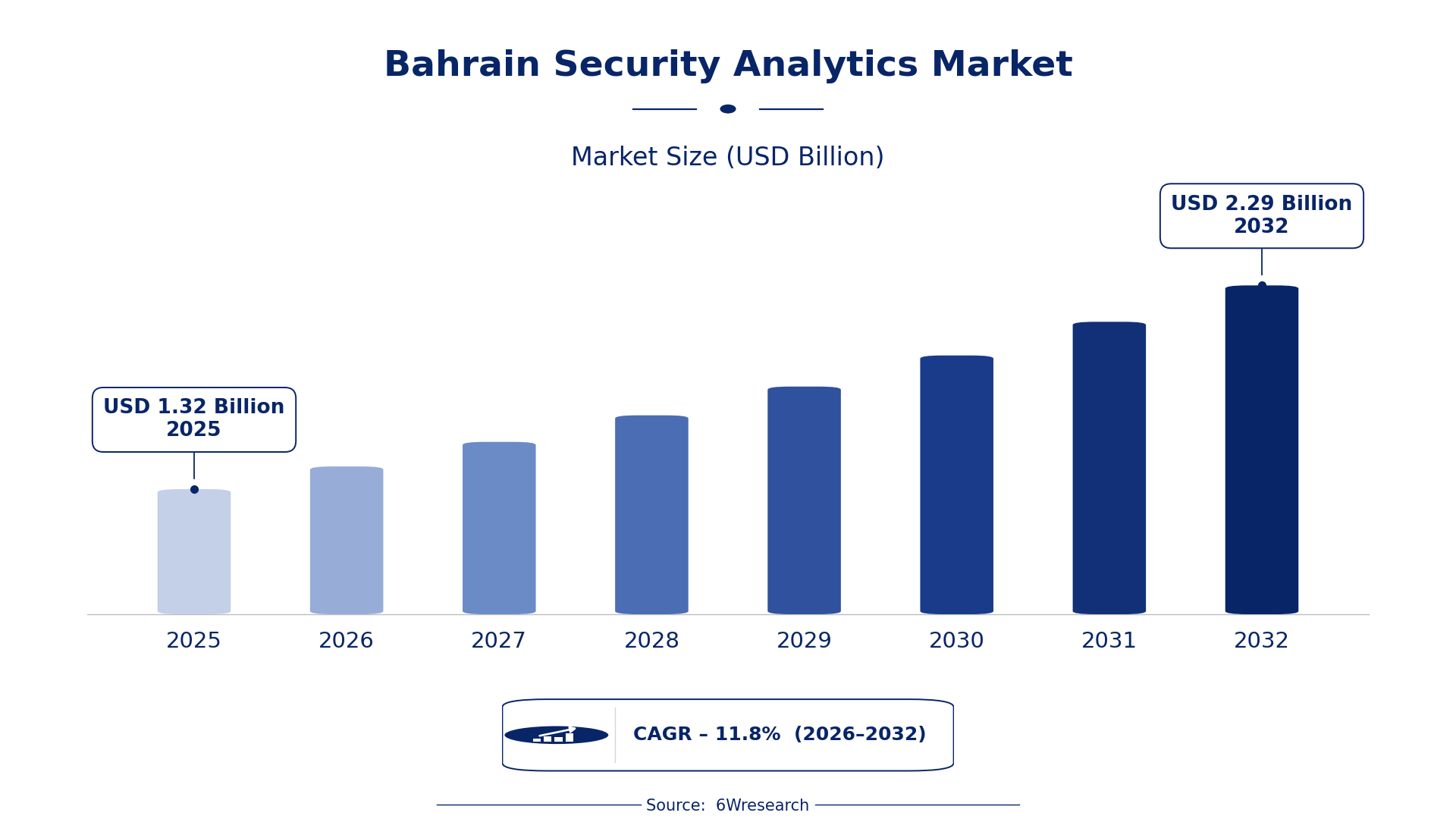
The Bahrain Security Analytics Market was estimated at USD 1323 Million in 2025 and is projected to reach USD 2293 Million by 2032, growing at a CAGR of 11.8% from 2026 to 2032.
Bahrain Security Analytics Market Synopsis
As organizations in Bahrain increasingly prioritize cybersecurity, the demand for security analytics is on the rise. Enterprises are turning to sophisticated analytics to not only detect anomalies but also to gain actionable insights that can lead to prompt incident responses.
Key sectors driving this growth include finance, telecommunications, and government, which are early adopters of these technologies. This proactive approach is enabled by integrations with SIEM and big data platforms, enhancing the overall cybersecurity posture of Bahraini enterprises.
Bahrain Security Analytics Market Year-wise Growth Rate and Key Drivers
This graph illustrates the annual growth rates of the Bahrain Security Analytics Market from 2021 to 2032, highlighting a steady upward trajectory and projected expansion over the forecast period.
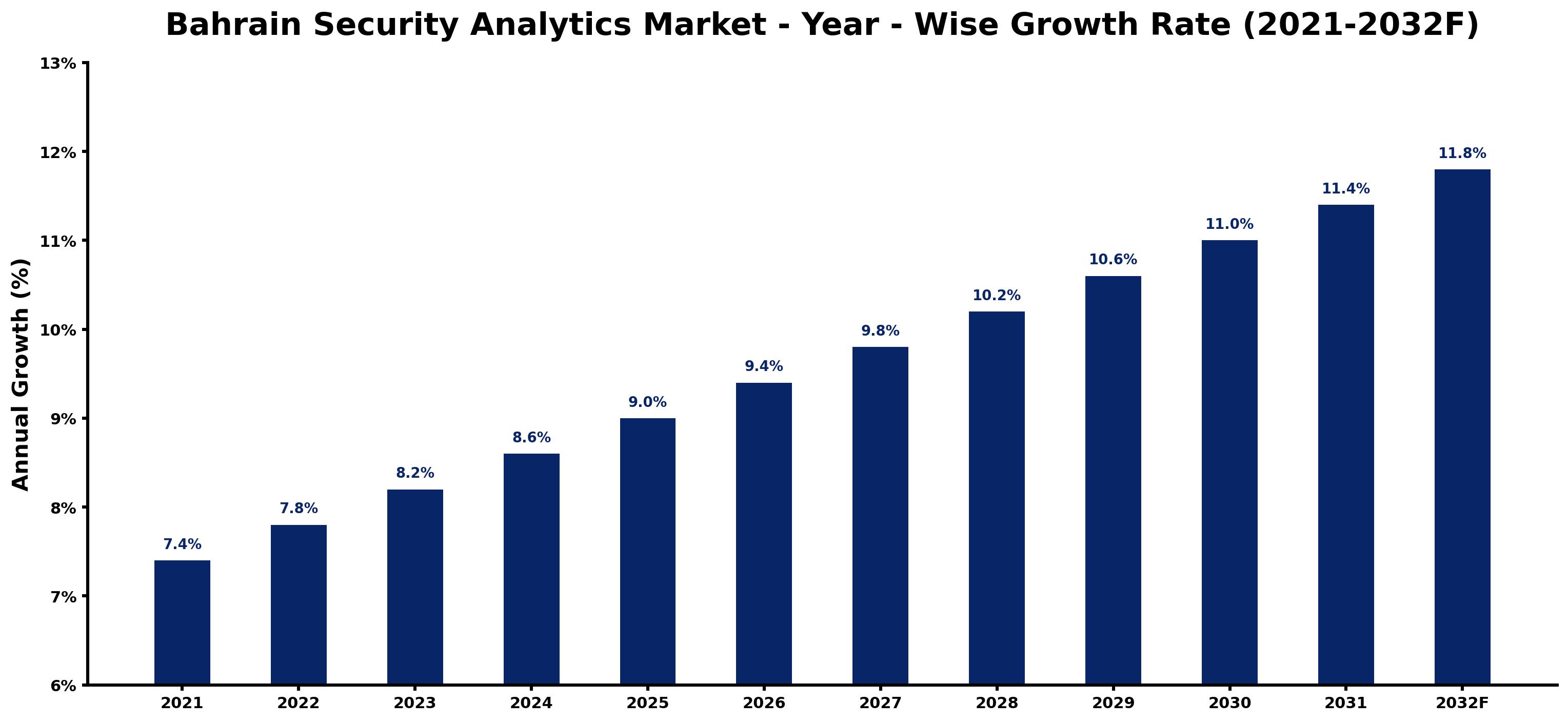
The table below presents the year‑wise growth rates along with the key drivers influencing the market
| Year | Growth Rate | Major Drivers |
| 2021 | 7.4% | Bahrain Economic Vision 2030 drives digital security investments. |
| 2022 | 7.8% | Growing fintech sector increases need for security analytics. |
| 2023 | 8.2% | National Cybersecurity Strategy enhances focus on data protection. |
| 2024 | 8.6% | Escalation in cyber threats motivates advanced analytics adoption. |
| 2025 | 9.0% | BAHRAIN's regulatory push for data privacy boosts sector growth. |
| 2026 | 9.4% | Adoption of AI in security enhances analytics capabilities. |
| 2027 | 9.8% | Collaboration with regional partners strengthens analytics infrastructure. |
| 2028 | 10.2% | Government investment in public sector cybersecurity escalates rapidly. |
| 2029 | 10.6% | Rise in digital transactions fuels analytics demand exponentially. |
| 2030 | 11.0% | Increased awareness of cyber risks drives consumer investment. |
| 2031 | 11.4% | Local startups innovating in security analytics expand market landscape. |
| 2032 | 11.8% | Emergence of smart city initiatives necessitates advanced security solutions. |
Note: Market size estimations and growth projections presented in this report are based on 6Wresearch's proprietary forecasting methodology, utilizing the latest available industry data, government publications, and primary research inputs.
Bahrain Security Analytics Market Key Takeaways
Below are some of the specific key takeaways from the market, including:
- Security analytics is critical for enhancing incident response capabilities in Bahraini organizations.
- Integration with SIEM systems helps in real-time monitoring and threat detection.
- The market is supported by government policies that advocate the use of advanced analytics.
- There is a growing demand for AI-powered analytics solutions that can effectively process large data volumes.
- Financial and governmental sectors are leading the adoption of security analytics tools.
Evaluation of Restraints in Bahrain Security Analytics Market
Despite the promising prospects, the Bahrain Security Analytics Market faces several challenges that could hinder its growth. The sheer volume of data generated daily creates a bottleneck, complicating real-time analysis and timely response to potential threats. Many organizations find it difficult to integrate different security tools into their existing infrastructure, resulting in gaps in threat intelligence and longer response times. on top of that, the shortage of skilled professionals in data analytics and cybersecurity hampers efforts to utilize these advanced tools effectively. Financial constraints also play a significant role, as smaller enterprises may struggle to afford the necessary investments in sophisticated security analytics solutions.
Bahrain Security Analytics Market Trends
Several trends are reshaping the Bahrain Security Analytics Market. A noticeable shift is the increased adoption of machine learning algorithms to improve the detection of advanced persistent threats. Enterprises are also leaning towards utilizing behavioral analytics to identify anomalies more accurately. As remote work becomes more common, there is a rising demand for analytics that monitor endpoints and cloud environments. on top of that, collaboration between public and private sectors is fostering innovation, leading to tailored solutions that address Bahrain's unique cybersecurity needs.
Bahrain Security Analytics Market Opportunities
Opportunities in the Bahrain Security Analytics Market are abundant, particularly for those investing in AI-driven platforms. Solutions that specialize in behavioral analysis and anomaly detection are particularly sought after. As organizations aim for more efficient data aggregation and visualization methods, there is a clear gap in the market for advanced tools that can provide actionable insights. Companies that can seamlessly integrate their analytics with existing SIEM systems will likely capture substantial market share. The emphasis on compliance and data protection regulations opens further avenues for growth, as enterprises seek solutions that not only meet security needs but also adhere to legal frameworks.
Government Initiatives in the Bahrain Security Analytics Market
The Bahraini government has made security analytics a focal point of its national cybersecurity strategy, emphasizing the importance of proactive threat detection and incident response. This regulatory focus aims to bolster the nation's defense against increasingly complex cyber threats. With strategic collaborations between governmental bodies and technology providers, there is a clear trajectory towards standardizing threat prediction methodologies and enhancing overall cybersecurity capabilities.
- A national cybersecurity framework established in 2025 mandates the integration of analytics in critical infrastructure sectors.
- Current initiatives include public-private partnerships aimed at developing AI-driven security analytics tools for local businesses.
- A recent programme launched in mid-2025 focuses on training cybersecurity professionals in advanced data analytics techniques.
- Upcoming regulations expected to roll out by 2027 will require organizations to implement continuous monitoring systems that utilize security analytics.
Future Insights of the Bahrain Security Analytics Market
Looking ahead to 2026-2032, the Bahrain Security Analytics Market is set to experience robust growth as organizations increasingly recognize the necessity of advanced security measures. The integration of artificial intelligence and machine learning will likely transform threat detection and response strategies, allowing for quicker and more efficient mitigation of risks. As cyber threats evolve, continuous investment in innovative analytics solutions will be essential for organizations aiming to protect their critical assets effectively.
Bahrain Security Analytics Market Latest Developments
Over the past year, the Bahrain Security Analytics Market has witnessed significant movements that signal a shift towards advanced analytics solutions. Companies are actively seeking to enhance their cybersecurity frameworks to stay ahead of emerging threats, resulting in a flurry of developments in this sector.
- A leading regional operator launched a next-generation security analytics platform in Q1 2025, enhancing real-time threat detection capabilities.
- An initiative that began in early 2025 is focused on integrating big data analytics into existing cybersecurity systems to improve incident response times.
- A major technology vendor is currently developing a cloud-based security analytics service expected to be available in early 2026.
- A partnership formed in late 2025 between local authorities and a technology firm aims to bolster training programmes for cybersecurity personnel.
Bahrain Security Analytics Market - Key Attractiveness of the Report
- 10 Years of Market Numbers
- Historical Data Starting from 2022 to 2025
- Base Year: 2025
- Forecast Data until 2032
- Key Performance Indicators Impacting the Market
- Major Upcoming Developments and Projects
Key Highlights of the Report:
- Bahrain Security Analytics Market Outlook
- Market Size of Bahrain Security Analytics Market, 2025
- Forecast of Bahrain Security Analytics Market, 2032
- Historical Data and Forecast of Bahrain Security Analytics Revenues & Volume for the Period 2022-2032F
- Bahrain Security Analytics Market Trend Evolution
- Bahrain Security Analytics Market Drivers and Challenges
- Bahrain Security Analytics Price Trends
- Bahrain Security Analytics Porter's Five Forces
- Bahrain Security Analytics Industry Life Cycle
- Historical Data and Forecast of Bahrain Security Analytics Market Revenues & Volume By Application for the Period 2022-2032F
- Historical Data and Forecast of Bahrain Security Analytics Market Revenues & Volume By Web Security Analytics for the Period 2022-2032F
- Historical Data and Forecast of Bahrain Security Analytics Market Revenues & Volume By Network Security Analytics for the Period 2022-2032F
- Historical Data and Forecast of Bahrain Security Analytics Market Revenues & Volume By Endpoint SecurityAnalytics for the Period 2022-2032F
- Historical Data and Forecast of Bahrain Security Analytics Market Revenues & Volume By Application Security Analytics for the Period 2022-2032F
- Historical Data and Forecast of Bahrain Security Analytics Market Revenues & Volume By Others(Content Security, ICS Security, Database Security, Cloud Security) for the Period 2022-2032F
- Historical Data and Forecast of Bahrain Security Analytics Market Revenues & Volume By Vertical for the Period 2022-2032F
- Historical Data and Forecast of Bahrain Security Analytics Market Revenues & Volume By BFSI for the Period 2022-2032F
- Historical Data and Forecast of Bahrain Security Analytics Market Revenues & Volume By Retail and eCommerce for the Period 2022-2032F
- Historical Data and Forecast of Bahrain Security Analytics Market Revenues & Volume By Media and Entertainment for the Period 2022-2032F
- Historical Data and Forecast of Bahrain Security Analytics Market Revenues & Volume By Travel and Hospitality for the Period 2022-2032F
- Historical Data and Forecast of Bahrain Security Analytics Market Revenues & Volume By Telecom and IT for the Period 2022-2032F
- Historical Data and Forecast of Bahrain Security Analytics Market Revenues & Volume By Healthcare for the Period 2022-2032F
- Historical Data and Forecast of Bahrain Security Analytics Market Revenues & Volume By Others(automobile, government, and education) for the Period 2022-2032F
- Historical Data and Forecast of Bahrain Security Analytics Market Revenues & Volume By Component for the Period 2022-2032F
- Historical Data and Forecast of Bahrain Security Analytics Market Revenues & Volume By Platform for the Period 2022-2032F
- Historical Data and Forecast of Bahrain Security Analytics Market Revenues & Volume By Services for the Period 2022-2032F
- Historical Data and Forecast of Bahrain Security Analytics Market Revenues & Volume By Professional Services for the Period 2022-2032F
- Historical Data and Forecast of Bahrain Security Analytics Market Revenues & Volume By Deployment Mode for the Period 2022-2032F
- Historical Data and Forecast of Bahrain Security Analytics Market Revenues & Volume By Cloud for the Period 2022-2032F
- Historical Data and Forecast of Bahrain Security Analytics Market Revenues & Volume By On-premises for the Period 2022-2032F
- Historical Data and Forecast of Bahrain Security Analytics Market Revenues & Volume By Organization Size for the Period 2022-2032F
- Historical Data and Forecast of Bahrain Security Analytics Market Revenues & Volume By Large enterprises for the Period 2022-2032F
- Historical Data and Forecast of Bahrain Security Analytics Market Revenues & Volume By Small and medium-sized enterprises (SMEs) for the Period 2022-2032F
- Bahrain Security Analytics Import Export Trade Statistics
- Market Opportunity Assessment By Application
- Market Opportunity Assessment By Vertical
- Market Opportunity Assessment By Component
- Market Opportunity Assessment By Deployment Mode
- Market Opportunity Assessment By Organization Size
- Bahrain Security Analytics Top Companies Market Share
- Bahrain Security Analytics Competitive Benchmarking By Technical and Operational Parameters
- Bahrain Security Analytics Company Profiles
- Bahrain Security Analytics Key Strategic Recommendations






































