Bahrain Smart Retail Market Size, Share & Growth Rate
The Bahrain Smart Retail Market was estimated at USD 822 Million in 2025 and is projected to reach USD 1496 Million by 2032, growing at a CAGR of 8.9% from 2026 to 2032. This impressive trajectory is driven by a wave of digital transformation initiatives undertaken by retailers, aiming to enhance customer engagement and streamline operations. The increasing competition from e-commerce players further compels brick-and-mortar stores to innovate by adopting smart technologies that meet the evolving expectations of consumers.
Bahrain Smart Retail Market Year-wise Growth Rate and Key Drivers
This graph highlights how the Bahrain Smart Retail Market has steadily grown over the years, supported by major growth factors.
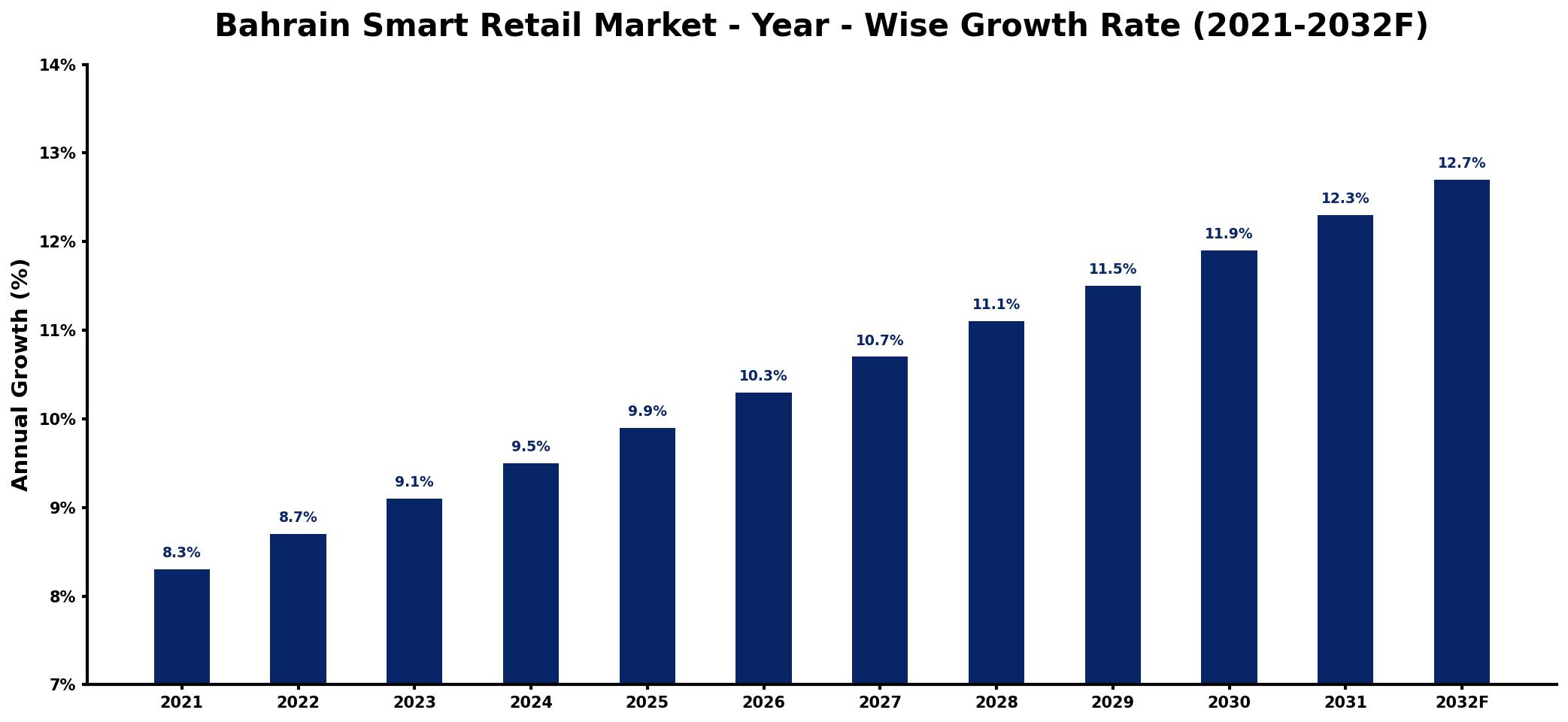
The table below presents the year‑wise growth rates along with the key drivers influencing the market
| Year | Growth Rate | Major Drivers |
| 2021 | 8.3% | increased consumer demand for convenience |
| 2022 | 8.7% | rise in digital payment adoption |
| 2023 | 9.1% | expansion of e-commerce platforms |
| 2024 | 9.5% | growth in mobile shopping applications |
| 2025 | 9.9% | investments in AI technologies |
| 2026 | 10.3% | development of personalized marketing strategies |
| 2027 | 10.7% | strengthening international trade flows |
| 2028 | 11.1% | adoption of advanced analytics tools |
| 2029 | 11.5% | rising procurement volume requirements |
| 2030 | 11.9% | increase in consumer engagement initiatives |
| 2031 | 12.3% | strengthening underlying market demand |
| 2032 | 12.7% | growing regional consumption patterns |
Note: Market size estimations and growth projections presented in this report are based on 6Wresearch's proprietary forecasting methodology, utilizing the latest available industry data, government publications, and primary research inputs.
Bahrain Smart Retail Market Synopsis
In Bahrain, the retail landscape is in the midst of a significant technological overhaul, as retailers increasingly leverage digital tools to optimize their operations and elevate the customer experience. The integration of AI-driven analytics, cashier-less checkout systems, and interactive displays is becoming the norm, marking a pivotal shift in how consumers engage with brands.
As consumers demand personalized shopping experiences and seamless interactions, Bahrain's retailers are compelled to adapt and innovate. This rapid evolution is not only reshaping customer expectations but is also fostering an environment ripe for technological investment, paving the way for a smarter, more efficient retail ecosystem.
Bahrain Smart Retail Market Key Takeaways
- The market is experiencing a robust growth trajectory, fueled by digital adoption and changing consumer preferences.
- Retailers are investing in advanced technologies like AI, IoT, and cloud-based solutions to remain competitive.
- Challenges around technology adoption and integration persist, particularly for small to medium-sized enterprises.
- Government initiatives are actively promoting retail sector digitalization and innovation.
- Opportunities exist in personalized shopping technologies and cloud-based retail solutions.
Evaluation of Restraints in Bahrain Smart Retail Market
Despite the promising growth prospects, the Bahrain Smart Retail Market faces several significant restraints. The high costs associated with implementing advanced technologies can deter many traditional retailers, particularly small and medium-sized businesses. Additionally, the complexity of integrating new systems with existing infrastructures poses a challenge. A notable skills gap exists, with a shortage of qualified personnel who can manage and maintain these technologies effectively. Furthermore, consumer concerns regarding data privacy and payment security can hinder the adoption of smart retail solutions, necessitating a careful approach from retailers.
Bahrain Smart Retail Market Trends
Current trends in the Bahrain Smart Retail Market illustrate a clear shift towards omnichannel retailing, where consumers expect seamless interactions across physical and digital platforms. Retailers are increasingly utilizing AI for customer behavior analysis, allowing for more tailored shopping experiences. The emergence of cashier-less checkouts and automated inventory management systems is also on the rise, contributing to operational efficiency and reduced wait times. Additionally, interactive displays and personalized marketing strategies are enhancing consumer engagement, reflecting a broader trend towards customization and immediacy in retail.
Bahrain Smart Retail Market Opportunities
Investment opportunities in the Bahrain Smart Retail Market are abundant, particularly in the realm of technology-driven solutions. Retailers can explore SaaS platforms, AI-powered inventory systems, and IoT integration services that cater to both supermarkets and fashion retailers. The deployment of personalized shopping technologies within malls presents another significant avenue for growth. As the demand for innovative retail experiences increases, investors and entrepreneurs can harness these opportunities to capitalize on the evolving landscape.
Government Initiatives in the Bahrain Smart Retail Market
The Bahraini government is actively supporting the digital transformation of the retail sector through various initiatives. Programs aimed at promoting smart payment systems, customer analytics, and inventory automation are at the forefront of its strategy. Bahrain's Economic Vision 2030 provides a framework that encourages e-commerce platforms and retail technology start-ups, fostering a culture of innovation. Regulatory frameworks have also been established to ensure data protection and secure online transactions, which are essential for building consumer trust and facilitating smart retail adoption.
Future Insights of the Bahrain Smart Retail Market
Looking ahead to the 2026-2032 timeframe, the Bahrain Smart Retail Market is poised for substantial growth as the adoption of technology becomes increasingly mainstream. Retailers are expected to further integrate AI and machine learning into their operations, enhancing customer insights and operational efficiency. The ongoing demand for personalized shopping experiences will drive investments in interactive technology and data analytics. Moreover, as consumer expectations continue to evolve, businesses that prioritize seamless and innovative shopping journeys will likely gain a competitive edge, ensuring sustained growth in the market.
Bahrain Smart Retail Market Latest Developments (2025 - 2026)
Recent developments in the Bahrain Smart Retail Market indicate a strong commitment to technological advancement. Retailers are increasingly piloting AI-driven solutions aimed at improving customer interactions and inventory management. Additionally, various initiatives are underway to enhance the integration of cashier-less technologies across multiple retail formats. The focus on improving cybersecurity measures is also gaining momentum, as companies seek to address consumer concerns regarding data protection while further promoting digital retail solutions.
Bahrain Smart Retail Market - Key Attractiveness of the Report
- 10 Years of Market Numbers
- Historical Data Starting from 2022 to 2025
- Base Year: 2025
- Forecast Data until 2032
- Key Performance Indicators Impacting the Market
- Major Upcoming Developments and Projects
Key Highlights of the Report:
- Bahrain Smart Retail Market Outlook
- Market Size of Bahrain Smart Retail Market, 2025
- Forecast of Bahrain Smart Retail Market, 2032
- Historical Data and Forecast of Bahrain Smart Retail Revenues & Volume for the Period 2022-2032F
- Bahrain Smart Retail Market Trend Evolution
- Bahrain Smart Retail Market Drivers and Challenges
- Bahrain Smart Retail Price Trends
- Bahrain Smart Retail Porter's Five Forces
- Bahrain Smart Retail Industry Life Cycle
- Historical Data and Forecast of Bahrain Smart Retail Market Revenues & Volume By System for the Period 2022-2032F
- Historical Data and Forecast of Bahrain Smart Retail Market Revenues & Volume By Digital Signage Solutions for the Period 2022-2032F
- Historical Data and Forecast of Bahrain Smart Retail Market Revenues & Volume By Smart Labels for the Period 2022-2032F
- Historical Data and Forecast of Bahrain Smart Retail Market Revenues & Volume By Smart Payment Systems for the Period 2022-2032F
- Historical Data and Forecast of Bahrain Smart Retail Market Revenues & Volume By Intelligent Vending Machines for the Period 2022-2032F
- Historical Data and Forecast of Bahrain Smart Retail Market Revenues & Volume By Augmented Reality Solutions for the Period 2022-2032F
- Historical Data and Forecast of Bahrain Smart Retail Market Revenues & Volume By Virtual Reality Solutions for the Period 2022-2032F
- Historical Data and Forecast of Bahrain Smart Retail Market Revenues & Volume By POS Solutions for the Period 2022-2032F
- Historical Data and Forecast of Bahrain Digital Signage Solutions Smart Retail Market Revenues & Volume By Smart Carts for the Period 2022-2032F
- Historical Data and Forecast of Bahrain Smart Retail Market Revenues & Volume By Application for the Period 2022-2032F
- Historical Data and Forecast of Bahrain Smart Retail Market Revenues & Volume By Foot-traffic Monitoring for the Period 2022-2032F
- Historical Data and Forecast of Bahrain Smart Retail Market Revenues & Volume By Inventory Management for the Period 2022-2032F
- Historical Data and Forecast of Bahrain Smart Retail Market Revenues & Volume By Loyalty Management and Payment for the Period 2022-2032F
- Historical Data and Forecast of Bahrain Smart Retail Market Revenues & Volume By Predictive Equipment Maintenance for the Period 2022-2032F
- Historical Data and Forecast of Bahrain Smart Retail Market Revenues & Volume By Brand Protection for the Period 2022-2032F
- Historical Data and Forecast of Bahrain Smart Retail Market Revenues & Volume By Smart Fitting Rooms for the Period 2022-2032F
- Historical Data and Forecast of Bahrain Smart Retail Market Revenues & Volume By Retail Offering for the Period 2022-2032F
- Historical Data and Forecast of Bahrain Smart Retail Market Revenues & Volume By Apparel and Accessories for the Period 2022-2032F
- Historical Data and Forecast of Bahrain Smart Retail Market Revenues & Volume By Fast-moving Consumer Goods for the Period 2022-2032F
- Historical Data and Forecast of Bahrain Smart Retail Market Revenues & Volume By Hardlines and Leisure Goods for the Period 2022-2032F
- Historical Data and Forecast of Bahrain Smart Retail Market Revenues & Volume By Others for the Period 2022-2032F
- Bahrain Smart Retail Import Export Trade Statistics
- Market Opportunity Assessment By System
- Market Opportunity Assessment By Application
- Market Opportunity Assessment By Retail Offering
- Bahrain Smart Retail Top Companies Market Share
- Bahrain Smart Retail Competitive Benchmarking By Technical and Operational Parameters
- Bahrain Smart Retail Company Profiles
- Bahrain Smart Retail Key Strategic Recommendations






































